Skip to content
DevMeme
5587 of 7435
When a single call consumes your entire developer day schedule
Meetings Post #6130, on Jul 27, 2024 in TG

When a single call consumes your entire developer day schedule

Why is this Meetings meme funny?

Level 1: One Call, Whole Day Gone

Think about a day when you have something in the middle that kind of takes over everything. For example, imagine you have a dentist appointment right after lunch. All morning, you’re a bit on edge about it — you can’t really start playing a long game or doing a big project because you know you’ll have to stop for the appointment. You might spend that morning getting ready for it, or just watching the clock. Then you go to the dentist for an hour. It’s not all day, it’s just one hour, but when you come back home you feel tired or your mouth hurts, and you don’t feel like doing much afterward. In the end, that one-hour dentist visit basically ate up your whole day. You were preparing for it, then doing it, then resting from it.

This meme is making the same kind of joke, but about a programmer’s work day. It says that one little meeting (a “call” with other people) in the middle of the day can mess up the entire day for the developer. Before the meeting, they’re getting ready and not coding. After the meeting, they’re recovering and trying to get back into work, but the day is almost over. It’s funny in a relatable way: even a short interruption can feel like it steals all your time. The picture shows a huge blue block on the calendar to drive home that idea. In simple terms, one small meeting can make a whole day go splat, just like one little appointment can rule your day.

Level 2: Deep Work Disruption

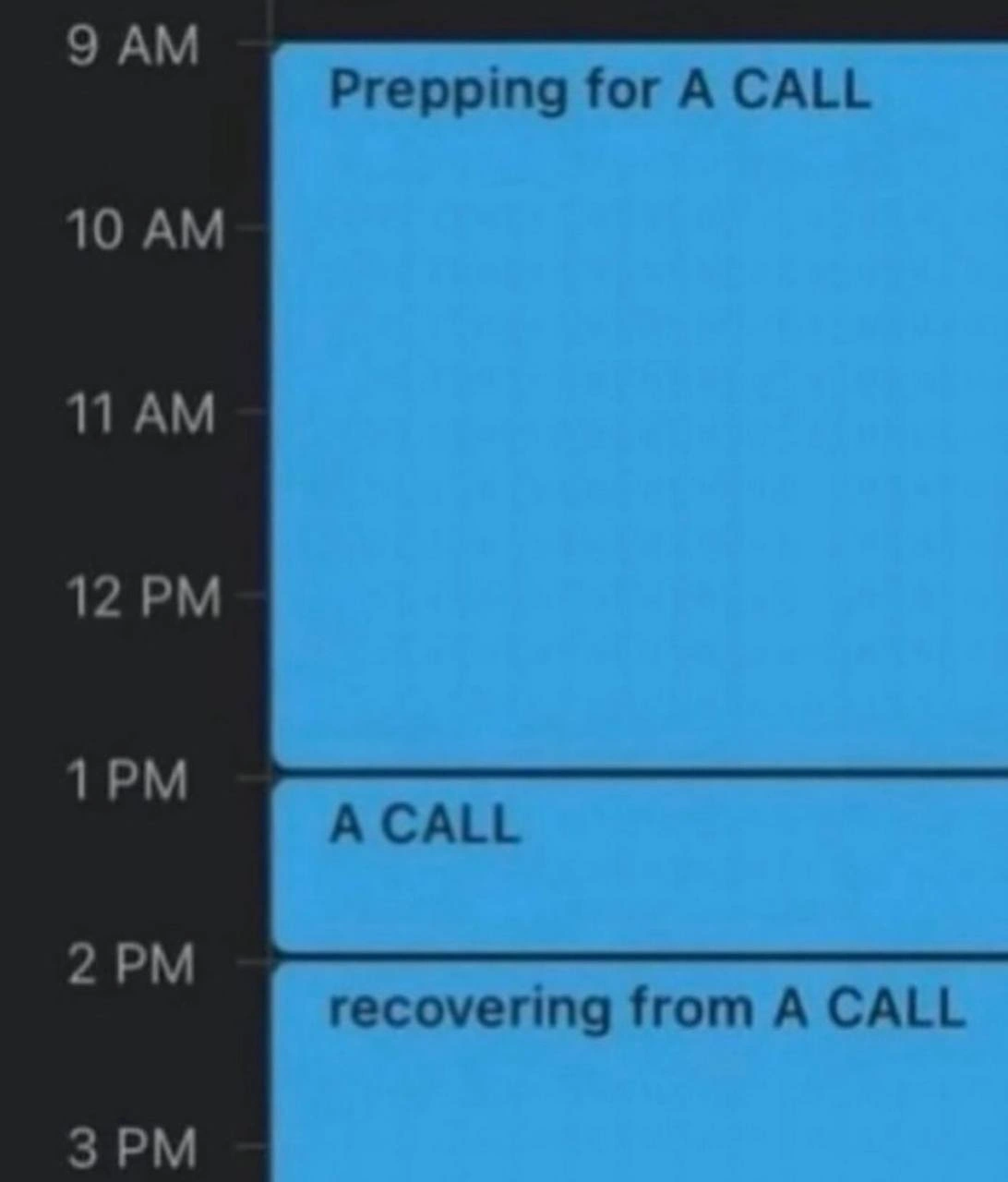
In this meme, we see an almost full-day calendar event dedicated to one meeting. The schedule from 9 AM to 3 PM is filled with a big blue block, even though the actual meeting (“A CALL”) is only from 1–2 PM. Why is the block so large? The labels tell the story: before the meeting is “Prepping for a call”, and after it is “recovering from a call.” In other words, a one-hour meeting is shown to consume the whole day: time spent getting ready for it, plus time spent getting back on track afterward. It’s poking fun at how a single meeting can break a developer’s entire day of work.

Let’s break down those parts. Prepping for a call (9 AM – 1 PM) means the developer is getting ready for the 1 PM meeting. This preparation might involve reading relevant documents, writing up a report or agenda, or just mentally bracing for the discussion. Often, it also means they won’t start any big coding task in the morning, knowing they’d have to stop once the call starts. It’s like if you have something important at 1 PM, you kind of hover in a holding pattern beforehand. Then comes the call itself (1–2 PM) – that’s the scheduled meeting, maybe a video conference with the team or a client. Finally, recovering from a call (2 PM – 3 PM) is the aftermath. After hanging up, the developer might need a break (meetings can be surprisingly tiring). They might spend this time writing down notes from the meeting, handling any quick tasks that came up in the call, or simply refocusing their brain to get back into coding. This post-meeting period is sometimes jokingly called call recovery mode – basically, time to “reset” after the meeting and find your place again in your work.

The meme humorously highlights a real productivity issue: context switching. That’s a term for when you switch from one task or “context” to another. Developers experience this when they go from writing code (which requires a lot of concentration) to attending a meeting (which is a completely different type of activity). There’s a cost each time you switch contexts – kind of like how your computer takes a moment to switch between programs. Humans take time to adjust, too. If you’re deep into programming (often called being in a flow state, or doing deep work), an interruption like a meeting can disrupt that flow. You can’t instantly jump back into a complex coding problem the minute the meeting ends; your brain needs time to reload all the details. That’s why the meme shows “recovering from a call” – the recovery is basically the developer trying to remember “Now, where was I with that code?” and getting back into the groove. This lost time around the meeting is what hurts DeveloperProductivity.

In many tech companies, this has become a common struggle — so common that it’s a source of MeetingHumor among developers. It’s funny because everyone recognizes it: that one tiny meeting can derail an entire day. It also reflects meeting culture in some workplaces, where there are just too many meetings (MeetingOverload). Especially with remote work, teams rely on scheduled video calls for communication, so you might see more calendar invites popping up. Remote developers sometimes end up with a lot of Zoom or Teams calls, and that can lead to meeting fatigue (feeling exhausted or burnt out from too many meetings). If you’ve ever spent a day in back-to-back classes or club meetings, you know how draining it can be — it’s the same for engineers with back-to-back calls. They have trouble finding a solid block of time to code.

Some companies and dev teams try to fix this by scheduling meetings smarter. You might hear terms like “Meeting Monday” or “No-Meeting Friday.” For example, Meeting Monday means they pack most meetings on Mondays so that the rest of the week has larger uninterrupted time for actual work. Or they encourage blocking out “focus time” on your calendar (marking it so no one else can schedule a call then). The goal is to reduce these context switches so developers can actually concentrate. The meme uses exaggeration to make a point: even though the meeting is just one hour, it can really spoil the flow of the entire day. For a junior developer or anyone new to this, it’s a heads-up with a laugh: be mindful that a little meeting can have a big ripple effect on your day’s productivity.

Level 3: One Call to Stall Them All

This meme hits every seasoned developer right in the schedule. It portrays the classic scenario where a seemingly simple one-hour meeting devours an entire day’s worth of coding. The image is a dark-themed calendar view with a huge blue block stretching from 9 AM to 3 PM, labeled in three parts: “Prepping for A CALL”, then the actual “A CALL” from 1–2 PM, and “recovering from A CALL” afterward. It’s absurdly funny because it’s painfully accurate: a tiny meeting becomes a productivity black hole, sucking in hours of preparation and recovery time around it.

From a senior dev’s perspective, this is a textbook case of the cost of context switching. In software terms, it’s like a CPU switching tasks — every time it swaps, there’s overhead (caches cleared, pipelines flushed). Here, the developer’s “mental cache” gets wiped before and after the call. You can’t just alt-tab your brain back to deep work instantly. That 4-hour “Prepping” block isn’t literally four hours of making slides; it’s the reality that once a mid-day call looms, your morning flow state is effectively shot. Why start a complex coding task at 9:30 if you’ll be interrupted at 1? Instead, you do trivial tasks, answer emails, or just anxiously context-switch into meeting mode. It’s a phenomenon so predictable that one could write pseudo-code for it:

# If a meeting splits the day, actual coding time approaches zero.
if calendar.has_meeting_at("1 PM"):
    morning_focus = False   # looming call disrupts deep work in the AM
    afternoon_focus = False # post-call brain drain, lost momentum

That single calendar.has_meeting_at("1 PM") check essentially nullifies the whole day’s productivity. The flow of writing code is fragile — once broken, it’s hard to restore. Software engineers cherish uninterrupted time, often needing hours to load a complex problem into their head. A 1 PM meeting is like hitting a big red “pause” button on that process. The meme exaggerates by labeling 9–1 as “Prepping” and 2–3 as “Recovering,” but honestly, it doesn’t feel like an exaggeration to those of us who’ve been there. The half-hour before the call, you’re thinking, “I have a meeting soon, can I really dive into this code right now?” And the hour after the call, you’re thinking, “What was I doing before? Where were we?” Meanwhile, any creative momentum you had is long gone.

This highlights the gulf between a Maker’s schedule and a Manager’s schedule. Paul Graham famously described how makers (developers, writers, any role requiring creation) operate in half-day or full-day blocks of focused work, while managers (leads, PMs, etc.) slice their day into many one-hour meetings. A manager might see a 1 PM meeting as just a one-hour block on a calendar (no big deal, right?), but for a developer — a maker — that meeting cleaves the day into two useless fragments. In essence, one meeting in the middle of the day can stall all meaningful coding on either side. It’s the one call to rule (or rather, ruin) them all.

The remote work era poured jet fuel on this problem. When teams went remote/hybrid, spontaneous hallway chats turned into scheduled video calls for everything. The result? MeetingOverload. Calendars became Tetris boards of back-to-back Zooms. Developers started experiencing MeetingFatigue: that drained feeling after staring into Brady Bunch grids of coworkers all day. In the meme’s spirit, you literally need time to recover from a call — whether it’s grabbing a coffee, doing a brain dump of meeting notes, or just reorienting your mind to get back into coding. A one-hour Zoom can feel as exhausting as a three-hour coding session, because you’re context-switching hard (mute/unmute juggling, speaking up at the right time, processing slides and chatter). By 2 PM, you’re wiped out. Call recovery mode might include slumping in your chair, rubbing your eyes, and wondering if it’s too late in the day to start that feature implementation you meant to do.

The humor here also lies in the implied absurdity that “prepping” and “recovering” take 4x longer than the call itself. It’s a tongue-in-cheek jab at corporate meeting culture. How many times have we thought, “All that fuss for a meeting that could have been an email?” The meme’s giant blue block visually screams what every developer feels: the overhead of meetings is the real time sink. You prepare slides or gather status updates for a 1 PM call, attend the call (where maybe you speak for 5 out of 60 minutes), then afterward you need to context-switch back to work, respond to any new emails or tasks from the meeting, and rebuild the mental map of your code. Before you know it, the day’s nearly over. It’s equal parts funny and frustrating because it’s true.

This is why many experienced devs and orgs push back, trying to reclaim focus time. Some teams attempt calendar_block_scheduling strategies like “No-Meeting Wednesdays” or stacking all meetings in one part of the day. (Hello, dreaded Meeting Monday, where they dump all the status calls so Tuesday can actually be productive!) The meme resonates especially in engineering circles because it artfully captures an open secret: DeveloperProductivity isn’t just lost in the 1-hour meeting itself, but in the deep work disruption that meeting causes. Every programmer who has had a single 1:00 PM call smack in the middle of their calendar will chuckle and groan at this image. It’s a comedic exaggeration of a real productivity killer — one that even the best of us haven’t quite figured out how to slay.

Description

The image shows a dark-themed daily calendar view with hourly markers listed vertically on the left from 9 AM to 3 PM. A solid bright-blue block fills almost the whole column. From 9 AM to 1 PM the block is labeled in bold black text "Prepping for A CALL"; from 1 PM to 2 PM a thin blue section reads "A CALL"; from 2 PM to 3 PM the blue block continues with the text "recovering from A CALL." No other events appear, visually conveying that preparation and recovery dwarf the actual one-hour meeting. Technically, the meme satirizes meeting culture and the hidden overhead that interrupts flow state, context switching, and developer productivity - especially prevalent in remote or hybrid engineering teams reliant on endless video calls

Comments

12
Anonymous ★ Top Pick That calendar is the human-layer RPC: 4 h TLS handshake, 1 h payload, 1 h FIN - then leadership wonders why our throughput looks like TCP slow-start every afternoon
  1. Anonymous ★ Top Pick

    That calendar is the human-layer RPC: 4 h TLS handshake, 1 h payload, 1 h FIN - then leadership wonders why our throughput looks like TCP slow-start every afternoon

  2. Anonymous

    The real distributed systems challenge isn't achieving consensus across nodes - it's achieving consensus on whether this meeting could have been an async Slack thread while preserving ACID properties: Anxiety, Concentration loss, Interruption, and Delayed delivery

  3. Anonymous

    This calendar perfectly captures the maker's schedule paradox: a single synchronous call doesn't cost one hour - it costs your entire day's cognitive budget. Senior engineers know that 'just a quick call' means context-dumping your mental stack trace at 9 AM, white-knuckling through the actual meeting while your IDE sits idle, then spending the afternoon trying to remember which architectural decision you were about to make before someone needed to 'sync up real quick.'

  4. Anonymous

    Manager: it’s just a quick 60-minute call; me: ah yes - stop-the-world GC with four hours of cache warm-up and tail-latency recovery, net throughput: zero features

  5. Anonymous

    That calendar is what happens when a single meeting becomes a blocking syscall - stop‑the‑world GC: 4h to warm caches, 1h pause, 1h heap compaction after

  6. Anonymous

    Meetings: where setup and teardown latencies dwarf the critical path execution time

  7. @RustyOtter 1y

    Only 4 hours?

  8. @Hollow_Arigo 1y

    why for recovery only 1 hour???? we need 5

    1. @Diotost 1y

      It didn't fit on a screenshot. Maybe it is already 10 hours and we can't see it?

  9. @DavidGarciaCat 1y

    Only 4 hours? Really?

  10. @anilakar 1y

    If you read "preparing for a call" as "spending time gathering pointless metrics and fine tuning the UI to please the middle managers who are eager to show their achievements to the C-suite", it suddenly no longer sounds like a joke

  11. @Valithor 1y

    I can actually confirm I have been in the situation before. I was given a metric shit ton of spreadsheets and was told to find a correlation between some metrics and a trend for new hires and have it ready in time for a meeting with C-Suite

Use J and K for navigation