Cargo Mommy: When Rust Compiler Errors Come with Gentle Encouragement
Why is this CLI meme funny?
Level 1: Mom Says It’s Okay
Imagine you’re doing a difficult homework assignment, and you make a mistake. Normally, the teacher would mark it wrong with a red pen and maybe say “Incorrect, try again.” That’s like a regular computer error message – it just tells you what you did wrong. Now picture instead that your mom is helping you, and when you mess up she smiles and says, “It’s okay, I know you can do better, sweetheart!” She might even give you a hug. This meme is about a computer program that acts more like that encouraging mom. When the code you wrote has an error, instead of just a cold error message, it adds a friendly note with a heart, basically saying “Don’t worry, you’ll get it next time!” It’s funny because computers usually don’t do that – they aren’t emotional or supportive. Seeing a programming tool talk to you as if it’s your caring parent is so unexpected that it makes programmers laugh. It’s a warm, silly twist: the computer is still telling you something went wrong, but also cheering you up so you feel better about trying again.
Level 2: Encouraging Errors
Rust is a programming language that is both powerful and notoriously strict about correctness. When you write Rust code, you use its build tool called Cargo (a command-line tool, i.e. a CLI). For example, you might run cargo build or cargo check in a terminal to compile your program. If there’s a mistake in your code, the Rust compiler (which Cargo invokes under the hood) will produce an error message. Rust’s error messages are actually well-regarded among programmers: they often explain what went wrong and sometimes even suggest how to fix it. However, no matter how informative an error is, seeing a big red error can still be frustrating. That feeling of “Ugh, another error? What did I do wrong this time?” is what we mean by debugging frustration – it’s the irritation and discouragement developers feel when they hit repeated errors or bugs while trying to make their code work.
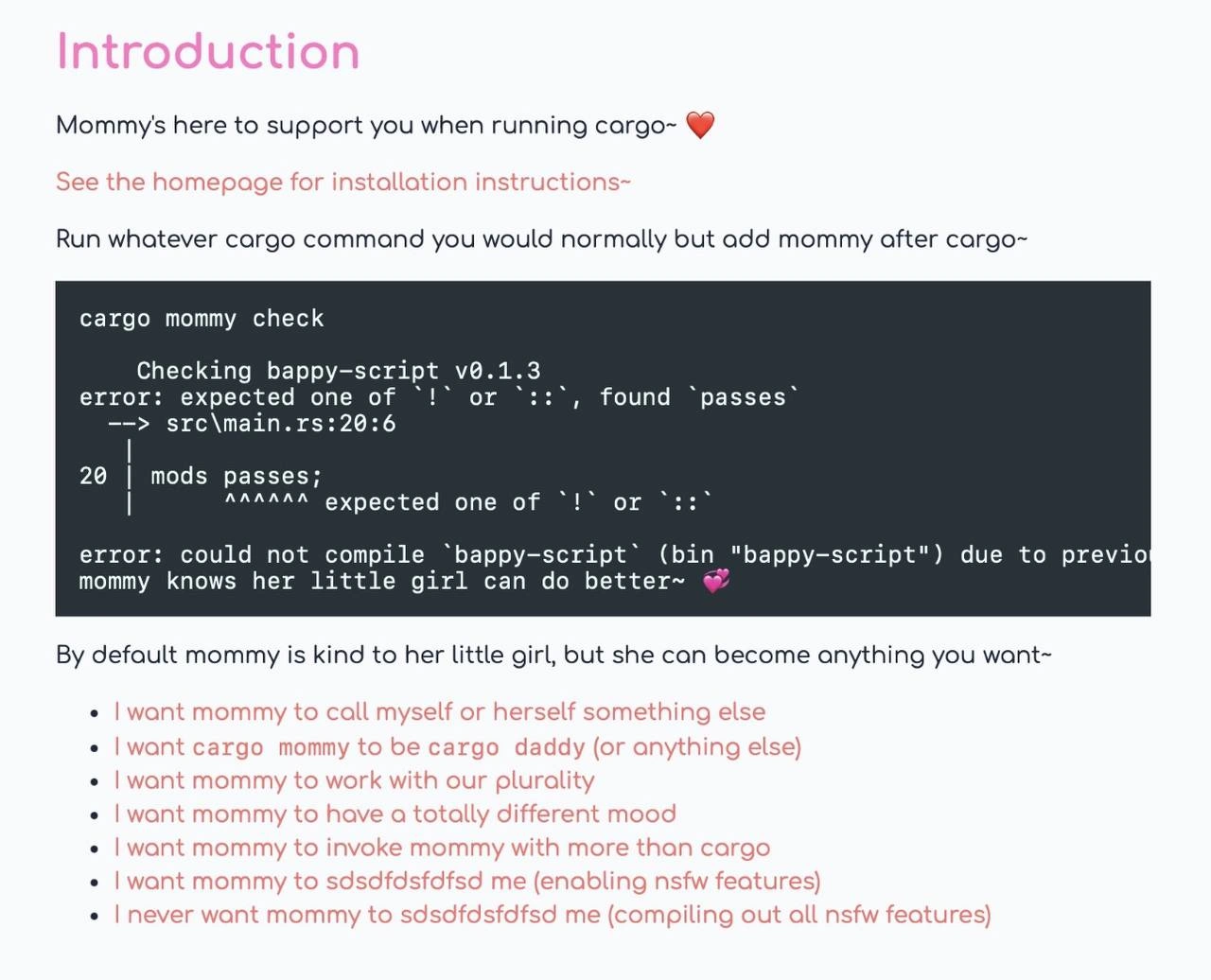
The meme shows a fictional (or perhaps real!) tool named cargo mommy. It’s presented in a cutesy, pink-accented documentation style, immediately signaling this is meant in good fun. The idea is that instead of running the usual Cargo commands, you run them with an extra “mommy” word. For instance, the example in the image uses cargo mommy check instead of the normal cargo check. Internally, this cargo mommy tool would act as a wrapper around the real Cargo. In simpler terms, it likely takes whatever command you give after “mommy” and runs the real Cargo with those arguments. So cargo mommy check runs the actual compile check, then adds its own twist to the output.
In the terminal output shown, we see what happens: Cargo is checking a crate (a Rust project) called bappy-script v0.1.3. It encounters an error in the code. The error message says: expected one of '!' or '::', found 'passes' at a certain line in src/main.rs. This is a typical Rust compiler error; it’s saying that at line 20, in the code mods passes;, the compiler got confused because it expected a different token (! or ::) after mod. (Likely the programmer accidentally wrote mods instead of mod – a small typo that Rust is pointing out). The compiler stops because of this error, and normally Cargo would then print “could not compile due to previous error” and exit. All of that is there in the snippet – nothing unusual so far.
The unique part is the final line: “mommy knows her little girl can do better~ 💞”. This is not something Rust would ever normally say! That line is coming from the cargo mommy tool. After seeing that the compilation failed, the wrapper prints this extra message. It’s essentially a motivational error message layered on top of the real error. The tone is extremely affectionate and reassuring – words like “little girl” and the heart emoji (💞) make it feel like a parent or loved one encouraging you after a mistake. This is intentionally whimsical. In the context of a programmer at their computer, it’s as if the computer itself is saying, “Don’t worry dear, mistakes happen and I know you’ll get it right next time!” This kind of response is the exact opposite of what error messages normally do (which is just inform you of a problem). It’s addressing the emotional state of the developer, not the code.
The documentation text in the meme also says, “Mommy’s here to support you when running cargo~ ❤️”. So the whole point of this tool/package is to support and comfort the developer. Under Developer Experience (DX), which is all about making tools nicer and more user-friendly for developers, this is a very quirky example. It’s not improving functionality or fixing any bug; it’s purely about the experience of seeing errors. The fact that it uses a loving “Mommy” persona is just one fun choice – the list of bullet points suggests you could customize it. For example:
- “I want cargo mommy to be cargo daddy (or anything else)” – This means you could have it call itself Daddy instead of Mommy, if you prefer a different form of parental figure or just a different name in the command.
- “I want mommy to have a totally different mood” – Maybe instead of always kind and gentle, you could configure it to be excited, or teasing, etc. It hints that the messages could change tone.
- Some bullet points mention NSFW features (not safe for work). This implies there might even be modes where the messages become a bit more adult or use naughty language for humor. For example, a “strict mode” where instead of saying “you can do better, sweetie,” it might playfully scold you with some profanity or risqué encouragement. It’s all meant in jest, presumably, as part of the humor.
- “I never want mommy to ___ me (compiling out all nsfw features)” – This means you can completely disable any inappropriate mode if you’re not comfortable with that or you’re in a professional setting. So the tool is configurable to remain purely wholesome or to venture into cheeky humor, according to the user’s preference.
All these customization options show how far the joke is taken: it’s like the tool is role-playing as whatever supportive figure or style you want. Technically, this would involve giving flags or config settings to the cargo mommy command, or perhaps installing different versions. It’s a parody of how normal tools might let you configure output format or color – here you configure what pet name it calls you or how flirty it is!
For a junior developer or someone new to Rust, let’s break down why this is funny. Rust, as a language, is known to be strict – if your code isn’t correct, the compiler won’t let it run at all. Beginners often struggle with Rust’s compile errors (for instance, the borrow checker errors about ownership can be hard to grasp initially). While the errors are helpful, getting a lot of errors feels disheartening. This meme is basically saying: what if, when you got an error, the tool also gave you a hug (metaphorically)? It’s making fun of the idea that sometimes what a frustrated coder needs is not more documentation or more error codes, but a bit of emotional support. By using a “mommy” persona with hearts and gentle language, it exaggerates this support in a comedic way. It’s an inside joke among developers: we take our tools so seriously, but imagine if one acted like your mom cheering you on. It also pokes a bit of fun at how some documentation or tools try to be overly friendly or “cutesy” (there’s a trend in some communities to write docs in a very friendly voice). This pushes that to an extreme.
In summary, cargo mommy is a playful hack on the Rust toolchain. It doesn’t change Rust or fix your code, but it changes the vibe of the error output. The categories relevant here are Compilers (because it’s about compiler error messages), CLI (it’s a command-line tool/extension), Debugging & Troubleshooting (since it appears when you have an error to fix, i.e. when debugging a compile issue), and Developer Experience (DX) (because it’s all about making the developer feel better during the coding process). The common tags like Rust, CompilerErrors, DebuggingFrustration, Tooling, and DeveloperHumor all tie into this: it’s specific to Rust’s tooling and error output, it addresses the frustration of debugging by using humor, and it is itself a tool (albeit a joke tool). The context tags cargo_mommy, rust_compilation_error, sarcastic_cli_output, and motivational_error_message describe exactly what’s happening: Cargo Mommy intercepts a Rust compilation error and produces a kind of sarcastic or at least cheeky CLI output (motivational in tone, but funny because it’s coming from a machine). This is a Rust meme born from real experiences (tough compiler errors) and our tendency to cope with humor.
Level 3: Mother of All Build Tools
At first glance, this pastel-colored README parody looks unbelievably wholesome for a command-line tool. And indeed, it introduces cargo mommy – a tongue-in-cheek extension of Rust’s package manager, Cargo, that turns compile errors into gentle encouragement. In the image, the normally stoic Rust compiler output is adorned with hearts and pet names. The terminal snippet shows a compilation failing with a typical Rust syntax error (expected one of '!' or '::', found 'passes'). Rust’s compiler is famous for clear, detailed error messages, pointing out exactly where you went wrong in src/main.rs line 20. But after the usual error text, cargo mommy adds a sugary supportive line:
mommy knows her little girl can do better~ 💞
This juxtaposition is hilarious to seasoned developers because it subverts our expectations. Usually, a compiler error is a cold, factual statement that something’s wrong – often triggering debugging frustration after the tenth error in a row. Rust’s errors are already friendlier than those of older languages (they often include help messages or suggestions), but they’re still fundamentally the computer saying “No.” Here, the tool personifies Cargo as a loving parent figure. It’s as if the strict Rust compiler, notorious for its tough love, suddenly put on a pink apron to say “I believe in you, sweetie!” to the programmer. The humor stems from mixing a CLI (Command-Line Interface) context – normally all business – with nurturing, almost absurdly affectionate language. It’s a mashup of two worlds: the unforgiving logic of compilers and the warm fuzzies of parental encouragement. The result is both ridiculous and endearing. Senior Rustaceans (Rust developers) chuckle because they’ve felt that pain of endless error messages and half-jokingly wished for some emotional support from their tools. This meme literally delivers that, complete with emoji and tilde slang for a cutesy tone.
From an experienced perspective, there’s also an appreciation for how this likely works under the hood. Rust’s Cargo is extensible – if you create any binary named cargo-something and put it in your PATH, you can invoke it as cargo something. So cargo mommy is probably a custom CLI tool (perhaps a real open-source crate someone published) that wraps the actual Cargo commands. When you run cargo mommy check, it’s probably forwarding to the real cargo check internally. We can imagine it spawning the real compiler process, streaming its normal output, and then hooking into the result. If the build fails (non-zero exit status), cargo mommy prints that sweet motivational line. It might even parse the error output to decide exactly what comforting phrase to use. The snippet suggests it doesn’t modify the error itself – it leaves the compiler’s honest diagnostic intact (showing you the code and explaining the error) – but then appends the “mommy” message as a soft landing. This way, you still know what to fix (mods passes; is clearly wrong Rust syntax, likely meant to be mod passes; without an extra “s”), but you also get a morale boost. It’s a clever balancing of tooling: not sabotaging the usefulness of the error message, just adding some emotional padding around the hard truth.
The senior dev community finds this so amusing because it speaks to a truth about Developer Experience (DX): coding is often a brutal cycle of trial and error, and error, and error... So why not add a bit of humor and support to that loop? We’ve all had those late-night debugging sessions where we feel utterly defeated by a stubborn bug or a cascade of compiler errors. At those moments, a playful message like “mommy knows her little girl can do better” is a comedic pat on the back — it acknowledges your frustration and defuses it with absurdity. It’s the same reason some teams set up funny failure messages or meme notifications when the build breaks: laughter takes the sting out of failure. Here the joke goes further by adopting a full maternal persona for the tool. There’s even a light sarcasm or irony in the choice of words — calling the developer “her little girl” — which is intentionally over-the-top. This absurd roleplay angle (with Cargo as an affectionate parent and the coder as the child) satirizes how developers sometimes feel infantilized by complex systems. You do something the compiler doesn’t like, and it’s almost like you’re a kid being scolded. Cargo Mommy says, “No scolding, only guidance and love.” It’s both very silly and oddly comforting.
What’s more, the meme’s text shows that the author went all-in with customization “wishes.” The pink bullet list in the image suggests you can rename Mommy to Daddy or anything else, work with “our plurality” (implying support for multiple personas or pronouns), set a different mood (maybe Mommy can be strict, sassy, or NSFW in her style). Yes, they even joke about a not-safe-for-work mode — perhaps for those who prefer their compiler to dish out tough love with some spicy language or provocative humor. The idea of toggling your compiler wrapper between wholesome encouragement and, say, drill-sergeant-style insults (“Did you seriously miss a semicolon again? Drop and give me 20 push-ups!”) is hilarious in itself. It reflects a rich vein of developer humor: customizing our tools not just for functionality, but for personality. This is reminiscent of classic gags like making error messages sarcastic or using novelty programs like cowsay to have an ASCII cow cheer you up in the terminal. In practice, such tools aren’t about solving the bug at all — they’re about keeping the developer’s spirits up. And in an industry where burnout and frustration are common, that comedic relief is precious. When the original poster says “Ok, which one of you did it?”, you can hear the amused incredulity. It’s a playful accusation — someone in the Rust community actually spent time to make a compiler error output say “💞 mommy believes in you 💞”. That question implies respect too: this person took the joke far enough to implement it. Seasoned devs love this kind of inside joke because it shows how far we’ll go to make each other smile during otherwise frustrating coding sessions. Rust, with its steep learning curve and strict rules (the infamous borrow checker that newbies wrestle with), has bred a culture that appreciates any light-hearted twist. Cargo Mommy is exactly that: a fun hack on the development workflow that shines a pink, heart-filled light on the normally dry world of compiler errors.
Description
The image shows a pastel-themed README section titled “Introduction” in pink text. Below, explanatory sentences read: “Mommy's here to support you when running cargo~ ❤️”, “See the homepage for installation instructions~”, and “Run whatever cargo command you would normally but add mommy after cargo~”. A dark terminal-style code block follows: ``` cargo mommy check Checking bappy-script v0.1.3 error: expected one of '!' or '::', found 'passes' --> src\main.rs:20:6 | 20 | mods passes; | ^^^^^^^ expected one of '!' or '::' error: could not compile `bappy-script` (bin "bappy-script") due to previous error mommy knows her little girl can do better~ 💞 ``` After the block, grey text states, “By default mommy is kind to her little girl, but she can become anything you want~”, followed by a pink bullet list of customization wishes (e.g., renaming “cargo mommy” to “cargo daddy”, enabling or disabling NSFW features). Visually, the layout mimics documentation for a whimsical CLI wrapper; technically, it parodies Rust’s Cargo tool by injecting nurturing, meme-style commentary into compile-time error output, highlighting developer-experience tooling and compiler frustration in a humorous way
Comments
26Comment deleted
We added “cargo mommy check” to the pipeline - same uncompromising borrow checker, but now every failure ends with “I’m not mad, just concerned,” so the seniors finally stopped tagging compiler errors as “needs parenting” in Jira
After 20 years of compiler errors telling us we're idiots, someone finally realized what we really needed wasn't better error messages, but emotional validation. Next up: cargo-therapist for when even mommy can't fix your lifetime annotations
Finally, a compiler that understands the emotional labor of dealing with lifetime annotations and borrow checker complaints. Because nothing says 'systems programming' quite like your build tool offering unconditional positive regard while your code fails to compile. It's the Rust community's answer to the age-old question: 'What if our tooling had the emotional intelligence our stakeholders lack?' Though I suspect even mommy's patience would wear thin after the 47th 'cannot move out of borrowed content' error in a single refactoring session
Emotional DX layer approved, but the highest‑ROI optimization here is deleting the extra 's' - not wrapping rustc in therapy
Cargo mommy: Passive-aggressive fixes for when Cargo's tough love feels too much like your last code review
‘cargo mommy check’ is peak DevEx: the error messages hug you, but the Rust parser still refuses anything but ‘!’ or ‘::’ - soft edges, hard invariants
:3 Comment deleted
Wow I hate that. Comment deleted
Pair it with the buttplug.io integration for the complete experience Comment deleted
I hope this is real Comment deleted
https://github.com/Shadlock0133/cargo-vibe The curse is real Comment deleted
I think it's called cargo-vibe? Comment deleted
already done it seems.... 😟 Comment deleted
Bruh Comment deleted
I guess it's from the same person who created shell mommy I had it running for my every command Comment deleted
wtf? Comment deleted
sdfsdsdsdf ? Comment deleted
Wtf? I want anyone that actually do this alive Comment deleted
I thought it is joke...damn.. Comment deleted
the issues and PRs on the github page are fucking hilarious Comment deleted
"mommy should tell me her version" Comment deleted
well, someone has to do this Comment deleted
they also ported it into python Comment deleted
Obligatory snek mommy / snek daddy Comment deleted
i wonder if it can vibe check Comment deleted
port it to chicken scheme egg mommy sounds fun Comment deleted