Skip to content
DevMeme
3835 of 7435
The Soul-Crushing Reality of Overrunning Management Demos
Meetings Post #4177, on Feb 7, 2022 in TG

The Soul-Crushing Reality of Overrunning Management Demos

Why is this Meetings meme funny?

Level 1: Trapped in a Meeting

Imagine your teacher says a class discussion will only last 5 minutes, but then it keeps going for an hour. You’d be sitting there, eyes wide and head drooping, thinking “when will this end?” That’s exactly the feeling in this meme. The developer was told the meeting would be quick (just 20 minutes), but the bosses kept talking and talking for two whole hours! The picture of the funny-looking fish with huge, tired eyes is like a cartoon showing how the developer feels inside – completely worn out and shocked that the conversation is still going. It’s like being stuck in a never-ending story time when you really just want to go outside and play. The meme is funny because we all know that exhausted, blank stare you get when something supposed to be short just never ends.

Level 2: Meeting Overload 101

  • "20-minute demo meeting" (Timeboxing): In software teams, meetings are often timeboxed – meaning they’re given a fixed length (say 20 minutes) and expected to end on time. A demo meeting is when developers show new features or progress to teammates or management. It’s supposed to be short and focused. Here, the top text jokes that a "twenty minute" demo is still going on after two hours! That means the timebox wasn’t respected at all. For a junior developer, it’s a surprising lesson: just because the calendar says 20 minutes doesn’t guarantee the meeting will actually finish in 20 minutes, especially if people keep talking.

  • Communication Overhead: This term means time spent communicating (meetings, emails, calls) instead of doing actual project work. Some meetings are important, but too many or overly long meetings create communication overhead – basically, time lost to talk. In this meme, the developer has spent an extra 1 hour 40 minutes in a meeting that should have ended, which is a huge overhead. New engineers often learn that you have to balance meeting time vs. coding time. When a meeting drags on, you start thinking about all the coding you could be doing instead.

  • Scope Creep: Scope means the set of topics or work intended to be covered. Scope creep is when that set quietly grows larger and larger. In a project, scope creep could be adding extra features not originally planned, causing the project to take longer. In a meeting, scope creep happens when new topics and questions keep popping up beyond the original purpose of the meeting. For example, a demo might start with just one feature to show, but then people begin discussing other bugs, future features, or unrelated issues – now the meeting’s scope has crept outward, and it’s no longer quick.

  • "Management ramble": This is a joking way to describe when managers start talking at length without a clear direction, often dominating the meeting. If you’re new in a company, you might not recognize it immediately, but it’s common: a manager asks one question, then keeps adding their own commentary, maybe telling stories or raising tangential points. That’s a management ramble. It’s not always bad-intentioned – sometimes they’re just enthusiastic or trying to be thorough – but it can make a meeting much longer than planned. To a developer (especially a junior one quietly listening), it can feel like “Why are we still talking about this?”

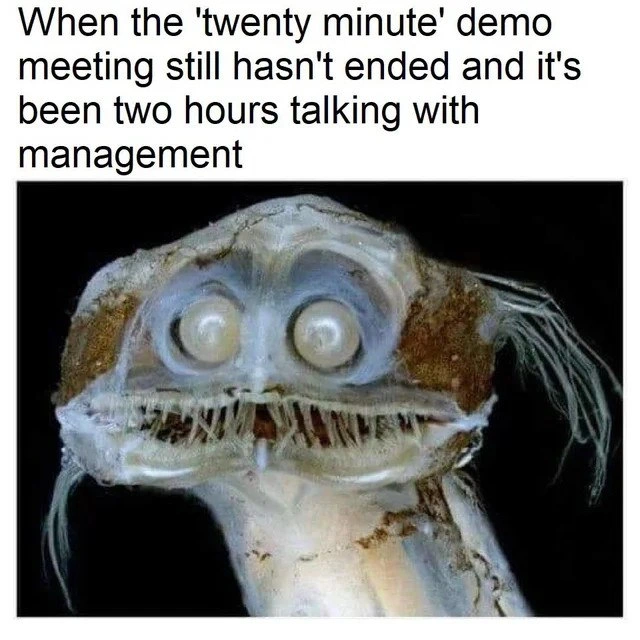
  • Developer exhaustion face: The image in the meme (that weird deep-sea creature with huge, tired-looking eyes and frilly teeth) is a funny stand-in for a programmer’s exhausted face. After sitting through an overly long meeting, developers might look drained or dazed. Maybe you’ve pulled an all-nighter studying for exams – that tired, blank stare you have the next day is similar to how a developer feels after two hours of nodding along in a meeting. The meme exaggerates it by using a crazy-looking fish to really show how fried our brains feel after such an ordeal. It’s saying: “This is me after that meeting – I feel like a zombie fish!”

In short, this meme is a mini lesson in MeetingCulture and meeting overload within corporate tech life. As a new developer, you’ll learn that meetings can sometimes go off-track or run long, and it’s both funny and frustrating when they do. The humor here comes from recognizing these concepts in action: the failed timebox, the extra talking (communication overhead), the sneaky extra topics (scope creep), and the well-meaning but lengthy management ramble – all contributing to one very tired developer who just wanted a 20-minute meeting, not a marathon.

Level 3: Timeboxing Twilight Zone

In the lofty world of agile theory, timeboxing is supposed to save us from exactly this nightmare scenario: a short demo meeting strictly capped at 20 minutes to prevent runaway discussions. Yet here we are, stuck in a meeting going on two hours and counting. This 'twenty minute demo' has entered the realm of a 20-minute 2-hour meeting – welcome to the Timeboxing Twilight Zone, where scheduled end times are a myth. The developer in the meme is experiencing time estimate slippage in its purest form. It's the corporate equivalent of a memory leak: the meeting keeps on consuming time, far beyond its allocated budget, and nobody can hit the stop button. It’s basically Parkinson’s Law run amok – work (or in this case, talk) expands to fill any available time (and then some) as long as someone is willing to keep talking.

Why does this happen? Blame a potent mix of communication overhead and classic scope creep during what should have been a simple demo. The moment multiple stakeholders or enthusiastic managers join the call, every little feature shown can spiral into a lengthy discussion. Instead of a quick "Here's the feature, any questions? No? Great, let's ship it," the demo turns into a drawn-out design review, requirement brainstorm, or worse – a monologue of management philosophies. The meme text explicitly calls out "talking with management" for two hours, which is code for enduring a management ramble of epic proportions. Management asks one question, then another, then starts pontificating about “the bigger picture,” and suddenly you're deep in a swamp of tangents and nice-to-have requests. Scope creep isn’t just for projects – it sneaks into meetings too. One minute you’re showing a completed user story, the next minute the discussion has drifted into planning next quarter's roadmap or re-examining an old feature nobody originally scheduled to talk about. Experienced engineers know this pattern all too well: a simple status or demo meeting slowly mutates into an everything-but-the-kitchen-sink discussion.

The result? The developer’s face begins to resemble that bizarre deep-sea creature in the image – translucent skin, bulging cloudy eyes, and a haunted expression that says “get me out of here.” It's a perfect visual metaphor: after diving way too deep into a marathon meeting in the dark depths of corporate bureaucracy, the engineer emerges looking like they’ve seen alien life. Those enormous eyes and jagged teeth mirror the mix of shock, fatigue, and silent horror a developer feels when a meeting devours the time they planned to use for actual coding. By the two-hour mark, any initial enthusiasm has long evaporated, replaced by a ghostly stare. It’s practically an out-of-body experience – the soul of the developer has left the building (or the Zoom call), leaving behind this glazed-over, fish-eyed husk nodding along to management’s never-ending commentary. This meme nails that developer exhaustion face we all recognize, exaggerating it into a creature from the abyss to drive the point home.

On a more systemic level, the meme highlights a widespread CorporateCulture problem: meeting overload and a casual disregard for engineers’ time. In healthy agile practice, ceremonies like a sprint demo or review are meant to be timeboxed to keep them efficient. But many organizations have a MeetingCulture where every "quick sync" turns into a prolonged meeting marathon or a feature-creep free-for-all. There’s often a disconnect between developers and management. Management (especially project managers or high-level stakeholders) tend to operate on a manager’s schedule – their day sliced into back-to-back meetings, context-switching on the hour – whereas developers operate on a maker’s schedule, needing large uninterrupted blocks of time to make things (write code, debug, design). When a meeting that was supposed to be a brief check-in runs over by +100 minutes, it wrecks the developer’s flow for the whole afternoon. Every experienced developer has grimly joked about meetings that "should have been an email." Looking at this meme, you can almost hear that inner monologue: "This entire two-hour ordeal could have been a 5-line email." The humor cuts close to reality: we’ve all been this wide-eyed creature at some point, caught off guard as a trivial sync-up ballooned absurdly out of proportion. It's a form of communication overhead hell – hours lost while everyone nods along, too polite (or too powerless) to interrupt the boss and get back to real work.

The meme strikes a nerve because it exaggerates a truth of office life: meetings often ignore the timebox and sap the energy of everyone involved. It’s a gentle poke at management’s expense – the ones usually responsible for letting a "quick demo" drag into a saga – and a cathartic laugh for developers who’ve felt their sanity slip away on a never-ending call. At the same time, it’s almost educational: a reminder that if you don’t respect the calendar limits, you might end up staring at the screen like a deep-sea fish out of water, wondering where those two hours went and why you agreed to this in the first place.

Description

A reaction meme about prolonged work meetings. The top text reads, 'When the 'twenty minute' demo meeting still hasn't ended and it's been two hours talking with management'. Below the text is a startling close-up photograph of a Telescopefish, a deep-sea creature. The fish has a skeletal, almost alien appearance with large, pearlescent, forward-facing eyes that look vacant and horrified. Its mouth is agape, filled with needle-like teeth, and its skin is translucent. The image captures a feeling of soul-draining exhaustion and despair. The humor resonates deeply with experienced developers who have frequently endured 'quick' meetings that spiral into multi-hour, unproductive discussions, derailing focused work and causing immense mental fatigue. It's a classic representation of corporate time-wasting and the communication gap between technical teams and management

Comments

8
Anonymous ★ Top Pick The demo was scheduled for 20 minutes, but the bikeshedding on the button color achieved consensus at the 2-hour mark. The feature itself remains untestable
  1. Anonymous ★ Top Pick

    The demo was scheduled for 20 minutes, but the bikeshedding on the button color achieved consensus at the 2-hour mark. The feature itself remains untestable

  2. Anonymous

    Agenda said 20 minutes, but demo meetings run on eventual consistency - they converge after enough retries, 120 wall-clock minutes, and a quorum of glazed eyes

  3. Anonymous

    The demo was supposed to be stateless, but somehow we're still holding a connection to the same VP who asked "can we make it pop more?" forty-seven minutes ago

  4. Anonymous

    The demo took 4 minutes; the remaining 116 were management discovering, live, what the product does. The meeting had no exit condition - like all loops written by people who don't code

  5. Anonymous

    The 'twenty minute demo' is software engineering's equivalent of 'just a quick question' - a temporal black hole where Planck time dilates exponentially with each stakeholder's 'one more thing.' By hour two, you've achieved what physicists call 'meeting singularity': the point where all productive work ceases to exist, your calendar has collapsed into itself, and you're maintaining a rictus grin while internally calculating the opportunity cost of not having a hard stop. Pro tip: Always schedule demos right before lunch or EOD - nothing enforces time boundaries like collective hunger or the immutable laws of daycare pickup schedules

  6. Anonymous

    The '20-min demo' that proves management's questions scale worse than O(n²) - straight to event horizon eternity

  7. Anonymous

    Our 20‑minute sprint review had an SLA until “quick question” enabled unbounded recursion - constant‑time ceremony promoted to O(n stakeholders), burning a feature’s worth of engineer‑hours

  8. Anonymous

    A 20‑minute demo is just a stale cache - once management says “one quick question,” you’re trapped in a two‑hour synchronous transaction: no rollback, no idempotency, and scope creep committed to the log

Use J and K for navigation