The Archaeological Dig for a 'Recent' Tech Solution
Why is this DevCommunities meme funny?
Level 1: Better Check the Date
Imagine you find a note in your kitchen that says, “The milk is fresh (I checked it one hour ago). Feel free to drink it.” That sounds reassuring, right? But what if you then notice that the note was written ten years ago? 😳 All of a sudden, that milk doesn’t seem so safe to drink! You’d probably laugh and think, “No way I’m trusting that – it was ‘fresh’ a long, long time ago!”
That’s the same idea this meme is joking about. In the meme, someone gave advice and said “I just checked an hour ago” to make it sound reliable at the time. But many years have passed since they said it. The situation is like reading an old message about something being okay back then, even though it might not be okay now. It’s funny because the advice is frozen in time – nobody updated it. Just like you wouldn’t trust a 10-year-old freshness note for milk, programmers find it silly (and a bit humorous) to trust a “checked one hour ago” comment when that hour actually happened ages ago. The moral of the story in simple terms: always check how old the information is, or you might end up with sour milk (or outdated advice)!
Level 2: Check the Timestamp
Let’s break down what’s happening in simpler terms. The image is a screenshot of an answer from Stack Overflow, which is a popular Q&A forum where developers help each other solve coding and configuration problems. Someone had a question about connecting to a MySQL database, and another user answered it. MySQL, by the way, is a type of database software – basically a system that stores data for websites and applications. It has a configuration file named my.cnf (kind of like MySQL’s settings menu in text form). In that file, there’s a setting called bind-address which tells MySQL which network address to listen on. Typically, bind-address = 127.0.0.1 means “only accept connections from the same machine (localhost).” This is a common default for security: the database won’t allow other computers to connect unless you change this.
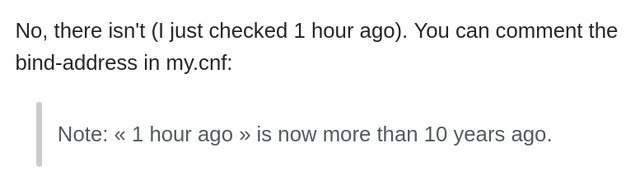
In the screenshot, the answer says: “No, there isn’t (I just checked 1 hour ago). You can comment the bind-address in my.cnf:” The person who wrote this was responding to a question – likely the question was asking if there’s an easier way to allow remote connections to MySQL. The answer basically means: “No, there isn’t an official toggle for that (I just looked into it an hour ago to be sure). The solution is to open the my.cnf configuration file and put a # in front of the bind-address line.” By adding a #, you “comment out” that line, which tells MySQL to ignore it. If MySQL ignores the bind-address setting, it will go back to its default behavior of listening on all network interfaces. In plain terms, commenting out bind-address lets other computers connect to the database. This is a known fix for the mysql_configuration_issue of “Why can’t my other server or app reach the MySQL database?”. It’s the kind of ConfigurationFile tweak that shows up often on forums and how-to guides.
Now, why is this funny or noteworthy? Look at the tiny note below the answer in the meme: “Note: ‘1 hour ago’ is now more than 10 years ago.” Stack Overflow shows relative timestamps like “answered 1 hour ago” when an answer is newly posted. In the context of the screenshot, the answer was very fresh when it was written – the person had checked the info an hour before posting, so they were confident it was up-to-date for that moment. But the meme is being viewed about ten years later! That means the answer is actually 10 years old (the note explicitly points that out).
Imagine stumbling on this solution via Google today. If you didn’t notice the date, you might think “Great, this person checked recently and this must still be true.” In reality, they checked a decade ago, which is a long time in technology. Over ten years, a lot can change: new versions of MySQL were released, maybe the default behavior of bind_address changed, or perhaps there’s now a more convenient setting or a warning about doing this. The humor (and risk) here is that a piece of advice can stick around the internet far past its prime. It becomes an outdated answer that people still copy because it’s the first thing they find. Developers call this the “Stack Overflow copy-paste syndrome” – relying on an old snippet without fully understanding it, just because it had many upvotes.
For a newer developer, this meme is a gentle lesson: always check the timestamp and context of an answer. If you see an answer from 2011 saying “I just tested this, it works,” you should consider that it was 2011’s truth, not necessarily 2021’s truth. In our example, editing my.cnf to comment out bind-address might have been the only solution back then, and it often did the trick. And to be fair, even today, if you have an older MySQL setup, that advice still works to let outside connections in. But it might not be the recommended approach anymore. Maybe newer MySQL versions have a different config file location, or they allow connections differently (for instance, some setups might use a cloud security group or firewall to control access instead of editing the DB config directly). There could also be security implications — opening your database to all interfaces isn’t always safe without other protections.
The DevCommunities aspect comes in with how this knowledge was shared. Stack Overflow is a community site, and its content is community-driven. That’s great because you get real-world answers, but nobody comes back to automatically update old posts if things change. Sometimes the original author or other users will add comments like “Edit: In newer versions, do X instead,” but often the answer just stays as it was. It essentially turns into stale documentation: instructions that remain frozen at the time they were written. The meme’s note “1 hour ago is now 10 years ago” is basically a big red flag saying “this advice might be very old.” It resonates with developers because many of us have experienced that moment: you try a solution and then realize the forum thread was from ages ago and possibly for an outdated version of the tool.
In simpler terms, this meme is reminding everyone: check the date on those forum answers. If you’re following a tutorial or Q&A solution, see when it was posted or if there are newer answers below. It’s a lighthearted way to say “things change in tech, so that super reliable answer might now be a bit of a legend.” For example, if a colleague handed you a programming book from 2009 and said “use this, it has all the answers,” you’d probably be cautious, knowing the programming language or libraries might have evolved since then. The same applies online. This particular case with MySQL’s bind_address is almost an inside joke in DatabaseHumor circles because it’s one of those one-liner fixes that every newbie learns at some point. But seeing it with a “just checked one hour ago” attached – when that check was made years ago – produces an eye-roll and a chuckle. It’s the digital equivalent of finding a note that says “the paint is wet” when it dried long ago.
So, if you’re new to this, the takeaway is: be mindful of legacy answers. It’s not that Stack Overflow or forums aren’t useful – they’re incredibly useful! – but always consider the context. Was this answer written for MySQL version 5.1 and you’re on 8.0 now? Does the answer date back to before a major change in the software? As a beginner, it’s easy to assume any highly upvoted answer is correct without question. This meme humorously points out why that can be dangerous. The environment moves on, even if the answer doesn’t. In short, what you see is a developer community joke about knowledge aging: a configuration tip that lived well past its expiration date, and the gentle ribbing of anyone who might still treat that “hour-ago” check as if it were yesterday. Always double-check if that solution you found is from an era long gone – you’ll save yourself some confusion and a few laughs.
Level 3: The Stack Overflow Time Capsule
Ten years in tech is practically a lifetime. This meme highlights how an answer on Stack Overflow can become a frozen time capsule of advice. The screenshot shows an old Q&A exchange about a MySQL configuration issue. The accepted answer confidently declares:
No, there isn't (I just checked 1 hour ago). You can comment the bind-address in my.cnf:
Note: "1 hour ago" is now more than 10 years ago.
That little note in grey says it all – “1 hour ago” has turned into a decade! It’s a playful jab at outdated_answers on community forums. At the time, the answerer had literally just verified the info and was up-to-date for that moment. The solution given was to comment out the bind-address setting in the MySQL config file (my.cnf). This was a well-known tweak to let MySQL accept connections from other machines. In the early 2010s, this advice was gospel for anyone debugging a mysql_configuration_issue (like “Why can’t I connect to my database remotely?”). The answer’s tone — “I just checked 1 hour ago” — was there to assure readers it’s fresh and accurate. And it probably was… in 2012.
Fast-forward to 2022 (when this meme was posted): that “hour” has stretched into 10+ years. The once-helpful tip is now an artifact, preserved in the archive of Stack Overflow like a bug trapped in amber. The humor comes from this forum_time_warp effect. It’s as if the answer has been sitting on the shelf, untouched, while the tech world kept evolving around it. We’re essentially doing community_qa_archaeology here – digging up a solution from a bygone era of software. In those ten years, MySQL has gone through several major releases (and even a fork to MariaDB), possibly changing default configurations and best practices. What was a clever fix back then might be irrelevant or even harmful now. But search engines don’t distinguish fresh wisdom from stale_documentation; they surface what’s popular and broadly linked. An answer with lots of upvotes from a decade ago can still rank high on Google today, so developers keep finding it. It’s knowledge that’s stuck in time.
Seasoned developers recognize this scenario all too well. We’ve learned (sometimes the hard way) that the top-voted solution on a Q&A site isn’t always current. Maybe it was written for an older version of the software, or under assumptions that no longer hold. The meme strikes a chord because it exaggerates that realization: one minute you’re happily copy-pasting a fix, and the next you notice the post date and go “Wait… 2012?!?”. It’s a funny-yet-scary reminder of knowledge_decay in fast-moving fields. Documentation, tutorials, and answers don’t auto-update themselves – they age, quietly. And unlike fine wine, tech advice usually doesn’t get better with age.
From an experienced perspective, the bind-address fix is a classic example of community knowledge that refuses to die. Even as environments change (e.g. containerized deployments, new security defaults), many people still stumble upon that same snippet:
# In my.cnf (MySQL config file)
# bind-address = 127.0.0.1
Commenting out bind-address (or setting it to 0.0.0.0) does enable remote access on older setups – and it’s not wrong per se – but the context is crucial. A senior engineer reading this answer in 2022 might smirk because they’ve seen this movie before. Perhaps now there’s a safer or more refined method (like updating firewall rules, using skip-networking, or an official setting in newer MySQL versions). Or maybe the bind_address property isn’t even in the same file or has a different default now. The comedic sting is that the answer’s phrasing hasn’t aged well: “I just checked 1 hour ago” reads absurdly when a decade has passed. It’s like a timestamped joke on how quickly “recent” turns into “ancient” in tech.
Fundamentally, this meme is poking fun at our collective StackOverflowDependence. Devs often treat Stack Overflow as an oracle of truth – copying code or configs blindly from high-scoring answers. Most of us have done it during late-night coding sessions or emergency fixes (Stack Overflow-driven development, anyone?). But that habit can bite back when the answer is ancient. The community might have moved on, or the software might have changed under the hood, yet the accepted answer remains etched in stone with all its upvotes. It becomes “legacy knowledge,” analogous to LegacyCode that still runs but nobody remembers why it was done that way. The meme uses the absurdity of a “1 hour ago” claim surviving ten years to remind us: always double-check the context. Just because an answer is marked correct and was once timely doesn’t mean it’s the best advice now.
In summary, at the senior level this meme is both a chuckle and a cautionary tale. It condenses a common industry lesson: time flies in technology and yesterday’s solutions can turn into today’s jokes. The phrase “I just checked 1 hour ago” frozen on a 10-year-old answer perfectly satirizes how even our most confident, freshly-verified knowledge can become obsolete. It’s a nod to those battle-scarred devs who’ve been burned by copy-pasting something that worked on an old version and then scratching their heads when it fails on a modern setup. We laugh because we’ve all been that person at some point – trusting the wisdom of the internet, only to discover we were holding a time capsule from the past. This meme says: look how far we’ve come, and don’t believe everything you read – especially if it hasn’t changed in a decade!
Description
A screenshot of a comment from what appears to be a developer forum or Q&A site. The top part of the image displays a helpful comment in a standard web font: 'No, there isn't (I just checked 1 hour ago). You can comment the bind-address in my.cnf:'. Below this, indented and highlighted by a vertical grey bar, is a meta-comment or system note that reads: 'Note: « 1 hour ago » is now more than 10 years ago.'. The humor stems from the stark realization that a seemingly recent and relevant solution is actually from a different era of technology. This is a universally shared experience for developers who often find answers on platforms like Stack Overflow, only to discover the advice is dangerously outdated. It perfectly captures the feeling of digital archaeology required to maintain legacy systems

Comments
11Comment deleted
That '10 years ago' fix is now a historical artifact. Applying it to a modern system is less like debugging and more like disturbing an ancient tomb and unleashing a curse of cascading failures
Stack Overflow time math: “checked 1 hour ago” - aka three MySQL forks, an Oracle acquisition, and the entire microservices trend later - yet that same snippet is still cargo-culted into every prod my.cnf
The half-life of "I just checked" in Stack Overflow answers is inversely proportional to how many production databases you've migrated since then
Stack Overflow answers age like production configs: '1 hour ago' is mutable, but the accepted checkmark is forever
Ah yes, the classic Stack Overflow time dilation effect where '1 hour ago' exists in a quantum superposition between 'just now' and 'before Docker was even a thing.' This is why senior engineers always check the timestamp on that perfectly relevant MySQL bind-address solution before copy-pasting it into production - only to discover the advice predates systemd, assumes you're still running MySQL 5.1, and the original poster's 'my.cnf' is actually in a completely different location on your Ubuntu 22.04 setup. The real technical debt isn't the code; it's the decade of context you need to mentally patch before that one-liner actually works
“I just checked 1 hour ago - comment the bind-address in my.cnf.” Translation: pre-Docker, pre-systemd, three MySQL majors ago… and a great way to put your DB on Shodan
Relative timestamps are the Confluence equivalent of cache-without-invalidation - ten years later someone’s still commenting out bind-address in my.cnf based on a stale hit
MySQL's bind-address: so stable it outlasts GitHub timestamps by a decade
Lol Comment deleted
I like your pfp Comment deleted
Thank you? Comment deleted