
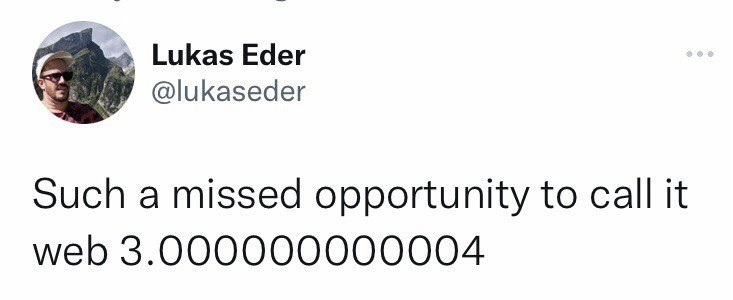
Web3 Finally Achieves Floating-Point Precision
Description
This image is a screenshot of a tweet from user Lukas Eder (@lukaseder). The tweet, presented in simple black text on a white background, reads: 'Such a missed opportunity to call it web 3.000000000004'. The humor is a sophisticated inside joke for software engineers, blending two distinct concepts. The first is 'Web3', the marketing term for the next iteration of the internet, often associated with blockchain and decentralization. The second is the well-known issue of floating-point imprecision in computing, where certain decimal numbers cannot be represented perfectly, often resulting in tiny errors like the one shown (e.g., 0.1 + 0.2 equaling 0.30000000000000004 in JavaScript). The joke cleverly satirizes the grand, often imprecise, promises of Web3 by framing its version number with a classic, unavoidable technical limitation
Comments
13Comment deleted
Web3's roadmap is a lot like floating-point math: the vision is grand, but the implementation details are full of rounding errors
Web3 keeps promising “immutable precision,” yet every Solidity audit feels like they implemented finance in float and called it Web 3.0000000000004
The real blockchain consensus problem isn't Byzantine fault tolerance - it's getting developers to agree that 0.1 + 0.2 should equal Web3, not Web3.0000000000004. At least now we know why gas fees are never quite what we calculate
Web 3.000000000004 would at least be honest: built on JavaScript, accurate to within an epsilon of its promises
Ah yes, the eternal struggle between marketing's 'Web 3.0' and what IEEE 754 actually gives you in production. At least with floating-point imprecision, you know exactly what you're getting: approximately what you asked for, plus or minus a few ulps. Unlike Web3 promises, floating-point errors are at least deterministic and well-documented since 1985. Though I suppose both share a common trait: explaining either to stakeholders requires a PhD-level understanding and infinite patience
Call it Web 3.000000000004 so when the roadmap drifts right, we can blame IEEE‑754 instead of governance
SemVer uses strings for a reason - call it Web3 in the deck and Web 3.000000000004 in prod if you insist on floats
Web3: decentralized, immutable, and off by 4 ulps - just like every sum since 1985
lmao true Comment deleted
Actually its 0.3000...0004 Comment deleted
Why (0)? Comment deleted
Because you can show any whole numbers in floats. But decimals get stored in fractions: 0x0.1 == 0.50 0x0.01 == 0.25 0x0.001 == 0.125 And so on... If you want 0.625 then you need a half (0.5) plus a eighth (0.125) Comment deleted
Thin Comment deleted