Skip to content
DevMeme
7014 of 7435
VPN Vendors Yelling Past Each Other About Who Sees Your Traffic
Security Post #7688, on Feb 8, 2026 in TG

VPN Vendors Yelling Past Each Other About Who Sees Your Traffic

Why is this Security meme funny?

Level 1: The Diary Courier

Imagine you're worried the mail carrier reads your postcards, so you hire a private courier who promises not to peek. One company shouts, "THE MAIL CARRIER READS YOUR POSTCARDS, HIRE A COURIER!" and another shouts back, "THE COURIER CAN READ THEM TOO, YOU JUST PICKED A DIFFERENT READER!" Both are right, both are yelling, and everyone watching is laughing because two businesses that do the same job are having a sidewalk argument about whose customers are being naive. The joke is that the loud argument accidentally taught everyone more truth than the ads ever did.

Level 2: What the Yelling Is About

Key terms, decoded for anyone whose first VPN was whatever their college recommended:

  • ISP (Internet Service Provider): the company that physically delivers your internet. Every packet you send passes through their equipment, so without encryption they can see which sites you visit and when.
  • VPN (Virtual Private Network): software that wraps your traffic in an encrypted tunnel to a remote server, then sends it to the internet from there. Your ISP now sees only the tunnel; the websites see the VPN's address instead of yours.
  • Trust shift: the core concept Windscribe is shouting about. The VPN provider's server decrypts your tunnel before forwarding traffic, so they occupy the exact observation point your ISP just vacated. You haven't removed the watcher — you've replaced them.
  • Threat model: a structured answer to "who am I actually defending against?" Without one, security purchases are vibes.

In practice, most of the web is already encrypted with HTTPS, so neither your ISP nor your VPN reads your passwords or page contents — they see metadata: domains, timing, volume. A no-logs policy is a promise that the VPN discards that metadata, and the strength of that promise ranges from independently audited to "trust me bro." If you've ever debugged a corporate proxy and realized the IT department could see every domain the office visited, congratulations: you already understand both tweets.

Level 3: Pick Your Surveillance Vendor

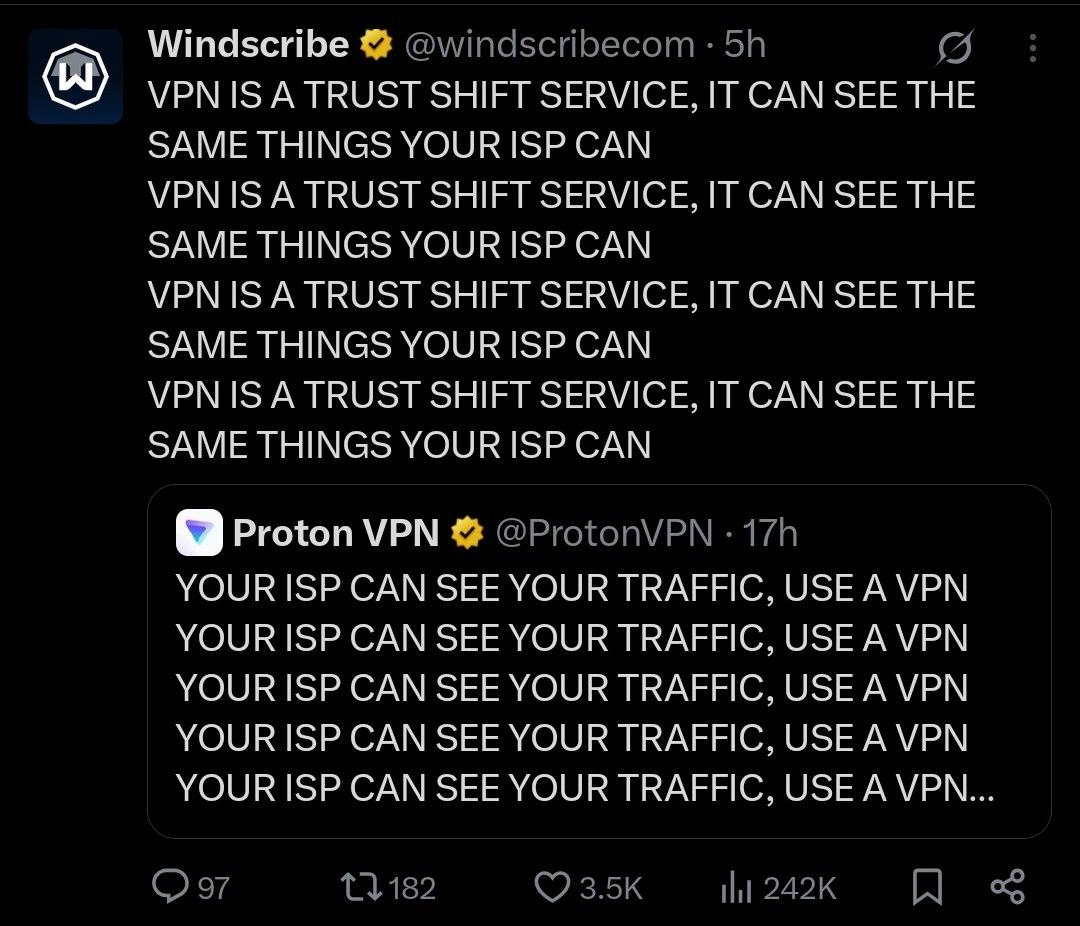
Two VPN companies screaming copypasta at each other in all caps is corporate Twitter beef at its finest, but the punchline is that both of them are technically correct, which is the worst kind of argument to watch. Proton VPN's repeated "YOUR ISP CAN SEE YOUR TRAFFIC, USE A VPN" is true and also the entire consumer VPN industry's business model compressed into one sentence. Windscribe's quote-tweet rebuttal — "VPN IS A TRUST SHIFT SERVICE, IT CAN SEE THE SAME THINGS YOUR ISP CAN", four times, matching the energy — is the uncomfortable footnote that marketing departments have spent a decade keeping out of the YouTube sponsor reads.

The technical reality both posts dance around: a VPN tunnel encrypts traffic between you and the VPN's exit node. Past that node, your packets travel exactly as naked or as TLS-wrapped as they would have anyway. What changes is who sits at the chokepoint. Your ISP sees encrypted blobs going to one server; the VPN provider sees everything the ISP used to see — DNS queries, SNI hostnames, connection metadata, timing. That's not privacy elimination, it's trust shifting: you've fired one observer and hired another, ideally one with a better logging policy and a jurisdiction you prefer. The veterans in the replies know the real question was never "VPN or no VPN" but what's your threat model? Hiding from a nosy ISP in a country that sells browsing data? Reasonable. Hiding from nation-state adversaries because an ad said "military-grade encryption"? That ad lied to you, and the soldier in the stock photo has never configured WireGuard.

What elevates this from security pedantry to genuinely funny is the format war: Windscribe didn't write a thoughtful thread with diagrams. They matched Proton's five-line all-caps repetition with four lines of their own, the discourse equivalent of two people with megaphones standing nose to nose. And it worked — 3.5K likes, 242K views — because privacy theater critique performs better as a shitpost than as a whitepaper. The industry knows this. That's the saddest part. The most accurate statement about VPN limitations to reach a quarter-million people this year was shouted in caps lock by a competitor with skin in the game.

Description

A dark-mode X.com screenshot of a quote-tweet battle between two VPN companies. Windscribe (@windscribecom) repeats four times in all caps: 'VPN IS A TRUST SHIFT SERVICE, IT CAN SEE THE SAME THINGS YOUR ISP CAN'. It quotes a Proton VPN (@ProtonVPN) post that repeats five times: 'YOUR ISP CAN SEE YOUR TRAFFIC, USE A VPN'. Engagement metrics show 97 replies, 182 reposts, 3.5K likes, 242K views. The meme captures the security-marketing reality check: a VPN does not eliminate traffic visibility, it merely moves the trusted observer from your ISP to the VPN provider - a nuance most consumer VPN advertising conveniently omits

Comments

21
Anonymous ★ Top Pick A VPN doesn't remove the man in the middle - it just lets you pick which man invoices you monthly
  1. Anonymous ★ Top Pick

    A VPN doesn't remove the man in the middle - it just lets you pick which man invoices you monthly

  2. @RaySollium99 5mo

    Windscribe and Mullvad are the REAL Based VPN companies, not Proton, Nord or (especially) Kape

    1. @tema3210 5mo

      And still, nothing beats the custom vpn server in a good country with properly set up encryption

      1. @RaySollium99 5mo

        This

      2. dev_meme 5mo

        Good country? Give me an example

        1. @Bjastkuliar 5mo

          https://www.youtube.com/watch?v=RzdJsRmRTyw

        2. @Navmesh 5mo

          depending on individual needs, I just use Swiss for torrenting and Ger just if I need VPN and speed.

        3. @TarasPushkar24 5mo

          It reminds me of that russian guy, how rented a flat in Kaliningrad just to set up starlink + vpn in it, cause elon banned his service in the rest of russia

      3. @thegrandwazoo 5mo

        mmmm, good country...

        1. @tema3210 5mo

          Anything with internet, corrupt and unresponsive government, like Bulgaria for example, if you can find cloud providers with hosting there (not germany bulk reseller)

      4. @SamsonovAnton 5mo

        VPS is a trust shift service, as the hosting provider can see the same things your ISP or VPN service provider can. 😝 Who cares, though, given that virtually all traffic is TLS-protected anyway (except online gaming, perhaps)?

        1. @tema3210 5mo

          The traffic itself is encrypted yeah, but still much info can be attributed via side channels, like when a host on watchlist has been contacted, by whom and so on. This allows malicious actors to still build fuzzy but extremely useful datamap. The VPS alleviates this given you share it with friends, so all silly things of all of you make up a "super villan" to the outside

          1. @SamsonovAnton 5mo

            But why are you trying to contact a watchlisted host, in the first place? Are you up to something — like downloading extremist tools, such as 7-Zip or SPECcpu? 😆

      5. @mrYakov 5mo

        How about chain of multiple servers on different countries?

        1. @tema3210 5mo

          And make them rotate based on the weather and crackhead math... Just to be sure) Such is think is justified if you are selling smth on darknet, too expensive for personal usage

          1. @chupasaurus 5mo

            i2p isn't expensive for personal use 😉

  3. @RaySollium99 5mo

    https://www.youtube.com/watch?v=iaJ0hCTCvdY

  4. @hyena_stuff 5mo

    Most paid VPNs will be better than your ISP - including Nord and the like. If you read your ISP's privacy policy, you'll likely be horrified (if you're in the US anyway). Most paid VPNs have much better privacy policies, since that's what they're selling.

    1. _ 5mo

      What about EU ISPs ? I guess GPRD and the like force them to have somewhat reasonable policies, but are they on par or still worse than VPNs ?

  5. @hyena_stuff 5mo

    The perfect is the enemy of the good. If you have the time and energy to get a very excellent VPN, do so - but if you're facing decision paralysis, it's ok to get one that's good enough

  6. @hyena_stuff 5mo

    I dunno, that's why I added the "at least in the US" qualifier. Definitely less of a privacy nightmare than over here, but not sure by what degree

Use J and K for navigation