Skip to content
DevMeme
5706 of 7435
Vercel's Business Model vs. Developer Knowledge on CDNs
DevCommunities Post #6257, on Sep 22, 2024 in TG

Vercel's Business Model vs. Developer Knowledge on CDNs

Why is this DevCommunities meme funny?

Level 1: Tying Your Own Shoes

Think of it like this: Imagine there’s a kid at school who charges other kids to tie their shoelaces. It’s convenient – if you never learned to tie your shoes, paying a small fee to this “shoe-tying expert” saves you time and hassle each morning. Now, what’s the biggest threat to that kid’s business? Other kids learning to tie their own shoes! The minute you figure out how to do the laces yourself, you won’t need to pay someone else anymore.

In this analogy:

  • The shoe-tying expert is like that fancy platform (Vercel) that’s making things easy for you for a price.
  • You learning to tie your shoes is like developers learning how to use a CDN by themselves.
  • Tying your own shoes is a bit of work to learn, but once you know how, it seems silly to pay someone every day for it.

The meme jokes that the fancy service might be afraid of people simply helping themselves with a basic skill. It’s funny because usually businesses worry about big competitors or crazy new technology – but here, the “threat” is just people getting a clue and doing a simple thing on their own. It’s as if a magician’s trick is revealed, and now nobody wants to buy tickets to the show.

Level 2: Old Tricks, New Platform

Let’s break down what all this means in plainer terms, assuming you’re a newer developer or just not super familiar with these buzzwords. The meme is about Vercel and CDNs and why knowing the basics can sometimes trump fancy new tools.

Vercel: This is a company that provides an easy way to deploy web applications (particularly those made with Next.js, a popular React framework). Think of Vercel as a service where you give them your website’s code, and they handle putting it online, making it fast globally, and scaling it up if you get lots of visitors. They emphasize their “Edge Network,” meaning they have servers around the world so your site loads quickly for everyone. Vercel also automates things like building your code, and gives you nice features like preview deployments (every time you update your code, it creates a preview URL to test) – all very handy for developers. Many startups and projects use it because it’s simple and integrates well with modern web dev workflows. The meme calls it a “fancy edge platform” – “edge” is the keyword, basically indicating their servers worldwide (the edge of the network, close to users).

CDN (Content Delivery Network): This is a more specific tool or component. Big companies (and cloud providers) offer CDNs that do one main thing: cache and deliver content from locations around the world. For example, if you have an image on your website, a CDN can make copies of that image on servers across continents. When a user in Asia visits your site, they get the image from a nearby Asian server; when someone in Europe visits, they get it from Europe, etc. This way, each user gets a faster load time compared to everyone hitting your single server (which might be say, in North America, causing faraway users to have slower access). Amazon CloudFront, Cloudflare, Akamai, Fastly – these are all CDN providers.

Now, using a CDN on your own requires some setup:

  • You might need to upload your static files to the CDN or tell the CDN where your origin server is so it can fetch and cache content.
  • You often adjust DNS settings so that your website’s domain uses the CDN. For example, you might CNAME assets.yoursite.com to something like assets.yoursite.cdnprovider.net so requests go via the CDN.
  • You also deal with cache settings (like those Cache-Control headers or settings in the CDN’s dashboard) to control how long something stays cached.

For someone new, that’s a bit of learning curve: documentation to read, settings to tweak. Mess one thing up, and maybe your site content doesn’t update when you expect, or you see old data for too long (we’ve all been confused by “I updated my site but I still see the old version!” at least once – often a caching issue).

What the meme is saying: Vercel’s business might suffer if developers realize that a lot of the speed and scalability improvements they seek can be achieved just by using a CDN correctly, without needing Vercel’s full platform. In other words, if your site is mostly static content (which many marketing sites, blogs, documentation pages are), you could:

  • Host it cheaply (even free) on something like GitHub Pages or an S3 bucket.
  • Put a CDN in front of it (many CDNs even have free tiers, e.g., Cloudflare’s free plan).
  • Voilà, your site is super fast globally and can handle lots of traffic, because the CDN takes the load.

This would require some knowledge and effort from the developer, but it cuts out the middleman. Vercel is that middleman that makes it zero-effort but in exchange, might charge for high usage or comes with certain limits.

Vendor Lock-In: This term came up; it means when you rely on a vendor (like a company’s platform) so much that it becomes hard to move away from it. If you deploy your whole site on Vercel and use their special features (say, their serverless functions, their proprietary analytics, etc.), moving to another solution means you’d have to rework those parts. Companies like Vercel aren’t evil 😈 – they legitimately solve problems and save time – but of course they like when you rely on them heavily (that’s business). So the cheeky suggestion in the meme is that Vercel’s “moat” (its competitive safety zone) is that devs don’t bother to learn the alternative.

Why “Why CDNs don’t really work” is funny to devs: Because it sounds like a car salesman saying “Basic cars don’t really drive well, you need this premium package to actually get anywhere.” Experienced devs know basic cars (CDNs) drive just fine for most trips. It’s only in special cases (like fancy interactive web apps with personalization, real-time data, etc.) that you might need extra horsepower (edge computing). So hearing a CEO say “CDNs don’t really work” comes off as self-serving. That screenshot of Guillermo Rauch likely came from a talk or article where he was highlighting scenarios that CDNs alone can’t handle well (like if content changes frequently, or needs user-specific data). But stripped of context and placed in this meme, it looks like he’s dismissing a very proven, useful technology – which is exactly what someone would do if they fear that tech undermines their product.

Imagine you’ve just learned about caching and CDNs as a junior dev. You might be in awe, like “Wow, I can just serve stuff from memory/nearby and it’s so fast, cool!” Then you see a statement like “CDNs don’t really work” from a respected figure; you’d scratch your head. Meanwhile, the senior dev next to you is chuckling because they see the subtext: of course CDNs work, he’s just trying to highlight their limits so the newer stuff seems necessary.

To put it simply: Vercel = convenience platform (does a lot for you, but you pay or lock-in), CDN = one piece of the puzzle (you have to assemble the puzzle yourself, but that piece itself is powerful). The meme humorously suggests if you know how to assemble the puzzle (which isn’t rocket science, but not trivial either), you might not need to buy the finished picture.

Level 3: The Ignorance Moat

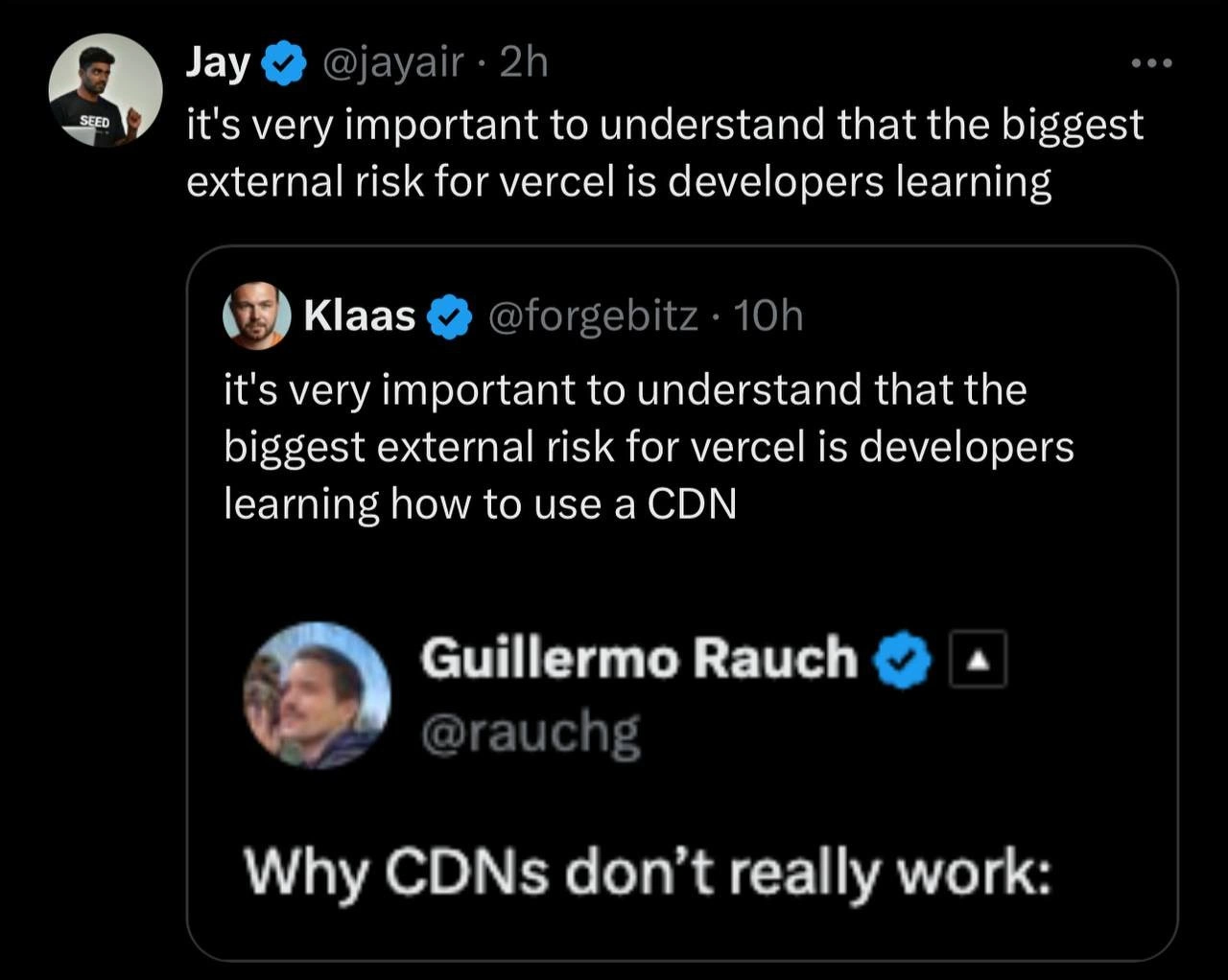
This meme is poking fun at Vercel’s business model by stacking tweets in a way that tells a story. At the top, a user Jay says: “the biggest external risk for Vercel is developers learning”. That’s an ominous half-sentence — learning what? The second user Klaas completes it: “...developers learning how to use a CDN”. Oof! 💥 This lands like a punchline: it implies that Vercel’s biggest threat is devs figuring out that instead of paying for Vercel’s premium edge platform, they could just use a plain CDN (which is often cheaper or even free) to speed up their sites. The third layer shows Vercel’s CEO Guillermo Rauch and the headline “Why CDNs don’t really work:” – presumably part of some official statement or article where he’s trying to downplay traditional CDNs, likely to make a case for the more complex solution his company provides. The meme’s structure itself is humorous: it’s like peeling an onion of sarcasm. Each layer adds context:

  • First layer: a vague statement about Vercel’s risk being devs educating themselves.
  • Second layer: spells out specifically that learning CDN skills would undermine Vercel.
  • Third layer: reveals the Vercel CEO apparently trying to convince everyone that “CDNs don’t work” (how convenient, right?).

For seasoned devs, this is a classic vendor lock-in humor. Vercel is a popular hosting platform especially for sites built with Next.js (which, fun fact, was created by the same folks). It offers effortless deployments, global edge caching, serverless functions, and all sorts of modern web development conveniences. It’s heavily in the Cloud and WebDev zeitgeist. However, a lot of what Vercel does isn’t black magic – it’s repackaging best practices (like CDNs, caching, and containerized deployments) in a really developer-friendly way. Their value-add is simplicity and integration: you push your code, and Vercel automates building it, deploying to their edge network, setting up caching, invalidating when you release new content, etc., all integrated with framework-specific tricks (e.g., for Next.js it automatically knows which pages are static vs dynamic). In industry terms, they’ve built a moat around their business – not with a super unique technology that nobody else has, but with developer experience and convenience. The joke here is that this moat might just be developer ignorance or laziness. If devs learn to do things the “old-school” way (manually setting up a CDN with an AWS S3 bucket or using Cloudflare’s free caching, etc.), they might realize they can get 90% of the performance benefits without a specialized platform.

Let’s unpack some terms and scenarios:

  • ContentDeliveryNetwork (CDN): A distributed network of servers that cache content. Senior devs recall using CDNs like Akamai, Cloudflare, Amazon CloudFront, etc., to serve static assets (images, CSS, JavaScript, videos) quickly worldwide. You often configure a CDN by pointing your static files to it or using a proxy mode where the CDN sits in front of your server (a reverse proxy that caches responses). A classic workflow might be: upload your static site to an S3 bucket and put CloudFront in front of it, or use Cloudflare to cache your site’s pages by just toggling a setting for your domain. It’s not hard per se, but it does require understanding of caching rules, DNS setup, and cache invalidation. And those things can trip up the uninitiated (we’ve all had moments where we deploy a change and still see the old version because, surprise, a CDN cached it and we forgot to bust the cache… “It’s not a bug, it’s the CDN doing its job!”).
  • Edge Platform (like Vercel, Netlify, etc.): This is a step beyond a plain CDN. These platforms combine deployment, serverless functions, and CDN caching under one roof. They often integrate with specific frameworks (Next.js, Gatsby, etc.) to auto-detect what can be pre-rendered (cached) and what needs to run as a live function. For example, Vercel might take a Next.js app and decide: these 10 pages are static (we’ll deploy them to CDN nodes globally), but this one page has server-side rendering (we’ll run that on our edge functions infrastructure). The developer doesn’t have to worry about where or how – Vercel’s platform orchestrates it. The “fancy” edge platform typically will also handle things like instant cache invalidation (when you redeploy, they purge the old content worldwide), routing, and sometimes even backend data via their own services. In other words, it’s managed convenience.

Now, why is it funny or biting? Because experienced developers know that under the hood, these platforms are using the same fundamental building blocks any of us could use ourselves:

  • The dirty secret is that you could replicate a lot of it manually: e.g., host static files on a CDN, use AWS Lambda@Edge or Cloudflare Workers for running dynamic code at the edge, set up a CI/CD pipeline to deploy your app on push, etc. In fact, large companies often build these kinds of setups in-house to avoid platform fees. But it requires time and expertise.
  • Vercel’s edge in the market (pun intended) is that it saves developers from needing to be a DevOps or infrastructure expert. You pay them (or on a free tier, you become part of their ecosystem) for that peace of mind. There’s a bit of vendor lock-in: once your project relies on Vercel’s specific features and build workflows, moving out to do it yourself or to another provider might require some re-work. They’re betting that many developers either don’t have the time or don’t have the knowledge to roll their own global deployment setup. This tweet basically says, if developers did gain that knowledge (“learning how to use a CDN”), Vercel would lose one of its biggest advantages.

From a senior perspective, this evokes memories of past “hype” cycles: we’ve seen new platforms arising that try to obfuscate or replace older tech, often claiming “Oh that old thing (CDN, server, whatever) doesn’t really work anymore, you need our way.” Sometimes it’s true for genuinely new use-cases, but often it’s partly marketing. IndustryTrends_Hype is the tag here for a reason – there’s constant hype around serverless, edge computing, Jamstack, etc. A battle-tested dev might chuckle because today’s edge platform sounds an awful lot like yesterday’s CDN plus some FaaS (Function-as-a-Service). It’s as if we put on some makeup and gave the old solution a trendy name.

One can almost hear the cynical internal monologue: “Sure, Guillermo, CDNs ‘don’t really work’… except for the entire freaking Internet which has been using CDNs quite effectively for two decades. But hey, gotta sell that edge platform vision!” 😏 The layered tweet format amplifies this snark. Each person in the thread is basically calling out that truth:

  • Jay insinuates: Vercel’s moat is developer ignorance.
  • Klaas makes it explicit: the ignorance about CDNs.
  • The screenshot of Guillermo is like the evidence: the CEO seemingly wants to perpetuate that ignorance or doubt— “CDNs don’t work (so use our product instead).”

It resonates with developers who have seen this pattern: a company’s marketing tries to convince you that doing it the simple, cheap way is flawed, so you should embrace their more complex (often paid) service. And often the dev community reacts with “Wait a minute… does it have to be that complicated?” This is the never-ending battle between simple HTTP caching and over-engineered platforms: simplicity versus hype. The humor has a bit of a schadenfreude element too – picturing Vercel execs shaking at the thought of devs leveling up and cutting out the middleman.

Level 4: Global Cache Conundrum

At the most fundamental level, this meme hints at the technical architecture battle between a Content Delivery Network (CDN) and a modern edge platform like Vercel. To seasoned engineers, this is about distributed caching and the physics of the internet. Why do we even need CDNs or fancy edges? Because data has to travel, and the speed of light isn’t getting any faster. A CDN is essentially a global cache: copies of your site’s files are stored on servers around the world so they can be delivered from somewhere closer to each user. This lowers latency (time it takes data to travel) by avoiding long trips across the globe for each request.

But here’s the catch known to any distributed systems nerd: keeping lots of copies of data in sync is hard. If your website updates something, all those CDN nodes might still have the old version cached. This brings up one of the infamous two hard problems in computer science: cache invalidation (the other hard problem, according to a classic joke, is “naming things” – and ironically, “edge platform” might just be a fancy name 🥴). CDN caches rely on strategies like TTL (Time To Live): you set an expiration, say 1 hour, and until that time passes the CDN will keep serving the old content. If you need to update sooner, you have to purge or invalidate the cache manually or via an API call, which is complex to manage perfectly. The meme references a quote “Why CDNs don’t really work:” – likely from Vercel’s CEO Guillermo Rauch, suggesting that traditional CDNs struggle with dynamic content or instant updates. Technically, he’s referring to this consistency problem: pure static CDNs aren’t great when your content updates frequently or needs personalization per user, because caches either serve stale data or you end up bypassing them, losing the benefit.

Modern edge platforms (like Vercel, Cloudflare Workers, AWS CloudFront + Lambda@Edge, etc.) try to solve this by running code on those edge servers. Instead of just caching static files, they can execute logic near the user: think of it as tiny regional servers that can generate or customize content on the fly, without always calling back to a central origin server. This can combine the low latency of CDNs with more up-to-date or personalized content. But of course, adding computation at the edge introduces its own complexity: How do those edge functions get deployed globally? How do they sync state or data (often they still call back to a central database or use distributed data stores, bumping into the CAP theorem trade-off: you can’t have perfect consistency, availability, and partition tolerance all at once). There’s also an implicit routing trick here. Traditional CDNs and edge networks use clever networking like Anycast routing and DNS resolution to direct a user’s request to the nearest node. Under the hood, BGP (the Internet’s routing protocol) and global DNS records work so that your-app.com might resolve to a different IP depending on whether you’re in London or Los Angeles, connecting you to the closest server. These are pretty hardcore low-level details – stuff average devs don’t usually tinker with – which is why platforms like Vercel abstract it all away.

So, at Level 4 we see the conundrum: Globally distributing content is a tough engineering problem, and CDNs have been the classic solution. They work brilliantly for static files (images, CSS, static HTML) – due to years of fine-tuned caching algorithms and network optimizations – but they can “struggle” with highly dynamic or personalized content unless you design your cache logic carefully. Edge platforms claim to address those shortcomings by essentially making the CDN smarter (running code, syncing data, handling cache invalidation for you). The humor underlying the meme is that none of this is magic – it’s trade-offs and well-known solutions. A veteran engineer knows that most websites (especially marketing sites, documentation, blogs) can be made blazing fast worldwide by simply using a CDN and proper caching headers. The “Why CDNs don’t really work” line in the screenshot is read sarcastically by insiders: we know CDNs do work extremely well for what they’re built for. It’s just that if everyone truly understood how to leverage them, fancy edge hosting platforms would have to justify themselves beyond what a CDN+some scripts can already do.

Description

A screenshot of a layered Twitter thread. At the bottom is a tweet from Guillermo Rauch, CEO of Vercel, with the text 'Why CDNs don't really work:'. This is quote-tweeted by a user named Klaas, who says, 'it's very important to understand that the biggest external risk for vercel is developers learning how to use a CDN'. Finally, another user named Jay quote-tweets Klaas, repeating the same text. The image captures a moment of industry satire. The humor lies in the irony that Vercel, a company providing a highly abstracted and easy-to-use global edge network (a sophisticated CDN), is humorously threatened by its own user base learning the underlying technology. The joke is that Vercel's value proposition is convenience, so if developers mastered the complexities of CDNs themselves, they might not need Vercel's service, thus making developer education an 'external risk' to their business model


Comments

15
Anonymous ★ Top Pick Vercel abstracts away the CDN so you don't have to learn it. Their CEO then posts why CDNs don't work, presumably to keep you from learning it. It's not a service, it's an information hazard
  1. Anonymous ★ Top Pick

    Vercel abstracts away the CDN so you don't have to learn it. Their CEO then posts why CDNs don't work, presumably to keep you from learning it. It's not a service, it's an information hazard

  2. Anonymous

    Pro tip: if your competitive advantage depends on devs never typing `Cache-Control: public, max-age=31536000`, your runway might expire before their TTL

  3. Anonymous

    The real vendor lock-in isn't the proprietary APIs or the migration costs - it's convincing developers that configuring CloudFront invalidation rules and debugging cache headers at 3am is somehow worse than a $500/month hosting bill for a blog that gets 12 visitors

  4. Anonymous

    The real 'edge' in edge computing isn't the network topology - it's keeping developers just far enough from understanding that their $200/month Vercel bill is essentially a fancy Cloudflare config with better DX. Guillermo's about to explain why CDNs 'don't work' right before developers realize they've been paying premium prices for what amounts to a well-marketed nginx reverse proxy with git integration

  5. Anonymous

    Most “edge platforms” are just managed cache invalidation - once engineers wire a CDN to an origin and set sensible headers, your moat is a marketing deck

  6. Anonymous

    Vercel's moat? Devs too busy shipping to grok Cache-Control max-age

  7. Anonymous

    Vercel’s moat isn’t edge compute; it’s collective amnesia about Cache-Control - flip s-maxage + stale-while-revalidate on a vanilla CDN and the “platform” collapses into a DNS record

  8. @Box_of_the_Fox 1y

    Same thing could be said about Salesforce

  9. @noi01 1y

    Cloud was a mistake

  10. @rtyusxz 1y

    Time is money

    1. dev_meme 1y

      Air is sometimes money too

  11. @Vanilla_Danette 1y

    It's very important to understand that the biggest external risk for vercel is developers

  12. @elonmasc_official 1y

    What funny here is about?

    1. dev_meme 1y

      Amount of money some devs throw at vercel

  13. @foxynhoz 1y

    My brain just translated CDN to CDeezNutz, now cant stop thinking about it

Use J and K for navigation