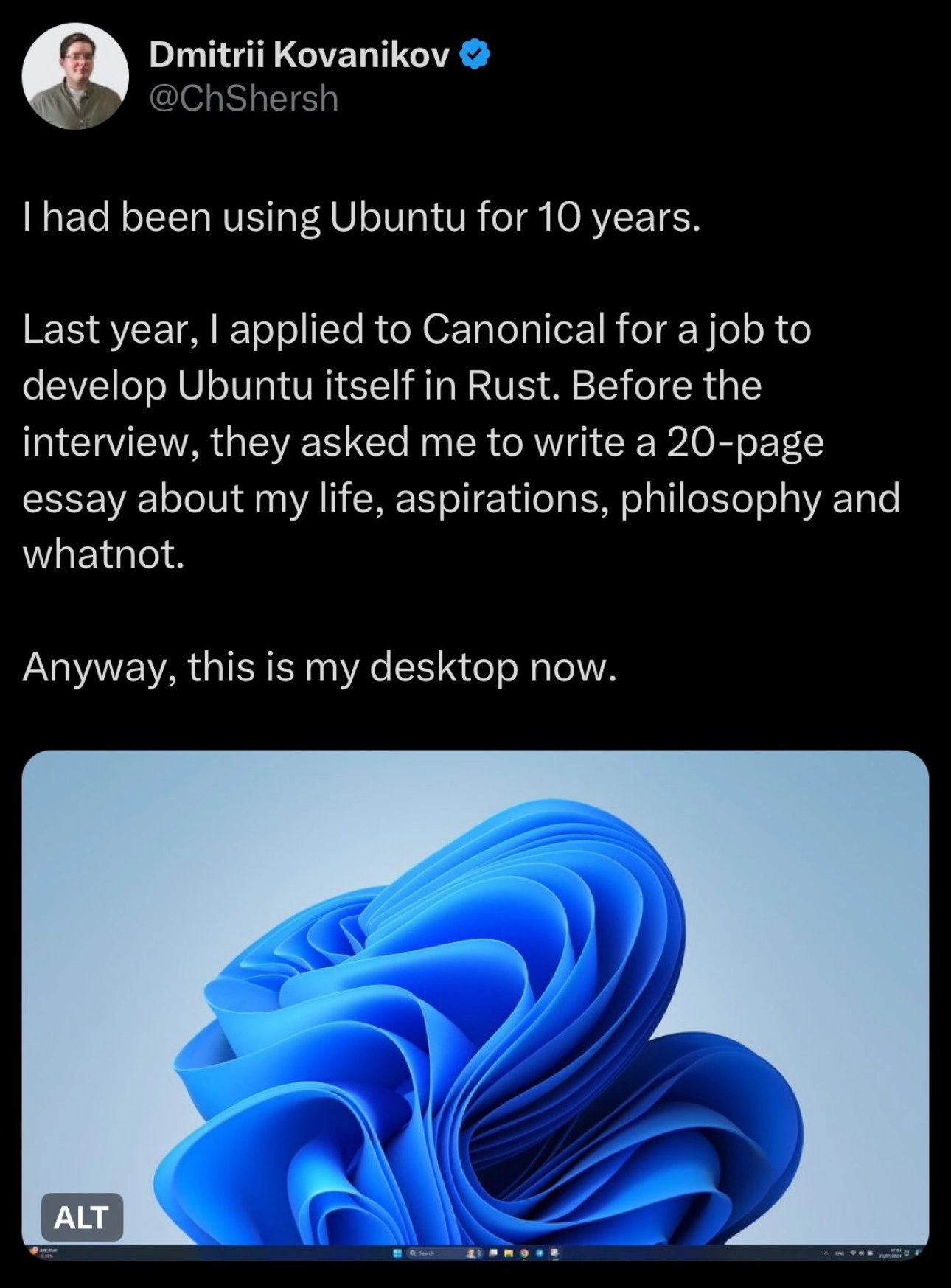
Ubuntu veteran rage-quits to Windows after Canonical’s 20-page Rust interview task
Why is this Interviews meme funny?
Level 1: When Play Feels Like Homework
Imagine you have a favorite toy or game that you’ve loved for years. You know everything about it and it makes you happy. One day, you hear you could help make that toy or game even better by joining the company that creates it – that’s like a dream come true! But before you’re allowed to help, the company gives you a giant homework assignment: “Write 20 pages about yourself, your dreams, and why you love this toy.” Twenty pages of homework, just to play and help out? That would be super annoying, right? It’s as if they care more about you doing a big boring chore than about the fact that you’re really good with the toy itself.
Now, feeling frustrated, you say, “You know what? Forget it!” Instead of doing the huge homework, you decide to go play with a different toy – maybe one you didn’t like as much before, but at least it doesn’t come with silly strings attached. It’s like if you loved Lego for years, tried to join Lego club but they made you write a book about why you love Lego, so you shrugged and picked up some Mega Bloks instead because at least nobody’s making you jump through hoops to enjoy them. It’s a bit funny and a bit sad: funny because it’s such an extreme reaction, and sad because the kid (or in this case, the grown-up developer) gave up on something they truly cared about due to an unnecessary hurdle.
In the meme’s story, the developer loved Ubuntu (a kind of computer system) and got so fed up with the “homework” the Ubuntu company gave him that he switched to Windows (another computer system he used to avoid). It’s humorous because it’s a big leap — like trading your favorite thing for the rival thing out of sheer exasperation. The core feeling is very relatable: when something you enjoy starts feeling like a chore or has too many rules, sometimes you just throw up your hands and walk away to keep your sanity.
Level 2: Linux Loyalist’s Last Straw
Let’s break down what’s going on here in simpler terms. The meme is a screenshot of a tweet by a developer who was a long-time Ubuntu user. Ubuntu is a popular version of the Linux operating system — basically an alternative to Windows or macOS that is open-source (free and community-driven). When someone says they’ve been using Ubuntu for 10 years, you can think of them as a real fan or expert user of that system. They’ve likely been through countless software updates, maybe tinkered with code or settings, and are very comfortable outside the Windows world.
Now, Canonical is the company that creates and maintains Ubuntu. Imagine Ubuntu as a big project, and Canonical is the team behind it. This developer loved Ubuntu so much that he decided he wanted to work for Canonical, helping to improve Ubuntu itself. Not just in any way, but by using Rust, a programming language that’s very trendy in systems programming right now. Rust is known for focusing on memory safety (preventing certain types of bugs) and high performance. In recent years, there’s been a lot of buzz about using Rust to rewrite parts of operating systems and other critical software because it can help make those systems more secure and reliable. So, applying for a job “to develop Ubuntu itself in Rust” means the guy wanted to be on the cutting edge: helping integrate this modern language into the Ubuntu project. That’s a pretty ambitious and exciting role for someone who loves Linux and Rust.
Here’s where things went sideways: before the interview even started, Canonical gave him a big homework assignment. They asked for a 20-page essay about his life, goals, philosophy, etc. Think about that — twenty pages is a lot. Most of the time when you apply for a tech job, you might submit a résumé, maybe a cover letter (which is like one page where you say why you want the job), and then typically you do some coding tests or technical questions. Being asked to write an essay at all is unusual for a programming job; being asked for something as long as a short college thesis is nearly unheard of. It’s like applying to be a software engineer and getting a task that feels more like a college admissions essay or a personal memoir. This is what we mean by an overkill hiring process or essay_based_screening – it’s far more than what’s normally necessary to figure out if someone can do the job. It probably felt frustrating and maybe a bit insulting to the candidate. After all, he likely expected to be tested on his coding ability or his understanding of Ubuntu, not to pour out his aspirations and philosophy on paper.
So what did he do? Well, according to the tweet, he didn’t even bother completing that monstrous essay. Instead, he basically said “forget it” and walked away from the opportunity. The funny (and telling) part is how he walked away: he shows that now his computer is running Windows 11. In the image, we see the standard Windows 11 desktop with its default light-blue wallpaper and centered icons on the taskbar. That image communicates a lot without words: it’s the look of a fresh Windows installation, the kind someone gets when they’ve decided to leave Linux behind. The tweet caption drives it home: “Anyway, this is my desktop now.” In context, it’s a bit of a tongue-in-cheek way of saying, “I was such a loyal Ubuntu guy that I even tried to work there, but after this ridiculous process, look, I’ve switched sides.”
To someone newer in the developer world, it helps to understand the significance of a long-time Ubuntu (Linux) user switching to Windows. Linux and Windows are like two different worlds in computing. Many developers choose Linux for its flexibility, power, and the philosophy of open source (where you can see and change the code that makes the OS run). Windows is closed-source (Microsoft’s proprietary system), often seen as more user-friendly for the average person but less open to tinkering by users. People get very attached to their operating system of choice; it becomes part of their identity and workflow. A person who’s been on Ubuntu for 10 years has probably customized their system just how they like it, is comfortable with the Linux command line (using tools like bash and apt-get), and maybe even looks at Windows with a bit of skepticism or dislike (there’s a classic friendly rivalry between the communities).
So switching to Windows after 10 years on Ubuntu is a big deal. It’s an emotional statement, almost like a sports fan switching to cheer for a rival team. The tweet is making a joke out of this drastic change. It implies that the experience with Canonical’s hiring task was so off-putting that it pushed him to abandon something he loved and go to the “opposite side.” And by calling Windows 11 “one of the best Linux distros” in the follow-up comment, he’s being sarcastic. It’s a bit like saying “fine, if you’re going to treat me like that, I might as well use Windows — it practically runs Linux stuff nowadays anyway!” (He’s referring to the fact that Windows 11 can run Linux tools through something called WSL, but that’s a technical detail. The main point is the irony.)
For a junior developer or someone just getting into tech, the takeaways from this meme are:
- Interviews can be weird: Not every company has a straightforward hiring process. Some might give you tasks that feel irrelevant or excessive. This story is an extreme example, meant to be funny, but it’s rooted in a real frustration many people feel.
- Passion can sour: This guy was passionate about Ubuntu/Linux. He even applied to work on it. But he got disheartened by how he was treated during the application. It shows that even if you love a technology or a platform, dealing with the organization behind it can be another story. In tech careers, people sometimes leave their “dream companies” or favorite domains because the reality doesn’t match the ideal, which can be a bummer.
- Linux vs Windows humor: The meme leans on the long-running jokes between Linux users and Windows users. Typically, hardcore Linux folks might joke about never touching Windows. So when one of them not only touches Windows but switches to it entirely – and then jokes that Windows is basically a Linux distro – it’s a funny role reversal. It’s like a twist ending in a story for those who know the background rivalry.
In simpler terms, imagine you’ve been a fan of a particular game or tool for years and years. You decide you want to be part of the team that makes it. But when you try, they make you do something completely unrelated and tedious, like writing a huge essay, before they even talk to you. You’d feel upset, right? This developer felt so upset that he ditched the thing he loved and went to a competitor. That’s the tech-world equivalent of storming off in a huff, and then joking about it to your friends. The tweet and the attached Windows screenshot tell that whole story in a humorous way.
Level 3: Rust in Kernel, Red Tape in HR
This meme hits home for seasoned developers because it mashes up two painfully familiar scenarios: the hype of new tech (Rust in an OS!) and the grind of HiringAndInterviews that value paperwork over prowess. The tweet’s author spent a decade as a loyal Ubuntu user — that’s like being in a long-term relationship with Linux. He finally decides to propose to his dream company (Canonical, which maintains Ubuntu) for a role working on the OS he loves, possibly involving the much-talked-about Rust integration. For context, Ubuntu in Rust is exciting: imagine parts of your favorite Linux distro rewritten in a modern, safe language. For an open-source enthusiast, it’s like being asked to help forge the future.
But then reality crashes the party: Canonical’s hiring process had an absurd hoop to jump through. Before even getting an interview, they wanted a 20-page essay about his “life, aspirations, philosophy and whatnot.” Twenty pages! That’s not an interview task, that’s a novella about Career_HR buzzwords. The humor here is that instead of proving his coding skills or showing off a cool Rust project, this veteran dev was asked to pour his heart out in writing, as if applying for a scholarship in creative writing or joining a monastery. We’re laughing (and cringing) because many of us have been through interview overkill – whether it’s 6 rounds of whiteboard puzzles or take-home projects that resemble unpaid labor. But a personal philosophy essay longer than some technical specs? That’s a new level of corporate ridiculousness. It’s a classic case of hiring_process_overkill and essay_based_screening gone wild.
Every senior dev knows the unspoken truth: lengthy hiring processes often scare away the very candidates you want to hire. Here, a 10-year Linux loyalist basically rage-quit not just the interview, but his entire OS allegiance. It’s as if the system said, “We don’t trust your 10 years of Ubuntu experience, not until you write us an autobiography in MLA format.” The tweet’s punchline, “Anyway, this is my desktop now,” comes with a picture of the default Windows 11 desktop — the bright blue swirly wallpaper and centered taskbar icons. That image hits like the final panel of a comic: the once-proud Linux user has surrendered to Windows. And not just any Windows, the very latest Windows11 with all its pristine, out-of-the-box settings. The absurdity is delicious: a person who presumably spent years tweaking GNOME or swapping out window managers on Ubuntu is now staring at the canned comfort of Microsoft’s OS. It’s as if a hardcore vegan just posted a selfie at a steakhouse.
Why is that so funny for devs? Because there’s longstanding playful rivalry and identity tied up in LinuxVsWindows. Die-hard Linux users often tout the freedom to configure everything, the open-source ethos, and avoidance of Microsoft’s ecosystem. For such a person, switching to Windows feels like defecting to the Empire. So the fact he did so willingly implies Canonical’s interview completely broke him. It was the last straw, the great equalizer that drove a free software devotee into the arms of what he likely considered the “dark side.” And the kicker: he calls Windows 11 “one of the best Linux distros.” This line is dripping with sarcasm and insider humor. Seasoned devs know that Windows is definitely not a Linux distro — unless you count how Windows 11 now includes the Windows Subsystem for Linux (WSL). With WSL, you can run Ubuntu inside Windows, so tongue-in-cheek, people sometimes joke that Windows is effectively running a hidden Linux. Saying “Windows 11 is the best Linux distro” is a cheeky way to mock how far Windows has come to meet Linux users half-way, and to underscore the irony of a Linux guru using it as his main OS. It’s a wink to the fact that this fellow might still open a Bash terminal on Windows, clinging to a piece of Linux even as he swaps wallpapers.
The InterviewHumor here also highlights a common industry gripe: hiring practices can be so out-of-touch that they repel good candidates. Instead of a practical test of Rust systems programming knowledge or reviewing the candidate’s open-source contributions, Canonical (in this story) wanted a mega-essay on personal philosophy. That’s reminiscent of a dreaded “cultural fit” exercise dialed up to eleven. It’s both funny and frustrating because we suspect some HR team thought this was a brilliant filter for passion and communication skills. Spoiler: it likely filters out anyone with a life. As a cynical senior dev might say, “Sure, because nothing proves you can write memory-safe kernel code like a detailed exposition of your life’s purpose.” The shared trauma is real — we remember pointless interview questions (“Where do you see yourself in 5 years?”) and tasks that felt like hazing. This meme exaggerates it to a comical extreme: a 20-page writing assignment about your soul before you even talk to an engineer. DeveloperFrustration intensifies!
On top of that, there’s the context of Rust being the hot new thing. Many of us have seen the Rust hype train: everyone wants Rust in their stack, resumes boasting Rust experience get extra attention, and companies like Canonical are eager to sprinkle some Rust on their projects (even the Linux kernel is starting to support Rust for drivers). The tweet’s author was clearly on board with this – he applied specifically to develop Ubuntu in Rust. So he’s not anti-Rust at all; he was probably excited by it. But after this debacle, even Rust’s sparkle wasn’t enough to keep him on Team Ubuntu. In a darkly comic way, it’s like saying: “I loved Ubuntu so much I wanted to help build it, but their process was so over-the-top that I’m now typing this from Windows… hope you’re happy, Canonical.” It underlines how a CorporateCulture misstep (making candidates endure a marathon application) can sabotage technical initiatives and community goodwill.
For those of us with years in the field, we nod knowingly at a few subtexts here:
- Passion vs. Burnout: A developer’s passion was to work on what he loves (Ubuntu/Linux). But passion can quickly turn to burnout or disillusionment when faced with irrelevant bureaucracy. Ironically, the company lost a passionate user who was potentially a great hire.
- Culture Fit Gone Wrong: Companies often ask open-ended questions or essays to gauge culture fit and communication. But there’s a fine line between reasonable and ridiculous. Twenty pages about “aspirations and philosophy” is way past that line — it’s hiring_process_overkill. It reads like some manager heard about Amazon’s famous essay-based hiring bar raiser and said, “Hold my beer.”
- Loyalty is Finite: Being a 10-year power user of a platform creates a strong loyalty… up until that platform’s gatekeepers treat you poorly. The meme shows even an “Ubuntu veteran” has a breaking point. It’s a cautionary tale to companies: don’t make your biggest fans jump through flaming hoops; you might just push them to your competitor.
- Windows Isn’t That Bad (Anymore): Ten years ago, a Linux die-hard going to Windows would be unheard of except under duress. But nowadays, Windows 11 with WSL2 can actually run Linux tooling nicely, and Microsoft has embraced developers to an extent (open-sourcing VS Code, embracing GitHub, etc.). The joke “W11 is one of the best Linux distros” has a kernel of truth — you can have a Linux-like dev experience on Windows now. So the meme also jabs at how times have changed: the once arch-enemy OS now tempts even the faithful, especially if their own camp alienates them.
All these layers make the meme painfully funny. We laugh, then we sigh, because we either lived something similar or we fear one day we will. In short, the meme skewers the absurdity of a hiring process that prioritized a pile of prose over proven programming prowess, and it does so by showing the ultimate “I’ve had it” moment: a Linux guru embracing the Windows logo out of sheer exasperation. That’s tech-world satire at its finest.
Level 4: Bureaucratic Buffer Overflow
At the cutting edge of OperatingSystems design, developers reach for languages like Rust to eliminate entire classes of bugs. Rust's strong guarantees — like its strict ownership model and compile-time checks — virtually abolish the dreaded buffer overflow and data races that plague C/C++ system code. In theory, rewriting Ubuntu components in Rust could yield a safer, more robust OS: no more mysterious segfaults at 3 AM, fewer security advisories caused by memory mismanagement. It’s the kind of technological aspiration a veteran Linux dev dreams about.
However, this meme highlights an irony: while the tech stack is moving towards memory safety and efficiency, the human side of the project fell victim to a bureaucratic overflow. The interview process at Canonical (Ubuntu’s parent company) presented a task so over-engineered — a 20-page essay about personal philosophy — that it effectively crashed the candidate’s enthusiasm. It’s as if the hiring pipeline had an unchecked buffer of HR requirements, causing a core dump of the applicant’s motivation. In software terms, the candidate experienced an HRException: StackOverflow from trying to allocate 20 pages of personal prose on the heap of an interview. No amount of Rust-inspired safety can prevent this kind of failure; there's no lifetimes or borrow-checker to manage CorporateCulture bloat.
This situation underscores a fundamental disconnect: we can rigorously prove code correctness and memory safety, but there’s no formal verification for a sane hiring process. The company sought a Rust ace to bolster Ubuntu’s code quality, aiming for fearless concurrency and flawlessness in the OS. Yet the selection mechanism was anything but efficient or lean. In an ideal world, a candidate’s decade of Linux experience or contributions might have been weighed; instead, the requirement was akin to solving an NP-hard problem of self-reflection serialization. It’s almost comedic from a theoretical standpoint — we strive for elegance in system architecture, but the organizational architecture is riddled with legacy “features” (like bureaucratic gatekeeping) that any seasoned engineer can see the absurdity in. The meme exposes that absurdity: even the most advanced technology (Rust’s safety, Linux’s openness) can’t save a developer from a human process that is, frankly, still running in unsafe mode.
struct Candidate {
essay_pages: usize,
life_philosophy: Option<String>,
// Note: actual coding skill fields mysteriously absent
}
fn passes_screening(c: &Candidate) -> bool {
// HR's pseudo-code logic: require ≥20 pages of soul-baring content
c.essay_pages >= 20 && c.life_philosophy.is_some()
}
// This "algorithm" compiles, but it doesn't say anything about Rust or Linux skills.
In essence, the meme jokes that while Ubuntu’s codebase might avoid a segmentation fault thanks to Rust, its hiring process suffered a segmentation fault of reason. The candidate, a ten-year Linux veteran, had his mental core dumped by management’s overreach. The outcome? He rebooted straight into Windows 11, humorously implying that an OS known for blue screens felt more stable than Ubuntu’s interview gauntlet. It’s a darkly funny twist where technical ideals (memory safety, open-source passion) are undermined by age-old corporate folly.
Description
Screenshot of a tweet on a black Twitter UI. The profile picture is blurred, the name reads “Dmitrii Kovanikov” with a blue-check badge, handle @ChShersh. Tweet text: “I had been using Ubuntu for 10 years. Last year, I applied to Canonical for a job to develop Ubuntu itself in Rust. Before the interview, they asked me to write a 20-page essay about my life, aspirations, philosophy and whatnot. Anyway, this is my desktop now.” Beneath the text is an image of a pristine Windows 11 desktop: light-blue gradient background with the default abstract blue swirl wallpaper and centered taskbar icons. The humor hinges on a decade-long Linux user abandoning Ubuntu for Windows after an over-engineered hiring requirement, highlighting pain around interview bureaucracy, OS loyalty, and Rust hype
Comments
26Comment deleted
Canonical wanted a 20-page personal manifesto; he responded with the ultimate exit command: `sudo apt-get install windows-11`
After a decade of sudo apt-get install, they asked for a 20-page philosophical treatise on life aspirations - turns out the real package dependency was Microsoft Office to write that essay. Sometimes the best way to contribute to open source is knowing when to close the terminal
After a decade of evangelizing Ubuntu and preaching the Linux gospel, this developer was asked to write a 20-page philosophical treatise just to interview for rewriting Ubuntu in Rust. The punchline? They're now running Windows 11. It's the ultimate 'you either die a hero or live long enough to see yourself become the villain' moment - except here, the villain is the hiring process that drove a loyal Linux advocate straight into Microsoft's arms. Nothing says 'we value your time and expertise' quite like demanding a novella about your life aspirations before even discussing the technical role. The real systems programming challenge wasn't memory safety in Rust - it was surviving Canonical's interview gauntlet without questioning your entire OS allegiance
Canonical's hiring demands borrow-checking your entire life before Rust even compiles
Hiring CAP theorem: choose Consistency (20‑page process) or Availability (candidates); Canonical chose consistency - partition happened, client rerouted to Windows
Canonical wanted a 20-page autobiography before the technical interview; Windows only wanted a one-click EULA - turns out hiring pipeline backpressure is a stronger migration strategy than any package manager
Wsl2 zaebis Comment deleted
dudes I just found that win11 provides a built-in sudo command yesterday… Comment deleted
if the command doesn't run stuff as NT\SYSTEM by default it's not exactly sudo Comment deleted
well... C:\Users\NexonSU>sudo devmgmt.msc Unknown error: %1 is not a valid Win32 application. (0x800700C1) Comment deleted
msc files are just configs. Why should they be executable themselves, without OpenDocument or another similar shell-level wrapper? Comment deleted
plot twist: he is actually using zorin OS Comment deleted
Plot twist: he promotes ALT Linux. Comment deleted
wait, twitter has alt text now? Comment deleted
when did they add that? Comment deleted
Ages ago I think Comment deleted
April 2022 google says Comment deleted
huh. damn Comment deleted
Hiring at Ubuntu is a weeeeiiird cult Comment deleted
self reflection experience from job interview interesting Comment deleted
Unity sucks Comment deleted
they say never meet your heroes Comment deleted
I applied to canonical. I wrote the essay. Then I took the IQ test, and the reaction test. I took 5 hours of interviews. I did a take home project with Juju, their extremely shit deployment system. And finallly after all that, which took 2-3 months, I got to meet the hiring manager. Comment deleted
And he offered me half what I was making at the time Comment deleted
I wished him good luck with his next useless rewrite of the installer and hung up Comment deleted
Wow, I know nothing now Comment deleted