Skip to content
DevMeme
5902 of 7435
Parents dream big; I debug penguin NFTs and memecoin tokenomics at thirty
Blockchain Post #6462, on Dec 17, 2024 in TG

Parents dream big; I debug penguin NFTs and memecoin tokenomics at thirty

Why is this Blockchain meme funny?

Level 1: Dreams vs Memes

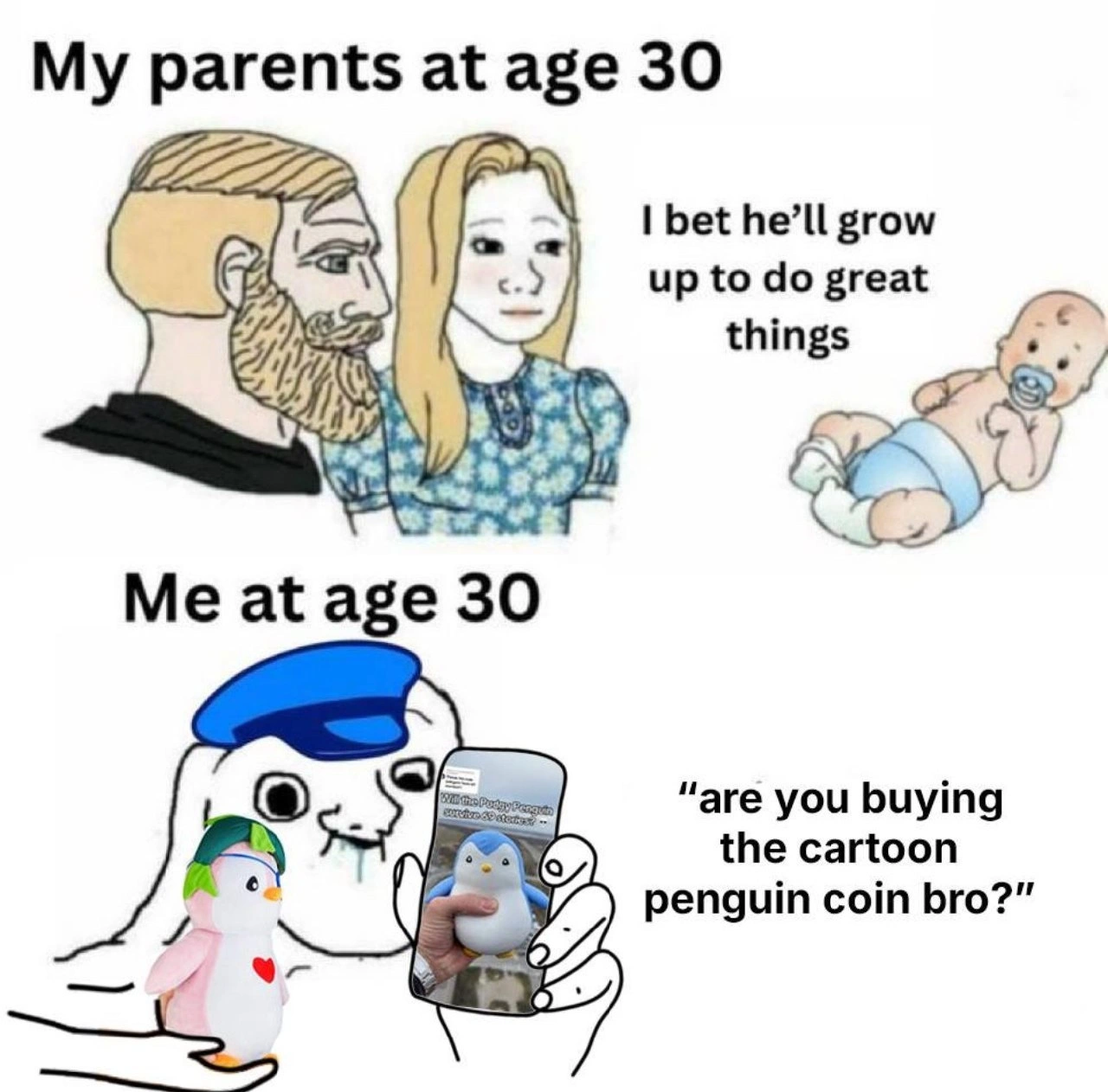
Imagine Mom and Dad thought I’d be a superhero or something by the time I grew up — maybe discovering a cure for a disease or at least having a really important job. But fast forward to me at 30 years old, and what am I doing? I’m really excited about a funny picture of a penguin on the internet and some pretend coins related to it. It’s as if they dreamed I’d become a famous chef, creating gourmet meals, but instead I’m spending my days trading Pokémon cards. In the picture, my parents hold me as a baby and say “he’ll do great things.” Meanwhile, grown-up me is staring at a cartoon penguin on my phone asking my buddy, “Hey, are you gonna buy this penguin coin?”

In super simple terms, the joke is about the difference between what parents expect and what actually happens. Parents hoped I’d be doing something big and impressive. But here I am, an adult who’s basically playing with digital toys and funny money. The “penguin coin” is like a made-up game token with a cute animal logo. It sounds childish, right? That’s the point – it’s a silly thing for a 30-year-old to be obsessed with, compared to having a normal grown-up life like my parents had at that age.

So why is this funny? Because it’s a big contrast. It’s like if your mom thought you’d be a doctor saving lives, and instead you became a collector of bobblehead dolls, spending all your time and money on rare bobbleheads. The difference between big hopes and silly reality makes us laugh. We don’t expect someone age 30 to be fixated on cartoon penguins and internet coins, but in today’s world, hey, it happens! The meme is basically laughing at me (the 30-year-old) for not living up to those grand expectations – I’m doing something that sounds a bit ridiculous instead. And it’s also poking a bit of fun at those trendy internet crazes where adults get really into things that sound like kids’ stuff. In the end, it’s a light-hearted way to say: Growing up isn’t always how our parents imagined, especially in the tech era of odd hobbies and online fads.

Level 2: Cartoon Crypto 101

Alright, let’s break down what’s going on in simpler terms, especially if you’re not deeply into the crypto or meme world. The meme compares two generations at the same age:

  • “My parents at age 30”: The top part shows cartoon parents holding a baby (that’s me as a baby). They’re saying “I bet he’ll grow up to do great things.” This sets a high expectation. At 30, my parents likely had a family and were doing what they considered responsible adult things. They imagined by the time I (their baby) reach 30, I’d be accomplishing something impressive and meaningful – maybe a prestigious career or some notable achievement. This is the typical proud-parent dream.

  • “Me at age 30”: The bottom part shows me (now 30 years old) in a very different scenario. I’m depicted as a meme character (a Wojak cartoon face wearing a blue cap, drawn in a somewhat dopey way). I’m holding a small toy-like penguin figure and my smartphone. On the phone screen is an image of a pudgy cartoon penguin similar to the toy. And next to me, there’s the quote: “are you buying the cartoon penguin coin bro?” This scene is packed with references to recent tech fads:

    • Cartoon Penguin Coin: This references a type of cryptocurrency or memecoin. Cryptocurrencies are digital money that live on a technology called a blockchain (which is like a distributed ledger or record-keeper across many computers). A memecoin is a kind of cryptocurrency that’s created mostly as a joke or meme, often with a fun theme but not much practical use. For example, Dogecoin is a memecoin that started as a joke featuring a Shiba Inu dog meme, yet it gained real monetary value because people started trading it. So a “cartoon penguin coin” suggests a pretend cryptocurrency themed around cartoon penguins. It’s not an actual famous coin (to my knowledge) but it parodies the fact that new silly coins pop up all the time (we’ve had coins based on frogs, dogs, Shiba Inus, you name it). The meme picks a penguin theme presumably because of a real trend where cartoon penguin images (we’ll get to that next) became popular and valuable in the crypto world.

    • Pudgy Penguins / Penguin NFTs: In the crypto craze, NFTs became a huge thing. NFT stands for Non-Fungible Token. Non-fungible basically means unique, one-of-a-kind. An NFT is like a digital collectible or certificate of ownership for a specific item (often a digital image or artwork). Think of it like owning a rare trading card, but digital. There was an actual NFT collection called Pudgy Penguins – essentially cute digital pictures of penguins with different accessories (hats, costumes, etc.). People were buying and selling those penguin pictures (each one an NFT) for thousands of dollars at the peak of the craze. Owning an NFT means you have a record on the blockchain saying “this one unique penguin picture belongs to you.” It’s a bit like having a signed certificate for a digital artwork. So, the little toy penguin the character is holding represents one of these penguin NFTs (the toy form just visualizes it as something cute and silly). The phone screen likely shows the marketplace or an image of the NFT.

    • “Are you buying… bro?”: The language “bro, are you buying… ?” is how a friend or online stranger might ask if you’re going to invest in some new crypto token. It’s very informal and hype-y. In crypto communities (like groups on Reddit or Twitter), people often egg each other on with phrases like “C’mon bro, get in on this coin, it’s gonna moon!” (“to the moon” means they expect the price to shoot up). So this caption is mimicking that vibe. It implies someone (maybe an online friend) is asking our 30-year-old self if he’s going to purchase the latest silly-sounding investment: a cartoon penguin coin.

So, putting it together: instead of doing something traditionally “great” at 30 (like having a stable career, a house, or some notable accomplishment), the 30-year-old in the meme is deeply involved in a trendy but arguably goofy aspect of tech — dealing with cryptocurrency and NFTs that revolve around cartoon characters. Specifically, he’s debugging penguin NFTs and analyzing tokenomics of a memecoin.

Let’s explain tokenomics: this word is a combo of “token” (as in crypto token) and “economics.” It refers to the design and economic principles of a crypto token. For example, how many coins will exist? How are they distributed or created? Will the coin’s code do something like burn (destroy) some coins over time to increase scarcity? All those rules and plans are tokenomics. In many serious cryptocurrency projects, tokenomics is a whole section of the whitepaper (a document outlining the project). For a memecoin (joke coin), the tokenomics might be tongue-in-cheek or just designed to entice people (like making an enormous supply of coins so each coin costs just fractions of a cent, making newbies think “if it even goes to $1 I’ll be rich!”). Our meme character “debugging memecoin tokenomics” suggests he’s trying to make sense of or fix issues with how a particular joke coin’s economy works. It’s a funny idea because tokenomics isn’t a physical thing you debug like an error in code; it’s more of a concept you analyze or a code you review. So it sounds humorous, as if he’s treating this flimsy meme economy with serious engineering diligence.

Now, why is this scenario humorous or significant?

  • TechHypeCycle: The meme is referencing a real phenomenon in the tech industry where a new technology becomes insanely popular and hyped (often disproportionately to its actual value). Blockchain and crypto experienced this. At one point, everyone was talking about launching tokens, buying NFTs, etc., even if they didn’t fully understand it. This is called a hype cycle: we get super excited (sometimes overly so), and things get a bit crazy. Eventually reality sets in, and some hypes crash or normalize. NFTs and memecoins had that crazy phase around 2021-2022. This meme is laughing at that: even a 30-year-old software developer—someone you’d think might be doing serious programming—got caught up in the craziness, to the point where he’s spending his time on it.

  • GenerationalHumor: There’s a common meme format on social media that goes “My parents at 30 vs Me at 30”. It usually highlights how life has changed across generations. For example, parents might have owned a home and had kids by 30, whereas many millennials (people born in the 1980s-90s who are around their 30s now) are renting apartments, playing video games, or dealing with things that seem less grown-up by old standards. It’s partly due to economic factors (houses are more expensive now, etc.) and partly cultural (people do things later or have different interests). Here, the focus is specifically on a millennial in tech. His “grown-up job” at 30 looks, to an outsider, kind of like playing with digital toys or imaginary money. That’s the adulting_fail aspect – where “adulting” means doing adult responsibilities successfully. The meme jokingly suggests our hero is failing at adulting in the traditional sense, since he’s more concerned with cartoon penguin assets than, say, family or a conventional career milestone.

  • Blockchain and NFTs explained simply: A bit more on what these are, since they’re central to the meme:

    • A blockchain is like a public ledger book that’s duplicated across many computers. It keeps track of transactions (like who owns which coin or NFT) in a secure way. Because many computers (nodes) must agree on each entry, it’s hard to cheat or change the records. This technology underpins cryptocurrencies (like Bitcoin, Ethereum) and NFTs.
    • An NFT (Non-Fungible Token) on a blockchain is basically a unique digital item certificate. For example, NFT can be thought of as a one-and-only digital trading card. In the case of Pudgy Penguins, each NFT is a unique penguin picture. People can buy/sell it, and the blockchain verifies who currently owns it. Even though you can copy the image itself (like screenshot the penguin), the NFT is the official ownership record recognized on the network, which is what people were actually buying.
    • A cryptocurrency coin (like our hypothetical PenguinCoin) is a digital coin that also lives on the blockchain. People treat it like money or an investment. A memecoin specifically is usually launched not to solve a big problem but to capitalize on a meme or trend – basically fueled by popularity and humor. They’re very volatile (prices swing wildly) and often not taken seriously by traditional investors, but during hype times, even these can temporarily explode in value if enough people jump in.

When the meme says the 30-year-old is debugging these things, it humorously implies he’s treating them as serious work. Debugging usually means finding and fixing errors in code. So maybe he literally is a developer working at a crypto startup, and he’s trying to troubleshoot why the “PenguinCoin” smart contract isn’t working right. Or it could be figurative, like he’s trying to figure out the logic behind these crazy markets (which is often illogical!). Either interpretation is funny: either he’s literally working on code for cartoon penguins, or he’s obsessively analyzing why his penguin investments aren’t doing what he hoped.

It’s worth noting that many people in tech did dive into these things out of genuine interest or the allure of quick wealth. If you were a programmer around the crypto boom, you might have tried writing a smart contract, minting an NFT, or at least joining discussions about these. It felt new and innovative… and also a bit ridiculous in hindsight. The meme captures that feeling perfectly: “I’m 30 and I’m using my skills to do this?

Lastly, the visual style: The characters are drawn in a popular internet meme style (Wojaks). The parents with hopeful expressions are a known depiction for boomers or Gen X in meme culture, and the droopy mouth guy in the cap at the bottom is often used to represent a kind of clueless or not-quite-with-it person (sometimes called “30-year-old boomer” meme, ironically using boomer for someone who is actually younger but behaves old/silly). The blue cap and slightly dazed look emphasize that the 30-year-old here might not be the pinnacle of sophistication – he’s sort of a dorky everyman. This amplifies the comedic contrast: loving, idealistic parents vs. the reality of their kid as a bit of an awkward crypto-nerd.

In summary, this meme is explaining, in a humorous way:

  • Our generation’s 30-year-olds often are not where our parents were at 30.
  • Instead of doing “great things” like starting families or notable careers, some of us are deep into niche tech phenomena like NFTs and crypto.
  • The specific example (debugging penguin NFTs and memecoins) highlights how tech workers can end up involved in very odd projects thanks to hype trends.
  • It’s funny because it mixes high-tech concepts with seemingly trivial obsessions, and it plays on the misunderstanding between generations (parents would likely scratch their heads at what “penguin coin” even means).

If you’ve ever had to explain to a non-tech friend or family member what you do and it sounded a bit silly out loud – this meme taps into that exact situation. It’s self-deprecating and relatable for anyone who felt their “big adult job” turned out to be unusual or not easily understood outside the tech bubble.

Level 3: From Tulips to Penguins

Why is it hilariously on-point that “Me at age 30” is debugging penguin NFTs and analyzing memecoin tokenomics? This panel hits home for many in tech because it skewers the gap between great expectations and the weird reality of our industry’s latest hype cycles.

First, consider the generational setup. The top panel shows my parents at 30, presumably some decades ago, saying “I bet he’ll grow up to do great things.” That’s a pretty grand expectation – typical of parents who assume their child might become a doctor, an engineer building bridges, a business leader, etc. By that age, those parents had a baby (the cartoon baby in a diaper) and likely a conventional stable life. Now cut to the bottom panel: me at 30 today is wide-eyed, possibly drooling, obsessing over a cartoon penguin coin on a smartphone. The juxtaposition is classic GenerationalHumor. It highlights what you might call a generational_expectation_gap: our parents thought we’d have life figured out; instead, we’re caught up in something they’d probably find completely baffling (and frankly, trivial). It’s a tongue-in-cheek take on the feeling many 30-ish tech folks have: “Uh, shouldn’t I have accomplished more by now – or at least something more tangible?”

Now, zoom in on the tech specifics: Cryptocurrency mania, specifically NFTs and memecoins. This is a very contemporary form of “great things” – great in hype, if not in substance. The meme is essentially saying: My parents dreamed I’d cure cancer; I’m busy deciding whether to buy a token named after a cute penguin. The absurdity is palpable. Even seasoned software engineers got swept up in the recent digital_collectible_mania. In 2021, NFT collections like Pudgy Penguins (a real set of cartoon penguin NFTs) sold for astonishing sums. Simultaneously, jokey cryptocurrencies (memecoins like Dogecoin or Shiba Inu) were skyrocketing in value purely because of internet buzz. The meme references “cartoon penguin coin” – seemingly a mashup of those trends (perhaps a fictitious memecoin inspired by Pudgy Penguins). And yes, in crypto circles people really do say things like “Bro, are you gonna ape into PenguinCoin?” — a bro-ey way of asking if you’re buying in. That quoted line “are you buying the cartoon penguin coin bro?” perfectly captures the FOMO-laden, hype-driven chatter on Reddit, Discord, or Telegram groups during a speculative frenzy. It’s comedic how casual and dumbed-down the pitch sounds, considering it’s about a high-tech digital asset. TechHumor often exaggerates reality, but here it’s barely an exaggeration.

From a senior developer’s perspective, there’s a bittersweet recognition: we’ve built incredibly advanced systems and yet this is how they get used. As an industry, we talk about changing the world with tech, but during hype phases, a lot of talent gets diverted into what can feel like trivial pursuits. IndustryTrends_Hype cycles have a way of creating these scenarios. Remember the dot-com bubble? Brilliant people in the late ’90s were joining startups selling pet food online with mascots and Super Bowl ads (Pets.com, anyone?). Or think of the Tulip mania way back in the 17th century – people went crazy speculating on tulip bulbs. Fast forward and we get a strangely similar vibe: speculative frenzy over cryptographic tokens representing cartoon penguins. It’s history rhyming in digital form. The header “From Tulips to Penguins” isn’t just poetic; it’s the literal arc of speculative bubbles – from rare flowers to JPEGs of flightless birds. Seasoned folks have seen this pattern enough times to sigh and chuckle.

Internally, the meme also pokes at the personal adulting_fail many feel. By 30, our parents had their stuff together (or so it seemed); whereas many of us in our late 20s or 30s still feel like kids at heart, now empowered (or cursed) with powerful tech toys and internet money. The line “debug penguin NFTs and memecoin tokenomics” is deliberately hyper-specific and silly-sounding, almost as if the 30-year-old’s grand accomplishment is equivalent to tinkering with a Tamagotchi or Pokémon cards – just digital and on a public ledger. It resonates with those of us who’ve had moments of, “What am I doing with my life?” For example, a highly skilled developer might find themselves spending an evening tweaking a script to analyze the price dynamics of PenguinCoin or trying to fix a bug in an NFT smart contract that prevents a penguin image from rendering in the app. It’s not curing cancer; it’s not even fixing a mission-critical production server at a bank — it’s fixing a penguin cartoon on a blockchain. 😅 The triviality mixed with high-tech complexity is comedy gold to people in the field.

Let’s not miss the TechHypeCycle aspect: in any hype wave, there’s a period where even rational engineers feel pressure not to miss out. It’s “crypto is the future, bro, you gotta get in!” So our 30-year-old meme protagonist might actually be trying to secure his financial future by diving into these penguin coins, because hey, some people did strike it rich in the chaos. There’s a whiff of greater fool theory here: the hope that you’ll buy this silly coin and someone even more optimistic (or clueless) will buy it off you for more. Many of us laugh because we either witness friends doing this, or did it ourselves. Remember those office chats or group texts: “Should I buy this new coin? It’s up 300% this week!” followed by “This is not financial advice… but 🚀🐧 to the moon!” We’re laughing with a hint of pain. The meme’s underlying truth is that tech folks who pride themselves on logic and reason also get caught up in irrational frenzies.

In the workplace too, hype can hijack priorities. Instead of finishing that solid SaaS feature or writing unit tests, suddenly the boss or colleagues are talking about “pivoting to Web3” or launching an NFT collection because competitors did. So you get absurd tasks like integrating a blockchain wallet login for a product that absolutely didn’t need one. The meme exaggerates it to a personal level: by age 30, instead of leading a team to build say, a life-saving app, our engineer is literally debugging crypto tokens with goofy themes. It’s a satirical mirror: you thought you’d be doing great things, but the market decided cartoon coins are what’s important right now.

To sum up the senior perspective: this meme lands because it’s a collision of promise_vs_reality. The promise was that by now we’d be achieving something significant (our parents certainly hoped so!). The reality is that even a highly capable techie might be knee-deep in one of technology’s more frivolous IndustryTrends. It’s funny in a self-deprecating way — we recognize how ridiculous the situation is. Yet, it’s also a tiny bit cathartic: hey, you’re not alone if you feel your work or side-hustle is bizarre compared to what older generations imagine as “real” work. And if you’ve ever had to explain to your parents that you’re dealing with “digital penguin collectibles” and watched their eyes glaze over… well, that’s exactly the kind of scenario this meme humorously encapsulates.

Level 4: Non-Fungible Fundamentals

At the deepest technical layer, this meme touches on blockchain mechanics and cryptographic economics in absurd disguise. The pudgy penguin in question isn’t just a cute image—it’s represented by an NFT (Non-Fungible Token) on a blockchain like Ethereum. Under the hood, an NFT is essentially a unique identifier (often a big number) managed by a smart contract (code running on the blockchain). The term non-fungible means each token is one-of-a-kind, in contrast to fungible assets like Bitcoin or dollars where any unit is interchangeable with another. This uniqueness is enforced through cryptography and consensus algorithms:

  • Cryptographic Hashing: Every transaction (like minting or transferring that penguin NFT) gets recorded in a block. Each block is chained to the previous one via a cryptographic hash (forming the blockchain). This makes the ledger tamper-evident—if someone tries to alter the ownership record of the penguin, the hashes won’t match up. Essentially, the penguin’s proof-of-ownership is baked into an irreversible Merkle tree of transactions.

  • Distributed Consensus: The network of computers (nodes) running the blockchain all agree on the same history of transactions through a consensus protocol (like Ethereum’s Proof-of-Stake or earlier Proof-of-Work). This means there’s no central database—everyone collectively agrees you own that cartoon penguin token. In computer science terms, they’ve solved a form of the Byzantine Generals Problem so that even untrusted parties reach agreement. It’s heavy theory ensuring your silly digital penguin isn’t duplicated or stolen.

  • Smart Contracts: NFTs are typically implemented via smart contract standards (e.g. Ethereum’s ERC-721 or ERC-1155). These are programs that define how tokens behave. For a penguin NFT, the contract might have a function mintPenguin(address owner) that assigns a new unique token ID to the owner and perhaps links it to metadata (like “Penguin #123: green hat, heart decal”). Debugging an NFT often means diving into this Solidity code to figure out issues like why an image isn’t displaying or why a transfer failed. If our 30-year-old protagonist is “debugging penguin NFTs,” they could be reviewing contract code or transaction logs to diagnose some quirky bug in the penguin token’s logic or its marketplace listing.

  • Tokenomics in Code: Now, memecoin tokenomics refers to the economic rules coded into a cryptocurrency (especially jokey ones). This can get surprisingly intricate. A memecoin smart contract might hard-code a huge total supply (e.g. 1 trillion coins) and automatically burn a percentage on each transfer, or redistribute fees to holders, etc. These rules are essentially algorithms intended to create scarcity or value—token economics via software. Debugging tokenomics could involve analyzing these algorithms line-by-line. For instance, if CartoonPenguinCoin (our hypothetical token) has a bug in the formula that calculates holders’ rewards, a blockchain developer might inspect the contract’s state variables and math for overflow errors or logic flaws. It’s the same rigor you’d apply to debugging any financial software, except here the code might include quirky variables like penguinHatColor or functions named yoloBuy() 😅.

  • Cryptographic Ownership: The serious cryptography doesn’t stop at the ledger. Ownership of that penguin NFT or memecoin is gated by public-key cryptography. Your coins sit at an address derived from a public key, and only the matching private key can sign a transaction to move or sell them. Losing your private key = losing your penguin forever, because the system’s security is grounded in unbreakable math (the impracticality of brute-forcing 256-bit keys). So when our meme-fied developer holds a phone showing the penguin coin, behind the scenes their wallet app is managing these keys and signatures. It’s wild if you think about it: decades of research in hash functions, digital signatures, and distributed computing are at play, all so that a digital collectible of a cartoon bird can be bought, proven unique, and traded globally without a central authority.

In summary, the meme’s ridiculous scenario is built atop very real, sophisticated technology. The blockchain ensures that cartoon penguin coin is a singular digital asset with verifiable ownership. The phrase “debug penguin NFTs” might conjure comedy, but it could involve reading complex Solidity code or analyzing transaction graphs. Our thirty-something engineer is essentially applying advanced computer science and cryptographic principles to digital collectibles. The humor at this level comes from contrast: serious technology facilitating something that feels inherently unserious. The tokenomics they’re grappling with are rooted in code and math (supply curves, distribution models, game-theoretic incentives), even if the subject is a meme. It’s a reminder that even TechHypeCycle fads like NFTs run on very real tech stack layers – from the physics of semiconductors crunching hashes, up through network protocols, consensus algorithms, and application code. All that, so we can securely trade… cartoon penguins. The incongruity is both marvelous and a bit absurd.

Description

The meme is split into two panels. Top panel caption: "My parents at age 30" shows stylized cartoon parents viewed from behind - a blond father with a beard and a blond mother in a blue floral dress - looking at a diaper-clad baby on the right. A speech bubble from the parents says, "I bet he’ll grow up to do great things." Bottom panel caption: "Me at age 30" depicts a Wojak-style character wearing a blue cap, clutching a small toy penguin with a green hat and heart decal while holding a smartphone. The phone screen displays an image of a similar pudgy penguin figurine with on-screen text partially visible. Large text to the right asks, "are you buying the cartoon penguin coin bro?" Visually, the contrast pokes fun at generational expectations versus modern reality. Technically, it riffs on the crypto/NFT mania where even seasoned engineers find themselves evaluating whimsical ‘cartoon penguin’ tokens instead of shipping production code, highlighting the hype-cycle absurdity of blockchain speculation
Comments

9
Anonymous ★ Top Pick Sure, my retirement plan is solid - once the ERC-721 for these penguins hits mainnet we’ll finally achieve household-level decentralization… right after I finish code-reviewing their smart contract that stores JPEG links in plain text
  1. Anonymous ★ Top Pick

    Sure, my retirement plan is solid - once the ERC-721 for these penguins hits mainnet we’ll finally achieve household-level decentralization… right after I finish code-reviewing their smart contract that stores JPEG links in plain text

  2. Anonymous

    While your parents were investing in index funds and 401ks, you're here calculating the gas fees on your third rugpull this month, wondering if the penguin tokenomics whitepaper mentioned anything about deflationary burning mechanisms or if you just YOLO'd your AWS budget into another jpeg-backed Ponzi scheme

  3. Anonymous

    At 30, my parents were debugging their first child's sleep schedule with deterministic algorithms. I'm at 30 debugging why my portfolio's gas fees cost more than the actual tokens, while explaining to my therapist that 'diamond hands' isn't a medical condition - it's a distributed consensus mechanism for poor financial decisions

  4. Anonymous

    Parents bet on curing cancer; I optimized gas limits for penguin JPEG liquidity pools

  5. Anonymous

    If your penguin coin’s tokenomics fit in a meme and governance is “vibes,” that’s not consensus - it’s eventual FOMO; the only write‑ahead log you’ll see is your regret

  6. Anonymous

    Did an architecture review of the penguin coin: zero utility, all marketing wallet, and the consensus protocol is FOMO - liveness guaranteed until the rugpull

  7. @phobosperi 1y

    welp, i'm an unwanted child, so i def have privileges to do shit. 😎

  8. @dvsLick 1y

    $niggabutt to the moon

  9. @patsany_horosh_mne_v_dm_pisat 1y

    This is not fine 🔥🐶

Use J and K for navigation