Two Guys on a Bus: My Slop vs Everyone Else's Slop
Why is this AI ML meme funny?
Level 1: My Mess Smells Fine
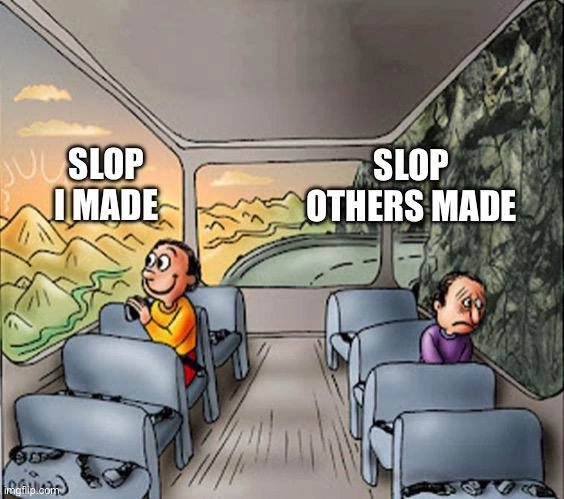
It's like how your own messy room feels cozy — you know exactly which pile has your homework and which sock mountain is clean — but walking into your sibling's identical messy room makes you gag. Same mess. Different owner. The cartoon shows two people on one bus: the guy looking at his own mess sees beautiful mountains, and the guy looking at someone else's mess sees a big ugly rock. The joke is that the mess never changed — only whose name was on it.
Level 2: Slop, Context, and the Review Queue
Key vocabulary for decoding this one:
- Slop is the now-standard term for low-quality, low-effort content — usually AI-generated — produced in bulk: filler blog posts, boilerplate code, auto-written docs. The defining trait isn't being wrong; it's being unconsidered.
- Code review is the practice where teammates read your changes before they merge. It exists precisely because authors can't see their own blind spots — the meme's whole point. The reviewer experiences your code without your memories attached.
- Double standard here means applying different quality bars to identical work depending on who made it. Every developer does this; the honest ones know they do.
The early-career version of this lesson arrives fast: the first time you read someone else's "quick hack" and feel genuine anger, then six months later read your own old quick hack and fail to recognize it — that's the bus changing sides under you. The professional fix is boring but real: review your own diffs as if a stranger wrote them, write the context down (commit messages, comments) so reviewers ride on your side of the bus, and extend others the benefit of context you can't see.
Level 3: Asymmetric Information, Asymmetric Forgiveness
The two-guys-on-a-bus format is the perfect chassis for this joke because both passengers are on the same bus. The happy one in the orange shirt gazes at golden mountains labeled "SLOP I MADE"; the miserable one in purple stares into a sheer rock face labeled "SLOP OTHERS MADE." Same vehicle, same road, same underlying quality of output — the only variable is authorship, and authorship changes everything about the view.
The mechanism being satirized has a respectable name: it's a flavor of the fundamental attribution error, refracted through code review. When you generate slop — the hastily prompted function, the README written by an LLM at 11 PM, the side project that's 80% boilerplate — you possess full context. You know which corners were cut deliberately, which TODOs are load-bearing, and what the glorious intended final form looks like. You're not seeing slop; you're seeing potential, backlit by sunset. When someone else's slop lands in your review queue, you have none of that context. You see only the artifact: the seven-hundred-line PR with the suspiciously uniform comment style, the error handling that catches Exception and whispers it into the void, the abstraction that abstracts nothing. Rock wall. No horizon. Afternoon ruined.
The word "slop" pins this firmly to the AI era — it became the community's term for low-effort generated content flooding feeds, package registries, and pull requests. And here the meme gets uncomfortably precise: the same developers who decry AI slop in others' contributions are shipping their own, because the personal experience of using a model is collaborative and contextual ("it helped me think!") while the experience of receiving model output is archaeological ("what was anyone thinking?"). Generation is pleasant; review is punishment. LLMs didn't create this asymmetry — every greenfield-vs-legacy argument is the same bus — but they industrialized it by collapsing the cost of producing the view out the left window to nearly zero, while the cost of sitting on the right side stayed exactly the same. The rock wall is now strip-mined at scale.
The imgflip watermark is its own tiny meta-joke: a low-effort meme, made with the lowest-effort tool, about low-effort output. The author presumably found the view lovely.
Description
The classic 'two guys on a bus' meme: a cartoon bus interior where a happy passenger in an orange shirt on the left gazes out a window at a glorious sunlit mountain-and-lake vista, labeled 'SLOP I MADE', while a miserable passenger in purple on the right stares out his window directly at a dark rock wall, labeled 'SLOP OTHERS MADE'. An imgflip.com watermark sits in the corner. The meme captures the asymmetric tolerance developers have for low-quality (often AI-generated) output: your own hastily generated code, content, or side project feels charming and pragmatic, while identical quality from others is unreadable garbage that ruins your code review afternoon
Comments
9Comment deleted
My slop is 'iterative delivery with known limitations'; yours is a Sev2 with a changelog
Slop will always be slop Comment deleted
Tbf I think showing cpp metaprogramming to kids should be legally punishable. Based AI in this case Comment deleted
Ai trying to protect kids from the dangers of learning too much programming Comment deleted
Isn't it the other way around? Comment deleted
depends on how self-conscious you are Comment deleted
Depends on whether you're an elitist or a perfectionist Comment deleted
Great analogy, never thought of these as opposites because never gave it much thought Comment deleted
they aren't. you can be both Comment deleted