Skip to content
DevMeme
4648 of 7435
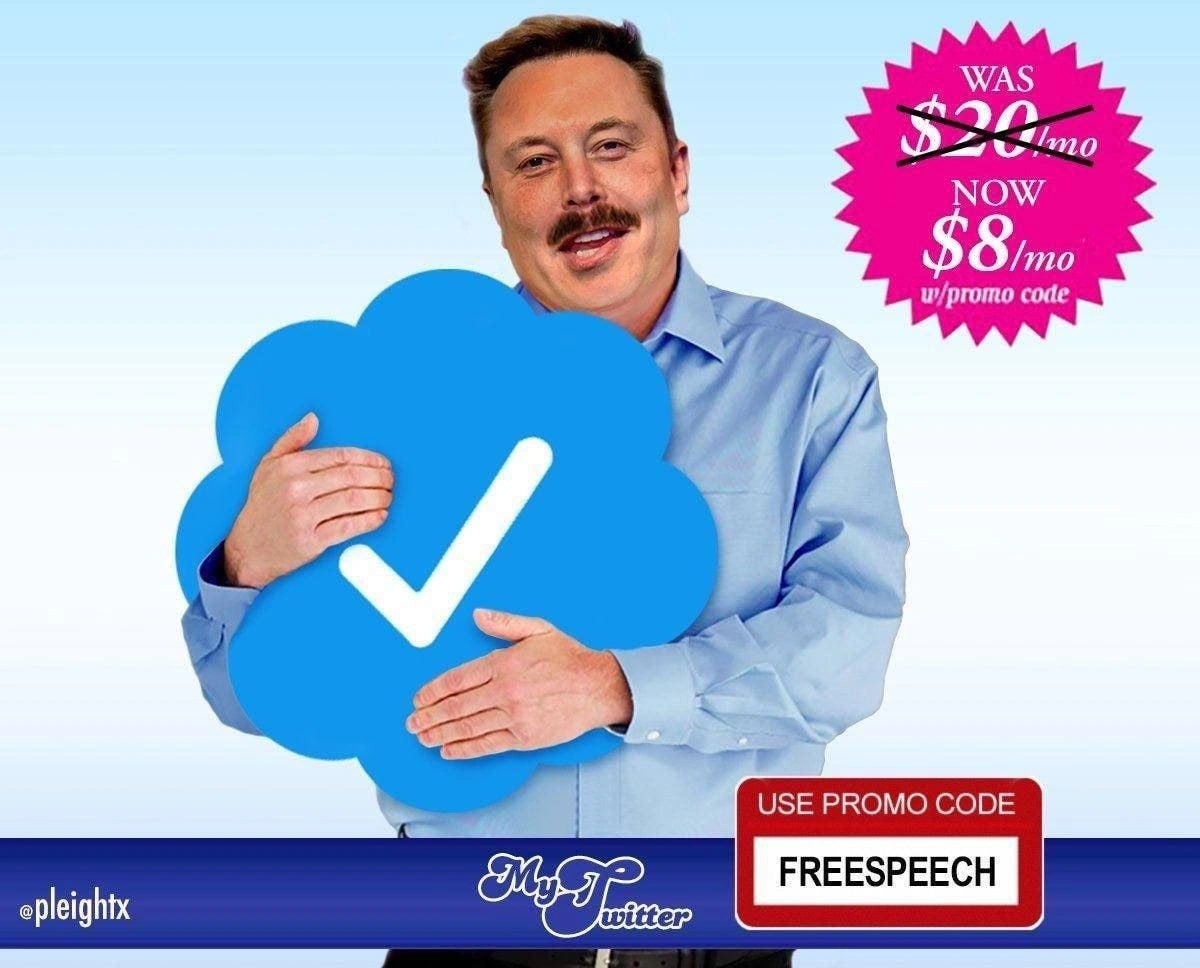
When free speech suddenly costs eight dollars with a promo code
IndustryTrends Hype Post #5097, on Jan 22, 2023 in TG

When free speech suddenly costs eight dollars with a promo code

Why is this IndustryTrends Hype meme funny?

Level 1: Not So Free

Imagine your friend promises to give everyone at school a free cupcake – no money needed. Sounds great, right? But when you show up to get your cupcake, your friend says, “Actually, you need to buy this special $8 sticker first, then you can have the free cupcake.” That feels pretty confusing and unfair, doesn’t it? The cupcake was supposed to be free, but now there’s a catch: you have to pay for something to prove you can have it. This meme is joking about the same kind of silly situation. It’s as if a big online club said, “Everyone can say whatever they want here, we believe in free speech!” and then suddenly added, “...but if you want a special blue badge that helps people trust what you say, it’ll cost $8 each month.” It’s funny because “free speech” sounds like it should be free (the word itself is “free”!), yet they’re treating it like a thing on sale. Just like the not-so-free cupcake, saying speech is free while charging money for a badge about it feels backwards. That upside-down logic is what makes people laugh – it’s a goofy reminder that sometimes “free” isn’t really free at all.

Level 2: From Free to Fee

Let’s break down why this Twitter Blue TechHumor meme is making the rounds. First, that big blue cloud with a white checkmark is Twitter’s famous blue_checkmark – the verification badge. Originally, getting a blue checkmark was free (invitation-only): Twitter would grant it to important public figures or brands to prove they were the real deal. It was a trust signal and helped prevent impersonation. Regular users couldn’t just get one by paying; it was like a special “official” status. Now enter twitter_blue, which is Twitter’s subscription service. In late 2022, Twitter’s new management decided to include the verification checkmark as a perk of a paid subscription – meaning paid_verification. Suddenly anyone willing to pay a monthly fee (the meme shows it as $8/mo) could get that once-exclusive blue badge. This was a radical shift: the blue check went from a merit-based, free verification to a paid feature behind a paywall (a classic Paywall Paradox). The meme highlights this by styling everything like a goofy sale ad, implying Twitter has put “credibility” on sale.

The promo code FREESPEECH in the image is a tongue-in-cheek jab at how “free speech” was the slogan used by Twitter’s owner to justify changes on the platform. In real online shopping, a promo code is a special word you enter at checkout to get a discount (say, 20% off or a lower price). Here, seeing USE PROMO CODE: FREESPEECH is absurd because it implies you have to pay money (but hey, at a discounted rate!) to unlock “free speech.” This is a play on words: “free speech” normally means the right to speak without censorship, not something you literally buy with money. The meme shines a light on that irony. It’s saying: Twitter advertised itself as a haven for free speech under the new regime, but then it attached a price tag to a key aspect of speech on the platform (the visibility and legitimacy that a blue checkmark can confer). The hot-pink starburst with WAS $20/mo crossed out and NOW $8/mo hints at an internal/external drama – indeed, when this change was first proposed, $20 per month was thrown around, then after public outcry (even author Stephen King complained on Twitter), it got chopped to $8. The meme mimics a cheesy As Seen On TV graphic to mock that pricing U-turn: it’s like a product that nobody was buying at $20, now on “sale” for $8.

For context, IndustryTrends_Hype is about how tech companies often launch changes with big promises and hype. In this case, the hype was “Power to the people! Everyone can be verified and have a voice!” – framed as an egalitarian move. But the MarketingVsReality contrast is sharp: in reality it’s also a way to drive new revenue (selling subscriptions) for the company. This is common in corporate culture: a noble principle gets used as branding for what is essentially a business model change. Many developers and tech observers have seen similar pivots, so they recognize the pattern: lofty language in the keynote, billing system changes in the background. The category CorporateCulture comes in when you think about internal Twitter folks seeing the phrase “free speech” turned into a literal discount code – it highlights a possible disconnect between what the company claims (supporting free speech) and what it’s doing (charging for features related to speech).

The meme’s imagery reinforces all this. The man in the blue shirt hugging the giant checkmark – that’s actually Elon Musk’s face edited onto a typical infomercial host’s body (a sly reference to how over-the-top and ridiculous this whole thing feels). The “My Twitter” logo at the bottom in a fluffy script is likely parodying brands like “My Pillow” or generic infomercial products, implying that Twitter under Musk has become like a corny product someone’s aggressively selling on late-night TV. Every element – the bright starburst, the crossed-out price, the bold promo code – is exactly what you’d see in a sales promotion graphic. For a junior developer or someone new to this saga, the key points to know are: Twitter Blue is a subscription that now gives a verification badge for $8 per month; that’s controversial because verification used to be free (for qualified people) and meant to protect authenticity. Elon Musk justified changes by saying he’s a “free speech absolutist” who wants more people to be able to speak on the platform — but the meme jokes that free speech on Twitter now literally costs money. It’s a classic case of TechTrends meet irony: turning an important concept (free speech online) into a marketing gimmick. Developers who have been through product launches can tell you: whenever there’s a big gap between a marketing slogan and the actual product reality, you’re bound to get memes calling it out. This one does it in style by treating the blue check like it’s on sale at a department store. Now that’s some TechHumor with a side of social commentary.

Level 3: Freemium Freedoms

Nothing says free speech like a promo code and a monthly fee, right? This meme gives a TechIndustryHumor twist to Twitter’s recent paid_verification saga. It parodies how Twitter’s new owner (yes, that’s Elon Musk’s face pasted onto a grinning infomercial salesman) turned the noble ideal of “free speech” into an $8 subscription upsell. The layout screams late-night Marketing infomercial: a big pink starburst shouting WAS $20/mo NOW $8/mo w/promo code, and the code FREESPEECH plastered in a bold red coupon box. Seasoned developers see the punchline: a platform that once touted itself as the global town square for free expression is now hawking blue checkmarks like they’re on clearance. It’s CorporateCulture satire 101 – MarketingVsReality in neon lights – and it cuts deep because we’ve all seen big-tech “pivots” like this. One day it’s grand promises about community and free speech, the next it’s “enter your credit card to validate your voice.” The meme even riffs on the MemeCulture around Twitter’s turmoil by mimicking a cheesy retail ad (the fake “My Twitter” logo and that cloud-shaped checkmark look like a product on QVC). For those in the know, that hot-pink “WAS $20, NOW $8” starburst isn’t random – it nods to the very real pricing flip-flop (remember when $20/mo was floated for Twitter Blue until a backlash led to the now-famous $8 deal?). The humor here comes from that industry trend of hype vs. reality: a new boss using grandiose ideals as a sales pitch, then slashing prices like a used-car dealer when the plan meets resistance. TwitterHumor like this lands because it’s too real: it captures the whiplash developers and users feel when lofty platform principles turn into absurd product TechTrends. In other words, the meme is winking at all the coders and tech veterans thinking, “Free speech, huh? At only $8 a month, what a bargain – sign me up for two!” It’s sarcasm served in 1080p: even the fundamental right of open discourse can be packaged with a limited time offer. The senior engineering crowd chuckles (perhaps a bit darkly) because we’ve witnessed this pattern before – today’s “revolutionary, people-empowering feature” becoming tomorrow’s monetization scheme. In short, the meme calls out the Marketing doublespeak: free speech isn’t so free when it comes with a price tag and a coupon code, and that absurd contradiction is exactly why it’s hilarious.

Description

The meme is styled like a cheesy late-night infomercial: a man in a blue dress shirt (face intentionally blurred) hugs an oversized, blue cloud-shaped badge with a white verification check-mark. In the top-right a hot-pink starburst reads, in all caps, "WAS $20/mo" (crossed out) and "NOW $8/mo w/promo code." A bottom banner shows a faux logo "My Twitter" at center-left, the artist credit "@pleightx" at bottom-left, and a red box at bottom-right saying "USE PROMO CODE" over the bold word "FREESPEECH." The layout mimics retail discount graphics to lampoon Twitter’s new paid-verification scheme, turning the platform’s advertised commitment to free speech into a tongue-in-cheek upsell. For developers, it satirizes big-tech monetization pivots, marketing spin versus product reality, and the broader hype cycle surrounding social-media platform overhauls
Comments

6
Anonymous ★ Top Pick Apparently the /tweet endpoint now returns 402 Payment Required unless your JWT includes scope:free_speech_pro - so much for idempotent freedoms
  1. Anonymous ★ Top Pick

    Apparently the /tweet endpoint now returns 402 Payment Required unless your JWT includes scope:free_speech_pro - so much for idempotent freedoms

  2. Anonymous

    When you realize the blue checkmark now has the same architectural integrity as a system where authentication, authorization, and accounting are all stored in the same VARCHAR(255) field

  3. Anonymous

    When your platform's 'free speech' costs $8/mo with a promo code, you've successfully monetized irony at scale - though the real engineering challenge is maintaining uptime when half your SRE team just got laid off via email at 2 AM

  4. Anonymous

    Growth turned proof-of-personhood into “apply coupon”; impersonation rate now depends on marketing’s A/B tests

  5. Anonymous

    X Premium: Availability for all takes, Consistency only with $8/mo blue check. Fully CAP theorem compliant

  6. Anonymous

    If your verification flow accepts a promo code, it’s not auth - it’s Status‑as‑a‑Service

Use J and K for navigation