Cat accidentally summons Siri and inspires automated feline playlist idea
Why is this Apple meme funny?
Level 1: Cat’s Surprise Song
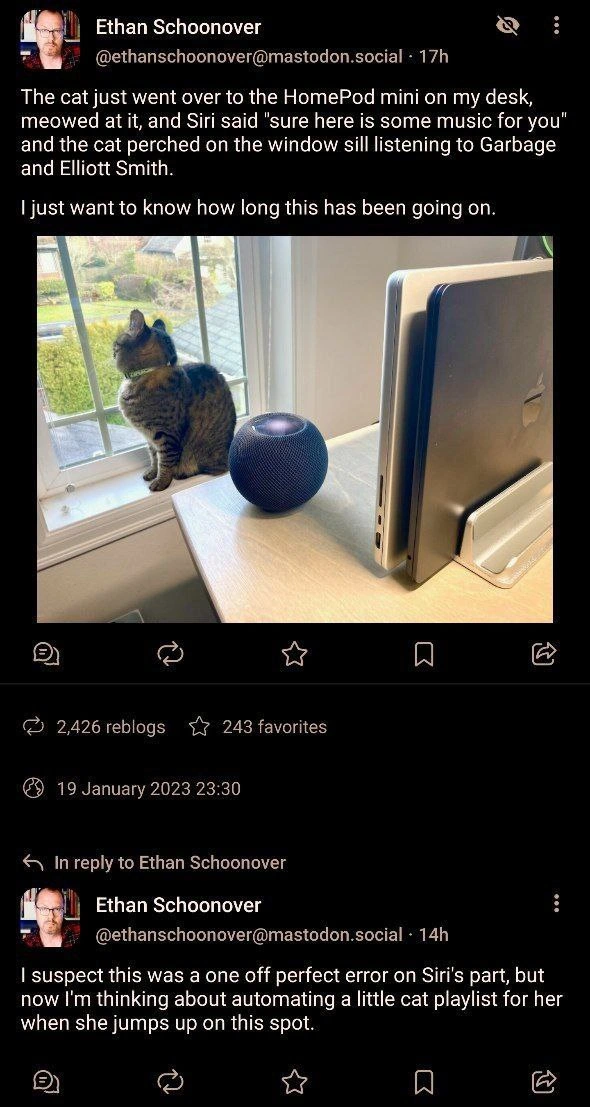
Imagine you have a smart music box that usually waits for you to say its name and tell it what to play. Now, picture your cat walking up to that box and meowing — just doing what a cat does. Suddenly, the music box thinks the cat’s meow is a person asking for music. Poof! The box says, “Okay, I’ll play some music for you,” and it starts playing songs. Now your cat is sitting by the window, ears perked up, listening to the tunes coming out of this magic box. It’s like your pet accidentally pressed the on switch of a radio and got a personal little concert! This is funny because we all know cats can’t actually use a music player or speak human language on purpose. The gadget got a bit confused and treated the cat’s voice as if you told it to play music. It’s as if a toy misunderstood a cat’s meow as a button press. The owner found it so amusing that he’s thinking, “Hmm, maybe I should set it up so that whenever my cat sits by the window, the music will play for her automatically.” In simple terms, the kitty would have her own playlist that starts by itself when she’s in her favorite spot. It’s a cute story because it shows technology doing something unexpected and sweet – giving a cat a surprise song – all because of a happy little mistake.
Level 2: Purr-fect Error
Let’s break down what’s happening in this meme in simpler terms. We have an Apple HomePod mini on a desk – that’s a small smart speaker made by Apple, which comes with Siri, Apple’s voice-controlled digital assistant. Siri is basically a little voice-operated helper that can do things like play music, set reminders, or answer questions. Normally, you have to say a special phrase like “Hey Siri” to get its attention, and then you ask it for something. In this scenario, the cat walked up to the HomePod and meowed. Somehow, that meow was close enough to fool Siri into thinking it heard a command. So Siri responded out loud with “Sure, here is some music for you” and started playing songs! The cat then sat on the window sill, apparently content, listening to the music (songs by the band Garbage and singer Elliott Smith, according to the post). The owner, Ethan, found this both hilarious and a bit mysterious – he joked, “I just want to know how long this has been going on,” as if the cat has been secretly commanding the HomePod whenever no one’s around. It’s funny because Siri misunderstood a meow (a cat sound) as a human instruction. This kind of mix-up is a classic example of siri_misunderstanding: the voice assistant got confused and treated a random sound as a real request.
This taps into a common quirk with voice user interfaces: devices like Siri or Alexa sometimes get triggered by accident. Maybe you’ve seen this with your phone or a smart speaker – you’ll say something on a call or the TV will be on, and suddenly your device thinks it heard “Hey Siri” or “Okay Google” and it speaks up. Here it’s extra amusing because it wasn’t even human speech, just a pet sound, yet the system reacted as if a person said something. Siri likely thought the cat’s noise was close enough to “play some music” or something along those lines. It shows that AI and machine learning, which power Siri’s voice recognition, aren’t perfect – they can latch onto the wrong clue. The HomePod mini doesn’t actually know a cat is meowing; it just knows “sound came in, it resembles a command, so I’ll obey.” It’s a bit of accidental Human vs AI comedy: the human didn’t ask for music, the cat unknowingly did, and the AI followed the wrong master!
In the follow-up message, Ethan mentions he suspects this was a one-time fluke (“a one off perfect error on Siri’s part”). But it gave him an idea: what if he intentionally set up a little automation so that whenever the cat jumps on that spot by the window, a playlist of songs starts playing for her? This is the feline_playlist_automation idea. In non-technical terms, that means using technology to make something happen automatically – in this case, detecting the cat’s presence and then letting Siri or the HomePod know to play “the cat’s music.” Apple actually lets users create custom routines (through an app called Shortcuts or HomeKit in the Apple ecosystem) so that certain triggers (like a sensor detecting movement, or even a specific sound) can start an action (like playing music on a speaker). So Ethan is joking about turning this funny accident into a real feature for his pet: a kitty music station that turns on whenever she sits by the window. It’s endearing because it shows a playful side of tech – using Automation not for something serious like turning lights on, but to entertain a pet. And given the internet’s love for CatMemes, the thought of a cat having her own playlist is just delightful. The whole thing highlights a friendly clash between Apple’s polished technology and the unpredictability of life (and pets!). It’s a reminder that as smart as our devices are, sometimes they do silly things… and sometimes those silly things can spark even more fun ideas.
Level 3: Fuzz Testing by Feline
From a seasoned developer’s perspective, this scenario hits that sweet spot of AI humor and relatable tech quirk. We’ve all experienced or heard of voice assistants like Siri, Alexa, or Google Assistant waking up at the wrong time – maybe answering a rhetorical TV question or responding to something that sounded like its name. It’s an accepted quirk of living with always-on tech: the occasional ghost trigger. But here it’s not some TV dialogue or random word – it’s a cat meowing. That takes the cake (or the catnip)! The meme recounts how Ethan’s cat strolls up to the HomePod mini on his desk, gives a meow, and suddenly Siri pipes up “Sure, here is some music for you.” The cat then happily sits on the window sill, listening to Garbage and Elliott Smith as if it were her personal playlist. This is hilarious on multiple levels. First, it’s an accidental voice command in action – essentially fuzz testing by feline. In software testing, fuzz testing means feeding random data to a system to see what breaks. Here the cat unknowingly fed random audio to Siri, and instead of breaking, Siri did something logically correct but contextually absurd. It’s a classic edge case that no product manager wrote a user story for: “As a cat, I want to ask for my jams on HomePod.” Experienced devs recognize that no matter how much you refine a system, users (or pets!) will find unanticipated ways to interact with it. This cat effectively became a QA tester for Siri’s voice recognition – and found a bug that’s more delightful than critical.
Second, the situation underscores the limitations of even advanced Voice User Interface design. Siri can’t distinguish between a human voice and a cat’s meow; it doesn’t have a parameter for “species” of the speaker. To Siri, sound is sound. A senior engineer chuckles at this because it exposes that gap between how AI is marketed (“smart” assistants) and how it really works (pretty dumb pattern matching at times). The HomePod didn’t think, “oh that’s just a pet” – it just mapped a noise to the closest command. Seasoned folks might recall similar incidents: parrots ordering items via Amazon Alexa, or the infamous news story where Alexa misunderstood a word and ordered a dollhouse, or how saying “serious” on a conference call can wake an iPhone (“Did you summon me?”). Digital assistants have a long history of comedic false triggers, and this meme taps into that collective experience. It’s the Human vs AI dynamic in a harmless context: our AI servants dutifully obeying nonsensical orders because they lack true understanding.
Now, beyond the error itself, there’s a very developer-like twist in the post’s follow-up: Ethan muses about actually automating a feline playlist for the cat whenever she jumps on that spot. That’s such a programmer response – turning a bug into a feature! The idea of an automated cat playlist brings in the Automation tag in a literal way. In the Apple ecosystem, this could be done with a bit of creative wiring: maybe using a HomeKit motion sensor or a camera aimed at the window seat, and a custom Siri Shortcut or Home Automation that triggers music when a cat-shaped presence is detected. It could even be as simple as training Siri to recognize the cat’s meow intentionally (imagine adding a shortcut: if microphone hears a meow sound > play “Cat Tunes” playlist). The meme’s humor is amplified for developers because we can’t help but think of how we’d implement that “Cat DJ” feature. It’s a pet project (pun intended) waiting to happen. We might joke about wrapping the cat’s meow in an API: cat.meow() becomes HomePod.playMusic(). In pseudo-code, it’s almost comic how simple it is:
# Pseudocode for a cat-triggered music automation
if sensor.detect("cat_on_windowsill"):
homepod.play_playlist("Cat's Favorites")
It’s amusing because we’re literally automating for a cat – something so extra, yet so relatable to anyone who’s spent an afternoon scripting a goofy home hack. This reflects a broader truth in senior dev life: we often automate silly, small things for fun or convenience (like smart feeders, pet cams, self-playing laser toys), not because it’s mission-critical, but because we can. The post resonated widely (over 2k reblogs!) because it combines our love of cats (the unofficial mascots of the internet) with an AI misfire. It’s a gentle reminder that even sophisticated tech can behave unexpectedly, and sometimes those surprises are adorable instead of catastrophic. In a world where we usually hear about AI failures as dangerous (think self-driving car mishaps or bad recommendations), this is a wholesome failure mode: Siri’s slip-up just gave a cat a relaxing music session. Any veteran dev can appreciate the absurdity and perhaps even envy the cat – after all, how often do we get an AI to do exactly what we want with just a meow? 😸
Level 4: The Meow-to-Music Pipeline
At the heart of this meme is an AI-driven voice recognition glitch. The HomePod mini’s speech recognition pipeline normally starts by continuously listening for a wake word (“Hey Siri”). This always-on wake-word detector is typically a small neural network that transforms incoming audio into spectral features (via an FFT or mel-spectrogram) and classifies it in real-time. Occasionally, non-speech sounds can produce a false positive match. In this case, the cat’s meow likely contained frequencies or rhythmic patterns that the Siri detector mistakenly aligned with its wake-phrase acoustics. Think of it like a hash collision in sound: different input (a meow) producing a signal that matches the pattern Siri was trained to recognize as a human calling its name. Once awakened, Siri’s full speech-to-text system kicked in. Modern voice assistants use deep learning models (like an encoder-decoder or RNN/Transformer-based ASR) to convert audio into text. A meow doesn’t map to any valid words, but the system still tries to parse something. Machine learning isn’t magic – it’s statistical pattern matching. Given a random, non-dictionary input, Siri’s NLP backend might have done one of two things: (1) mis-transcribed the meow as a phonetic approximation (perhaps the drawn-out “meooow” was parsed as “muuuu–sic” – not entirely implausible if the model tries to fit the closest known word, which could be “music”), or (2) detected speech noise and fell back to a default action. Voice assistants often have fallback behaviors for low-confidence input – one common one is to play something generic (music, a default radio station) when the request is unclear but the user seems to want audio. The key is that Siri’s algorithms applied human-centric natural language processing to a very non-human sound. This reveals a classic quirk of AI/ML: models are only as good as their training data. It’s safe to assume Siri’s training didn’t include feline vocabulary, so we’ve stumbled into an edge case. The humor arises from this accidental invocation path: an innocent meow traveled through Siri’s complex voice UI stack, triggering a completely valid command. Under the hood, what should have been filtered as noise was misclassified as a meaningful request, lighting up the full Siri pipeline – from wake-word engine to cloud-based intent handler – culminating in music playback. It’s a delightful example of a false positive in voice recognition, where the cost of a mistake is low (you get some tunes) and rather entertaining. Indeed, this “meow-to-music pipeline” exposes how voice user interfaces sometimes lack context awareness – Siri doesn’t know it’s a cat “speaking.” It just follows its probabilistic models. In academic terms, this is a precision vs. recall trade-off for wake-word detection: Siri is tuned to rarely miss a real “Hey Siri” (high recall), at the expense of occasionally triggering on noise (lower precision). The outcome here is essentially an AI misunderstanding – the kind that reminds us there’s no true intelligence or common sense in the machine, just pattern recognition. The result? A perfectly ordinary HomePod mini voice assistant inadvertently turned into a cat DJ, courtesy of a convolutional neural network and a confused ML model. And because even advanced algorithms sometimes produce charming errors, we get this meme-worthy scenario of a cat jamming out to Garbage and Elliott Smith on Siri’s recommendation.
Description
Screenshot of a dark-themed Mastodon post by Ethan Schoonover. The post text reads: "The cat just went over to the HomePod mini on my desk, meowed at it, and Siri said 'sure here is some music for you' and the cat perched on the window sill listening to Garbage and Elliott Smith I just want to know how long this has been going on." Beneath the text is a photo: a grey tabby cat sits on a white window-sill, looking outside. On the desk in front of the window are a dark blue spherical HomePod mini and a closed MacBook standing vertically in a silver dock. The UI shows 2,426 reblogs, 243 favorites and the timestamp "19 January 2023 23:30". A follow-up reply from the same user reads: "I suspect this was a one off perfect error on Siri's part, but now I'm thinking about automating a little cat playlist for her when she jumps up on this spot." The humor comes from Siri (an ML-driven voice assistant) interpreting a cat's meow as a valid command, highlighting quirks of AI/ML voice recognition and sparking thoughts of home automation workflows

Comments
6Comment deleted
The cat just pulled off a zero-click meow-injection: one fuzzed utterance and Siri deploys a perfectly curated Garbage/Elliott Smith playlist - while my voice requests still 503
The cat's been running unauthorized A/B tests on your music recommendation algorithm and honestly getting better engagement metrics than your last three quarters of product updates
Classic edge case in voice assistant NLP: when your cat's meow hits just the right frequency spectrum to trigger Siri's wake word detection, and the subsequent audio gets classified as a valid music request. It's the acoustic equivalent of SQL injection, except instead of dropping tables, you're dropping indie rock playlists. The real engineering question here is whether to file this under 'false positive activation' or 'feature request for pet-aware context switching.' Either way, this is what happens when your training data doesn't include enough feline vocalizations - though I suspect Apple's ML team never anticipated needing a 'is_user_a_cat' confidence score in their intent classification pipeline
When your wake-word model favors recall over precision, the cat becomes a DAU and “Feline Mode” sneaks onto the roadmap - aka tech debt with whiskers
Siri's ASR finally aced cat spectrograms - turns out overfitting on YouTube pet vids yields Garbage-tier playlists
Meow injection gave the cat admin on my voice UI - time to add RBAC and rate‑limit felines