Skip to content
DevMeme
4349 of 7435
Image not processed
Post #4753, on Aug 9, 2022 in TG

Image not processed

Why is this developer meme funny?

Level 1: Stop Before More Get Hurt

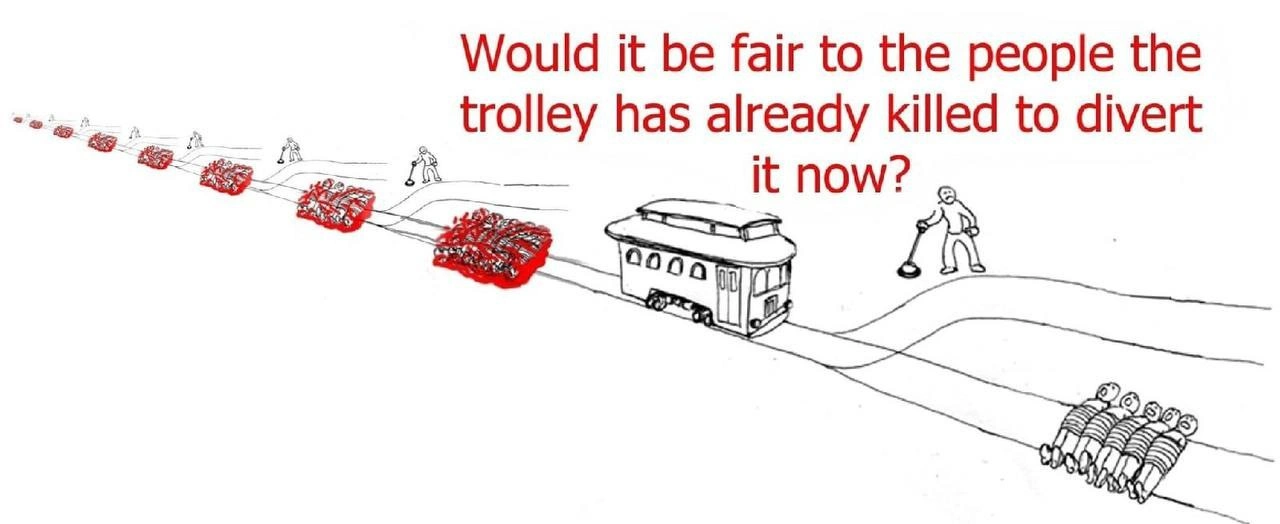
Imagine you and your friends are playing with toy cars, and one car keeps knocking over little toy figures on a track. You’ve already seen it knock over a bunch of them one by one, and everyone is upset about those broken toys. Now the car is headed toward a new group of five clean, unbroken toys. You have a chance to turn the car away so it won’t hit them. But then someone asks, “Would it be fair to the toys that are already broken if we don’t break these other ones too?” That sounds pretty silly, right? Breaking more toys on purpose doesn’t help the ones that are already broken. You’d probably say, “No way, let’s save the toys that are still okay!” The joke in the picture is funny because it shows a grown-up version of that silly idea. It’s making fun of the idea of continuing to do something bad just because you did it before. Everyone knows you should stop the harm as soon as you can — there’s no sense in ruining more things just to make the earlier accidents feel “worth it.”

Level 2: Stuck on the Same Track

Let’s break down what’s happening here in simpler terms. In software development, Technical Debt is a metaphor for the consequences of quick-and-dirty solutions and postponed clean-ups. Imagine you cut corners writing code to meet a deadline — that’s like borrowing time, and the “interest” you pay is the extra trouble and bugs that pile up later. Over years, this LegacyCode (old inherited code) can become messy and brittle, causing lots of problems. Refactoring is the process of improving that code’s structure without changing what it does, kind of like reorganizing a cluttered room so you stop tripping over things. Developers often want to refactor nasty legacy systems to make them safer and easier to maintain.

Now, the meme uses the famous trolley problem setup — a runaway trolley on tracks heading towards disaster — as an analogy. In the drawing, the trolley has been going down one track for a long time, leaving a trail of red-highlighted “casualties” behind it. Each of those red marks is like a production_incident – think of them as major bugs or crashes that happened because the system is in bad shape. The guy at the switch lever represents the team or the decision-makers (like a project manager or tech lead), who have the power to change the trolley’s course onto a different track. On that alternate track, we see five people tied up, alive but in danger. That could stand for the costs or risks of refactoring: for example, taking developer time away from new features (those five could be five features or five stakeholders waiting), or the risk that a big change might initially break some things (short-term pain).

The big sarcastic question on the image says: “Would it be fair to the people the trolley has already killed to divert it now?” In plain terms, this is mocking a mindset of “we’ve come this far, so we might as well keep going.” It’s referencing the sunk_cost_fallacy — a common human mistake where we continue with a bad plan because we’ve already invested in it. In a real software team scenario, this would be like saying: “We’ve been suffering with this bad code for years. Is it right to fix it now? That wouldn’t be fair to all the engineers who had to suffer earlier!” Of course, that sounds ridiculous when you say it out loud. The people (or systems) hurt by past incidents gain nothing from future people also getting hurt. Stopping more harm is always better. But in offices, you often hear reasons to avoid a big fix: “We already spent millions on this system, so we can’t just replace it,” or “We’re too far along to change course now.” That’s the status_quo_bias and sunk cost thinking creeping in.

For a junior developer, this scenario might feel surprisingly relatable. Perhaps you’ve joined a team and discovered a chunk of code that’s really hard to work with — full of hacks, no documentation, causing bugs frequently. You suggest, “Why don’t we rewrite or refactor this?” It seems obvious to you that cleaning it up would save a lot of trouble. But then you hear something like, “We don’t have time for that this quarter,” or “It’s been like this for years, just deal with it for now.” You might even witness repeated outages (downtime or serious bugs in production) because of that very code. Yet, management still says “later” or worries that rewriting would delay other work. It’s frustrating, right? That’s exactly what this meme is highlighting with the trolley imagery. The CorporateCulture in some places values pushing forward with new features (staying on the current track) over investing time to fix foundational problems (switching tracks). They tie themselves to the current path, even if it’s a path of pain.

Let’s decode the elements one by one:

  • The runaway trolley = a project or system that’s currently in motion, going full speed ahead on the original plan. It represents momentum — the project keeps moving whether or not it’s a good idea.
  • The main track with bodies = the current approach has caused a series of failures or “casualties.” Each “body” could be a high-severity bug, an all-hands fire-fight, or a lost customer; basically evidence of damage done by not fixing underlying issues.
  • The switch lever = the decision point where the team could choose a different route. In real life, this is the opportunity to start a refactor, overhaul the design, or allocate time to pay down the tech debt.
  • The alternate track with five tied people = the potential short-term sacrifice that a refactor might entail. Those five people might symbolize things like: a delay in delivering new features (disappointing some users or executives), the effort of five developers who would be tied up doing the rewrite, or even the risk of some parts breaking during the transition. It’s what management often focuses on when arguing against change: “If we pull the lever, five things could go wrong or be delayed.”
  • The question in red text = a sarcastic impersonation of a manager’s voice asking if it’s fair to change course after all the troubles we’ve been through. Of course, it’s not about actual fairness; it’s poking fun at the irrational feeling that past effort would be “betrayed” by doing the smart thing now.

In simpler terms, the meme is comparing a RefactoringNeeded situation to a silly moral dilemma. Stopping the project’s continued damage (diverting the trolley) is obviously the right call, just like saving new people from getting hit by a train would be the right call. The humor comes from how absurd the stated reason is for not doing the right thing. It makes us imagine a manager literally saying, “We can’t improve the system now because that wouldn’t be fair to all the trouble we endured before.” When you’re new in the industry, you might be shocked that this kind of reasoning sometimes wins in meetings, even if no one phrases it so bluntly. Over time, you learn that part of a developer’s job is convincing stakeholders that fixing core problems is worth it — essentially, that it’s okay to pull the lever and avert disaster, even if you didn’t do it earlier. This meme resonates because it takes that internal struggle every dev team has (fix the old problems or keep forging ahead?) and illustrates it as a literal life-and-death trolley problem. It’s both funny and a little cathartic to see it laid out so starkly.

Level 3: Tech Debt Train Wreck

This meme hits seasoned engineers right in the feels, because we’ve all witnessed a tech debt catastrophe that just kept going. Picture a decades-old LegacyCode system — a monolithic application held together by duct tape and // TODO: fix later comments — plowing through one production_incident after another. Each red splatter on the track? That’s another outage at 3 AM, another team of developers scrambling to revive a broken service, another customer impacted. Yet the project’s EngineeringManagement hesitates at the switching lever (the big refactor or redesign) every time. The bold red question, “Would it be fair to the people the trolley has already killed to divert it now?”, perfectly lampoons the excuses we hear in real life. It’s management’s MisalignedExpectations and warped logic distilled into a dark joke. In meetings, this attitude shows up as: “We’ve invested so much in this platform; rebuilding it would make all that work (and suffering) look like a waste. Let’s stay the course.” Meanwhile, every sprint the team spends more time cleaning up wreckage than building new features. The TechnicalDebt just keeps accruing interest, and the “bodies” keep piling up.

Developers share a grim laugh at this because it’s ManagementHumor born from pain: we recognize the sunk cost thinking immediately. The boss might not literally say it’s “unfair to past victims” to fix things, but sometimes it feels that way. I’ve seen projects where after each crisis (a server meltdown, a data loss, a security breach), the engineers beg to Refactor the brittle parts. And every time, higher-ups respond with some flavor of, “maybe later, we can’t afford it now, we’ve come this far.” It’s a DecisionMaking loop from hell. The meme’s trolley operator holding the lever is that one sensible engineer or tech lead ready to pull the switch towards a better path, but being overruled by momentum and CorporateCulture nonsense. It’s as if the company prides itself on “toughing it out” on the crappy legacy track, much like a captain going down with the ship — except dragging the whole crew along.

This scenario is a status_quo_bias in action: sticking with the familiar pain because change introduces new uncertainties. Diverting the trolley (i.e. a major refactor or rewrite) could be risky and time-consuming — those five people tied to the other track might represent the resources and features sacrificed during a big rewrite. Management sees that and balks: “Think of the five projects we’d have to delay! Can’t do that, not after all we’ve already lost.” The bitter irony is that by not “sacrificing” short-term comfort, they’re guaranteeing continuous pain long-term. It’s like an ethical_tradeoff turned upside down: choosing to let small disasters keep happening rather than taking one big hit to fix the problem. The meme resonates deeply because it’s simultaneously hilarious and horrifying — we laugh, then sigh, remembering how many times we’ve lived this. It underscores the unwritten absurdity in many organizations: better to let more production_incidents happen than to admit we should have pulled a different lever years ago.

To drive the point home, consider a snippet of the “logic” this meme mocks:

// Pseudocode for management's decision algorithm
if (pastCasualties > 0) {
    continueCurrentPlan();  // Don't "waste" prior suffering; stay on broken track
} else {
    changeCourse();         // Only consider change if no one has been hurt yet
}

That’s obviously an anti-pattern, but it’s not far from reality. The code might be tongue-in-cheek, but real teams have followed this script implicitly. The longer a bad practice runs, the more misguided loyalty it seems to earn. It becomes taboo to suggest a fix “now” because why didn’t we do it earlier? So the org doubles down. Every seasoned dev has war stories: the critical system that everyone is afraid to touch, held together by cron jobs and prayer. It crashes periodically, and each time there’s a hurried patch (another body on the track), but no overhaul. Why? Because “we survived this long, so just a bit further…” This meme perfectly encapsulates that dark comedy. We’re basically watching a TechDebt train wreck in progress, with management asking if stopping the carnage would somehow be unfair to the already fallen. It’s funny in the way that nervous laughter at a post-mortem is funny — it hurts because it’s true. The next time you hear someone argue against a much-needed RefactoringNeeded because “we’ve spent too much on the current system,” just picture this trolley and ask them: “So, you want to keep running people over out of respect for the dead?” Maybe that’ll jolt them off the rails.

Level 4: Sunk Cost Express

“Would it be fair to the people the trolley has already killed to divert it now?” This tongue-in-cheek question is basically a textbook example of the sunk cost fallacy put into a darkly comic scenario. In rational decision theory, only future consequences should matter — past losses are “sunk” and can’t be recovered. But humans aren’t purely rational: once we’ve invested heavily in a course of action (or a codebase), we irrationally feel that changing course would waste that investment. Here the meme exaggerates that bias to absurdity: insisting on staying on the deadly track out of “fairness” to those already run over. It’s a twisted echo of the real-world logic where managers say, “we can’t quit now, or all our past effort (or suffering) will have been in vain.” This is often coupled with status quo bias — a preference for keeping things as they are. In the original philosophical trolley_problem, a person at the lever faces an ethical tradeoff: do nothing and let a trolley kill five people, or pull the switch to divert and kill one person instead. The morally challenging part is choosing the lesser of two evils. But in this meme’s parody, the calculus is inverted in an absurd way. It’s lampooning a mindset where continuing a harmful path is somehow seen as morally preferable just because harm has already been done. No ethical framework actually supports “letting more people die to justify those who already died” — that’s pure dark satire. The humor lands because it exposes a decision-making paradox: by clinging to past costs (or mistakes), we end up causing even more damage. In software projects, this phenomenon is painfully common. Teams keep pouring time into a doomed system or piling patches on a LegacyCode base because they “already spent years on it.” Academically, it’s the same fallacy that economists warn about and psychologists study, just illustrated with a runaway trolley and hapless victims. Essentially, the meme’s trolley is a TechnicalDebt train fueled by cognitive bias, hurtling forward while everyone intellectually knows it should have been stopped or rerouted long ago.

Description

This image could not be processed due to an error
Comments

7
Anonymous ★ Top Pick I'd make a joke about this image, but I can't see it. Maybe it's a 404 error?
  1. Anonymous ★ Top Pick

    I'd make a joke about this image, but I can't see it. Maybe it's a 404 error?

  2. Anonymous

    “Architecture review: ‘We can’t retire the monolith now - it would invalidate all the 3 a.m. pages that kept it alive.’ Behold, the sunk-cost SLA.”

  3. Anonymous

    This is every legacy codebase migration meeting where someone argues we can't switch to microservices because it would dishonor the developers who died maintaining the monolith

  4. Anonymous

    This perfectly captures every architect's nightmare when the CTO asks 'Should we rewrite the monolith?' after you've already spent three years and $10M on incremental improvements. Sure, we could pivot to microservices now, but explaining to the board why we're abandoning the system we just defended in last quarter's review? That's the real trolley problem - except both tracks lead to you being tied to them during the next all-hands meeting

  5. Anonymous

    Like a legacy monolith that's already claimed five engineers' sanity: divert to microservices now, or honor the fallen with more outages?

  6. Anonymous

    Calling off a rollback because it wouldn’t be ‘fair to those already hit’ is how a reversible deploy becomes an append-only log of customer pain

  7. Anonymous

    Leadership's stance on refactoring: don't pull the lever; it's not backward-compatible with all the suffering we've already shipped

Use J and K for navigation