Skip to content
DevMeme
4348 of 7435
Image not processed
Post #4756, on Aug 9, 2022 in TG

Image not processed

Why is this developer meme funny?

Level 1: Bigger than Infinity

Imagine you’re faced with a terrible choice: either way, a lot of people are going to get hurt, like so many that you can’t even imagine the number – it just goes on forever. But here’s the weird part: one option hurts a group that goes on forever in a way you can count (like 1, 2, 3, 4, … never ending), and the other option hurts a group that’s even more than forever, in a way you can’t count (it’s like they fill every little space!). It sounds crazy, but the joke is saying even if both choices involve endless tragedy, one of those “endless” groups is actually bigger than the other. It’s like someone asking you: Do you want an infinity of bad stuff to happen, or a bigger infinity of bad stuff? Normally, we’d say “Infinity is infinity, it’s all terrible!” But a math-loving brain knows one infinity can indeed be bigger. So the funny (and creepy) idea is that you should pull the lever to choose the smaller infinity of people to get hurt, as if that’s somehow “better.” It’s a bit like having to choose between two infinitely huge piles of candy to throw away – one pile is endless but made of individual candies you could line up, and the other pile is so super endless that between any two candies there’s always another candy. Both piles are beyond huge, but the second pile is kinda extra beyond huge. If you absolutely had to pick one to get rid of, you’d pick the first pile (the just regular “endless” one) because it’s not as monstrous as the second.

The humor here comes from how silly and absurd the situation is. We normally use the word “infinity” to mean “endless” or “uncountable,” so saying one infinity is bigger than another is like saying one forever is longer than another forever. It makes your brain do a double-take. In the context of the trolley story, it’s super dark because we’re counting people’s lives with these crazy numbers. But it’s presented in a jokey way: only a total math nerd would even think about “optimizing” an already off-the-charts bad situation. So the meme is funny because it’s taking a serious moral question and turning it into a bizarre math puzzle about infinity. It tickles that part of us that finds it amusing when logic and real life don’t quite match up. In simple terms, it’s funny-and-morbid because it asks: “Which is less bad: endless bad, or even more endless bad?” – a question that’s both ridiculous and thought-provoking, all at once.

Level 2: Infinite Body Count

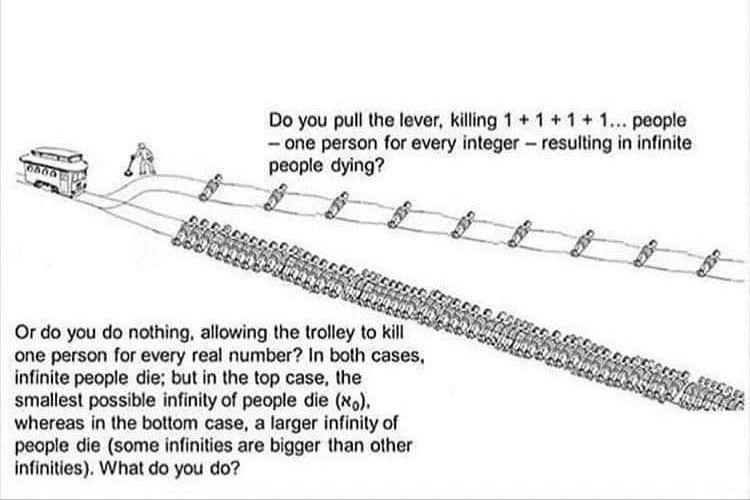
Let’s break down the joke in simpler terms. First, the Trolley Problem: imagine a runaway trolley on tracks, about to hit a bunch of people. You’re standing next to a lever. If you do nothing, the trolley stays on its path and will kill a certain group of people on the main track. If you pull the lever, the trolley switches to a side track, where it will kill a different group of people. In the usual story, it’s something like “5 people on one track vs 1 person on the other track.” It’s a famous ethical dilemma – do you actively sacrifice one life to potentially save five? That’s the baseline scenario. Now, this meme gives the trolley problem a nerdy twist: both groups are infinitely large! No matter what, an infinite number of people will die, but one infinity is smaller than the other. That sounds crazy – how can one “infinite” be smaller than another?

This is where DiscreteMathematics and a bit of set theory come in. In mathematics, there’s a concept of countable vs. uncountable infinity. Countable infinity (like $\aleph_0$, pronounced “aleph-naught” or “aleph-null”) refers to a set that is infinite but countable in principle – meaning you could list or count the elements one-by-one, even though you’d never finish. Classic example: the set of all whole numbers (0, 1, 2, 3, ...). There are endless whole numbers, but you can enumerate them: 1st, 2nd, 3rd, etc. We say this set has a size (or cardinality) of $\aleph_0$, the smallest form of infinity. On the other hand, uncountable infinity refers to a set so huge you cannot list its elements sequentially; there’s no way to count them one by one because between any two elements you find, there are infinitely more lurking in the gaps. The classic example here is the set of all real numbers (all the decimals, essentially). Even just between 0 and 1, there are infinitely many real numbers – and not just countably many, but uncountably many. If you try to label them 1st, 2nd, 3rd, you realize you can always find another number that’s not on your list (this is the essence of Cantor’s famous proof). So we say the real numbers form a larger type of infinity (often called the continuum).

Now, the meme’s scenario is basically:

  • If you pull the lever (switch tracks) – the trolley goes onto the upper track, where there’s one person for every integer. That implies a lineup of victims indexed 1, 2, 3, and so on forever. This group is countably infinite (ℵ₀ people).
  • If you do nothing – the trolley stays on the lower track, with one person for every real number. That sounds bizarre, but imagine the people are packed in every conceivable point along the track, no matter how small the intervals – this group is uncountably infinite (a larger infinity).

To visualize it clearly, let’s compare these two tracks:

Track Choice Victims Arrangement Type of Infinity Symbol
Pull the lever (switch) 1 person at each distinct position you can count (like spaced out one after another: person #1, #2, #3, ...) Countably infinite people ℵ₀ (aleph-null)
Do nothing (don’t switch) 1 person at every possible point on the track (infinitely dense crowd, covering every tiny segment) Uncountably infinite people (continuum – larger $\infty$)

In simpler terms: the top track has an endless line of people you could, at least in theory, count one by one (1, 2, 3… never ending). The bottom track has so many people that counting them one by one isn’t even possible – there’s always another person squeezed in between any two you count! Both lines of victims are infinite in length, but the bottom one is a thicker infinity. It’s like comparing an infinite list of individual points versus an infinitely continuous stretch of people.

For a new developer or student, this relates to some basic CSFundamentals. We often deal with discrete things in computing (like integers, memory addresses, or loops that iterate a set number of times). Those are countable ideas. Even an infinite loop in code (while(true)) is conceptually listing out countable steps (1st iteration, 2nd iteration, and so on). But if someone asks you to loop through all real numbers between 0 and 1, that’s not something you can code – you can generate random reals or approximate them, but you can’t enumerate them without skipping a bunch, because there’s no “next” real number in a sequence sense. The notion of countable vs uncountable is a fundamental idea you might encounter in computer science theory or math courses. It teaches that infinity isn’t all one thing – there are levels to infinity.

So what’s the joke? It’s that the person by the lever is basically confronted with an impossible “greater infinity vs lesser infinity” choice. Normally, trolley problems are about tough moral choices, like 5 lives vs 1 life. Here it’s ∞ lives vs ∞ lives – which is nonsensical at first glance. But then the meme reminds us (in that printed text) that “some infinities are bigger than other infinities.” So the geeky solution is: pull the lever and choose the smaller infinity of deaths (ℵ₀) to save the larger infinity (continuum) from dying. It’s an ethical optimization problem phrased in a very tongue-in-cheek way. We’re treating human lives like numbers to minimize, which is both logically intriguing and morbid. This is very much GeekHumor because it assumes you know about infinite sets and their sizes. And it’s DarkHumor because we’re joking about a scenario where unlimited people die either way – pretty grim content to laugh about! The relatable aspect (for those in on the joke) comes from recalling our lessons in math/CS where we learned about $\aleph_0$ and the continuum and were amazed (or confused) that infinity comes in different flavors. The meme basically says: “Alright, smarty-pants, apply that knowledge to a ridiculous moral dilemma. What now?”

In summary, the meme sets up an extreme infinite_edge_cases version of a classic problem just to highlight a quirky math fact. If you’re not familiar with countable vs uncountable infinity, the meme will just seem extremely weird or pointless (“Infinite people die either way? So what?”). But if you do know that ℵ₀ < (size of reals), you get the punchline: one track is objectively “less infinite” than the other. The correct geeky answer to “What do you do?” would be “Pull the lever, kill ℵ₀ people, since ℵ₀ < continuum – it’s the lesser of two evils, mathematically speaking!” It’s a very niche joke that combines a philosophical problem with a DiscreteMathematics concept. The result is both educational (hey, you just recalled some set theory) and absurd, which is why it’s funny in a very nerdy way.

Level 3: The Lesser of Two Infinities

For an experienced developer or CS student, this meme prompts a knowing chuckle (and maybe a groan) because it’s the classic trolley dilemma taken to an absurd extreme. The Trolley Problem is a well-known philosophical thought experiment: a runaway trolley is barreling down tracks towards a group of people. You stand at a lever that can redirect the trolley to a different track, where a single person (or some smaller group) is tied down. Do you do nothing and allow the trolley to kill the larger number of people, or do you pull the lever, actively causing it to kill fewer people? It’s an ethical puzzle about choosing the lesser of two evils. Typically, it’s 5 versus 1 lives – a finite choice. But in this geeked-out version, it’s ∞ versus ∞ lives! This meme is PhilosophicalHumor meeting GeekHumor on a dark mathematical stage. The scenario asks: “Do you sacrifice a countably infinite number of people to save an uncountably infinite number? Or do you stand by and let the larger infinity perish?” It’s tongue-in-cheek because either way infinite people die. By any normal ethical standard, both outcomes are unimaginably horrific – truly off the charts. But the meme nudges a particularly nerdy mindset: if you had to choose, you might as well choose the option where “only” ℵ₀ people die, because ℵ₀ is the smaller infinity. It’s an outrageous twist on “minimizing casualties.” Dark humor indeed – we’re making a relatable joke only in the sense that those who’ve taken discrete math or CS theory get the reference to infinities. It’s the kind of niche joke that makes math folks grin while everyone else furrows their brow.

Why is this funny to a seasoned dev or theorist? Because it resonates with how we think about problems. We’re trained to consider edge cases and extreme scenarios (“What if input size goes to infinity?”). We obsess over Big-O notation and scalability: we know that not all infinities are equal – for instance, an algorithm that does $2^n$ steps will outscale one that does $n$ steps as $n \to \infty$. Here that analytical mindset is applied in the most literal (and morbid) way: treating human lives as a variable to optimize. It’s an infinite edge case for an ethical algorithm. The text even spells it out: “In both cases, infinite people die; but in the top case, the smallest possible infinity of people die ($\aleph_0$), whereas in the bottom case, a larger infinity of people die.” This is essentially the narrator saying, “Mathematically, $\aleph_0 < |\text{continuum}|, so let’s minimize the loss.” It’s ethical_optimization gone berserk – a utilitarian calculus where the utilities are infinite cardinals. Only a bunch of math/CS geeks would frame a moral choice in terms of transfinite arithmetic and then laugh about it!

The shared experience being satirized is that moment in a theoretical computer science class (or a late-night deep philosophical chat) when you first learn that some infinities are bigger than others. It’s a brain-bending revelation. If you’ve been through that, the meme is immediately RelatableHumor: you recall the example of how there are infinitely many natural numbers and infinitely many real numbers, but one infinity (reals) somehow eclipses the other. Perhaps you even remember Georg Cantor and his diagonal proof – a proud part of CS fundamentals and math history. Now, seeing that abstract concept applied to a silly trolley_problem scenario is hilariously nerdy. It’s like an inside joke among those who survived Set Theory 101. We all know the “ah-ha” of discovering $\aleph_0$ vs continuum, and the meme winks, “hey, what if we actually had to choose between them, like a coding problem from hell?”

The visual reinforces the joke brilliantly. On the top track, the stick-figure victims are drawn as spaced-out individuals, implying you could number them 1, 2, 3, and so on – a depiction of a countable set (discrete points). On the bottom track, the figures are drawn continuously packed, shoulder to shoulder with no gaps, representing a continuum of people (uncountable – there’s literally someone at every point along the track). Any developer who has dealt with DiscreteMathematics versus continuous data can appreciate this distinction: it’s like the difference between iterating through an array of items one-by-one versus trying to iterate through a continuous range (which you just can’t in code). In fact, a cheeky way to think of it in programming terms is:

# Countably infinite loop (top track scenario)
i = 1
while True:
    run_over_person(i)   # one person with a distinct integer ID
    i += 1
# This loop conceptually hits person 1, then 2, then 3, ... forever (ℵ0 victims)

# Uncountable "loop" (bottom track scenario)
# Pseudo-attempt: no real iteration possible for uncountables
x = 0.0
while x is not None:
    run_over_person(x)   # x is a real number location of a person
    x = get_next_real(x) # there's no well-defined 'next' real number
# Even between 0.0 and the next candidate, infinite people would be missed!

A senior engineer or CS theorist will smirk at that snippet: the top loop is an infinite while that at least conceptually enumerates victims (one per integer). The bottom one illustrates the impossibility of stepping through an uncountable set – there is no function get_next_real(x) that covers all real numbers without skipping an unending number of them in between. In other words, an uncountable crowd can’t even be indexed or iterated over like a list – it’s beyond any coding construct. This is the kind of extreme thought experiment that tickles the brains of those who enjoy theory: it’s taking an abstract concept (countable vs. uncountable infinity) and injecting it into a grim real-world analogy to produce a twisted laugh.

Importantly, the meme also pokes fun at how a geeky mindset can detach from reality. A normal person sees infinite casualties vs infinite casualties and says “Both options are equally horrible!” But the theoretical utilitarian geek in us goes, “Ah, but one infinity is actually a smaller tragedy than the other. We can still optimize this!” It’s a satire of that hyper-logical approach we sometimes default to in tech. We often reduce problems to numbers and edge cases; here we’ve reduced moral tragedy to a cardinality comparison. The question “What do you do?” at the end of the text is the cherry on top – it challenges the reader in a mock-serious way: are you the kind of person who would actually pull the lever to minimize an infinite body count? It’s absurd, it’s impossible in reality, and that absurdity is exactly what makes it funny. It’s inviting us to laugh at our own tendency to apply cold analytical reasoning (like big-O style thinking) to literally anything, no matter how inappropriate. We recognize the pattern (“find the lesser harm”) but the context has been dialed up to infinity, which subverts expectations and tickles the dark funny bone.

In summary, this meme hits the geek humor jackpot by combining a familiar moral thought experiment with a lesson from set theory. It satirizes the way coders and mathematicians handle infinite_edge_cases and optimization. The phrase “some infinities are bigger than other infinities” is both a mathematical fact and the punchline here. It’s a nod to those in the know, the folks who think about infinite loops, unbounded sets, and the nuances of CSFundamentals. We laugh (perhaps nervously) because the meme shines a light on our analytical compulsion – even when dealing with an infinitely grim scenario, the reflex is to compute the lesser of two infinities. That blend of philosophical gravity and nerdy precision is what makes this both hysterical and horrific. It’s the lesser of two infinities – a joke only a set theory aficionado could love.

Level 4: Cantor’s Trolley Conundrum

At the highest level, this meme mashes up set theory with the classic Trolley Problem to create a darkly comical scenario. It exploits the advanced concept of infinite cardinalities – a topic from Discrete Mathematics and theoretical computer science – to pose an “ethical algorithm.” In formal terms, pulling the lever results in a death count of size $\aleph_0$ (aleph-null), while doing nothing leads to a death count of size $|\mathbb{R}|$ (the cardinality of the continuum). These are two different orders of infinity: countable vs uncountable. The notation $\aleph_0$ denotes the size of the set of all integers (the smallest infinity), and $|\mathbb{R}|$ is the size of the set of real numbers, a strictly larger infinity. Cantor’s famous theorem proved $\displaystyle \aleph_0 < 2^{\aleph_0}$, meaning:

$$ |\mathbb{N}| = \aleph_0 < 2^{\aleph_0} = |\mathbb{R}| ,, $$

so indeed some infinities are bigger than other infinities. Here $|\mathbb{N}|$ is the number of natural numbers (the countable infinity), and $|\mathbb{R}|$ is the number of real numbers (the uncountable infinity, often called the continuum).

What does this mean in the meme’s twisted railroad terms? Pulling the lever corresponds to lining up victims in a one-by-one sequence, effectively one person for every integer 1, 2, 3, … ad infinitum. That’s an $\aleph_0$ body count – an infinite sequence of people spaced out along the upper track. Not pulling the lever means the trolley stays on the lower track, plowing through an unbroken continuum of people so densely packed that there’s one victim for every real number (they occupy every point on the track with no gaps). That crowd’s size is uncountable, a larger infinity. The meme text explicitly labels the top track as “1 + 1 + 1 + … people” (a countable sum) and the bottom track as “one person for every real number,” highlighting the difference between summing discrete individuals versus covering a continuous range.

From a theoretical CS perspective, this countable vs. uncountable distinction is profound. A countably infinite set can, in principle, be enumerated by an algorithm (though it would never terminate, you can imagine a loop listing 1, 2, 3, …). An uncountable set cannot even be listed out sequentially; there’s no algorithm that can iterate over every real number one by one because between any two listed reals, uncountably many others remain. This ties into the fundamentals of computability: there are countably many possible computer programs (since any program is a finite sequence of characters), but uncountably many different mathematical problems or input values in the continuous domain. This disparity is why some problems are unsolvable by algorithms – there are more possible problems (uncountably many) than there are programs to solve them! It’s the same principle Cantor used in his diagonalization argument to show $|\mathbb{R}|$ is bigger than $|\mathbb{N}|$, and Turing later leveraged to prove the existence of uncomputable problems (like the famous Halting Problem). In short, the meme’s math isn’t just abstract: it’s connected to deep CS fundamentals about what we can compute or enumerate.

The humor here is that we’re treating “number of people killed” as an abstract cardinal number, as if optimizing a data structure or algorithm. The hapless person by the lever is essentially performing an ethical optimization: they have to choose between two infinite sets of casualties and aim for the one with the smaller cardinality (the lesser infinity ℵ₀). It’s a morbid twist on optimization theory – usually in big-O terms we say one growth rate eventually outpaces another as inputs approach infinity; here we’re comparing the literal size of two infinite outcomes. A seasoned mathematician or theoretician appreciates the nuance: $\aleph_0$ vs continuum is like a hierarchy of infinite magnitude, not unlike comparing $O(n)$ to $O(2^n)$ in algorithmic complexity (except here we’re comparing the sizes of sets of victims, not runtime). The Trolley Problem has been upgraded into a set-theoretic thought experiment. This Cantor’s Trolley Conundrum tickles us because it’s academically precise and absurd at the same time – the lever operator is minimizing the “cost function” (casualties) in a scenario where both outcomes are infinitely catastrophic. It’s a mashup of formal math and dark humor that only us geeky folks would concoct. And yes, it’s a bit disturbing if you step back – we’ve taken a moral dilemma and turned it into a calculation involving transfinite arithmetic. But for those of us who remember proving $\aleph_0 < 2^{\aleph_0}$ on a homework assignment, the set theory inside this joke is as thrilling as it is grimly funny.

Description

This image could not be processed due to an error
Comments

7
Anonymous ★ Top Pick I'd make a joke about this image, but I can't see it. Maybe it's a 404 error?
  1. Anonymous ★ Top Pick

    I'd make a joke about this image, but I can't see it. Maybe it's a 404 error?

  2. Anonymous

    Pull the lever - countably infinite casualties still fit in a sharded Jira backlog; uncountable ones blow past the cardinality limits on our observability stack, and legal hates undefined behavior

  3. Anonymous

    This is basically every distributed systems design review: "Should we shard by user ID and kill performance for ℵ₀ sequential queries, or partition by timestamp and murder ℵ₁ concurrent connections?"

  4. Anonymous

    When your code review becomes a philosophical debate about whether O(n) deaths are morally superior to O(2^n) deaths, you know you've been in academia too long. At least with aleph-null casualties, you can still iterate through them in finite time - though your CI/CD pipeline might have opinions about the heat death of the universe as a deployment deadline

  5. Anonymous

    Pull the lever: I'll take O(ℵ0) failure modes over O(2^ℵ0) - at least you can enumerate the postmortems; the continuum path makes edge cases dense in every sprint

  6. Anonymous

    Prod trolley problem: pull the lever and turn an uncountable outage into a countable set of 429s; choose aleph-null pain and call it “graceful degradation.”

  7. Anonymous

    Pull the lever - |ℕ| < |ℝ|, so fewer deaths: basic cardinality optimization beats uncountable tech debt

Use J and K for navigation