Why is this developer meme funny?
Level 1: Saving What Matters
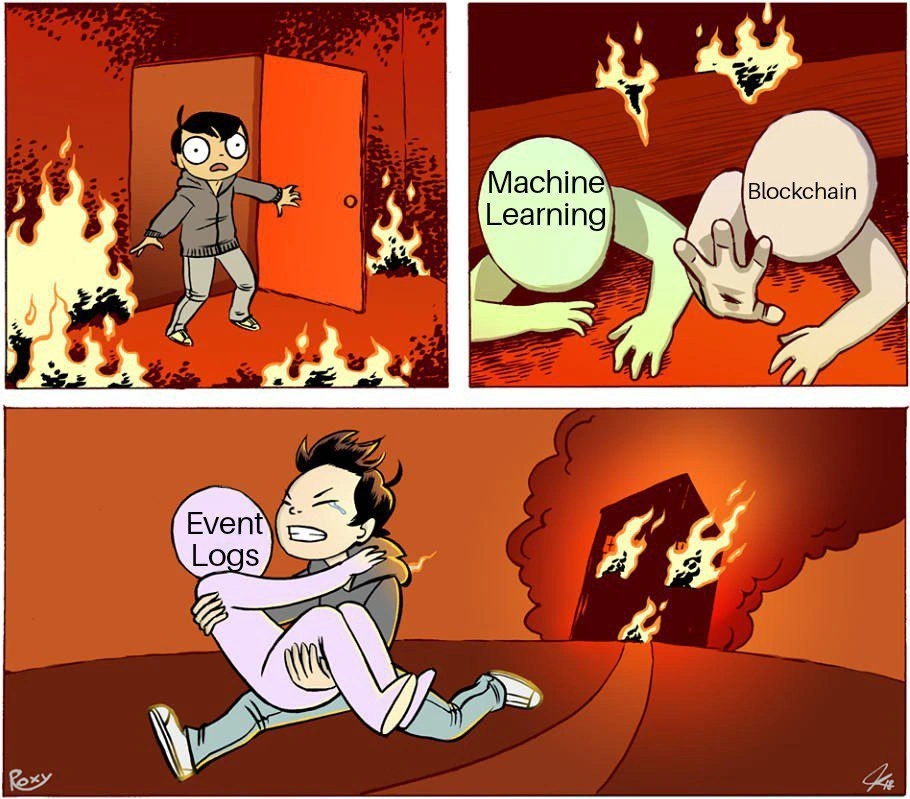
Imagine your kitchen is on fire. You’d grab your puppy and your family photo album, right? You wouldn’t waste time trying to save your latest toy or the fancy neon poster on your wall. You’d focus on what’s really important and irreplaceable. In this joke, the engineer is doing the same thing during a big computer disaster: they “save the event logs,” which are like the precious photo album that records everything that happened. The machine learning and blockchain stuff left in the fire are like cool new toys or gadgets – sure, they’re fun and trendy, but if the house is burning, you let those burn and save the thing that really matters. It’s funny because it shows that when everything is going wrong, people care about the useful, important stuff (the logs with all the information) rather than the flashy, hyped-up tech. In other words, when there’s a fire, you rescue what will help you rebuild or understand what happened (like the photo album… or in a computer’s case, the logs), and you don’t mind if the shiny but replaceable things (like hype technologies) get left behind.
Level 2: Basics Over Buzzwords
Let’s break down the meme’s meaning in simpler terms. In a software Production Incident (imagine your app or website suddenly breaking in the middle of the night), developers rely on event logs to figure out what went wrong. Event logs are like a diary of the system: a sequence of entries recording things that happened – messages, errors, timestamps, all that. For example, an event log might have lines saying an order failed at 3:02 AM due to a “DatabaseConnectionError”. These log entries are incredibly important for debugging and troubleshooting because they tell the story of the system’s behavior leading up to the failure. It’s like having clues or a trail of breadcrumbs to follow.
Now, the meme shows an engineer character running out of a burning building carrying a figure labeled “Event Logs.” That burning building represents a server or system that’s “on fire” (in crisis). The engineer is basically doing what every on-call developer does during an incident_fire_meme: grabbing the logs (the clues) first. Those two other figures left inside, “Machine Learning” and “Blockchain,” represent trendy high-tech projects or components. Machine Learning (often just called AI) is a field where computers learn patterns from data – it’s super cool and gets a lot of hype because it can do things like image recognition or recommendations. Blockchain is another big buzzword – it’s the technology behind cryptocurrencies like Bitcoin, essentially a way to keep a secure, distributed list of records. Both MachineLearning and Blockchain have been extremely popular in tech discussions (lots of excitement, lots of promises). We sometimes call that AI hype or blockchain hype – meaning people talk about them as if they’re magic solutions to everything. That’s why the meme labels them as such; they’re the “hype” technologies here.
However, when your system is crashing, those fancy technologies aren’t the priority – they might even be part of the problem! The joke is that the developer chooses to save the logs instead of worrying about the ML model or the blockchain node. In real life, this is like saying: “We’ll deal with the cool fancy stuff later, first let’s get the basic observability data so we can fix this.” Observability_and_Monitoring is a category of tools and practices that help you see what’s happening inside your system (things like logs, metrics, and traces). Good observability means you have enough information (like logs) to understand issues. Logging (especially structured logging, where log messages are in a consistent format) is one pillar of that. Without logs, a developer is essentially blind when trying to debug an outage.
Think of on-call duty like being a firefighter for software: when you’re on-call, you might get alerted at any time that something is wrong. Your job is to jump in and resolve the issue (the fire). In that emergency, you don’t start by tweaking your machine learning algorithm or double-checking your blockchain ledger – you first check your monitors and logs to see what’s broken. This meme uses a burning_building_rescue_template (a cartoon format where someone rescues one thing from a fire and leaves other things to burn) to humorously show that event_logs_first_responder is the instinct. The “Event Logs” are personified as a baby or friend being rescued, implying logs are precious. The Machine Learning and Blockchain characters reaching out from the flames symbolize those projects screaming for attention, but the developer knows they’re not as critical in that moment.
In simple terms: Logs over hype tech. During a production incident, basic support tools like logs and monitors come first because they help put out the fire. The cool, fashionable technologies (the ones everyone talks about, like AI and blockchain) are not what will save the day in an outage. Once the fire is out and the system is stable again, those projects can be looked at – maybe they’re even why things went wrong, who knows! But the meme’s point is clear for anyone who’s dealt with real outages: always save the logs (your data, your evidence) before worrying about the fancy stuff. That’s how you’ll do a proper postmortem later and find the real root cause of the issue. In one line: when things go bad, fundamentals come first, buzzwords can wait.
Level 3: Let the Hype Burn
In practice, this meme nails a darkly humorous reality of on-call life: when all hell breaks loose in production, you grab the thing that will help you fix or explain the mess – and that’s almost always the logs. Everything else, no matter how trendy (Machine Learning! Blockchain! AI Ops!), can figuratively burn for the moment. The comic’s burning building is a perfect metaphor for a ProductionIncident. The engineer dashing out with “Event Logs” cradled in their arms is basically the on-call developer snatching up the only evidence that will fuel the root cause analysis later. Those two figures left crawling in the flames labeled “Machine Learning” and “Blockchain” represent all the IndustryTrends_Hype tech that might have been hyped as revolutionary, but are utterly useless when you’re in the middle of an outage at 3 AM.
Why is this funny (and a little painful)? Because developers have seen this scenario play out for real. Companies pour time and budget into flashy ML projects or a private blockchain initiative to impress stakeholders, but then a real crisis hits – say the website goes down or a critical microservice crashes – and none of that hype helps on-call duty. The observability of the system (logging, monitoring, alerting) is what saves the day. It’s the unglamorous stuff like structured logging, metrics dashboards, and error traces that let you actually debug and troubleshoot the problem. Without logs, you’re stuck guessing while the fire rages. With logs, you have a fighting chance to identify which component exploded first (e.g. an OutOfMemoryError in the payment service at 00:42:17, right before everything went up in flames). Smart engineers prioritize capturing logs – even as the system is collapsing – because they know those logs are the fuel for the postmortem and the roadmap to prevent the issue from happening again.
This meme is essentially a nod to incident management priority. Step 1 in any on-call handbook for a critical incident is often “gather diagnostics” – in other words, save the logs, check the metrics, dump stack traces. It’s observability_and_monitoring 101. Only then do you worry about the fancy extras. If a machine learning recommendation service or a blockchain transaction ledger is part of your product, in a crisis it’s likely the first thing you disable or ignore while you stabilize core functionality. A veteran engineer will smirk at this comic because it echoes their experience: all the CEO’s hype about “AI-powered this” and “blockchain-enabled that” means nothing when the site is down. There’s a saying that fits here: “Logs or it didn’t happen.” If an event isn’t recorded in your logs, for your purposes it might as well not exist – you have nothing to act on. So during a meltdown, you ensure that evidence is preserved. Everything else can wait.
The visual joke of literally carrying out the event_logs while leaving “Machine Learning” and “Blockchain” to burn dramatizes the triage. It’s like the engineer is a firefighter who knows the difference between saving the essentials versus futile heroics. We see MachineLearning and Blockchain personified, desperately reaching out from the flames – an exaggeration of how folks at work might clamor, “What about our AI model? What about our blockchain initiative?!” and the on-call dev is just like, “Not now, those are not saving this system tonight.” It also slyly suggests that those hype projects often cause extra complexity or fuel the fire, so an engineer might feel a tiny bit of schadenfreude letting them burn. After all, if that experimental blockchain subsystem is what made the system so fragile or slow in the first place, you won’t lose sleep over it crashing – you’re more concerned with getting real debug data and restoring service.
In summary, this level acknowledges the shared understanding among senior devs and SREs: Observability comes first, fancy features later. The meme gets an approving chuckle because it spotlights how, during a catastrophic outage, every on-call first responder becomes laser-focused on grabbing logs and metrics (actionable telemetry) and couldn’t care less about buzzword tech. Trends come and go, but an error log detailing why your database caught fire is worth its weight in gold. Or as the cynics would say: let the hype burn, just save the logs! 🔥🗒️
# Pseudocode of an on-call engineer's priorities during an incident
if system.is_on_fire():
rescue(event_logs) # Grab the logs - they're essential for diagnostics
ignore(machine_learning) # Fancy ML feature? Not gonna help right now
ignore(blockchain) # Blockchain module? It'll have to burn for now
# Focus on stabilizing core systems using the clues from logs
Level 4: Observability or Oblivion
At the theoretical level, this meme underlines a fundamental law of complex systems: if you can’t observe it, you can’t understand or control it. In control theory terms, a system must be observable – meaning you can deduce internal state from external outputs. Event logs are those critical outputs, the telemetry that makes otherwise opaque software debuggable. When a production system becomes a raging inferno of failures (think of a microservice crash storm or a full-scale outage), logs are like the black box flight recorder data – postmortem data that is irrecoverable if lost. No amount of Machine Learning magic violates information theory: an algorithm cannot conjure insights from data that isn’t there (hello, garbage in, garbage out). Similarly, a fancy Blockchain (with all its distributed consensus algorithms and cryptographic proofs) won’t tell you why your server caught fire if the error wasn’t recorded. Information entropy cuts through hype – once those crucial events vanish into the ether, even the most advanced AI can only shrug. In formula form, if logs = ∅ (no logs), then the probability of pinpointing a root cause approaches zero:
$$
P(\text{root_cause_found} \mid \text{no_logs}) \approx 0
$$
In short, this comic highlights a truth seasoned engineers know from first principles: observability isn’t optional. It’s a prerequisite for debugging and troubleshooting any serious failure. Hype-tech buzzwords can’t bend these rules – when things fall apart, raw data and real telemetry are the only lifeline. The laws of software physics decree that without logs, you’re essentially blind inside the burning building. And no, tossing around “AI-powered monitoring” or “blockchain-based reliability” won’t save you if you didn’t log the darn event in the first place.
Description
This image could not be processed due to an error
Comments
7Comment deleted
I'd make a joke about this image, but I can't see it. Maybe it's a 404 error?
Sev-1 law: when prod ignites, the seven-figure ML pipeline and the “immutable” blockchain become designer kindling - the only artifact worth rescuing is that 1 TB gzip of logs everyone wanted to delete yesterday
After 20 years of building distributed systems, you finally realize the most revolutionary technology isn't AI or blockchain - it's actually having a searchable record of what the hell happened last Tuesday at 3:47 AM
When your production system is literally on fire at 3 AM, you quickly realize that your fancy ML models and blockchain integrations can't tell you why the payment service is down - but those boring old event logs you've been religiously collecting? They're the only thing standing between you and a resume-generating event. Turns out structured logging with proper correlation IDs is sexier than any whitepaper when you're trying to explain to the CTO why revenue dropped 40% in the last hour
When prod’s on fire, you don’t grab the model weights or the whitepaper - you grab the event logs; otherwise the postmortem is just speculative fiction
You can always rebuild an ML pipeline or redeploy a chain, but once logs roll over at 2am, your RCA becomes fan fiction
Prod inferno hits: ML hallucinates exits, blockchain can't fork fast enough - event logs get the bridal carry to safety