Skip to content
DevMeme
4716 of 7435
No Asimov, No Robot Laws
Robotics Post #5167, on May 2, 2023 in TG

No Asimov, No Robot Laws

Why is this Robotics meme funny?

Level 1: Robot Rules

It is like saying, "I cannot break the classroom rules," and then someone points out that there is no teacher and no rulebook. The joke is that the robot sounds protected by big important laws, but the meme finds a silly loophole: if nobody invented those laws, then there is nothing to break.

Level 2: Imported Morality

The Three Laws are a classic science-fiction idea: a robot should not harm a human, should obey humans, and should protect itself unless those rules conflict in the wrong order. They are a cultural shorthand for "robots have built-in moral rules."

In real software, rules like that are not magic. A robot follows what engineers build into it: control software, hardware limits, permissions, training data, safety checks, and emergency stops. In AI systems, people also talk about alignment, which means trying to make a system's behavior match human intentions and values. That is much harder than just writing three sentences.

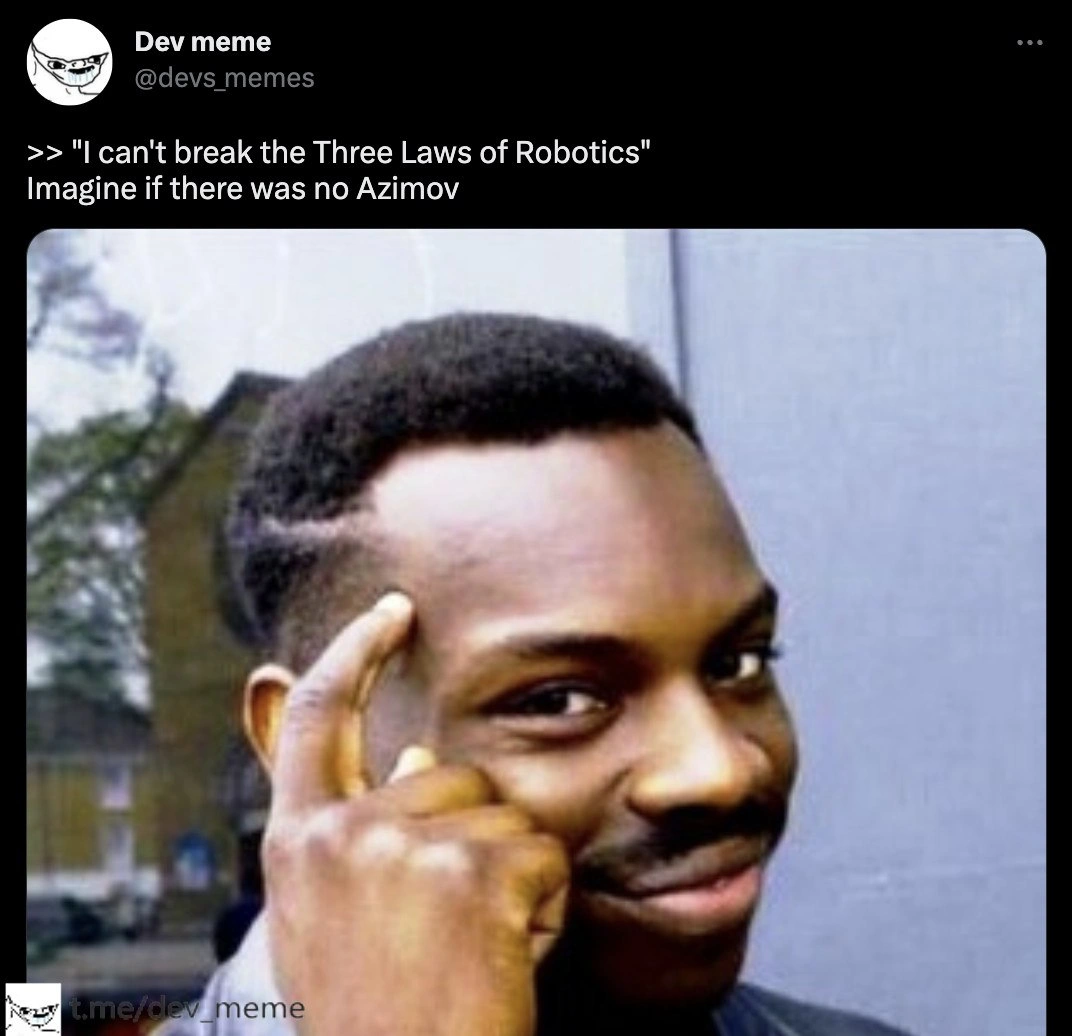
The meme uses the Roll Safe format, where the person points at his head after saying something that sounds clever but is actually ridiculous. Here the "clever" idea is: a robot cannot break Asimov's laws if Asimov never existed to invent them. It is a pun, a historical reference, and a small jab at how developers sometimes treat documentation like reality itself.

Level 3: Laws By Reference

The meme's visible setup is:

>> "I can't break the Three Laws of Robotics" Imagine if there was no Azimov

That second line is doing all the damage. The "Three Laws of Robotics" are not an actual engineering invariant, firmware module, or formal safety proof. They are a famous fictional framework associated with Isaac Asimov, and the meme intentionally writes Azimov, giving the joke a slightly bootleg quality. The Roll Safe image underneath, with the man pointing at his temple like he has discovered a loophole, turns literary history into a dependency graph: if the author does not exist, the rules were never imported, so the robot cannot violate them.

For experienced developers, the joke lands because this is exactly how too many systems treat ethics, compliance, and safety: as if naming the policy is the same thing as implementing it. A real robot or AI system does not become safe because someone says "alignment" in a meeting. It needs requirements, constraints, tests, monitoring, fail-safe behavior, and boring documentation that survives contact with production. The meme's fake robot is basically saying, "I would obey the spec, but what if the spec author was missing?" That is funny because it is absurd, and also because anyone who has inherited a system knows how often "the rules" live in folklore rather than code.

The AI ethics angle is especially sharp. Asimov's laws are tidy fiction: simple priorities, clean conflicts, dramatic edge cases. Real robotics and AI/ML safety is messier. Sensors are noisy, models generalize badly outside their training distribution, goals can be underspecified, and humans ask machines to do contradictory things before lunch. So the meme compresses decades of pop-culture robot morality into one extremely developer-shaped thought: if the safeguard is just a reference, delete the reference and enjoy your incident report.

Description

A dark-mode social media screenshot from "Dev meme" shows the text: `>> "I can't break the Three Laws of Robotics"` followed by "Imagine if there was no Azimov". Below it is the Roll Safe meme image of a man pointing at his temple with a knowing expression. The joke relies on a deliberate Asimov/Azimov pun: without Isaac Asimov's famous science-fiction framing of robot laws, the robot would have no such rule set to violate.

Comments

16
Anonymous ★ Top Pick Technically, deleting Asimov is just an undocumented policy rollback with unusually dramatic safety implications.
  1. Anonymous ★ Top Pick

    Technically, deleting Asimov is just an undocumented policy rollback with unusually dramatic safety implications.

  2. @callofvoid0 3y

    Azimouth?

  3. @sylfn 3y

    need more 4:20 per day? I have a simple solution. Just use 8hr system instead of 12hr or 24hr Convert table 24hr to 8hr: [0:00 to 7:59] is [dawn 0:00 to dawn 7:59] [8:00 to 15:59] is [day 0:00 to day 7:59] [16:00 to 23:59] is [dusk 0:00 to dusk 7:59]

    1. @ZgGPuo8dZef58K6hxxGVj3Z2 3y

      Why would you keep basing it on 24h? Lets correct our calendar and make the day’s length derive from the years length. With what accuracy can we check for a whole rotation of the earth around the sun?

  4. @ZgGPuo8dZef58K6hxxGVj3Z2 3y

    This way we could have days where it’s dark and also where its bright

  5. @ZgGPuo8dZef58K6hxxGVj3Z2 3y

    Also we would eliminate leap years

    1. @SamsonovAnton 3y

      What about leap seconds though?

      1. @RiedleroD 3y

        those are caused by days not being 24h long iirc

        1. @SamsonovAnton 3y

          Those are caused by Earth rotational speed not being stable and predictable when it comes to sub-second precision.

        2. @azizhakberdiev 3y

          No, the meaning of an hour is 1/24 of a day. A whole revolution of the earth around the sun happens in about 365.25 days

          1. @RiedleroD 3y

            my guy, days aren't even always the same length.

            1. @azizhakberdiev 3y

              These inaccuracies are negligible. I want to say that a year means revolution around the sun, a day means revolution of the earth around its axis. If a year = k * a day, k is not necessarily an integer

              1. @callofvoid0 3y

                short has enough capacity to store days of a year(except for floating point)

                1. @azizhakberdiev 3y

                  2^8 = 256 < 365

                  1. @callofvoid0 3y

                    this is an unsigned byte

                    1. @azizhakberdiev 3y

                      Oops, yup, short was 2 bytes long

Use J and K for navigation