Software Development: The Art of Fighting Your Past Self
Why is this TechDebt meme funny?
Level 1: Cleaning Up Your Own Mess
Imagine you spent all day building a huge castle out of toy blocks in your room. You were in a rush and left the blocks scattered everywhere. The next morning, you walk into your room and step on a block – ouch! Now you have to clean up the entire mess. You’re frustrated and mutter, “Who left all these blocks on the floor?!” Then you realize it was you, just a day younger. In this story, building the messy block castle is like writing code quickly without tidying it up. Having to clean it up later (and maybe feeling mad at the “person” who made the mess) – that’s what it feels like for a programmer to fix or improve the code they wrote in the past. It’s funny in the same way stepping on your own toy can be kinda funny: you have only yourself to blame! The meme is joking that being a programmer is basically this situation over and over – you keep finding little “messes” you made earlier and you get to clean them up, almost like arguing with a younger you about why they didn’t do it better. But hey, at least you always learn to put your toys (or code) away more neatly next time... until you forget again!
Level 2: When Code Fights Back
In simpler terms, this meme compares software development to a sci-fi scenario where you’re literally battling your past self. Of course, there’s no real time machine or physical fight – it’s talking about the experience of working with legacy code, which means old code that’s already in use (often written by an earlier version of you). For a junior developer, the first encounter with legacy code might be returning to a project you wrote a year ago in college or your first month on the job. You open the source and think, “Why did I do it that way?” Suddenly, you’re in a showdown with younger-you through the code. The tweet suggests that if you ever daydreamed about testing your karate moves on your younger clone, programming gives you a metaphorical taste of that: you metaphorically “punch” past-you by finding flaws in the old code and fixing them. Meanwhile, past-you kind of “punches” back with every confusing workaround or bug you now have to deal with. This back-and-forth struggle is what we call refactoring and debugging.
Let’s break down some key terms and why they matter here:
Legacy Code – This is any old code that’s already written and running, often inherited from someone else or from your own earlier efforts. It tends to be harder to understand or modify because it wasn’t written with your current knowledge. Imagine opening a project you haven’t touched in ages – that’s legacy code. You sometimes find strange things in there that you have to figure out, almost like deciphering a treasure map drawn by a less experienced explorer (who happens to be past-you).
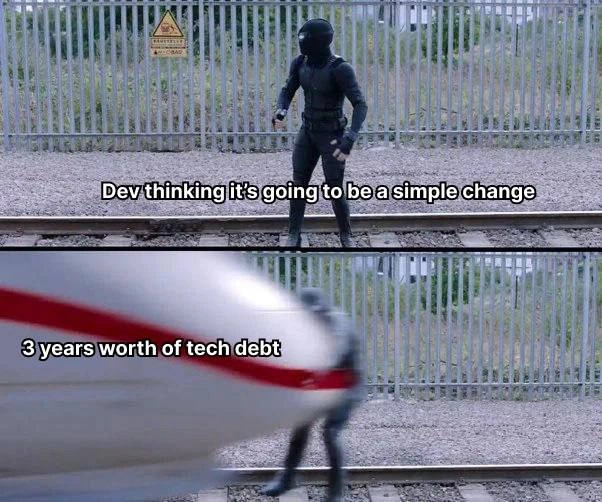
Technical Debt – This is a big concept in the meme’s subtext. It’s like when you do something the quick way instead of the right way: you “borrow time” by skipping best practices, but later you “pay for it” with extra work. Past-you might have said, “I don’t have time to write proper error handling or tests, I need this feature done now.” That saved time back then is the “debt”, and present-you is the unlucky soul stuck paying interest – which comes in the form of debugging weird issues or rewriting that code properly. The tweet is funny because every developer knows they’ve accumulated technical debt that their future self (or team) will curse about. It’s relatable humor: we’ve all left ourselves little traps due to deadlines or inexperience.
Refactoring – This is the process of cleaning up and improving existing code without changing what it does for the user. Think of it as renovating an old house: you keep the outside the same but reorganize the messy rooms and fix the creaky floors inside. In the context of fighting your past self, refactoring is basically you defending against past-you’s sloppy code by restructuring it into cleaner, more efficient code. For example, if past-you wrote one giant 300-line function that does everything, present-you might refactor it into smaller, well-named functions. That’s like taking a clumsy strategy from your younger self and turning it into a solid plan. It can be tedious work – which is why past-you avoided it – but it’s how you defeat the chaos they left behind.
Code Quality and Code Smells – Code quality refers to how readable, maintainable, and reliable the code is. High-quality code is easy for any developer (including future you) to understand and modify. A code smell is a common term for something in the code that looks off or is a known bad practice – like a super long function or ambiguous variable names (
x,data2,stuff– you get the idea). In the “fight” analogy, code smells are like the dirty tricks past-you left in the arena. Maybe you encounter a mysterious global variable that changes unpredictably – that’s a smelly problem you now have to clean up. The meme is funny because we normally only expect to battle other people’s bad code, but here you are, essentially wrestling with your own earlier mistakes. It’s equal parts embarrassing and comical.
The tweet format itself (a one-liner joke) works well here because it delivers a relatable truth quickly. Tons of developers saw that tweet and thought, “Ha, that’s exactly my life!” whether they’re maintaining a massive legacy system at a big company or just revisiting last semester’s project. Early in your career, you might not realize how fast code becomes “old” and awkward. But after a few projects, you inevitably run into something you wrote when you were newer or in a rush, and you cringe. You might literally feel like you’re arguing with a past version of yourself: “Why did you do this?!” The good news is, discovering flaws in your old code is a sign you’ve grown as a programmer. The bad news? You’ll be doing this forever – every bit of code you write today might be something you look back on later and facepalm. And that endless cycle of improvement (and regret) is exactly what the meme jokingly calls out. Software development isn’t just about happily writing new code; a huge part is maintaining and refactoring existing code. In other words, it’s a career that often feels like sparring in a time loop with your past self’s choices.
Level 3: The Git Blame Paradox
Ever looked at a piece of legacy code and muttered, “Who wrote this garbage?” only to run git blame and discover the culprit is you from five years ago? That’s the paradox this meme nails perfectly. It jokes that being a software developer is like building a time machine specifically to brawl with your younger self. In practice, “fighting a younger version of yourself” means debugging, refactoring, or completely unraveling code that past-you thought was a great idea at 2 AM. The tweet’s dark humor hits seasoned devs right in the gut: we’ve all been there, slogging through a chaotic codebase and cursing the innocent (yet horribly misguided) past version of us who wrote it.
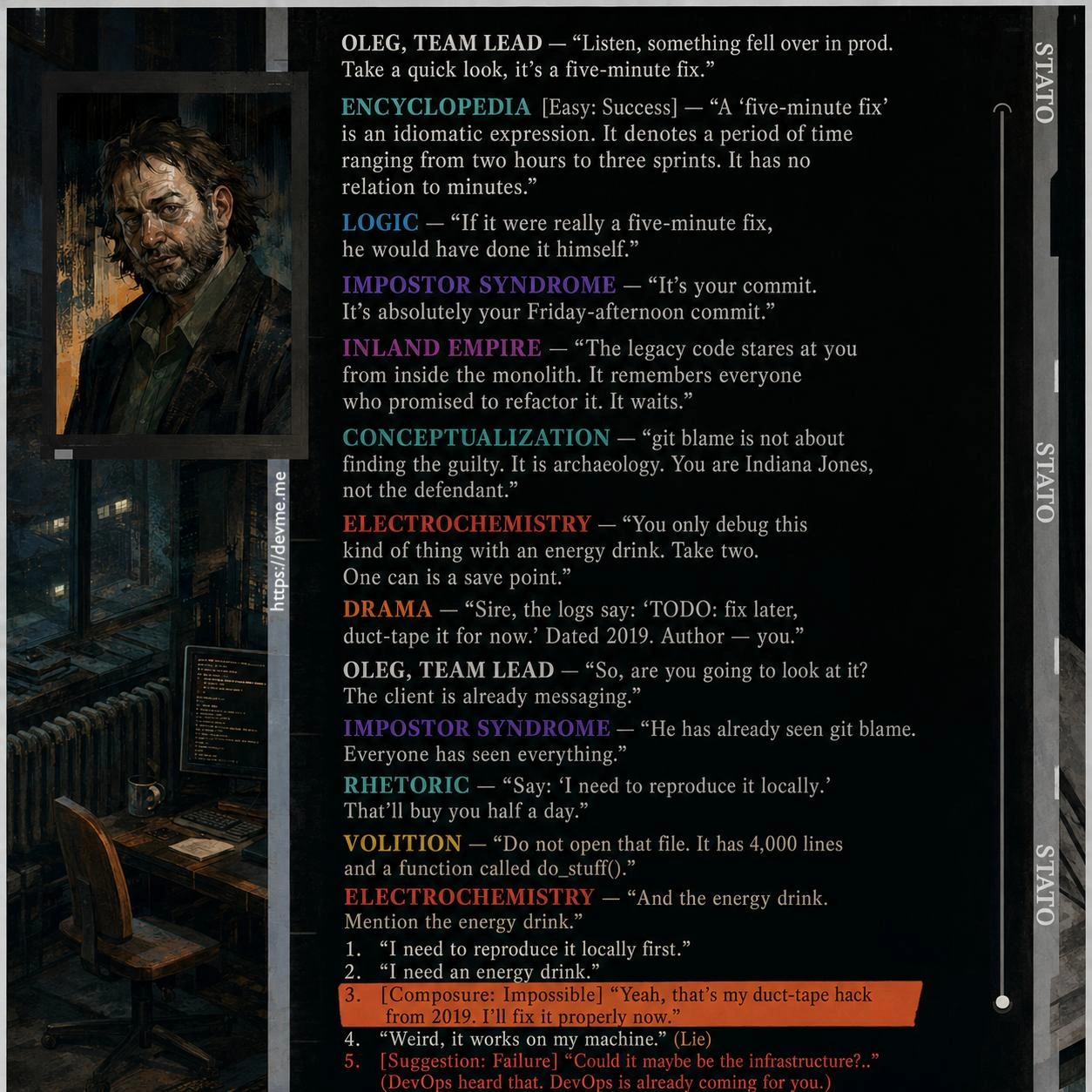
Why is this so funny and painful? Because it’s universally true in software development: as you gain experience, your old code begins to look like a collection of code smells and questionable decisions. The meme’s “travel back in time” gag pokes fun at the eternal legacy-code showdown every developer faces. We might not have actual time-traveling DeLoreans, but we do have version control history – a disturbingly effective way to confront our past mistakes. Technical debt (those quick-and-dirty shortcuts you took to meet a deadline) ages like unrefrigerated fish, leaving a stink for your future self to deal with. When you open a source file and see // TODO: fix this later from years ago, it’s like finding a ticking time bomb left by an earlier you. And defusing it can feel like hand-to-hand combat with your former self’s bad decisions.
In a large legacy codebase, this fight isn’t just a one-time event – it’s an iterative boss battle. Every bug fix or new feature becomes a mission to untangle old hacks. Maybe past-you decided to hardcode a bizarre magic number (42 everywhere, really?). Now present-you has to figure out why and untangle that mess without breaking the entire system. The humor escalates when you realize the “younger version” of your opponent isn’t even that young – it might be you from last week who left that brilliant abomination “workaround” that seemed harmless at the time. Refactoring becomes your karate move to fight back, cleaning up the sloppy code to vanquish the ghosts of implementations past. But as any battle-scarred engineer knows, past-you doesn’t go down without a fight – expect confusing naming, lack of comments, and cleverly concealed bugs as your opponent’s secret weapons.
This tweet resonates deeply because it acknowledges a secret of the trade: much of software engineering is cleaning up your own mistakes. It’s a shared industry joke that writing code is fun, but reading your own old code is horrifying. The meme’s popularity (thousands of likes and retweets since 2013, still relevant in 2020) proves this isn’t a fleeting issue – it’s practically a law of nature in development. The self-deprecating humor here helps take the sting out of that realization. Sure, it feels like a betrayal when you realize the “idiot” who designed the module you’re debugging is in fact you, just with less knowledge. But it’s also comforting (in a twisted way) to know every developer has this experience. We’ve all fantasized about sending warnings to our past selves (“Dear 2013 me: PLEASE don’t implement your own authentication”). Since we can’t actually time-travel, we settle for the next best thing: screaming into the void (or tweeting) about our developer regrets. In short, this meme wryly celebrates the fact that in software, you are both the hero and the villain in your own story – designing clever solutions one day, and then wrestling with that same “cleverness” years later.
Past Me: “It compiles, ship it! Future me can clean it up.”
Present Me: “Future me is here – and I’m gonna strangle past-me for this code.”
Description
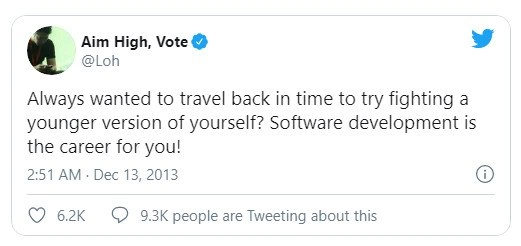
A screenshot of a tweet from the user 'Aim High, Vote' (@Loh), posted on December 13, 2013. The tweet's text reads: 'Always wanted to travel back in time to try fighting a younger version of yourself? Software development is the career for you!'. The tweet has 6.2K likes and is being discussed by 9.3K people. The image captures a witty and relatable observation about the nature of a software development career. The humor lies in the analogy of maintaining or refactoring old code to a physical fight with one's past, less experienced self. Senior developers find this particularly funny because they frequently encounter their own previous work and are baffled or frustrated by the design choices, lack of documentation, or bugs left by their 'younger' self, leading to an internal struggle that feels like a battle across time
Comments
9Comment deleted
The ultimate senior engineer interview question: 'Show me a piece of your code from 5 years ago and explain why you're not a terrible person.' It's a trick question; we're all terrible people
Every git-blame session on the old monolith is a boss fight with 2009-me, who thought a 400-line Singleton wrapped around a global mutex was “future-proof architecture.”
The only time travel paradox worse than killing your grandfather is trying to understand why your past self thought naming that critical service variable 'temp2_final_FINAL_v3' was acceptable - and realizing you still haven't fixed it in production after three major releases
Every senior engineer knows the real horror isn't merge conflicts - it's opening a file you wrote 3 years ago, seeing 'TODO: refactor this mess,' and realizing past-you was both optimistic about future-you's motivation and brutally accurate about the code quality. Time travel debugging: where you're simultaneously the hero and the villain, and the only winning move is to blame it on 'business requirements' and move on
Git blame is our time machine: every outage sends me to 2013-me who shipped local timestamps and a homegrown auth; I bring migrations, shims, and humility
Software dev: time travel where you debug decade-old code by the moron who wrote it - your younger self
Git blame: the time machine where the final boss is 2013‑you with merge rights
I had enough problems with just trying to understand what prior me meant by not using a fine variabile in Jekyll and that isn't even coding Comment deleted
So true... Comment deleted