The Evolution of Avoiding 'Threads' in Software Engineering
Why is this TechHistory meme funny?
Level 1: One Word, Two Meanings
Imagine someone uses the same exact phrase to talk about two totally different things – that can be pretty funny once you realize the mix-up! It’s a bit like a pun or wordplay. For example, think of the word “troll.” In fairy tales, a troll is a scary creature under a bridge, so if your grandparent said, “stay away from trolls,” they meant don’t go near those monsters. Nowadays, on the internet, a troll is what we call a person who posts mean or silly comments just to upset others. So if your parent says, “stay away from trolls online,” they’re giving the same basic warning (avoid trolls), but now they mean rude people on the web, not mythical creatures. See how the meaning shifted even though the words stayed the same? That’s what’s happening with “threads” in this meme.
Long ago (in tech time), “avoid threads” meant don’t mess with a kind of complicated tool in computer programs (because it could cause problems). Today, “avoid threads” might mean don’t get involved in those super long chains of messages on social networks (because it can be tiring or annoying). It’s funny because if you only hear the words, you might think it’s the same advice, but it’s actually about two completely different things depending on when or where you hear it. The meme makes us laugh by revealing this little trick of language – one moment we’re thinking about coding and computers, and the next moment we’re thinking about chats and posts – all with the same phrase. It’s a simple play on words that shows how language in the tech world can change over time, and noticing that change gives a nice “aha!” chuckle.
Level 2: From Concurrency to Conversation
For newer developers or those outside the loop, let’s break down what’s going on in this meme. The confusion (and comedy) all centers on the word “threads.” In programming, a thread is a technical term: it’s essentially a sequence of instructions that can run in parallel with other sequences. Think of it like having multiple workers (threads) inside one program, each doing a task at the same time. This is a core concept in computer science (CS_Fundamentals) called concurrency – many things happening at once. For example, a web server might use multiple threads so it can handle several user requests simultaneously instead of one after the other. However, using threads in code can be tricky. Since all threads in a program usually share the same memory (like sharing the same workspace), they need to be careful not to step on each other’s toes. If two threads try to change the same piece of data at the same time, you can get errors or unpredictable behavior. This is known as a race condition – it’s like two people trying to write on the same whiteboard at once, overwriting each other’s work. To prevent problems, programmers have to use locks or other synchronization techniques to make threads take turns or coordinate. Doing this correctly is hard; doing it incorrectly leads to bugs that are famously hard to find. Because of these challenges, a lot of experienced folks in the early 2000s would say things like “Avoid threads unless you really need them.” They weren’t saying to avoid the topic on forums – they literally meant be cautious about using multi-threading in your code. At the time, languages and operating systems exposed threads pretty directly to programmers (e.g., you’d create and manage threads yourself with libraries like pthread in C or Thread classes in Java), and it was easy for beginners to get in over their heads. So “avoid threads” was basically advice to use simpler approaches when possible (for instance, handle tasks one-at-a-time or use safer concurrency libraries) rather than diving into complex multi-threaded programming without preparation.
Now, let’s flip to the social media meaning of “threads.” In online communities – especially on platforms like Twitter or Mastodon (which is where this meme comes from) – a thread is something completely different. It means a series of posts or messages that are connected as a continuous conversation. If someone has a lot to say on a topic, they might not fit it all in one post (especially when platforms had character limits like 280 characters on Twitter). So they post a sequence: Post 1, Post 2, Post 3,… each replying to the previous, forming a “thread” of messages. It’s basically like a multi-part story or an essay broken into chunks, and each chunk is posted one after the other so readers can follow along. You might have seen people say “🧵 Thread:” and then start explaining something step by step across several tweets or toots. It became a popular way to share tutorials, opinions, or detailed news on social media without linking to an external blog. However, not everyone loves this format. Reading or following a long thread can be tedious for some; it requires tapping “show more” repeatedly and can clog your feed. There’s even a bit of meme culture in developer circles about “Twitter threads” – some find them useful and engaging, while others joke that if you have that much to say, you should just write an article. So nowadays, when someone says “I hate threads” or “avoid threads” in a social context, they are likely referring to these long chains of social media posts rather than programming threads. They’re basically expressing, “I don’t enjoy reading or dealing with those lengthy online discussions.” It’s a kind of gentle gripe common in DevCommunities, where people spend a lot of time both coding and tweeting about coding.
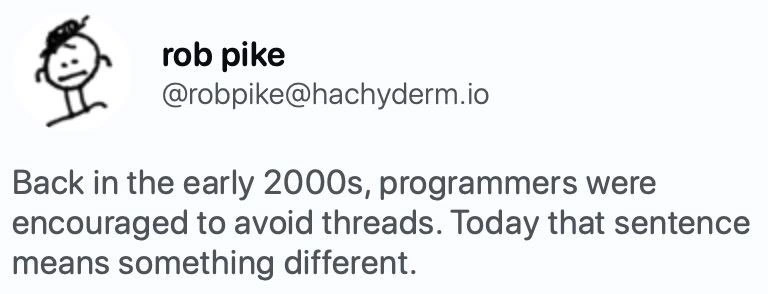
Now, what makes the meme funny is that one sentence is tying these two meanings together. The post shows Rob Pike (notable as a co-creator of the Go programming language and a respected voice in programming) saying: “Back in the early 2000s, programmers were encouraged to avoid threads. Today that sentence means something different.” He’s playing on the double meaning. When he says “Back in the early 2000s,” he’s referencing that era’s programming advice – avoid using threads in your code if possible, because of all the complexity and bugs they can introduce. When he says “Today that sentence means something different,” he’s pointing out that if you say “avoid threads” now, people will likely think you mean “avoid those multi-post discussions on Twitter/Mastodon.” It’s a clever observation about how terminology changes over time. Essentially, the exact same words have shifted context: from a caution in software engineering to a comment on social media habits.
A bit about Rob Pike @[email protected]: This is the Mastodon handle shown in the image. Mastodon, by the way, is an open-source social network similar to Twitter (many developers moved there around 2022–2023). Rob Pike is kind of a big deal in programming history – he worked at Bell Labs, was involved in building operating systems and Unix tools, and later at Google he co-designed the Go language. The fact that he’s the one posting this adds a little extra humor for those who know him, because he’s intimately familiar with threads (in the coding sense) and helped create better ways to handle concurrency. So when he jokes about “avoid threads,” it’s like a master chef joking about two kinds of “spaghetti” – the code kind and the food kind. The avatar in the screenshot – a stick-figure doodle – and the whole tone is very casual, showing this is a lighthearted, witty remark.
To sum up: the meme is funny because it uses one phrase, “avoid threads,” to connect two worlds:
- World 1 (circa 2000s programming): Threads = parallel code tasks. Advice: avoid them to not mess up your software.
- World 2 (today’s social media): Threads = chains of posts. Advice/joke: avoid them if you find them annoying or tiresome.
If you understand both contexts, seeing them juxtaposed in one sentence is a little mind-twisting and amusing. It’s the kind of relatable humor that makes tech folks smirk and maybe share the post with the comment “#TechHumor”. Even if you didn’t know the background, now you can see why those who do are chuckling. The meme has both a nod to programming_history and a wink at our current developer culture online.
Level 3: Concurrency vs Chatter
At first glance, the meme looks like just another social media post – a quote from Rob Pike on Mastodon – but its humor hits home for developers because it bridges two very different contexts with the same phrase. Back in the day, a senior developer or CS professor might grimly advise you “avoid threads” in your program. Every experienced coder from the early 2000s can recall war stories of multi-threaded apps going awry: deadlocks freezing the whole system, race conditions creating intermittent bugs that seemed impossible to reproduce, and frantic late-night debugging sessions trying to untangle which thread did what. This was common enough that “avoid spawning threads unless you absolutely must” became common wisdom. In other words, don’t create a bunch of threads willy-nilly in your code – it was like juggling chainsaws: yes, you can parallelize work, but one mis-step and everything crashes. There was even an unofficial divide in the industry between “thread people” and “event-loop people” – those who built concurrency with threads and those who preferred asynchronous non-blocking loops to dodge thread issues altogether. So, for a lot of veteran engineers, the phrase “avoid threads” triggers memories of hard-to-debug concurrency models and advice from mentors to use safer patterns. It’s practically trauma humor: we laugh because we survived those thread-induced nightmares (and maybe still wake up in a cold sweat thinking “did I lock that mutex?”).
Now fast-forward to today’s developer culture on Twitter, Mastodon, and forums. The word “threads” has taken on a whole new life. If someone says “I wrote a thread”, they’re probably talking about a series of connected social media posts – basically a longer story or discussion broken into bite-sized posts. And guess what? Many people (developers included) have started to groan about those threads too! In modern online discourse, “avoid threads” has become a cheeky way to say: “Ugh, I don’t have the patience for that 20-post long rant or tutorial on social media.” It’s almost an etiquette or sanity tip: lengthy social_media_threads can be exhausting or come off as self-indulgent, especially when one tweet or toot at a time trickles out a narrative that could’ve been a single coherent blog post. Within dev communities, there’s a running joke that whenever someone says “Long thread incoming… 🧵”, half the audience preemptively rolls their eyes or reaches for the “show more” button with caution. It’s relatable humor: we’ve all seen those mega-threads where by the 15th reply in the chain, you’re either totally engrossed or completely annoyed.
So the meme cleverly juxtaposes these two meanings. Rob Pike – a legendary figure who literally helped design Go’s concurrency features – posts: “Back in the early 2000s, programmers were encouraged to avoid threads. Today that sentence means something different.” The punchline lands because Rob is playfully pointing out how the context flipped. Avoiding threads used to be sage technical advice; now it reads like snark about internet thread discourse. The developer audience finds this hilarious for a few reasons. First, it’s an inside joke for those who know the history: if you remember why threads were feared in software, seeing the same warning applied to Twitter/Mastodon threads is delightfully ironic. It’s like hearing your strict CS professor from 2003 now also grumble “and stay off those Twitter threads, kids!” Second, it speaks to how tech terminology and culture evolve. The word “thread” migrated from the realm of OS and CPU scheduling into the realm of tweets and toots, and in both realms, overdoing it causes headaches. This parallel is rich comedic material – essentially, DeveloperHumor that operates on a double pun. Even the specifics add layers: the post is on Mastodon (a Twitter-like platform popular among devs nowadays), by a handle @[email protected] that verifies it’s really that Rob Pike. His avatar is a simple stick-figure doodle with messy hair – a very unpretentious, old-school internet vibe. It’s the kind of profile one might expect from a Unix veteran who enjoys minimalism and a bit of cartoonish humor. That detail isn’t the crux of the joke, but it reinforces the tone: this is a renowned technologist speaking very plainly and wryly.
In essence, the meme is shining a light on a terminology shift within the programming world. It gets a chuckle because everyone in the crowd implicitly completes the sentence: “Today that sentence means something different… avoiding threads is no longer just about avoiding concurrency bugs, it’s about dodging those endless social media diatribes.” It’s a wink to the audience who lives in both worlds – we write code by day and doomscroll tech Twitter by night. We remember when “thread” only meant one thing (and gave us anxiety), and now it means another (and gives us a different kind of headache). The overall commentary is also mildly poking fun at how our community communication has changed. We went from cautioning each other about multi-threading hazards to cautioning each other about multi-post Twitter storms. The phrase “means something different” is doing a lot of work and inviting us to laugh at the double meaning. Rob Pike essentially leverages a bit of programming history to roast modern social habits. It’s a perfect storm of nerdy humor – the kind of joke that makes senior devs smirk knowingly and perhaps explain it to the newer folks who didn’t live through the original “thread scare.”
Level 4: Threads Considered Harmful
In the early 2000s, advising developers to “avoid threads” was serious engineering wisdom, not a social media tip. At the time, threads referred to parallel execution units in software – the building blocks of concurrency. Spawning multiple threads allows a program to do many things at once (e.g. handle multiple clients or tasks concurrently), but it also unleashes a Pandora’s box of complexity. Each thread shares the same memory space, so if two threads try to read and write the same data without coordination, you get a race condition – a kind of intermittent bug that can produce wrong results or crashes depending on unpredictable timing. Debugging such a bug is notoriously difficult because the problem might vanish when you try to observe it (the classic Heisenbug). In operating system theory (a staple of CS_Fundamentals), threads require careful synchronization (using tools like mutexes, semaphores, or monitors) to avoid chaos. A missed lock or an extra unlock() can lead to scenarios like deadlocks (two threads waiting forever on each other) or memory corruption. There’s even an academic joke that threading problems are so intractable that the only safe multi-threaded program is the one with a single thread running – a tongue-in-cheek nod to how hard true concurrency is to get right.
Back then, one influential phrase was “Threads are evil” – not because threads are literally malicious, but because they can make a codebase non-deterministic and fragile. Computer scientists had been grappling with these issues for decades (the concept of mutual exclusion and semaphores goes back to Dijkstra in the 1960s). In practice, by the 2000s many veteran engineers had accumulated battle scars from multi-threaded C++ or Java programs that blew up in production due to subtle timing bugs. A simple increment operation like x++ could go awry if done from two threads simultaneously:
// Pseudocode illustrating a race condition:
int counter = 0;
Thread A: // increment counter
tempA = counter; // reads 0
tempA = tempA + 1; // calculates 1
// --- context switch here ---
counter = tempA; // writes 1
Thread B: // increment counter
tempB = counter; // reads 0 (A hasn't stored new value yet)
tempB = tempB + 1; // calculates 1
counter = tempB; // writes 1, overriding A's increment
// After both threads run, counter is 1 instead of 2!
// This is a classic lost update due to unsynchronized threads.
As trivial as that code looks, without proper locking both threads interfere with each other’s updates. Multiply this complexity across thousands of operations, and it becomes nearly impossible to reason about program state. Formal verification of thread interleavings is NP-hard (exponential possibilities of task scheduling), so testing can’t catch all possible orderings. No wonder the refrain was “avoid threads if you can.” Instead, engineers often favored simpler concurrency models: either stick to single-threaded event loops (which avoid the issue by processing events one at a time) or use processes (isolated with separate memory) to sidestep shared-state nightmares. This era saw the rise of advice like “share nothing, communicate via messages” as a safer alternative to threads. In fact, computer scientists like Rob Pike (the author of this meme’s quote) later championed the idea: “Don’t communicate by sharing memory; instead, share memory by communicating.” This mantra, baked into the design of the Go programming language (which Rob co-created), draws from the older CSP model – it’s essentially telling developers to avoid low-level threads and locks, and use higher-level message-passing or goroutines that abstract away the perilous aspects of threading.
So, historically, “avoid threads” was a caution from seasoned system builders who knew that naive multi-threading could wreck your software (and your sleep schedule). It was advice rooted in hard-earned lessons about concurrency. Fast forward to today, and that exact phrase resurfaces in an entirely different arena – which is where the joke twists in a new meaning. The same words that once warned about technical threading pitfalls are now being used in developer circles as a witty social-media commentary. It’s a clever play on how terminology evolves: a phrase born from operating system textbooks ended up equally applicable to internet forums and Mastodon timelines. In other words, the “harmful threads” have moved from code to DevCommunities chatter, and that irony is what makes this meme brilliant for those of us who’ve lived through both eras.
Description
A screenshot of a post from a social media platform, likely Mastodon given the handle format. The post is by Rob Pike (@[email protected]), a well-known computer scientist, and features his signature minimalist stick-figure avatar. The text of the post reads: 'Back in the early 2000s, programmers were encouraged to avoid threads. Today that sentence means something different.' The humor comes from a clever play on words. In the early 2000s, 'threads' referred to programming threads, a method of achieving concurrency that was notoriously difficult to manage correctly, often leading to complex bugs like race conditions and deadlocks. In the modern context, 'Threads' is also the name of Meta's social media platform, a competitor to Twitter/X. The joke contrasts the historical technical advice with the contemporary social media landscape, highlighting how terminology in tech evolves
Comments
12Comment deleted
In the 2000s, improper thread management led to deadlocks. Today, it leads to endless scrolling and your data being locked in with Meta. One was a concurrent programming problem, the other is a problem for concurrent-ly all of humanity
2002: Join your threads or they’ll leak memory; 2023: Mute your threads or they’ll leak dopamine - either way the scheduler still preempts us
Rob Pike warning about threads in the 2000s: 'They'll cause race conditions!' Rob Pike warning about threads in 2024: 'They'll cause rage conditions!'
Rob Pike perfectly captures how 'avoid threads' went from sage concurrency advice to social media survival strategy. Back then, we worried about deadlocks and race conditions; now we worry about ratio'd takes and engagement bait. Though honestly, debugging a heisenbug in a multithreaded C program still feels less painful than reading some Twitter threads - at least with the former, you can attach a debugger and the problem doesn't argue back
My deadlock-avoidance strategy works for both pthreads and Mastodon: never acquire the comment lock
2003: avoid threads - they’ll deadlock the process; 2025: avoid threads - they’ll deadlock the conversation. Same primitive still works: mute(x)
Threads: once mutex mayhem in userland, now endless reply chains clogging the fediverse - still best avoided
these threads? Comment deleted
cpu threads? Comment deleted
fabric threads Comment deleted
Meta Threads? Comment deleted
But the sentence still stands Comment deleted