Thousand-Yard Stare Rendered Inside a Retro Low-Poly Game Level
Why is this Games meme funny?
Level 1: The Tired Guest at the Cartoon Party
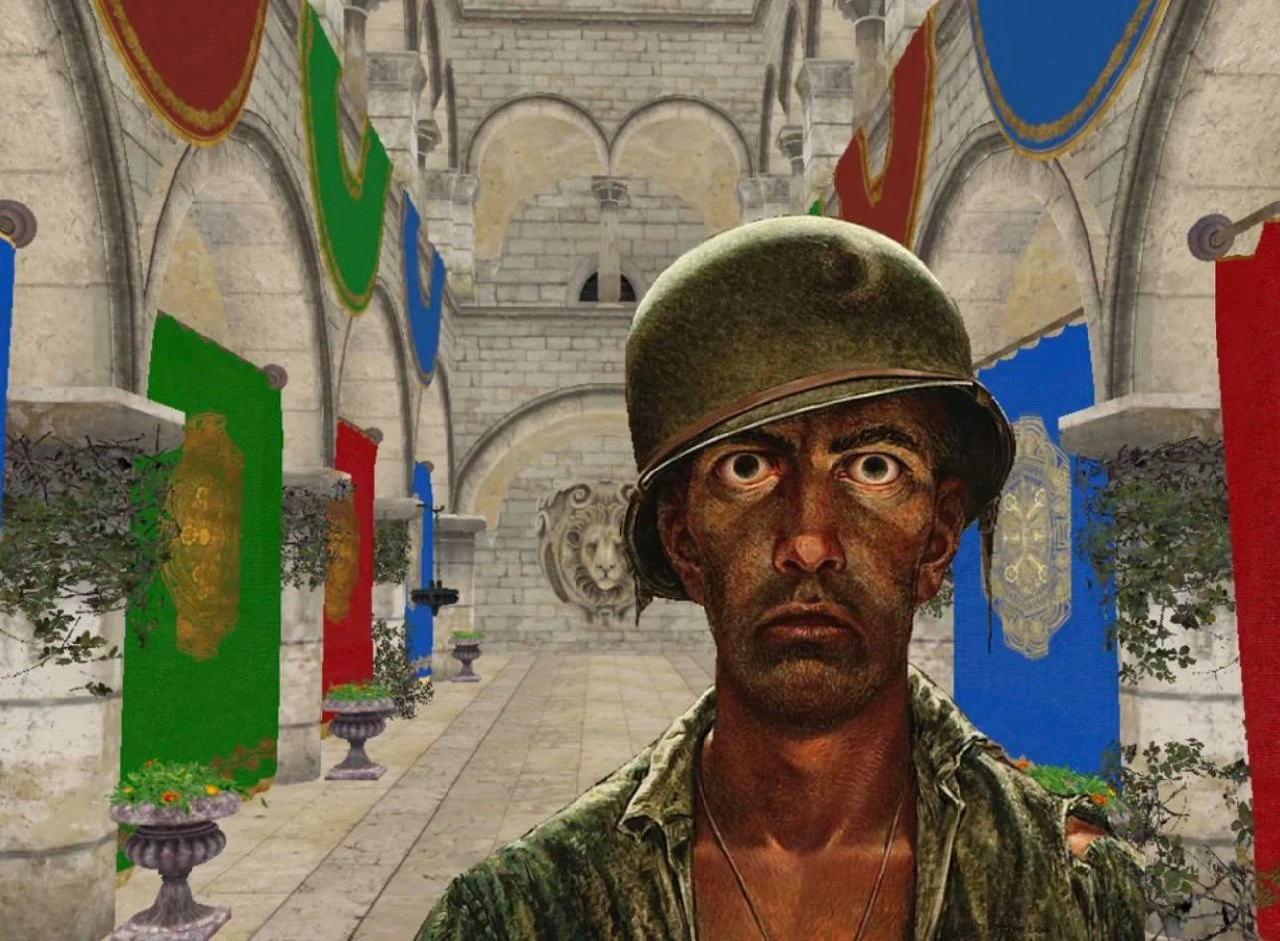
Imagine someone who just finished the hardest, longest day of their entire life walking into a child's birthday party — balloons, streamers, cardboard castle — and just standing there, staring at nothing, while the party happens around them. That's the whole picture: a very real, very tired face stuck inside a bright, blocky toy world that has no idea what he's been through. It's funny the way a deep sigh is funny — everyone has had a moment where the world around them felt way too cheerful for how wrecked they were, and this image is that feeling wearing a helmet.
Level 2: The Two Artifacts in the Frame
The 2,000 Yard Stare is one of the most famous American war paintings: a portrait of a shell-shocked WWII Marine whose unfocused, wide-eyed gaze gave English the phrase "thousand-yard stare" — the expression of someone mentally checked out after prolonged trauma. In meme usage it's shorthand for I have seen too much: surviving finals week, a brutal on-call rotation, or a 300-comment code review.
Low-poly graphics are 3D visuals built from a small number of polygons — the triangles that make up every 3D model. Around 1998–2003, hardware could only push so many triangles per frame, so games used simple geometry dressed in flat image textures: a wall is one rectangle wearing a photo of bricks; a banner is a flat sheet with no cloth simulation. Modern eyes read that style instantly as "retro shooter." The background here — repeating stone arches, blocky urns, paper-flat banners — is a loving reproduction of that constraint era, whether captured from an actual old game or composited to look like one.
The meme works by juxtaposition: a hyper-detailed traumatized face pasted into a chirpy primitive world. The format needs no words because the contrast does the talking — which is also a useful early lesson in visual communication: the gap between two styles can carry more meaning than either style alone.
Level 3: Marines of the Render Distance
The composite is doing something genuinely clever with art history. The face is Tom Lea's The 2,000 Yard Stare — painted in 1944 for Life magazine after the battle of Peleliu, depicting a Marine whose mind has visibly left his body — and it has been dropped, helmet and all, into a sun-bleached low-poly Mediterranean courtyard straight out of the Serious Sam school of level design: stone cloisters with arched galleries, a lion-head relief, planter urns, and flat-textured banners in pure saturated red, green, and blue hanging with the physics of plywood. No caption. The collision of the two visual languages is the text.
The joke's engine is fidelity mismatch. Lea's soldier is rendered with the full weight of traditional painting — bloodshot eyes, sunken cheeks, individually traumatized stubble — while everything behind him obeys a polygon budget from 2001: repeating stone textures, banners that are single quads, foliage that's clearly an alpha-masked billboard. The format has become the internet's standard idiom for a very specific flavor of exhaustion: the only conscious entity in an environment too cheerful and too simple to acknowledge what you've been through. Veterans of long projects recognize it instantly — the person who survived the death-march release, standing in the sprint retro while everyone discusses emoji reactions.
For anyone who grinded shooters in the late-90s/early-2000s, the choice of backdrop carries extra archaeology. That era of FPS design — Serious Sam, Painkiller, the tail end of the Quake lineage — was defined by arena combat: gorgeous (for the time) static architecture in which hundreds of enemies were thrown at you in waves until your trigger finger dissociated. Putting the 2,000-yard stare in that environment is historically literate: those games were, mechanically speaking, attrition warfare simulators with vacation-postcard texturing. The RGB banners are a quiet bonus joke for graphics people — red, green, and blue at full saturation, the three additive primaries hanging like regimental colors of the rendering pipeline itself.
There's also a gentler reading the format supports: burnout as anachronism. The painted Marine is from a higher-fidelity reality than the world he's stuck in — which is precisely how it feels to carry real, complicated experience through systems (games, jobs, codebases) built on cheerfully simplified assumptions. The environment will never understand him. It can't; it's 12,000 triangles.
Description
Tom Lea's famous WWII painting 'The 2,000 Yard Stare' - a hollow-eyed soldier in a battered helmet and tattered camo shirt - is composited into a low-polygon 3D game environment reminiscent of late-90s/early-2000s shooters like Serious Sam. The background shows a stone courtyard with arched cloisters, a lion-head relief on the wall, planter urns with flowers, and flat-textured banners in saturated red, green, and blue hanging from the arches. The juxtaposition of the traumatized painted face against the cheerful, primitive game geometry conveys shell-shock-level exhaustion, a format widely used to express burnout from grinding through something far too long. No caption text is present; the visual contrast carries the joke
Comments
12Comment deleted
That's the face of the one engineer who still remembers why the level loads in exactly that order - and knows nobody else ever will
mysterious posting once again. Comment deleted
Just a proper-programming meme on this vibecode channel, don't worry p.s. say if you were to count vertices, how would you do that? Comment deleted
Cap here, it's called Sponza test scene, and it's one of the most popular testing scenes for Computer Graphics folks. Comment deleted
Ahhhh, the good old days of learning graphics engines. I think I saw it first when trying to learn how instanced rendering works Comment deleted
I don't understand this one even after reading the comments about graphics programming stuff, to me this looks like a scene from an old game like Assassins creed Comment deleted
PTSD from spending 6 months looking at this scene while debugging your shit Comment deleted
and what was your shit? a game? a game engine? a 3d render pipeline? a shader? a low level graphics library like OpenGL? a 3d rendering engine? Comment deleted
Mine? I did some opengl and dx11 shitcoding and then decided to do something else. Lost interest completely Comment deleted
this is one of the widely used test scenes, think utah teapot, blender monkey, etc Comment deleted
Is there anything to know about this for a game developer? Comment deleted
I vaguely remember this but only for when I was doing graphics card tests. Pretty sure it came as software bundled with the PC Comment deleted