Peeling the 'Protective Film' Rips the Entire LCD Panel Off
Why is this Hardware meme funny?
Level 1: Peeling the Frosting Off the Cake
Imagine getting a beautiful new cake with a clear plastic wrapper over it. You start pulling the wrapper off, and it feels weirdly stuck... so you pull harder... and harder... and then you realize you weren't holding the wrapper at all — you just peeled off the entire top of the cake, frosting and everything, in one giant sheet. Now you're standing there holding the best part, staring at a sad gray slab. It's funny because of how confident the pulling was, and how the little voice saying "this seems too hard" was ignored right up until it was far, far too late.
Level 2: What That Dark Sheet Actually Was
New monitors and laptops often ship with a thin plastic protective film over the screen — slightly wrinkled, with a little tab, designed to peel away with zero effort. What this person grabbed instead was the polarizing layer: a functional optical sheet that's laminated into the display, not laid on top of it. An LCD works by shining a white backlight through liquid crystals that twist light, and the polarizer is the final filter that turns that twisting into the picture you see. It is supposed to stay attached for the lifetime of the device.
How to never end up in this photo: real protective film peels off easily and is usually printed with icons or a pull tab; if you're fighting it, stop. The torn black flakes along the panel edge in the image are the adhesive and layer stack giving way — the point of no return. There's no repair short of replacing the entire panel, which on a budget monitor costs more than the monitor.
This is also a classic first-PC-build rite-of-passage story, the display equivalent of mounting a CPU cooler without removing the sticker on the heatsink — except that mistake is recoverable, and this one converts a monitor into a backlit cutting board.
Level 3: It Offered No Resistance, Until It Did
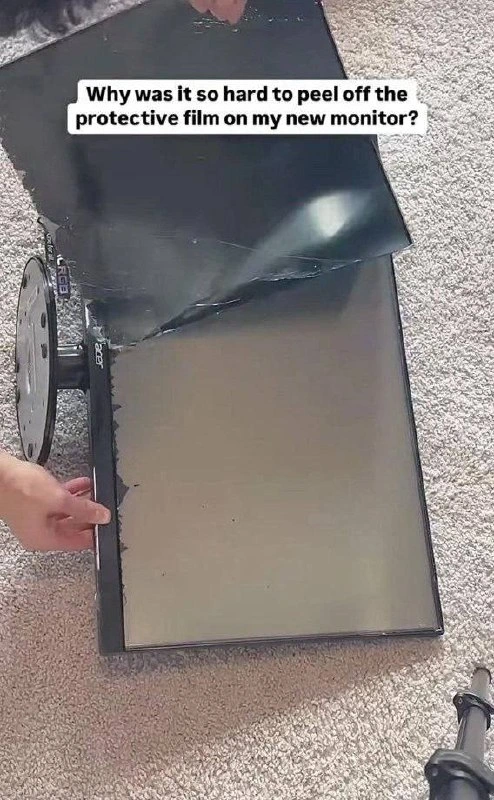
"Why was it so hard to peel off the protective film on my new monitor?"
The photo answers its own question with maximum cruelty. On the beige carpet lies a monitor, face up, stand base at the left — and a hand peeling back what the owner believed was the factory shipping film. Except the "film" is a large, rigid, dark sheet, and underneath it isn't a glossy new screen: it's a blank grey-green rectangle with torn black flecks crumbling along the edge. That dark sheet is the polarizer — and parts of the panel stack bonded to it — meaning this monitor displayed its last frame before it ever displayed its first.
The technical irony is delicious. An LCD doesn't emit images; it gates light. The backlight shines through a sandwich: rear polarizer, liquid crystal layer driven by a TFT matrix, color filters, front polarizer. The liquid crystals don't produce light or color — they rotate the light's polarization per subpixel, and the front polarizer is what converts that rotation into visible brightness. Strip it off and the remaining stack passes light indiscriminately: you get exactly the uniform grey-green void visible in the photo. The user didn't scratch the screen; they removed the component that makes the screen a screen. (Fun corollary beloved by hardware tinkerers: keep the peeled polarizer, hold it in front of the panel, and the image reappears — people have built "privacy monitors" this way on purpose. This owner did it by accident, with extra tearing.)
The deeper, evergreen engineering lesson is encoded in the caption's plaintive "why was it so hard": resistance is feedback. Real protective film lifts with a fingernail and a whisper. When an operation that should be effortless requires force, the correct move is to stop and re-examine your model of the system — yet humans reliably do the opposite, interpreting resistance as a reason to pull harder. Every domain has this failure: the bolt that "just needs more torque" and snaps, the rm -rf that "just needs sudo," the migration script that "just needs --force." Confidence scales with commitment, not correctness; by the time the panel started delaminating, the sunk-cost engine was running at full power. And like all the best hardware disasters, it's irreversible — there is no undo, no rollback, no warranty claim that survives the phrase "I peeled the screen off."
The carpet deserves a mention too: brand-new monitor, assembled and ruined directly on the floor, static-friendly fibers and all. Every step of this unboxing was a small vote for catastrophe; the polarizer just counted the ballots.
Description
A photo taken on beige carpet shows a desktop monitor lying face-up with its round stand base visible at left. A hand holds the bezel while a large dark sheet - which the owner believed was the factory protective film - is peeled back, but it is actually the monitor's polarizer/panel layer, leaving behind a blank grey-green rectangle with torn black flecks along the edge. Overlaid white-on-black caption text reads: 'Why was it so hard to peel off the protective film on my new monitor?' The image is classic hardware-destruction humor: an irreversible, warranty-voiding mistake performed with total confidence, instantly painful to anyone who has ever unboxed display hardware
Comments
2Comment deleted
Proof that 'it offered no resistance until suddenly it did' applies to monitors exactly the way it applies to force-pushing to main
It was there to protect the monitor from you, but it was not good enough Comment deleted