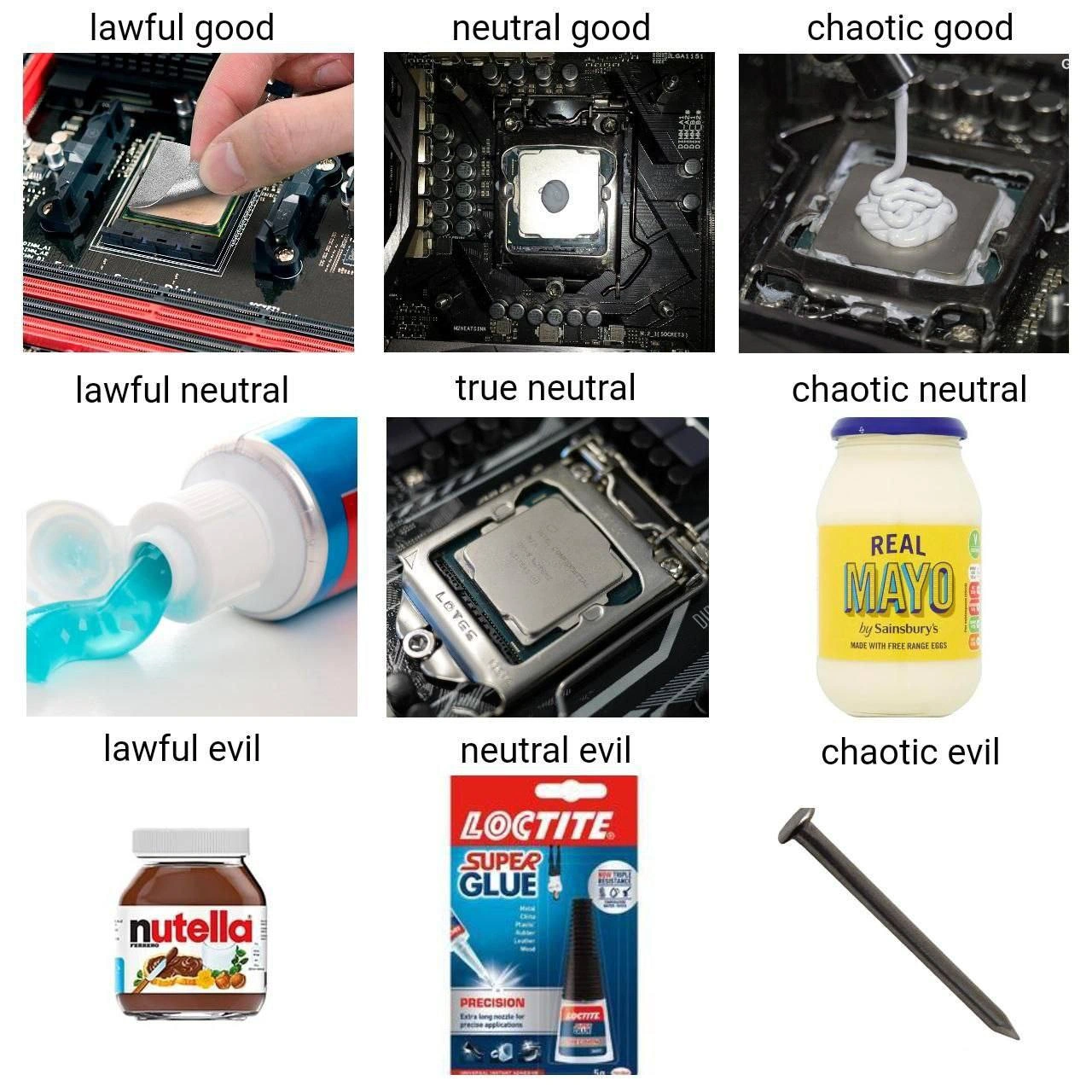
Thermal Paste Alignment Chart: From Proper Application to Nutella and Nails
Why is this Hardware meme funny?
Level 1: Don’t Try This at Home
Imagine you have something very hot, like a cooking pan, and you want to cool it down or handle it without burning yourself. Normally, you might put a proper heat-safe pad or oven mitt between you and the hot pan – that’s like using the correct thermal paste for a computer’s hot CPU. Now, this meme jokes about people using completely wrong things instead of the proper cooling paste, and it compares those choices to heroes and villains!
Think of the “good” choices as the heroes: one hero uses a special metal pad (the right tool) to keep the computer cool, and another hero spreads the proper cooling goo evenly, which also works well. Even the silly hero who dumps a huge glob of the goo is messy but still trying to do the right thing – the computer will be okay, just a bit sticky.
Now the “neutral” ones are like people who either don’t help or use odd substitutes. One person doesn’t put anything at all – kind of like forgetting to put a coaster under a hot pan and ruining the table. That’s not helping the computer at all, but it wasn’t on purpose – they just didn’t know better. Another person tries toothpaste or mayonnaise from the kitchen as if those could do the same job as the special paste. It’s a bit like someone using toothpaste to glue something because they ran out of glue – it might sort of work for a very short time, but it’s obviously not the right thing and will end up a sticky dried mess. They’re not trying to be mean to the computer, but they’re doing something kinda wacky that won’t end well.
Finally, the “evil” choices are the villains of the story: these people use items that will definitely hurt the computer. One evil character uses Nutella (a chocolate spread) on the hot computer chip – that’s as bad as it sounds, like putting chocolate on a hot engine – it’s going to melt and burn and make things worse! Another villain actually uses super glue instead of the special paste, which is super bad because it glues the computer parts together forever and also stops them from cooling down – basically a trick that will break the computer. And the most crazy villain of all just throws a steel nail in there, as if that would help. That’s like someone trying to fix a broken toy by hammering a nail into it – it’s not fixing anything, it’s just destroying it more!
So why is this funny? Because even if you’re not a computer expert, you can tell that toothpaste, food like mayo or Nutella, glue, or nails are totally the wrong things to put inside a computer. It’s obviously a bad idea, just like it would be silly to use jelly instead of gasoline in a car, or use a crayon to draw on a phone screen to fix a scratch. The meme makes it extra funny by arranging these ideas as a chart of “good to evil” – pretending the good choices are virtuous heroes and the bad choices are evil villains in a game. It’s a goofy way to say “only the right cooling stuff should go on a CPU, and these other crazy things are a big no-no!” Even if you don’t get the game reference, the pictures themselves are over-the-top enough to make you laugh and remember: Don’t try this at home, folks – your computer will thank you!
Level 2: Condiments ≠ Thermal Paste
Let’s dial it back and explain the basics. Computers, especially the CPU (the central brain of the computer), get really hot when they are working hard. To keep them from overheating, we attach a heatsink (usually a metal block with fins, often with a fan) on top of the CPU to pull the heat away. But here’s a key detail: between the flat surface of the CPU and the flat surface of the heatsink, you need a special filler material to help heat flow across. That filler is called thermal paste (or thermal compound) or sometimes a thermal pad. The surfaces have microscopic imperfections, and if you just clamp them together with nothing, tiny air gaps stay in between – and air is a very bad conductor of heat. Thermal paste is designed to fill those gaps with a material that conducts heat much better than air, keeping the CPU nice and cool by transferring heat to the heatsink efficiently.
This meme plays with that concept by showing nine different things you could put between the CPU and heatsink, presented in a grid like a D&D alignment chart. (In Dungeons & Dragons, characters can be “lawful” or “chaotic” and “good” or “evil” – the chart is a popular format for jokes, putting things into categories like lawful good, neutral evil, etc. based on their behavior.) Here, instead of characters, we have thermal interface materials – some are proper and good for hardware, and others are hilariously bad ideas. It’s a fun way to categorize from the best (top-left) to the worst (bottom-right) cooling material choices. Let’s go through them in plainer terms:
Lawful Good (Top-Left): The image shows a neat metal thermal pad being placed on a CPU. A thermal pad is a legit product used instead of paste – it’s like a thin sheet that you put on the CPU, and it can transfer heat well. This is basically an ideal, by-the-rules choice. It’s clean, it’s effective, and it’s exactly what you’d find in a proper PC-building guide. So it’s “lawful” (follows the rules) and “good” (helps the CPU).
Neutral Good (Top-Center): Here the CPU is completely covered with a thin layer of actual thermal paste. Thermal paste is the normal goopy stuff (usually gray or white) that you’re supposed to use. This person spread it evenly over the whole CPU surface. That’s generally a good practice (though some might just put a dot and let it spread when the heatsink is pressed on). Either way, this is a correct application – the CPU will have good contact with the heatsink and cool properly. It’s “neutral good” because it’s definitely good for the CPU, though maybe a bit overthorough or not exactly by a single-dot method (hence neutral rather than lawful, but it’s still a positive/good approach).
Chaotic Good (Top-Right): Now we see a CPU with a wildly excessive swirl of thermal paste, like someone squeezed out a whole tube in a spiral pattern 😅. This is an actual thermal paste (so the material is correct), but the amount is overkill. The vibe is chaotic: it’s messy, it’s more than needed, but the intention was still to cool the CPU (a good intent). In real life, using way too much paste can be a bit messy – the excess will squish out the sides when the heatsink is put on. It might not harm anything (unless the paste is electrically conductive and touches the motherboard, but most standard pastes are made not to conduct electricity). It’s just not a tidy or efficient method. It’s the equivalent of, say, generously icing a cupcake when you only needed a thin layer – not harmful, just extra. So it’s “good” because at least it’s the right stuff, just “chaotic” in execution.
Lawful Neutral (Middle-Left): This image is a tube of blue toothpaste being squeezed out. Amazingly, people have tried using toothpaste as a substitute for thermal paste! Toothpaste has a paste-like consistency and can fill gaps, so in a pinch, some experimenters (or desperate folks who didn’t have real paste) have done this. At first, toothpaste can actually conduct heat okay (and the CPU might run reasonably cool for a short while). That’s why someone might think “Hey, it’s paste, it might work” – they’re following the idea (the “law”) that you need a paste. That’s why it’s “lawful neutral”: the person is doing something that seems technically by the rule (using a paste-like substance, lawful), but it’s not particularly good or evil at that moment – more like a MacGyver trick that’s not sustainably good. The big catch is toothpaste dries out when it gets hot. After even a few hours or days, it can harden and start cracking, which means it loses contact and stops conducting heat. Then your CPU temperatures will soar. So it’s not a real solution, just a temporary hack at best. Definitely not good for long-term CPU health, but not instantly destructive like the truly evil ideas.
True Neutral (Middle-Center): This one shows a CPU with nothing on it at all – a bare CPU just sitting there with no thermal paste. In the context of the joke chart, “true neutral” means doing nothing: neither helping nor actively harming on purpose. Maybe the builder forgot to apply paste, or didn’t know it was needed. This is actually a common beginner mistake in PC building! The result though is bad: without any thermal interface, the contact between CPU and heatsink is poor and the CPU will overheat quickly. So while the alignment “true neutral” implies no particular bias, in reality this scenario is very bad for performance. The CPU’s temperature will spike because those tiny air gaps act like an insulating blanket, trapping heat on the chip. Modern CPUs will usually detect this and slow themselves down a lot or shut off to avoid damage. So if you ever build a PC and see temps hitting max or the computer shutting down immediately, one of the first things to check is “Did I put the thermal paste on?”. It’s the ultimate neutral mistake – not an act of evil, just an absence of the good stuff that needed to be there.
Chaotic Neutral (Middle-Right): Here we have a jar of Real Mayonnaise. Yes, the same mayo you’d put in a sandwich 🥪. This is someone trying to improvise a thermal paste using a kitchen condiment! It’s chaotic because it’s an unorthodox, pretty crazy idea – nowhere in any PC building guide does it say “apply two tablespoons of mayo to your CPU.” Why might someone do this? Hard to say – maybe just as a joke or experiment, or truly they had nothing else and thought “mayo is thick and gooey, maybe it could work?” In fairness, mayo is mostly oil and water, and oil can conduct heat better than air, so at the very start, it might transfer some heat. But the problem is, once the CPU heats up, that mayonnaise will start to change: the water part can evaporate or even cook (since CPUs can reach 70-90°C easily under load), and you might literally fry the mayo. The oily residue left will not be effective and could even go rancid or crusty. It might even leak out. Ultimately, it will fail to keep the CPU cool for long. The alignment “neutral” indicates this wasn’t done out of malice – more out of chaotic curiosity. It’s not as deliberately destructive as the ones we’ll see next, but it’s definitely not a good idea. This falls firmly under the category of “don’t try this at home” – it’s a fun thing someone did for laughs (there are actually YouTube videos of people testing stuff like this), but not for a real PC you care about!
Lawful Evil (Bottom-Left): Now the bottom row is the “evil” category – things that can really harm your CPU or are just plain wrong. Lawful evil in the chart is a jar of Nutella spread. Nutella, delicious as it is, does not belong in a computer. Why is it lawful evil? “Lawful” because on the surface, it adheres to the idea of using a paste. Nutella is paste-like (thick, brown, gooey), so someone following the “rule” of “use paste between surfaces” might use it in a twisted literal way. But it’s evil because it’s ultimately very bad for the machine. Nutella is full of sugar, oil, and nuts – none of which conduct heat well once things start drying or burning. If you actually put Nutella on a CPU, it might spread and conduct some heat at first (and you’d have a PC that smells like a chocolate factory briefly 😅). However, as the CPU heats up, the Nutella will warm and possibly liquefy a bit or dry out and harden. Either way, after a short time, it loses whatever tiny usefulness it had. It could even melt and drip, or harden into gunk that is hard to clean. There’s also a small chance the sugars could caramelize or the oils could cause short circuits if they seep onto electrical parts (since some substances in food can be slightly conductive or just make a mess). So using Nutella is kind of an evil prank level of suggestion – it’s not something a rational person does to a machine they like. But it’s “lawful” in the sense that it pretends to follow the mechanic (it is a paste, after all!), making it a sly, deceptive kind of evil. Definitely do not use chocolate spread as a cooling solution! This panel is basically making fun of any idea where someone says “well, it’s paste, so it must work, right?” – No, it won’t!
Neutral Evil (Bottom-Center): Here we see a package of Loctite Super Glue. This is a very dangerous idea for a CPU: using glue instead of thermal paste. The meme labels it “neutral evil” because this action would straightforwardly wreck your hardware without any chaotic flair – it’s a very direct, cold kind of bad idea. If someone actually did this, it could be either a huge misunderstanding or an act of sabotage. A newbie might think “the heatsink should be glued on so it never comes off!” – not realizing that the heatsink usually has clamps or screws and the paste is only for heat transfer, not adhesion. Or someone malicious might secretly swap a friend’s thermal paste with super glue as a cruel joke. In any case, the outcome is awful: Super glue (cyanoacrylate) will stick the CPU and heatsink together permanently, but it’s not designed to conduct heat. In fact, it will likely create a thin film that prevents proper heat flow. The CPU will start to overheat because the heat can’t escape well through the glue layer. And when you try to pull the heatsink off… surprise, it’s cemented. You could rip the processor right out of the motherboard socket or damage it trying to remove the glued cooler. It’s basically a hardware death sentence. That’s why it’s evil. It’s “neutral” evil rather than chaotic because there’s a certain logical (though horribly misguided) method to it – it’s using a normal product (glue) in a very wrong way, but in a straightforward manner. No randomness, just a clear but evil misuse. This highlights to any reader: never use adhesives that are not meant for CPUs. (There are special kinds of thermal adhesives for some small chips in electronics, but those still have thermal conductivity and are not permanent super glues like this.) This panel of the meme usually gets strong reactions – it’s a nightmare scenario for PC enthusiasts.
Chaotic Evil (Bottom-Right): The final image is just a steel nail. Imagine someone holding a metal nail and saying “Yup, this will help cool my CPU.” It’s completely absurd – a nail is small, solid, and nothing about it is suited for spreading heat across a CPU surface. If the other choices were progressively worse, this one breaks the scale. It’s chaotic evil because it’s basically destructive insanity. Perhaps the thought is “metal conducts heat, so I’ll put a piece of metal in there” – but a single nail touching the CPU and heatsink (if it even stays in place) covers maybe 1% of the area that paste would cover. The rest of the CPU would be separated by air still. So the heat transfer would be terrible. The CPU would overheat almost immediately. Plus, a nail could scratch the CPU or other parts, or cause a short circuit if it contacts the motherboard or any electronic components (since steel is conductive electrically too). There’s also zero reason to do this – it’s not following any rule or logic (that’s why it’s chaotic). It’s like someone just wanting to watch the world burn, or a joke to illustrate “the worst possible idea.” Essentially, the meme is saying this is the ultimate wrong way to attempt cooling, as if an evil madman chose it. Of course, nobody would seriously try a random nail as a thermal interface (we hope!), but it’s a funny exaggeration to make the point: don’t do utterly random harmful things to your hardware! It’s the kind of thing that if it appeared on a tech forum, you’d think the person was trolling or joking.
In summary, the meme is taking a very real computer maintenance task (applying thermal paste for CPU cooling) and showing both the correct ways and the outrageously incorrect ways to do it, framed as if each choice has a “moral alignment.” This is a common format in tech and gaming communities for humor. It resonates with people who have built PCs or who love tech humor because each panel reminds them of either a common tip or a memorable tech horror story. From a junior perspective, you can also learn something here: only the top row contains proper solutions (thermal pad or a reasonable amount of actual thermal paste) – everything else is a joke about what not to do. So if you’re new to building computers, take this meme as a light-hearted cautionary tale: Use real thermal paste or pads for your CPU’s cooling – not toothpaste, not food, and definitely not glue or random metal objects! 😄
Level 3: From Graphite to Glue
At the highest level, this meme mixes hardware humor with a classic Dungeons & Dragons alignment chart. It’s mapping various thermal interface choices—ranging from genius to truly insane—onto the moral spectrum from lawful good to chaotic evil. In other words, it’s an engineering absurdity showcase of how people cool a CPU (Central Processing Unit) with either proper thermal paste… or with utter nonsense. Seasoned builders and performance geeks see this and laugh (or cringe) because they’ve either heard of these wild hardware hacks or experienced similar cpu_cooling_failures firsthand. Let’s break down why each panel’s choice lands in its alignment:
Lawful Good: A neat metal thermal pad being placed on the processor is as by-the-book as it gets. This is the paladin of cooling solutions. A thermal pad (often a graphite sheet or phase-change pad) is a legitimate, even proper, Thermal Interface Material (TIM). It’s precise, clean, reusable, and safe. In a world of PC building, using a pre-cut pad is lawful because you’re literally following a recommended method, and good because it reliably keeps the CPU cool. No mess, no guesswork – just optimal heat transfer. A rule-abiding PC builder who values stability would go this route, earning that Hardware lawful good badge.
Neutral Good: Here we see the CPU’s lid completely but thinly coated with standard thermal paste. This is a well-meaning approach: maybe a tad overzealous in ensuring full coverage, but the intent is to do right by the hardware. It’s neutral good because it might not follow the one-dot or pea-sized best practice law to the letter, but it’s certainly not harmful or crazy. In fact, many experienced builders manually spread paste evenly like this to avoid hotspots. The result? Good heat conduction and happy temperatures. A neutral good character in D&D cares about doing good more than sticking rigidly to rules – likewise this builder ensures good cooling even if their method is a personal style. The CPU will run cool and stable, which is ultimately a performance win.
Chaotic Good: Ah, the infamous spaghetti swirl of paste on the CPU. HardwareHumor at its finest. This person slapped on a wild mound of TIM – an absurd thermal_paste_alignment_chart exaggeration of “more paste = more cooling.” It’s definitely chaotic because it ignores the usual guideline (“don’t use too much!”) in favor of a creativity (or overkill) burst. Yet it’s still good in the sense that the substance is correct – it is real thermal paste – and the goal is to protect the CPU. In practice, this CPU will probably survive; the excess paste will squish out when the heat sink is mounted, making a huge mess but still filling all gaps. The system won’t catch fire or anything, though too much paste can slightly hinder heat transfer (since even good paste isn’t as thermally conductive as metal). But as alignments go, chaotic good means well with a reckless approach, and that’s exactly this scenario: well-intentioned, messy enthusiasm. Seasoned engineers chuckle because they’ve seen novices plaster way too much paste out of caution. It’s harmless humor—at least they didn’t reach for the mayonnaise yet.
Lawful Neutral: Now we venture into the truly odd choices. A tube squeezing out blue toothpaste onto a brush? Yes, regular minty toothpaste as a CPU TIM substitute. This is actually a semi-famous hardware hack – in emergencies some tinkerers discovered you can use toothpaste as a short-term thermal paste replacement (it’s pasty, fills gaps, and initially conducts heat okay). It’s labeled lawful neutral because the person is following a “rule” of using a paste-like substance (so adhering to the form of the law, in a twisted way), but they’re neutral in not really aiming to help or harm long-term. They just pragmatically used what was on hand. The result initially might be surprisingly decent cooling for a day or two, which is why we call it lawful (there’s a logical method to this mad science). But toothpaste dries out quickly and becomes an insulator (chalky crust) – leading to cpu_cooling_failures soon after. It might hold the fort for a few hours if you absolutely had nothing else at 3 AM, but any seasoned engineer knows this neutral efficacy won’t last. It’s a bit like a bureaucratic solution: technically fills the role (there is paste), but without real care for good or evil outcomes.
True Neutral: The center image shows a totally bare CPU, shiny and completely un-pasted. Nothing at all between the processor and the cooler (or perhaps the cooler isn’t even on yet). This is the embodiment of true neutral – the builder did nothing. No help, no harm intended, just… neglect. In a D&D sense, true neutral is indifferent, and here the person either forgot the thermal compound or didn’t know it was needed. The humor is that doing nothing is portrayed as a valid “neutral” choice. In real hardware terms, this is a classic newbie mistake: mount the heat sink without any TIM. What happens? The minute you power on, the CPU’s temperature skyrockets. Heat fails to transfer efficiently across the tiny air gaps, and the chip will throttle down hard or trigger an emergency shutdown to avoid self-destruction. It’s a cpu_cooling_failure you discover when your brand-new build turns off after 10 seconds because the CPU hit 100°C in a flash. True neutral indeed – no deliberate malice or benevolence, just zero intervention (and zero cooling). Among PC builders, forgetting thermal paste is an ultimate facepalm, so seeing it labeled so nonchalantly in the meme gets a knowing laugh.
Chaotic Neutral: Now it gets really weird – a big jar of REAL MAYO mayonnaise. Yes, someone apparently thought “If toothpaste can kinda work, why not my sandwich spread?” This is pure chaotic neutral energy. It’s chaotic because who on Earth would smear mayonnaise on a CPU as a cooling interface?! And yet, the intent might not be outright evil: maybe they genuinely were curious or desperate and had no malicious intent toward the hardware. (In the grand internet tradition of “Will it work? Let’s try it!” science experiments, mayo has indeed been tested as TIM.) Initially, mayo is thermally okay-ish because it’s mostly water and oil – it might conduct heat for a short while. But as the CPU heats up, you can imagine what happens: the water content cooks off or separates, the oily goo left behind starts insulating rather than conducting, and it might even cook the egg proteins in the mayo. 🤢 After a little while, you’d have a gross, possibly solidifying layer of goop, and likely a heat sink that smells like rotten eggs. So performance will nosedive and the CPU will overheat once the mayo “TIM” turns to crust. It’s neutral (not evil) because the poor soul using it probably wasn’t trying to destroy the PC; maybe they thought “hey it’s just a thermal paste alignment chart suggestion on a forum, and I have mayo in the fridge…”. It’s happened in real life as a joke/test, and this meme immortalizes that mayonnaise_heat_sink insanity. Hardware engineers see this and howl– it’s the ultimate engineering humor example of “just because it’s paste-like doesn’t mean it’s a thermal paste!”
Lawful Evil: Now we’re in villain territory. A jar of Nutella (chocolate hazelnut spread) is shown as the lawful evil option. Why evil? Because using Nutella as thermal paste will almost certainly end in a sticky, burned-up disaster for your CPU. Why lawful? Think of an evil character who still follows a code or rule: in this case, they technically followed the idea of “use a paste between CPU and cooler” – except they chose edible chocolate as the material. It’s like a diabolical twist on the rules. In appearance, Nutella is brown and gooey, maybe one could even fool someone into thinking it’s a legit thermal compound (some thermal pastes are grey or silver, but close enough at a glance!). An unsuspecting victim might not realize their “helpful friend” applied Nutella, not Arctic Silver. As a thermal interface, Nutella actually has a bit of oil and powder which might conduct heat briefly, but much like mayo (and even more so due to sugar content), it will become a nightmare once the CPU heats up. The sugar can crystallize or burn, the oils can separate, and you might end up with a baked-on chocolate film. If mayonnaise was egg-cooking, this is literally nutella_conductivity turning into a hot fudge on your processor. 🤦♂️ It’s evil because it’s guaranteed to make the machine suffer. Some experimenters have tried it for fun – initial temps might be half-decent, but it rapidly degrades. Plus, Nutella could potentially conduct electricity if it stays liquid (it has water content, though low, and maybe ionic stuff from cocoa) – imagine shorting out CPU pins with dessert spread! So lawful evil is apt: there was a “logical” procedure followed (use paste, check), but done with a treacherous, hardware-ruining substance. It’s the kind of prank or sabotage only an enemy (or a YouTube prankster) would pull. The alignment chart format nails this: it’s both funny and horrifying to performance enthusiasts to see a beloved high-end CPU treated like a piece of toast with Nutella.
Neutral Evil: This one sends shivers down any PC builder’s spine: a package of Loctite Super Glue. The neutral evil alignment is depicted with actual adhesive intended to permanently bond materials. In an evil sense, this is how you assassinate a CPU under the guise of “fixing” it. Why neutral? Because it’s a cold, methodical kind of evil — no flamboyant chaos, just a straight-up brutally bad choice. Perhaps someone utterly ignorant might think “hey, I should glue the heatsink on so it stays put!” or an evildoer might want to ensure the CPU never comes apart from the cooler ever. Either way, using super glue instead of thermal paste is catastrophic. Glue is not designed for thermal conductivity at all – it’s an electrical insulator and a thermal insulator. So what happens? The moment you power the system, heat from the CPU gets trapped. Maybe the edges transfer a tiny bit of heat if glue is thin, but likely the CPU will hit max temp in seconds. Unlike the bare CPU (true neutral) which at least you can fix by just adding paste, the glued CPU is basically ruined. Once that glue sets, the cooler is cemented on. If the CPU overheats and you try to remove the heatsink to apply real paste, you’ll find it bonded like it’s part of the motherboard. Trying to yank it off can rip the CPU out of its socket or crack it—an engineering horror story. In tech support lore, we actually have seen cases where misguided folks put epoxy or glue on their processor, thinking it’s needed to hold the cooler – resulting in destroyed chips. So neutral evil indeed: there’s a method to the madness (it’s a “glue for a job” approach, just the wrong job), executed with evil result. Performance wise, this is murder – your CPU will likely thermally throttle or die. And if you thought cleaning dried toothpaste was bad, try cleaning super glue off a delicate CPU... Good luck. This panel is a favorite in the meme because it elicits a gasp from anyone who’s built a PC: “No, not the super glue!!!” – the perfect neutral evil reaction.
Chaotic Evil: Finally, the coup de grâce of chaotic_evil_nail. The image shows a lone steel nail, implying someone might use a metal nail as their “thermal interface” or cooling solution. This is beyond just a bad idea; it’s hardware psychopathy. Chaotic evil in D&D is the alignment of demons and crazed villains – utterly unpredictable, destructive, and senseless. A steel nail certainly fits: presumably this means someone either jammed a nail between the CPU and heatsink, or used a nail instead of proper mounting hardware, or who knows what. Any way you spin it, it’s disastrously chaotic. There’s no coherent rationale – it’s not even a paste or a spreadable material! If you actually tried to use a nail to conduct heat, it would be laughably ineffective: the contact area is maybe the tip of the nail touching the CPU lid, meaning 99% of the CPU is not contacting anything but air. Steel’s thermal conductivity (~50 W/m·K) is far lower than the copper or aluminum of a heatsink, plus a single thin nail cannot carry away the heat generated by an entire chip. The CPU would overheat almost instantly, likely triggering an emergency shutdown. This assumes the nail even stays in place. More likely, a loose metal nail would scratch the CPU surface, maybe rattle around, possibly short out some circuitry if it touches the motherboard. It’s hardware carnage. If super glue was a cold, planned evil, the nail is reckless, chaotic evil – like someone just said “I dunno, throw a nail in there, that should solve it!” The result: nothing short of hardware homicide. It’s the final punchline of the meme, as anyone with a tech background sees the nail and goes “Okay, that’s just pure madness.”
The overall humor comes from taking something serious – CPU cooling practices – and exaggerating it to a moral spectrum. Anyone obsessed with Performance or who’s fried a CPU by bad cooling will appreciate how wrong most of these are. By framing it as a D&D meme format alignment chart, it satirically labels the “good” thermal solutions versus the “evil” ones. It’s essentially a cautionary tale (don’t use toothpaste_as_tim, avoid mayonnaise_heat_sink, for heaven’s sake don’t super_glue_processor or you’ll nail your CPU’s coffin!) delivered in a geeky joke format. The lawful good to chaotic evil range also implies how intent matters: the top row tried to do right by the rules of physics, the middle row gets increasingly indifferent or wild, and the bottom row is just flagrant abuse of the poor CPU. Seasoned engineers find it hilarious because it references real-life absurd things they’ve seen on forums or in prank videos. It’s a perfect HardwareHumor alignment chart that speaks to our inner dungeon master and PC builder simultaneously.
To put the outcomes in pseudo-code, aligning each “thermal solution” with its fate:
TIM_choices = {
"thermal_pad": "All good, stable temps 😊.",
"thin_paste_layer": "Optimal coverage, runs cool 😎.",
"paste_swirl": "Overkill & messy, but works.",
"toothpaste": "Okay initially, dries out fast -> overheating.",
"no_paste": "Bare metal contact: immediate overheating 🔥!",
"mayonnaise": "Temps ok for minutes, then it cooks 😫.",
"nutella": "Briefly fine, then hot fudge failure (meltdown).",
"super_glue": "Sticks forever, overheats – permanent regret 💀.",
"steel_nail": "No contact area... CPU fries almost instantly."
}
Each key is the “material” from the meme and the value is essentially the outcome. As you can see, only the first few are sane. By the bottom, we’re in chaotic evil territory where the CPU either overheats catastrophically or ends up permanently damaged. The meme exaggerates for comic effect, but it’s grounded in real physics and PC building knowledge: good thermal interfaces save CPUs, bad or missing ones destroy them. The alignment chart format just adds that extra nerd flair that makes the joke resonate in dev and engineer circles. Hardware folks get a kick out of it because it’s both a warning (“don’t ever do this!”) and an inside joke about the crazy things people have tried in the name of engineering or desperation. In short, if you ever see someone reaching for a jar of Nutella or a nail during a PC build, you now know they’re about to do something chaotic evil!
Description
A 3x3 D&D alignment chart meme about applying thermal paste to a CPU. Lawful Good: properly spreading thermal paste by hand. Neutral Good: a small dot of paste in the center (the recommended method). Chaotic Good: a swirl pattern of paste. Lawful Neutral: squeezing thermal paste from a tube. True Neutral: a bare CPU sitting in its socket with no paste. Chaotic Neutral: a jar of Sainsbury's Real Mayo as thermal compound. Lawful Evil: a jar of Nutella as thermal paste. Neutral Evil: Loctite Super Glue. Chaotic Evil: a metal nail driven into the CPU socket. Each entry escalates the horror of what you could put between your CPU and heatsink, from legitimate thermal compounds to increasingly destructive alternatives
Comments
22Comment deleted
Fun fact: The Verge's PC build guide would place somewhere between Chaotic Neutral and Lawful Evil on this chart, and that's being generous
The difference between 'Chaotic Good' and 'Chaotic Neutral' is whether you're debugging a thermal issue or a mysterious short circuit caused by mayonnaise electrolytes
Sure, you can refactor bad code, but once you deploy the super-glue TIM, the rollback plan officially becomes a heat gun and a prayer
The real alignment chart is watching junior devs apply thermal paste for the first time versus the senior who's been using the same tube of Arctic Silver since 2008 and swears the mayonnaise benchmark from Tom's Hardware was 'actually not that bad for emergency situations.'
This alignment chart perfectly captures the spectrum of thermal paste application philosophies: from the lawful engineer who reads the datasheet and applies exactly 0.1ml with a spreader, to the chaotic evil sysadmin who's discovered that permanent CPU attachment solves the 'loose heatsink' ticket once and for all. The 'chaotic neutral' mayonnaise approach is technically an emulsion with thermal properties - just not the ones you want when your CPU hits 100°C and your server room starts smelling like a failed sandwich. At least the nail provides excellent mechanical coupling, even if it does void the warranty and several laws of physics
Only one of these reduces junction-to-case thermal resistance; the others are superb strategies for guaranteed throttling, RMA denial, and long-term consultant billables
Mayo TIM: because nothing says 'enterprise-grade cooling' like thermal throttling your prod cluster at 100% load
Using Loctite as thermal paste is the hardware equivalent of adopting a niche database in prod - initial write sticks great, rollback needs an angle grinder
Legends use wasabi Comment deleted
Are these just random pictures? Comment deleted
Mayo? Comment deleted
why lawful has so much weird shit?... Comment deleted
Such an excessive amount of thermal grease cannot be considered any good. Comment deleted
what's this? Comment deleted
( Comment deleted
Мы живём буквально как в 1984 Comment deleted
это называется демократия Comment deleted
но ты не знаешь что значит слово "голосование" Comment deleted
Голосование это лишь свобода выбора Comment deleted
А тут комментарии недавно появились, или они тут давно, просто я этого не замечал? Comment deleted
they have been here for quite some time Comment deleted
For my homeserver, I used Sudocrem (the diaper rash cream). Temps are 📉 👌 Comment deleted