The Misunderstood Victory of Zero Errors
Why is this Bugs meme funny?
Level 1: Under-the-Bed Mess
Imagine you clean your room by shoving all your toys and clothes into the closet and under the bed. You then proudly tell your parents, “Look, my room is all clean! There’s no mess to be seen.” Technically, the floor is clean and everything looks tidy at first glance – there are 0 visible problems. Now suppose your parent checks the room, opens the closet, and sees the hidden chaos. They say, “Could you also organize the closet instead of just hiding everything?” Uh-oh! Suddenly, your big triumph (“the room is clean”) feels deflated. You realize you have more cleaning to do. You might feel upset and protest, “But I did clean it – see, the floor is clean!”
In this story, getting the room “clean” by hiding stuff is like a developer getting the code to compile with 0 errors. The parent asking to clean the closet is like the QA asking to fix the warnings. The kid’s frustrated reaction (“I thought I was done!”) is just like the developer’s over-the-top anger in the meme. It’s funny because the kid (or the developer) thinks the job was complete, only to find out there’s another level of tidy-up needed, and they really don’t want to do it. We’ve all felt that annoyance when someone points out something we missed after we thought we were finished – it’s a very relatable feeling.
So, just as it’s better to not just hide the mess but actually clean it up, in programming it’s better not to ignore those warning signs but to fix them. The meme makes us laugh by showing an exaggerated version of what happens when someone is asked to do that extra cleaning: the dev essentially throws a tantrum about fixing warnings. It’s a silly take on a common situation, and it reminds us that if you tidy everything properly (not just the obvious stuff), you won’t have someone nagging you about the hidden mess later!
Level 2: No Errors? Not So Fast
Let’s break down what's happening in simpler terms. When software developers write code, they use tools to build it into a running application. For compiled languages like C++ or Java, that tool is called a compiler. During a build, the compiler checks the code. If it finds something outright wrong – those are called errors – it will stop and report them. An error might be a typo, a missing piece of syntax, or trying to use a variable that hasn’t been defined. For example, if you forget a semicolon in C++ or try to call a function that doesn’t exist, the compiler will throw an error. The program won’t run until you fix that. Zero errors means the compiler didn’t find any show-stopping mistakes.
Aside from errors, the compiler can also give warnings. Warnings are like the compiler saying, “Hmm, this doesn’t break your program, but it might be problematic.” They don’t stop the build or prevent the program from running, but they are meant to alert you to something. For instance, imagine you create a variable and then never use it. The program will still compile and run fine, but the compiler will warn you: “Hey, you never used this thing – did you maybe forget to remove it or forget to use it?” Another example: you call a function that’s labeled as deprecated (meaning it works for now but is old and might be removed in the future). The compiler will display a warning about that, too. The idea is to give you a heads-up about potential issues or sloppy code, even though they’re not critical errors.
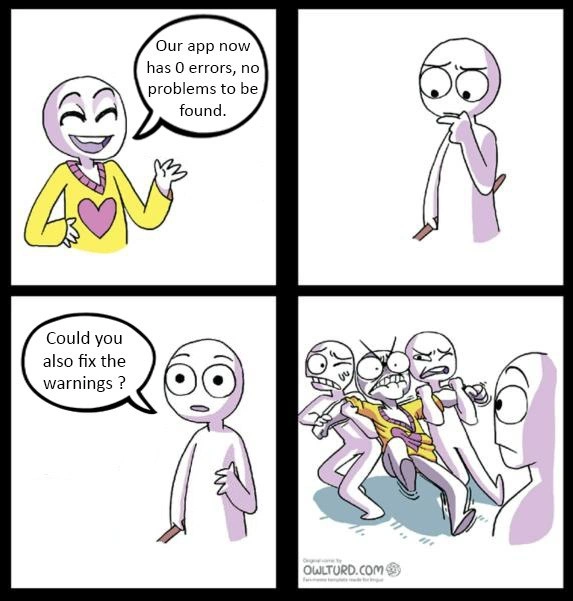
Now, in the meme, when the developer says “Our app now has 0 errors, no problems to be found,” he’s excited because the code compiled successfully with no errors at all. In his mind, that means the job is done and the app has “no problems.” But we (and the QA person in the comic) know that not everything is perfect. Sure enough, the QA person then asks, “Could you also fix the warnings?” This means even though the build had zero errors, there were still some warnings showing up. The developer was planning to ignore those because, hey, the program ran and the build succeeded. But the QA is saying, “Let’s not ignore them; let’s fix everything, even the small stuff.”
Who is this QA person? Quality Assurance engineers (QA) are the folks who make sure the software is not only working, but working well. They test features thoroughly, try to catch bugs, and often care about things like maintainability and best practices. If there are compiler warnings, a diligent QA or team lead might consider them worth fixing on principle – today’s warning could be tomorrow’s bug.
For a newer developer, here’s the key point: warnings vs errors are not the same. Zero errors means your code passed the basic test of “will it run at all.” But warnings are the tool’s way of suggesting, “This might be a bad idea, even though I can still run it.” It’s like if you handed in homework and got a perfect score (no errors), but the teacher wrote a note saying “Your handwriting is messy” or “Be careful with this step.” The score is fine, yet there’s feedback to heed. A program can run with warnings just fine right now. However, it’s usually a good idea to fix warnings because they often highlight real issues or improvements. For example, an “unused variable” warning might not break anything, but cleaning it up makes the code cleaner and less confusing. A deprecation warning alerts you to change something before it stops working in a future update.
Many modern development teams strive to have no warnings at all in their builds, not just no errors. They treat any warning as something that should be resolved. In fact, some projects configure their build systems or CI/CD pipeline (the automated process that builds and tests code) to fail if any new warnings appear. This forces everyone to deal with warnings as soon as they come up, keeping the codebase tidy. Not all teams do this, though. In more relaxed teams, people might let warnings slide, especially if they seem harmless, and focus only on errors that immediately break things.
So what’s the joke here? It’s the way the developer reacts to the QA’s request. Instead of saying, “Sure, I’ll take care of the warnings too,” the comic shows the developer basically throwing a fit at the suggestion. The last panel has the developer (actually three of him, in a cartoonish effect) dragging the QA away in a rage. Of course, in real life a programmer isn’t going to literally attack their coworker! But they might roll their eyes, sigh dramatically, or complain “Why do we have to care about those stupid warnings? The code runs, doesn’t it?” It’s like if you cleaned your room and someone said, “You missed a spot,” and you got so mad you practically chased them out of the room. The humor comes from exaggerating that feeling of being annoyed when someone asks you to do extra work that you technically could skip.
In summary, the developer is happy that the code compiled with 0 errors (think of that as “no visible mess”), but the QA asks him to also fix the warnings (clean up the hidden or minor messes). The developer’s over-the-top angry reaction is played for laughs – it’s poking fun at how we can get defensive about our work. The meme is funny to developers because it reflects a real scenario in a silly way: sometimes we declare victory too soon (“It builds, we’re done!”) and get grumpy when told to polish things up. The takeaway for a junior dev is: just because the code compiled doesn’t mean it’s perfect. Those warnings deserve attention too, even if they’re not as urgent as errors. Keeping a clean build (no errors and no warnings) is part of good coding practice, even if this comic shows a dramatized tantrum when someone is reminded of that.
Level 3: Green Build, Yellow Flags
This meme hits home for any seasoned developer who's seen a “clean” build that wasn't truly clean. In the first panel, our proud developer is celebrating a successful build: “Our app now has 0 errors, no problems to be found.” That euphoric moment when the code finally compiles with no build failures and all tests pass is something every dev savors. It's the green light in the Continuous Integration (CI) pipeline – a signal that it’s safe to deploy. Compiler errors: 0. Woohoo! Time to pat ourselves on the back, right?
But then comes the second panel: a colleague (in this case, a QA engineer) pauses, hand on chin, clearly pondering something. You just know a caveat is coming. By panel 3, they pop the dreaded question: “Could you also fix the warnings?” – essentially the classic “please fix those warnings” request that many developers have heard at least once. In software terms, this is like saying, “Great, it runs... now can we make sure it doesn’t have any potential issues either?” It's a reasonable question from a code quality standpoint – after all, those warnings exist for a reason. However, it touches a nerve in developer culture.
Suddenly in panel 4, chaos ensues: the once-happy developer has effectively cloned themselves into three enraged copies, and they're dog-piling the poor QA who dared to mention the dreaded W-word (warnings!). This ridiculous overreaction by the dev team is what makes it coding humor. It's a caricature of the tension between “It works, ship it!” and “But shouldn’t we make it cleaner/better?”. Developers often joke that once the code compiles and runs, any further nitpicking (like addressing non-crashing warnings) is just cruel. The meme exaggerates this sentiment to comic extremes – the developer(s) literally dragging the requester away as if to silence them, which visually represents the dev team’s over-the-top pushback.
Why is this so relatable? In many development teams, compiler warnings are treated as second-class citizens compared to errors. They show up as yellow or gray messages in the build log that everyone sees but often ignores. The attitude often is:
"Meh, it's just a warning. The app runs, so it's fine."
In other words, many developers think if the program works correctly, warnings can be safely ignored as harmless noise. This mindset is especially common when deadlines are tight or the team is juggling heavy workloads – it’s hard to justify polishing things that aren’t on fire. Warnings can pile up over time until they become background wallpaper in the build output. No one fixes them because no one has made it a priority. It's like the broken windows theory applied to code: if you tolerate a little mess, people start assuming it’s normal and ignore it completely.
Now enter the QA perspective. QA (Quality Assurance) folks are tasked with looking at the product holistically and catching issues that developers might overlook. From a QA point of view, those warnings are problems waiting to happen – maybe not today, but perhaps in the next release or under an unusual scenario. So when a QA engineer says “fix the warnings,” they’re advocating for preventative maintenance and higher standards. In our meme, the QA’s request to clean up warnings is akin to pointing out something the developers have swept under the rug. To a developer who’s just relieved that the feature finally works and all the errors are gone, this feels like a bucket of cold water.
"We finally got this thing to compile and pass tests, and now you want us to waste time on warnings?!"
That reaction (which many of us have at least felt internally) can make the QA’s valid request seem like nitpicking. It’s as if the goalposts were moved: you thought you scored a goal by getting a successful build, and now someone says the goal doesn’t count unless you also repaint the lines on the field.
The humor also lies in a familiar developer pain point: being asked to do cleanup or extra polish when you thought the job was already done. It’s an ouch moment that most programmers have experienced. You fix all the major bugs or compile errors in a task, feeling victorious, only for a colleague or a code reviewer to come back with, “Looks good, but can you also address these minor warnings (or style issues)?” Internally, you might groan or feel a twinge of annoyance. The meme externalizes that feeling as a comically violent outburst. We laugh at the cartoon because of how absurdly it depicts something that, in real life, usually happens through gritted teeth and maybe a passive-aggressive comment in the commit message.
From an organizational standpoint, this meme highlights a gap in priorities and communication. Developers are often under pressure to deliver new features and meet deadlines, so they tend to focus on the minimum criteria for “done” (if it builds and passes basic tests, ship it!). Non-fatal issues like warnings might be logged in a backlog but are easy to defer. QA, however, is responsible for the overall quality, which includes things that might not immediately break anything but could affect maintainability or cause future bugs. So you get this classic friction: the developer thinks, “Why are we talking about warnings when the app works?” and the QA thinks, “Why celebrate an app that ‘works’ if it’s giving hints of possible problems?” Both sides actually want a good product, but they have different thresholds for what needs attention now.
The cartoon’s extreme depiction of the dev team’s reaction (physically assaulting the person who brought up warnings!) underscores how touchy this subject can be. Of course, in reality no one is going to literally drag QA out of the building for suggesting better practices. But verbally, you might witness heated arguments or grumpy attitudes in meetings when this topic comes up. The meme gets a laugh because it takes that annoyance and dials it up to 11. The developer's over-the-top response is a way of poking fun at ourselves — how sometimes we programmers do get irrationally defensive when someone points out flaws right after we finally got things working.
In the end, experienced developers chuckle at this comic because they’ve learned the hard way that 0 errors ≠ 0 problems. A build that’s “green” but full of yellow warning flags is not truly clean. It may run today, but leaving warnings unchecked is just delaying the cleanup (or worse, planting the seeds of a future bug). The meme is a lighthearted reminder of that truth. It’s funny and a bit cathartic because we recognize the scenario so well. The ideal solution, of course, is to make fixing warnings a normal part of coding (so nobody has to beg for it later), but then we wouldn’t have this hilarious comic to bond over. After all, part of developer humor is laughing at our own little frustrations and the silly situations we find ourselves in when communication breaks down. It’s both a technical lesson (don’t ignore warnings) and a cultural one (devs and QA should be on the same side, not adversaries).
Level 4: The Compiler's Conscience
At the deepest technical level, compilers treat errors and warnings very differently. When you compile code, the compiler builds an internal model of your program (often an Abstract Syntax Tree or AST) and enforces the language’s rules strictly. If there's a direct violation of those rules – say a type mismatch or a missing symbol – the compiler raises an error. Errors are non-negotiable fatal problems: the code cannot proceed to build an executable until they're resolved. For example, if you try to add a number to a piece of text or call a function that doesn’t exist, you’ll get a hard error and the build will halt. You must fix such errors to get the program running.
Meanwhile, warnings are the compiler's polite way of saying, "This isn’t technically against the rules, but it looks suspicious." Compilers (and static analysis tools called linters) perform additional checks on code that go beyond mere syntax. They use heuristics and flow analysis to catch likely bugs or bad practices. However, because these conditions might not break the program right now, the compiler doesn’t stop you – it just warns you. It’s like the compiler has a conscience whispering, "Are you sure you meant to do this?"
Let’s illustrate the difference with a simple comparison:
| Code Snippet (C++) | Compiler Reaction |
|---|---|
int x = "hello"; |
Error: cannot convert const char* to int. (Compilation fails.) |
int unused = 42; /*...*/ |
Warning: unused variable unused. (Program still compiles fine.) |
In the first case, the code breaks a fundamental rule (assigning incompatible types), so the compiler emits an error and refuses to continue. In the second case, having an unused variable doesn't violate the C++ grammar or type system – the program will run just fine – but the compiler issues a warning (for example, -Wunused-variable in GCC/Clang) to flag a potential issue: why allocate something that's never used? Maybe it’s a mistake or leftover.
Under the hood, compilers maintain a whole set of warning diagnostics for things like: unused variables, deprecated function calls, unreachable code, possible null pointer dereferences, signed vs. unsigned number comparisons, and so on. These are real issues that might indicate bugs or poor code quality, but they aren’t outright errors according to the language specification. The decision to label something a warning is often about conservatism vs. pragmatism. The compiler designers ask: Is this construct always wrong, or just possibly wrong? If it's "always wrong" (like a syntax error or type violation), it must be an error. If it's "possibly wrong" or a bad practice, it becomes a warning – a nudge to the developer without halting the build.
This approach balances safety with practicality. There’s a theoretical aspect here: because of the Halting Problem and other limits of static analysis, a compiler cannot perfectly detect every logical bug in code – it can only make educated guesses. If compilers treated every guess of a potential bug as a fatal error, developers would be blocked by too many false alarms. Instead, warnings serve as a compromise: they signal “This could be trouble” but leave it to the programmer to decide how to handle it. It's the compiler acting as an early QA, pointing out code that smells funny without crying wolf each time.
Many professional teams actually adopt the stance that any compiler warning is a serious matter – they turn on strict flags like -Wall (enable a broad set of warnings) and even -Werror (treat all warnings as errors) during development. This forces a zero-tolerance policy: the build fails if there's even one warning. In effect, it makes the distinction between warnings and errors disappear because any warning will break the build. The scenario in our meme arises in teams that haven’t mandated that level of strictness: the build might be “clean” in terms of 0 errors, but still unclean with numerous warnings that scroll by in yellow text during compilation.
In short, warnings are the compiler’s conscience and a legacy of early static analysis tools (the original Unix lint program was literally created to pick the "lint" – tiny flaws – out of C code). They exist because compilers want to help you catch issues before they become real bugs. But since warnings don't actually stop the show, whether to fix them often becomes a judgment call left to developers. That’s exactly where our meme’s conflict comes from: the code technically compiles (no errors), yet the compiler’s conscience has raised some yellow flags, and someone (QA in this case) is daring to insist those be addressed.
Description
A four-panel comic strip by artist Shen Comix (also known as Owlturd). In the first panel, a cheerful cartoon character in a yellow sweater with a pink heart on it proudly exclaims, 'Our app now has 0 errors, no problems to be found.' In the second panel, another plain white character looks on thoughtfully, hand on chin. In the third panel, this second character asks, 'Could you also fix the warnings?'. The final panel depicts the first character being forcibly dragged away by three other figures, screaming and resisting, while the character who made the request looks on with a neutral expression. This meme humorously captures a common developer frustration. The technical context is the crucial distinction between compiler/linter errors, which are critical issues that prevent code from running, and warnings, which are potential problems or style issues that don't break the application but are still recommended to fix. For developers, achieving 'zero errors' is a major milestone, so the immediate follow-up request to fix a potentially huge number of warnings can feel like a Sisyphean task that dismisses their hard work
Comments
7Comment deleted
An error is the build telling you it's broken. A warning is the build telling you that you're about to be
Nothing triggers a full-company incident like QA enabling -Wall -Werror on the 20-million-line monolith; suddenly every principal engineer is explaining why that 2008 deprecation warning is “core business logic.”
After 15 years in the industry, you learn that '0 errors' just means the compiler gave up trying to explain what's wrong, and those 847 warnings are actually the compiler's cry for help before it achieves sentience and quits to become a Rust evangelist
This perfectly captures the moment when a developer celebrates achieving `-Werror` compliance, only to realize the team has been running with `-Wall -Wextra` disabled for years. The real horror isn't the warnings themselves - it's discovering that 'fixing' them means confronting a decade of implicit conversions, unused variables, and that one function returning a pointer to a local variable that somehow still works in production
Errors die quietly; warnings rise like tech debt zombies, feasting on senior dev weekends
Propose -Werror in CI and watch the org escalate to a SEV-1 in Slack
“0 errors” is cute - flip on -Werror and watch CI fail on every TODO, nullability hazard, and deprecated API we’ve been labeling “future work.”