Skip to content
DevMeme
4237 of 7435
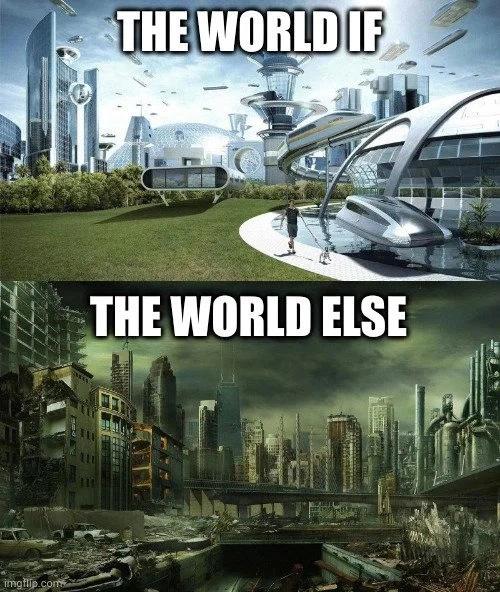
When a single else branch decides the fate of the entire world
CS Fundamentals Post #4632, on Jul 3, 2022 in TG

When a single else branch decides the fate of the entire world

Why is this CS Fundamentals meme funny?

Level 1: Choose Your Own Adventure

Imagine you’re reading a storybook where you get to decide what happens next. On one page it says: “If you take the left path, you find a treasure and the kingdom lives happily ever after.” But on the next page it says: “Else, if you take the right path, a dragon comes out and everything falls apart.” That’s exactly what this meme is joking about. It’s showing how one little choice (the left path or the right path, the if or the else) can lead to two completely different endings — one wonderful and one terrible.

In everyday life, it’s like saying: “If I do my homework, I get ice cream and a fun evening. Else, if I don’t do it, I get in trouble and have a bad day.” The top picture (the shiny city) is the happy ending where everything went right, and the bottom picture (the ruined city) is the bad ending where things went wrong. We find it funny because it’s such an exaggerated, cartoonish way to show how one tiny decision can change everything. It’s a big silly reminder that sometimes a small “yes or no” choice can feel like the difference between a perfect world and a disaster — and that idea, blown up to a global scale with futuristic cities and apocalypses, just makes us laugh!

Level 2: Fork in the Code

For a less seasoned developer, let’s break down the joke. In programming, an if/else statement is a basic construct that lets the program decide between two actions based on a condition. Think of it as a fork in the road of your code. The condition is usually a boolean value (true/false). If the condition is true, the program executes the code inside the if block. If it’s false, the program executes the code inside the else block. This structure is a cornerstone of CS fundamentals and a key part of controlling a program’s flow. In other words, conditional logic allows your software to make decisions.

The meme uses a popular two-panel format to visualize this idea. The top image shows a futuristic, utopian city with flying cars and happy people, labeled “THE WORLD IF”. The bottom image shows a dark, post-apocalyptic cityscape in ruins, labeled “THE WORLD ELSE”. These captions are a direct play on the code keywords if and else. It’s saying: “This is the world if the if condition is met... and this is the world else (i.e., if the condition is not met).” The contrast is extreme for comedic effect: in the if case, everything is perfect; in the else case, everything is broken.

So why is this funny to developers? Because it dramatizes a feeling we’ve all had when debugging or writing code. Even early in your coding journey, you learn that a single line can change program behavior. For instance, consider a simple login check:

if password == "secret123":
    print("Access Granted: Welcome!")
else:
    print("Access Denied: Wrong Password.")

This tiny control flow decision completely changes the outcome for the user — one path prints a welcome message (a good result), the other prints an error (a bad result). The meme exaggerates this concept to the entire world: one branch leads to a tech utopia, the other to total collapse. It’s relatable because even in small projects, forgetting to handle the “else” case or writing a wrong condition can lead to big problems (maybe not city-destroying, but possibly app-crashing!). Many new programmers have run into bugs where they thought “If only that if condition had been true, everything would have been fine!” or discovered that an untested else-path did something crazy. This is a form of DeveloperHumor that makes light of those “facepalm” moments when a tiny code decision has outsized consequences. By referencing an “if/else” in the meme’s text, it firmly anchors the joke in coding culture—anyone familiar with ConditionalLogic or basic code ControlFlow will get the pun. And the hyperbolic imagery (high-tech paradise vs. crumbling city) just makes the contrast comically obvious, much like how a bug can make the difference between an app running smoothly or crashing spectacularly. Essentially, the meme is a visual metaphor for a simple coding idea: one line of code can completely change what happens next.

Level 3: One Boolean, Two Worlds

At the highest technical level, this meme pokes fun at how an if/else conditional can bifurcate program execution into wildly different outcomes. The top panel’s gleaming utopia and the bottom panel’s wasteland illustrate two branches of code — one where a condition is true (the if branch) leading to a perfect scenario, and one where it's false (the else branch) leading to catastrophe. This contrast resonates with developers because a single boolean flag or condition often gates critical functionality. In real systems, a tiny piece of conditional logic can decide whether everything works smoothly or everything catches on fire.

In programming, control structures like if statements are fundamental to control flow. They act like forks in the road: if a condition is satisfied, the code takes one path; otherwise, it takes the alternate path. The meme hilariously exaggerates this by showing an ideal world versus an apocalyptic one, reflecting how it feels when a simple code branch determines success or failure. Seasoned developers have seen scenarios where a lone else clause (often an afterthought in code) triggers bugs severe enough to bring down systems. It’s the ultimate demonstration of the software “butterfly effect”: one small boolean flips and you either get The Jetsons or Mad Max in production.

Consider a snippet of pseudo-code capturing the meme’s essence:

if (conditionIsTrue) {
    // True branch: utopia
    enableFlyingCars();
    provideUnlimitedCleanEnergy();
    celebrateWorldPeace();
} else {
    // False branch: dystopia
    triggerZombieApocalypse();
    collapseCivilization();
    launchEmergencyBackupServers();  // too late, everything is down
}

Here the if path leads to a utopian outcome (flying cars, free energy — basically the developer’s dream world where everything works), while the else path leads to disaster (zombie apocalypse, civilization collapse — the nightmare scenario when a critical bug hits). DeveloperHumor often exaggerates, but there’s truth underneath: a wrongly placed else or a mis-evaluated condition can wreak havoc. For example, Apple’s infamous goto fail bug in SSL was essentially a tiny logic mistake that skipped a security check — akin to always taking the wrong branch — resulting in a major vulnerability. And who hasn't merged a seemingly innocent feature flag, only to find that the else path (which never ran in testing) causes a production meltdown? No pressure on that one if statement, right? This meme humorously captures that shared anxiety. We laugh because every experienced dev knows the stakes of a single branch: the fate of your program (or your all-nighter) can hinge on it. It’s a tongue-in-cheek reminder that in code, as in the meme’s two-panel world, branching logic consequences can be night-and-day.

Description

Two-panel meme. Top image: bright, ultra-modern utopian city with sleek skyscrapers, flying cars, green lawns, and people strolling; bold white text centered at the top reads "THE WORLD IF". Bottom image: dark, ruined, post-apocalyptic city with collapsed buildings, broken highways, flooded streets, and smoggy sky; bold white text centered at the top of this panel reads "THE WORLD ELSE". The joke riffs on programming control flow - an idyllic outcome for the true branch versus catastrophic results for the else branch - highlighting how a single conditional statement can radically change execution paths, a relatable exaggeration for developers debugging if/else logic

Comments

23
Anonymous ★ Top Pick Legacy law: between utopia and a 3 AM Sev-0 lies one untested else branch that nobody’s owned since the original architect became a keynote speaker
  1. Anonymous ★ Top Pick

    Legacy law: between utopia and a 3 AM Sev-0 lies one untested else branch that nobody’s owned since the original architect became a keynote speaker

  2. Anonymous

    This is what happens when your error handling consists entirely of '// TODO: handle this properly later' - the ELSE clause becomes a post-apocalyptic wasteland of unhandled exceptions, null pointers, and that one legacy system nobody wants to touch that somehow keeps the entire infrastructure running

  3. Anonymous

    This meme perfectly captures the senior engineer's existential dread: we spend 80% of our time architecting the pristine 'if' path with clean abstractions and elegant patterns, only to watch production traffic inexplicably take the hastily-written 'else' branch we added at 2 AM before the deploy. The real kicker? That else clause you thought would handle 0.01% of cases? It's now your primary code path, and the utopian if-block you lovingly crafted is gathering dust in the coverage reports at 3% execution

  4. Anonymous

    We architect the “if” for the roadmap; the “else” gets written at 3am via kubectl exec by whoever’s on call

  5. Anonymous

    World IF: exhaustive match on a sealed enum; World ELSE: the catch‑all default that logs “should never happen” and pages Ops at 3am

  6. Anonymous

    The world if architecture diagrams matched prod vs the world else: three layers of 'temporary' hacks and a COBOL microservice

  7. @sylfn 4y

    looks like there were times when second picture was better than first now

    1. @RiedleroD 4y

      what?

      1. @sylfn 4y

        maybe russian will help "на второй картинке видно, что когда-то там было лучше, чем сейчас на первой"

        1. @RiedleroD 4y

          I still don't speak Russian 😅

          1. @sylfn 4y

            second picture before apocalypse is better than first picture

        2. @feskow 4y

          i don't see why city on second picture was better

          1. @sylfn 4y

            that is just feeling without proof

            1. @RiedleroD 4y

              maybe because it feels more familiar?

        3. @beton_kruglosu_totchno 4y

          "the scene from 2nd picture was once better than on 1st picture before it decayed" @RiedleroD

          1. @RiedleroD 4y

            ah, that makes a lot of sense. Yeah, again, mostly because there's a lot of things to recognize from how our cities currently look.

  8. @beton_kruglosu_totchno 4y

    actually they both look awful without trees

    1. @RiedleroD 4y

      the first one looks like some Oligarch Haven, and I'm not here for that.

  9. @glatavento 4y

    if [[unlikely]] else [[likely]]

  10. @elonmasc_official 4y

    It is reversed in the world of golang

  11. @MedjayBayek 4y

    Idiocracy

  12. dev_meme 4y

    The world try The world catch

    1. @feskow 4y

      Functional programming OOP

Use J and K for navigation