Skip to content
DevMeme
2896 of 7435
The Watchdog Has a Watchdog
Apple Post #3201, on Jun 8, 2021 in TG

The Watchdog Has a Watchdog

Why is this Apple meme funny?

Level 1: The Guard Has a Guard

This is like a museum where one guard watches a door, and another guard watches that guard. If you distract the first guard, the second guard sounds an alarm. If you remove the second guard, an even bigger alarm goes off. The joke is that the phone is so determined to stay working that even turning off the safety checker is treated as danger.

Level 2: The Health Check Bites

A watchdog is a safety mechanism that checks whether something is still alive. The watched component must periodically report in, often called a check-in or heartbeat. If it stops reporting, the watchdog assumes the system is stuck and triggers recovery.

In this image:

  • SpringBoard is the iOS process responsible for important home-screen and app-launching behavior.
  • watchdogd is shown as the daemon involved in watching system health.
  • Userspace means normal system processes outside the kernel.
  • A kernel panic is a serious OS-level stop condition, usually followed by a reboot.
  • A KEXT is a kernel extension, a lower-level component that can participate in system behavior.

The confusing part for a newer developer is that stopping a troublesome process does not always remove the rule it enforces. Sometimes the rule exists at another level. If your app is being restarted by a process manager, killing the process manager may trigger a platform alert. If your container fails a health check, the orchestrator may restart it. If the thing that handles health checks disappears, a still deeper layer may decide the machine is unsafe.

So the visible question "how do I disable it?" has the classic systems answer: carefully, with more context than you wanted, and possibly not from the layer you are standing in.

Level 3: Liveness Recursion

The best line in the image is the reply:

The watchdog has a watchdog!

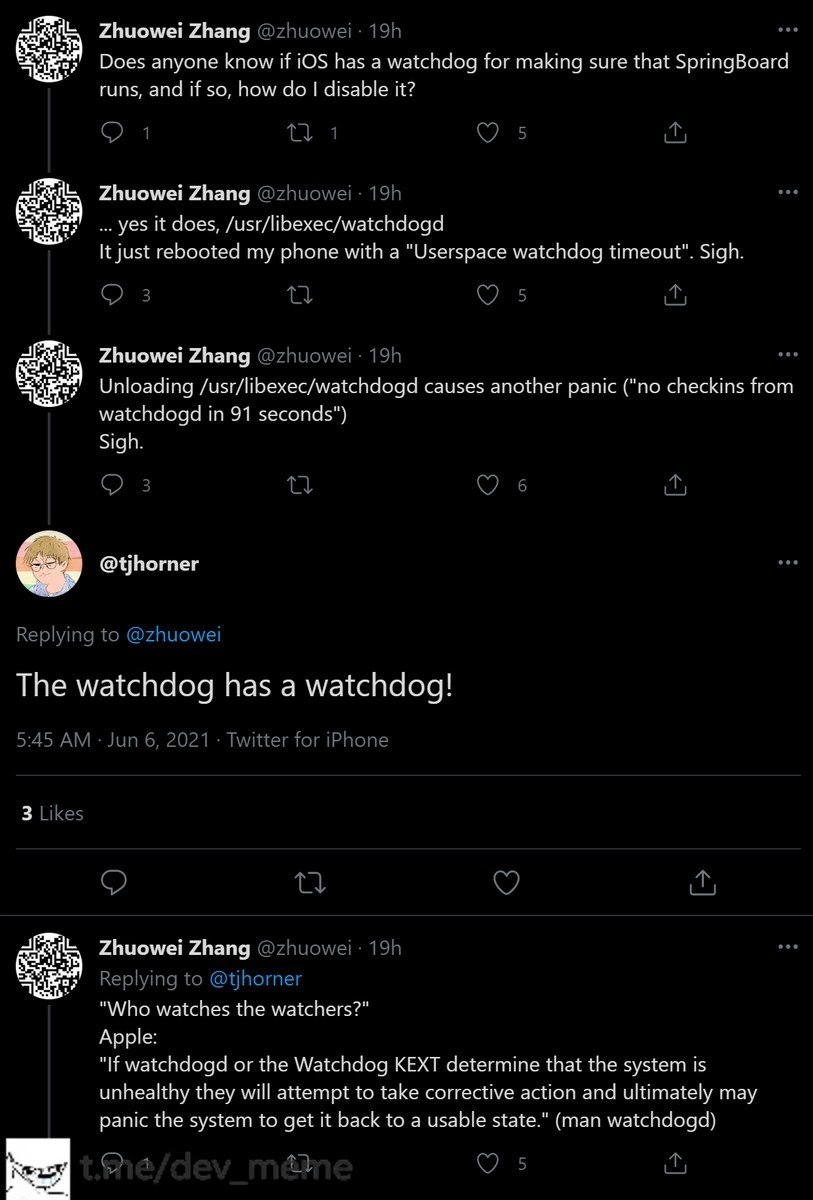
That lands because it turns a debugging attempt into a reliability ouroboros. Zhuowei Zhang first asks whether iOS has a watchdog for SpringBoard and how to disable it. The next visible posts answer the question by experiment: yes, /usr/libexec/watchdogd exists; yes, the phone can reboot with a userspace watchdog timeout; and no, simply unloading the daemon does not make the problem go away.

For experienced developers, this is familiar in a painful way. Production systems often contain layers of supervisors, process managers, health checks, circuit breakers, orchestration probes, service meshes, and platform daemons whose job is to restart the thing that stopped responding. Then one day you try to debug the restarted thing by stopping the restarter, and you learn that another restarter is watching that restarter. Congratulations, the architecture has become a trust fall with a clipboard.

The humor is especially sharp because iOS is not a friendly playground for arbitrary system surgery. On a desktop Unix machine, stopping a service may just break that service. On a phone, SpringBoard is central to the user experience, and Apple strongly prefers a device that reboots into a usable state over one that lets a researcher quietly remove safety rails and leave the UI wedged. That makes sense for users, and it is maddening for anyone trying to inspect internals.

The post message jokes that Tim Cook will personally shut down the phone if the hardware watchdog is removed. That exaggeration works because the visible thread already makes iOS look almost personally offended by tampering: kill SpringBoard supervision, get rebooted; kill the supervisor, get panicked. Somewhere deep in the stack, a tiny policy engine is folding its arms.

Level 4: Watching the Watchdog

The visible thread is funny because it stumbles into a real operating-system reliability pattern: liveness supervision. A component like SpringBoard can be monitored by watchdogd; watchdogd itself can be monitored by a deeper watchdog mechanism; and if the expected check-ins stop, the system may choose a forced reboot or kernel panic over remaining in an unknown state. The image says the phone rebooted with:

Userspace watchdog timeout

and then says unloading /usr/libexec/watchdogd caused another panic with:

no checkins from watchdogd in 91 seconds

That is not arbitrary cruelty. In a tightly controlled mobile OS, the system is designed around the assumption that certain services must keep proving they are alive. A watchdog is effectively a deadline monitor: "tell me you are healthy before the timer expires, or I assume the system is wedged." This is common in embedded systems, phones, appliances, and other environments where a hung UI is worse than a hard reset.

The recursive joke is that disabling the monitor looks like a clever debugging shortcut until the architecture treats the absence of the monitor as its own failure condition. This is the systems-programming equivalent of removing the smoke detector and discovering the building has a smoke-detector detector. It feels absurd, but the logic is defensible: if the thing responsible for enforcing recovery disappears, the platform can no longer trust its own health model.

This is also why the Apple-style line in the screenshot says watchdog components may take corrective action and may panic the system to restore usability. In kernel and mobile OS design, "panic" sounds dramatic because it is, but it is sometimes the least bad option. A device stuck in a half-dead state can lose input, block critical services, drain battery, or corrupt assumptions held by higher layers. A reboot is crude, but crude tools are popular because they still work at 3 AM.

Description

A dark-mode Twitter thread shows Zhuowei Zhang, @zhuowei, asking: "Does anyone know if iOS has a watchdog for making sure that SpringBoard runs, and if so, how do I disable it?" He then replies: "... yes it does, /usr/libexec/watchdogd It just rebooted my phone with a "Userspace watchdog timeout". Sigh." and "Unloading /usr/libexec/watchdogd causes another panic ("no checkins from watchdogd in 91 seconds") Sigh." Another user, @tjhorner, replies, "The watchdog has a watchdog!" timestamped "5:45 AM · Jun 6, 2021 · Twitter for iPhone," with "3 Likes." Zhuowei then quotes "Who watches the watchers?" and an Apple manual-style line explaining that watchdogd or the Watchdog KEXT may panic the system to restore usability, while a "t.me/dev_meme" watermark sits at the bottom.


Comments

8
Anonymous ★ Top Pick Killing the liveness checker just summons the liveness checker checker, which is exactly the kind of recursion that ends in a panic.
  1. Anonymous ★ Top Pick

    Killing the liveness checker just summons the liveness checker checker, which is exactly the kind of recursion that ends in a panic.

  2. @Dobreposhka 5y

    Tim Cock*

  3. @Agent1378 5y

    But why? For rooting?

  4. @MagnusEdvardsson 5y

    You may buy apple products, but you never own them

  5. @ZgGPuo8dZef58K6hxxGVj3Z2 5y

    This is nothing compared to windows there are A LOT of watchdogs... not to speak about UWP. I hope there will be a new kernel with UWP only in mind. That would be the best OS ever like Xbox just without Win32 games

    1. @Odbjorn 5y

      Use Linux ?

      1. @blade_prime 5y

        Awoken ones say btw arch

        1. @arpanetus 5y

          guix u meant

Use J and K for navigation