Skip to content
DevMeme
4235 of 7435
When your C code just stares into the void pointer abyss
LowLevelProgramming Post #4630, on Jul 2, 2022 in TG

When your C code just stares into the void pointer abyss

Why is this LowLevelProgramming meme funny?

Level 1: Pointing at Nothing

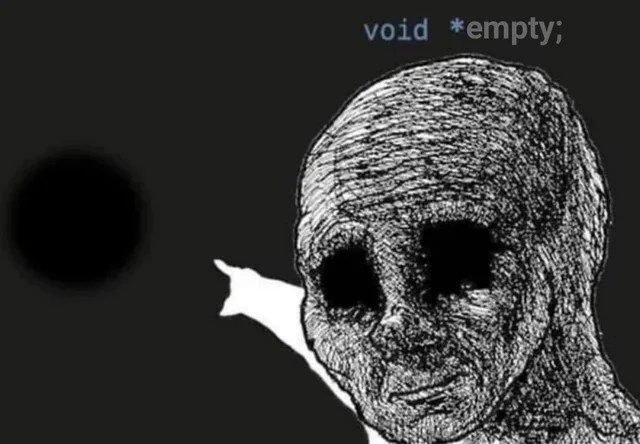
Imagine you have a map that’s supposed to lead you to treasure, but the map is completely blank. In programming, a pointer is kind of like a map to some treasure (the treasure being data in the computer’s memory). Now, in this meme, the code void *empty; is basically saying “here’s a map, but it doesn’t lead to anything yet.” The picture makes a joke out of it by showing a person (the drawn figure on the right) literally pointing at a big black empty circle (on the left) – he’s pointing at “nothing.” It’s funny in a nerdy way because the code uses the word void (which means “nothing” or “empty” in this context), and the image shows a void (an empty space). So the programmer’s code is literally pointing at nothing, and the poor guy in the drawing looks pretty upset about it!

You don’t need to know C to get the basic joke: it’s like someone trying to use a tool or a pointer that isn’t set up properly. It’s the same as giving directions to a place that doesn’t exist – if someone tries to follow those directions, they’ll end up nowhere, just lost. The emotional punchline is that the programmer is staring into this emptiness, probably realizing his mistake. It’s a bit silly and a bit dark: silly because pointing at nothing is absurd, and dark because in real life that mistake causes programs to crash. Even if you’re not a coder, you can relate to that feeling of “uh-oh, there’s nothing there!” The meme basically says: in the land of C programming, if you’re not careful, you might find yourself pointing at an abyss with your code – and that’s both tragic and comically true.

Level 2: Pointer to Nowhere

Let’s break down what’s happening for those newer to PointersInC. In C programming, a pointer is a variable that holds a memory address – basically, it “points” to a location in memory where some data is stored. Think of it like a card with a locker number on it: the card itself isn’t the stuff you want, but it tells you where to go find that stuff. A void * (pronounced “void pointer”) is a special kind of pointer that doesn’t have a type associated with it. It’s as if you have a magic key that could open any type of locker, but only if you know what type of locker you’re dealing with. You often see void * used for generic data buffers or in systems code where you need to pass around raw addresses.

Now, in the code snippet from the meme – void *empty; – we’re declaring a pointer named empty that can point to “something” (some data of any type), but we haven’t actually pointed it at anything yet. It’s like we just picked up a random locker key off the ground; we have no clue what locker (if any) it goes to. In C, if you don’t initialize a pointer (give it a definite address to hold), it contains whatever random bits were already in that piece of memory. This is UndefinedBehavior territory: using an uninitialized pointer is a big no-no. There’s no default safety net here (unlike some languages that might auto-initialize things to null or zero).

What happens if we try to use empty as it is? Say we tried to read or write through this pointer (called dereferencing the pointer). Because empty isn’t set to a valid address, the program will likely crash with a SegmentationFault. A segmentation fault is basically the operating system saying, “Hey, you’re pointing at memory you have no right to access – I’m gonna shut you down now.” It’s a very common error when dealing with pointers in C/C++ and is often one of the first serious bugs new C programmers run into. If you’ve ever seen a program output "Segmentation fault (core dumped)", that’s the system halting your program for touching memory it shouldn’t – often caused by a bad pointer. This can happen if you have a NULL pointer dereference (NULL means the pointer is explicitly set to point at nothing, address 0) or, like in our case, a completely garbage pointer like empty that could be pointing anywhere.

So why is the meme funny? It’s taking this technical scenario and giving it a literal visual. The text void *empty; is shown at the top to set the scene: “here’s a pointer to void named empty.” The left side of the image shows a solid black circle – basically void, nothingness. And on the right, you have a sad-looking Wojak character reaching out and pointing to that black circle. Wojak is a meme character often used to represent feelings – here likely the feeling of emptiness or despair. The poor guy looks like a developer who just found out their code is pointing to absolutely nowhere. It’s an existential kind of humor: “staring into the void” is a phrase used when someone is confronting emptiness or the great unknown, and a void * in C literally can be thought of as a pointer into the unknown. The meme resonates with programmers because dealing with such a bug (a pointer bug) often feels daunting and bleak at first – like you’re looking into a void trying to figure out what went wrong.

For a junior developer, the takeaway is: always initialize your pointers! If empty is meant to point to something, you’d either allocate memory for it (e.g. using malloc in C) or assign it the address of an existing variable. If you truly don’t have something for it yet, at least set it to NULL. For example:

void *empty = NULL;  // empty now explicitly points to nothing

This way, if someone (or you) later tries to use empty without assigning it properly, the program will reliably crash at that moment, which is easier to catch (because the address 0 is off-limits, the OS immediately raises a segfault). It’s better than empty holding some random address which might not crash immediately and instead corrupt memory. This simple void *empty; bug is a classic in LowLevelProgramming with C – it might compile without errors or warnings (unless you have extra checks enabled), but it blows up when your program runs. The meme is a light-hearted reminder of that classic Bug. It taps into the shared knowledge among C programmers (and C++ folks, who also deal with raw pointers) that something as small as one uninitialized pointer can send you on a wild hunt through core dumps and debugger sessions. Seeing the Wojak pointing at literal emptiness perfectly captures that “Oh no…” moment when you realize what the issue is.

Level 3: The Abyss Gazes Back

In C (the granddaddy of Low-LevelProgramming in the CFamilyLanguages), declaring void *empty; is like loading a debugger’s haunted house. A **void*** is a generic pointer – it can point to any data type. But here it’s not pointing to anything at all, just declared and left hanging. Seasoned developers immediately cringe at this combo of emptiness and pointers. Why? Because an uninitialized pointer is pure UndefinedBehavior. It’s the code equivalent of staring into a black hole: if you try to use that pointer, SegmentationFault is practically waving from the abyss. The meme’s Wojak figure with hollow eyes and outstretched finger captures that thousand-yard stare of a programmer who just realized their pointer went NULL and void – quite literally gazing into nothingness.

For a senior engineer, this image hits home. We’ve all been there: at 3 AM, chasing a mysterious crash, only to find some forgotten void * that was never assigned. The joke exaggerates the scenario into existential_void_humor, but it’s not far off – debugging memory bugs can feel like communing with the void. The text void *empty; in light-blue monospace is both a simple C declaration and a warning sign. In a language with ManualMemoryManagement, if you don’t assign that pointer to a valid memory address (maybe from a malloc or by pointing at an existing variable), it remains an unpredictable beast. It might still hold some leftover garbage address from the stack – a one-way ticket to segfault city.

UndefinedBehavior in C is notorious: the language spec literally says anything can happen if you misuse memory. Maybe your program crashes immediately with a brash SegmentationFault, or maybe (worse) it doesn’t crash and instead silently corrupts data elsewhere. Seasoned C folks joke that UB could even make “demons fly out of your nose” – meaning it’s completely out of your control. An uninitialized void * is exactly that kind of demon. If you’re lucky, it’s just NULL and you get a clean crash. If you’re unlucky, it points to some valid-looking address and you end up scribbling over random memory, leading to bizarre bugs that gaze back at you much later. That’s the dread of a null_dereference_dread and its even sneakier cousin, the wild pointer. This meme condenses that dread into a single frame: the left side’s black circle is the “void” in void pointer – a perfect visual pun – and the Wojak on the right is every programmer witnessing their code leap into that emptiness.

The humor here comes from two levels of void: void* means “pointer to no specific type,” and in this case it’s also pointing to no actual data. It’s like a double negative making a darkly funny positive – a pointer truly pointing to the void. The meme format (a sorrowful Wojak pointing) adds that layer of shared veteran sentiment: “Yep, I’ve done this. I’ve pointed a pointer into oblivion and paid the price.” It’s an inside joke among systems programmers, poking fun at how a tiny oversight (void *empty with no value) can open up an abyss of troubleshooting. The Languages tag is no accident: only in a language like C (or C++ if you’re not careful) do you get this mix of power and peril. High-level languages won’t even let you touch this abyss – but then, where’s the fun (or the horror)? As the saying goes, “If you gaze into the pointer abyss, the pointer abyss gazes also into you.” This meme nails that truth: in C, when your code stares into a void pointer, sometimes the SegmentationFault stares back.

Description

A dark-mode meme shows a Wojak-style line-art figure on the right, sketched in white against a solid black background, with its arm outstretched and index finger pointing left. Floating on the left side is a perfectly round, pitch-black circle that visually represents absolute nothingness. Center-top, rendered in a light-blue monospace font, the exact code snippet "void *empty;" appears, declaring a void pointer named "empty". The joke riffs on low-level C programming: a void* can point to any type yet, if left unassigned, it literally points to the void - invoking memories of null dereferences, undefined behaviour, and manual memory-management dread familiar to systems engineers

Comments

33
Anonymous ★ Top Pick Fifteen architecture reviews later, the “extensible plugin framework” is still a single global void *empty; - apparently undefined behaviour is the most scalable abstraction
  1. Anonymous ★ Top Pick

    Fifteen architecture reviews later, the “extensible plugin framework” is still a single global void *empty; - apparently undefined behaviour is the most scalable abstraction

  2. Anonymous

    After 20 years in the industry, I've learned that void pointers aren't just type-erased memory addresses - they're portals to the shadow realm where your debugger fears to tread and valgrind whispers 'definitely lost: 8 bytes in 1 blocks'

  3. Anonymous

    When you dereference that void pointer at 3 AM and realize you've been staring into the abyss of uninitialized memory - and the abyss segfaults back. The real horror isn't the undefined behavior; it's explaining to the on-call team why production went down because someone thought 'void *empty' was just a philosophical statement, not a ticking time bomb waiting for that inevitable NULL check you forgot to write

  4. Anonymous

    Dereference that void*, and the void dereferences your stack trace right back

  5. Anonymous

    void* empty; - the event horizon of our ABI where every type crosses and type safety never returns

  6. Anonymous

    void* is the black hole of type systems - everything fits until invariants spaghettify into a 3am segfault

  7. Deleted Account 4y

    void*

  8. @sylfn 4y

    fixed

    1. @cptnBoku 4y

      Bruh

    2. @callofvoid0 4y

      exactly me

  9. @AlexKart20129 4y

    void *empty=nullptr;

  10. @RiedleroD 4y

    recently i had a uint8_t*& and I didn't like it. dereferencing yielded a uint8_t&. Dereferencing twice yielded an exception about how I can't dereference an uint8_t. I'm tired.

    1. @sylfn 4y

      you cant dereference references, only pointers

      1. @RiedleroD 4y

        …why?

        1. @beton_kruglosu_totchno 4y

          are you joking?

          1. @RiedleroD 4y

            I'm a beginner at C++, give me some slack

            1. @beton_kruglosu_totchno 4y

              references are transparent pointers, you do not dereference them, you just use them

              1. @RiedleroD 4y

                I didn't even mean to use references. I specifically asked for an uint8_t* to be passed into my function and C++ just gave me an uint8_t*& instead.

                1. @beton_kruglosu_totchno 4y

                  give us MCVE please :3

        2. @sylfn 4y

          references work as pointers but autodereferenced

          1. @RiedleroD 4y

            ok so why didn't it let me put a uint8_t& into a function that needed a uint8_t*?

            1. @beton_kruglosu_totchno 4y

              because reference is basically same as the value it references

    2. @beton_kruglosu_totchno 4y

      also, there cannot be a pointer to reference, so you are talking about reference to pointer

      1. @RiedleroD 4y

        right, sorry. It was an uint8_t&*.

        1. @RiedleroD 4y

          I think.

        2. @sylfn 4y

          this is pointer to reference i think, and is disallowed

        3. @beton_kruglosu_totchno 4y

          I do not really remember how the types are written so maybe you named it correctly first time I just want to clarify that pointer to references do not exist because reference is supposed to be a compile time abstraction with potentially no runtime storage

      2. @sylfn 4y

        but why there is no "array of references"

  11. @SamsonovAnton 4y

    int** 0x3f800001 SIGBUS¹ ¹ On architectures that totally disallow unaligned access, like SPARC.

    1. @kulikov0 4y

      *cpp developer

      1. @sylfn 4y

        you can touch yourself!

        1. @kulikov0 4y

          Well, I'm in

  12. @hekary715 4y

    😳

Use J and K for navigation