The World's Fastest Corporate Reversal
Why is this CorporateCulture meme funny?
Level 1: Wait, I Changed My Mind
Imagine you’re playing a game of Jenga, building a tall tower out of wooden blocks. You decide to pull out one of the important blocks from the bottom – maybe you think it’ll make the game more exciting or you just weren’t sure what would happen. Well, as soon as you remove that block, the whole tower starts wobbling like it’s about to crash! You panic, realize you made a mistake, and quickly push the block back in to stop the tower from falling. Phew! In this story, the tower is a super important company, and that block you pulled out is like the company’s leader. The people in charge of the company thought they could remove their “block” (fire their boss) and everything would be fine, but instead everything started to shake and look like it might collapse. So now they’re rushing to put that block – their boss – back in place to keep the whole thing standing. It’s a bit like yelling at your best friend to go away, then realizing you really need them and saying, “Actually, wait, please come back!” It’s funny in a wow-that-was-silly way: even big, smart companies sometimes do something drastic and then say, “Oops, never mind, undo that!”
Level 2: Undoing a Mistake
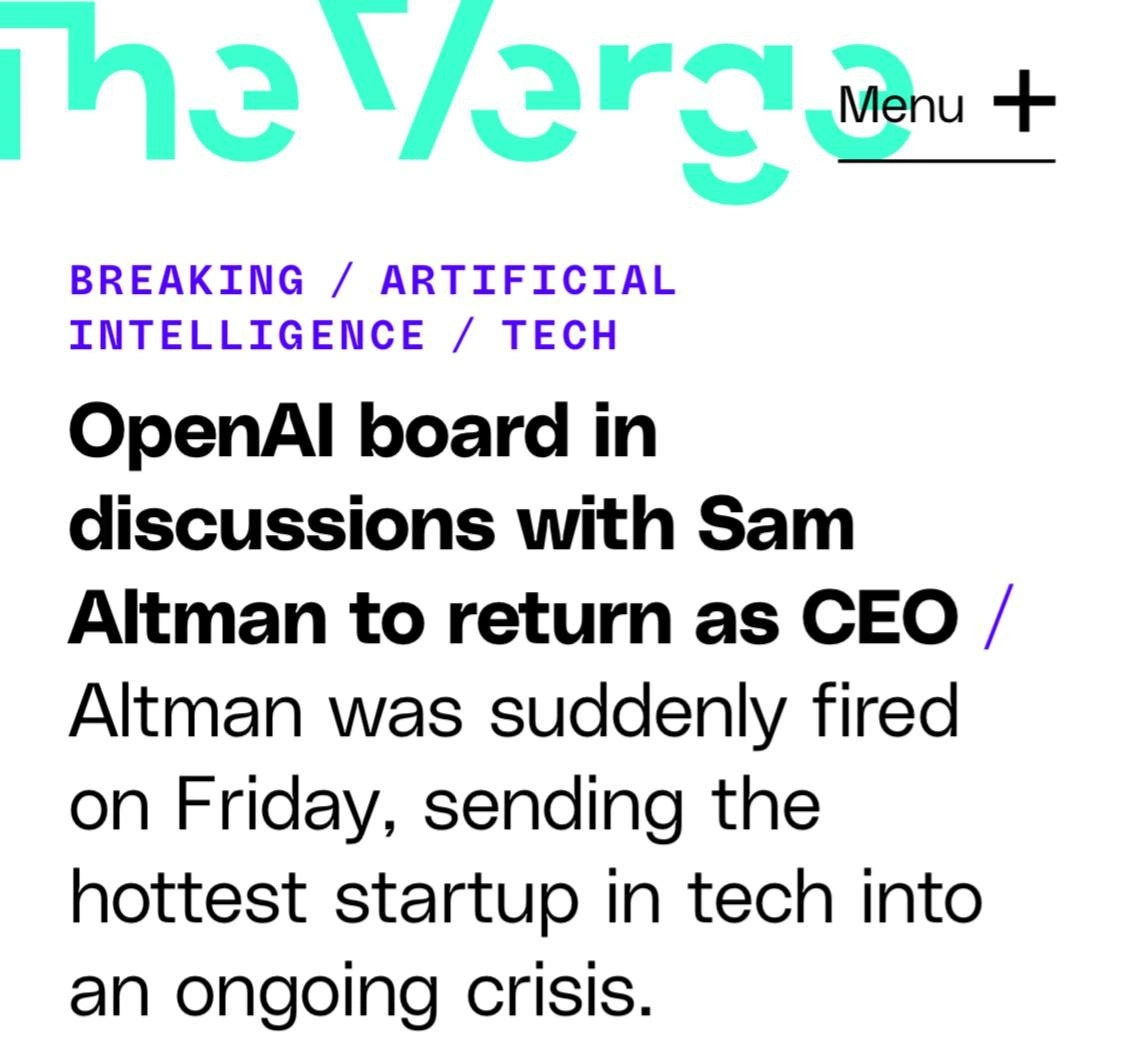
Let’s break down what’s happening in this meme. OpenAI is a famous AI startup (they created ChatGPT, which you might have heard of). Sam Altman, the guy mentioned, was the CEO – basically the boss running the company. Late one Friday, OpenAI’s board of directors (a group of people who oversee the company’s big decisions) suddenly decided to fire him. This was a huge surprise – imagine the coach of a champion team getting kicked out in the middle of a season. The news headline in the image, from a site called The Verge, says “OpenAI board in discussions with Sam Altman to return as CEO”. In simple terms, after firing him, the board is now talking about bringing Sam back as CEO. It’s a complete 180° turn, and it happened just a couple of days after the firing. The meme jokes that the startup is hitting Ctrl+Z – the keyboard shortcut for “undo” – on the “CEO commit”. In coding, a commit is when you save a set of changes to the codebase (like saying “yep, let’s go with these changes”). Here, the “CEO commit” refers to the decision the board made about the CEO – effectively a change at the top of the company. By “hitting Ctrl-Z”, the company is trying to undo that change. This is funny to developers because in our daily work, if we make a mistake in code, we can often revert it or undo it pretty quickly using version control tools (like Git) or even a simple undo command. But in real life, especially in a big company, you can’t usually reverse a huge decision with a keystroke. Firing a CEO is a massive move – it affects employees, products, investors, and even other companies that rely on OpenAI’s AI services. Indeed, many tech products out there use OpenAI’s APIs (their AI tools) in their own apps. So when Sam was fired, a lot of people in the tech community freaked out – “Is OpenAI going to be okay? Are our plans now in jeopardy?” It’s what the description calls an “ongoing crisis”. The startup culture at OpenAI went into chaos mode: imagine engineers not sure if they should continue their projects, managers fielding panicked calls from partners, and investors worrying if the company’s value will tank. The board basically saw this backlash and thought, “Uh oh, maybe we went too far.” So now they’re considering reversing their decision – essentially a do-over. In development terms, it’s like deploying a bad update and then quickly rolling it back to the last good version because everything started breaking. The meme captures this situation with humor: treating the board’s very human, high-stakes error as if it were just a mistaken code change that needs an undo. It’s poking fun at the AI hype cycle too – OpenAI is the superstar of AI right now (“the hottest startup in tech”), so any drama around it gets blown up big time. In summary, the company tried to make a bold change (new CEO) but immediately saw it was a mistake, and now they’re trying to “Ctrl-Z” that decision to calm things down.
Level 3: Friday Deploy, Monday Revert
Every seasoned engineer felt a pang of déjà vu seeing this saga: the board of the world’s hottest AI startup did a massive production deploy on a Friday (firing the CEO) and by Monday was frantically rolling it back. It’s the tech industry equivalent of merging a big untested feature that breaks everything. The meme’s title – “When your AI startup hits Ctrl-Z on the CEO commit” – nails the absurdity: they committed a leadership change and then essentially hit Ctrl+Z (undo) when chaos ensued. OpenAI sits at the peak of the AI hype cycle, powering products and slide decks across the globe, so ousting Sam Altman without warning was like yanking the main engine out of a moving plane. Senior devs recognize the fallout: product teams scrambling to reassess dependencies, sprint backlogs suddenly in flux because so much of the roadmap leans on OpenAI’s stability. The screenshot from The Verge drives it home – the bold headline “OpenAI board in discussions with Sam Altman to return as CEO” is tech’s version of an incident report. That urgent purple kicker “BREAKING / ARTIFICIAL INTELLIGENCE / TECH” might as well be a PagerDuty alert for anyone connected to the AI ecosystem. It signals that a supposedly “stable release” of corporate leadership has catastrophically failed and a hotfix is in progress. The humor here comes from treating high-stakes corporate drama with developer lingo: we talk about a CEO like a code change that can be reverted. It’s funny because in software, we’re used to version control and quick undos when something goes wrong – but in StartupCulture, undoing a board decision is almost unheard of. Yet here we are: the board basically introduced a bug into the organization (firing the visionary CEO, causing an uproar among employees and partners), and now they’re hastily patching it by rehiring him. It’s a surreal intersection of CorporateCulture and code culture. Veteran engineers have seen this pattern in other forms – a rushed decision that seemed “innovative” or bold, followed by a weekend of burning technical (and now managerial) debt to reverse it. It’s equal parts tragic and comic: the people at the top thought they could “pivot” instantly, only to learn that leadership isn’t something you can refactor overnight without breaking all the interfaces. So this meme strikes a chord: it’s a pithy commentary on AIIndustryTrends (where even the leadership is volatile during a hype frenzy) and a nod to the universal law of tech: Don’t deploy major changes on Friday – whether it’s code or CEOs.
Level 4: Two-Phase Commit: Board Edition
In a robust distributed system, a commit isn't final until everyone agrees – and if something goes wrong, you roll back to a safe state. Apparently, OpenAI’s board attempted an organizational version of a two-phase commit: Phase 1, they abruptly fired Sam Altman (the company’s co-founder and CEO) on Friday; Phase 2, they expected the system (employees, investors, partners) to accept the new state. Instead, the network of stakeholders threw a consensus error – essentially a “not OK” from every corner of the cluster. In database terms, the transaction was forced to ABORT. The board’s bold change wasn’t atomic or isolated at all; it left the company in a half-committed, inconsistent state (an “ongoing crisis”). None of the stakeholders were read-for-commit, so the only way to restore consistency was a complete rollback – undoing the CEO removal and trying to put Sam back at the helm. It’s as if the board attempted to COMMIT; without a proper PREPARE; stage, violating the first rule of distributed consensus: reach quorum before making irreversible changes. The fiasco underlines a darkly funny parallel between computers and corporate moves: even the hottest AI startup isn’t above basic ACID principles – make your changes Atomic, Consistent, Isolated, and Durable – or watch the whole system trigger a giant “Ctrl+Z” to recover. The undo here isn’t a simple keyboard shortcut; it’s a multi-day scramble akin to a cluster recovery after a failed deployment. Durability took a hit (that firing didn’t stick!), but at least eventual consistency might be restored by returning the original “primary node” (Sam) to leadership. In short, the board tried to push a high-stakes update to “production” on a Friday without consensus, and the only safe state turned out to be the previous state – leadership rollback engaged.
Description
A screenshot of a breaking news article from the tech publication 'The Verge'. The website's teal logo is visible at the top. Below the masthead, under the categories 'BREAKING / ARTIFICIAL INTELLIGENCE / TECH', the main headline in bold black text reads: 'OpenAI board in discussions with Sam Altman to return as CEO'. A sub-headline provides context: 'Altman was suddenly fired on Friday, sending the hottest startup in tech into an ongoing crisis.' This image captures the pivotal moment during the November 2023 OpenAI leadership saga where the board, just a day or two after firing CEO Sam Altman, was already negotiating his return. The rapid reversal highlights the immense pressure from investors and employees, and the chaotic, fast-moving nature of the corporate drama that dominated the tech industry's attention
Comments
7Comment deleted
The OpenAI board's decision-making process seems to follow a 'commit directly to main, panic, and then immediately try to git revert' strategy
The board basically ran `git revert HEAD~1` on Friday’s "remove_ceo" commit - now pray the conflict with Microsoft’s private fork resolves before Monday’s deploy
OpenAI achieved AGI: an Artificially Generated Instability that perfectly simulates a dysfunctional board meeting, complete with emergent properties like self-terminating leadership and recursive decision loops
When your board's rollback strategy is more aggressive than your deployment pipeline, but unlike production incidents, you can't just blame it on a misconfigured feature flag. Turns out 'move fast and break things' applies to organizational structure too - though usually we version control our CEOs better than this
The board shipped a Friday prod change called “new CEO,” triggered org-wide 500s, and spent the weekend trying to rollback to the last known good commit: Sam
OpenAI board's 48-hour CEO flip-flop: faster inference than GPT-4, zero reasoning tokens
Classic Friday deploy: ‘remove CEO’; weekend SEV-1, Monday revert HEAD~1 - turns out governance had no feature flags and the bus factor was 1