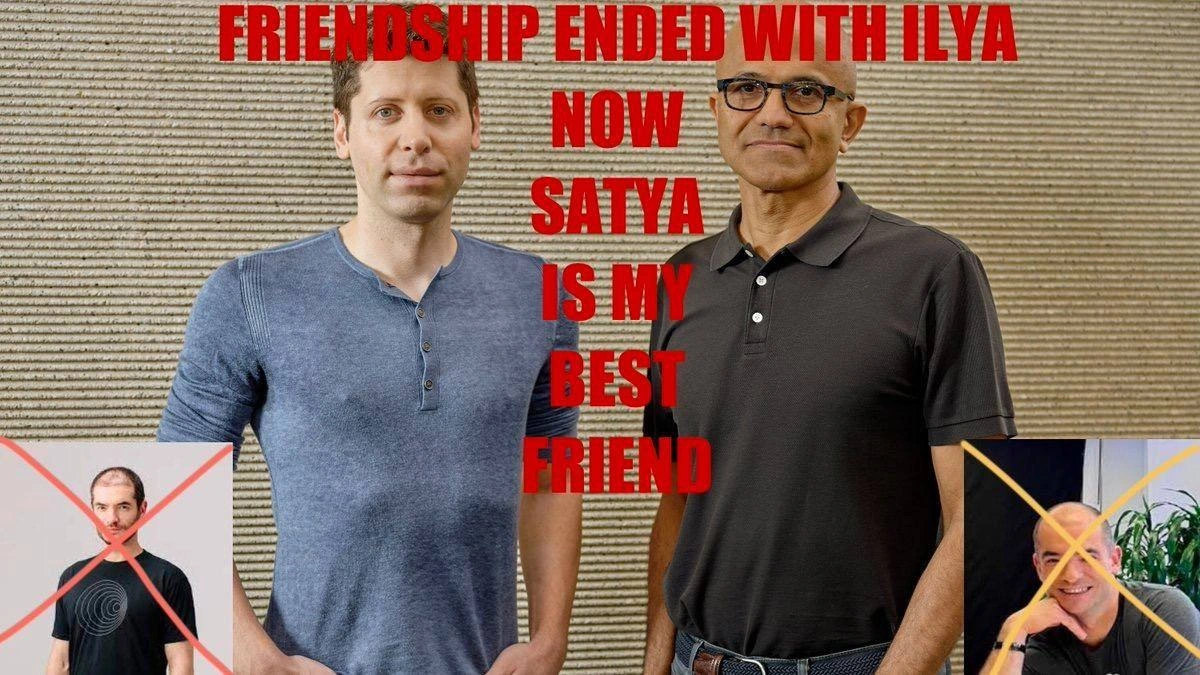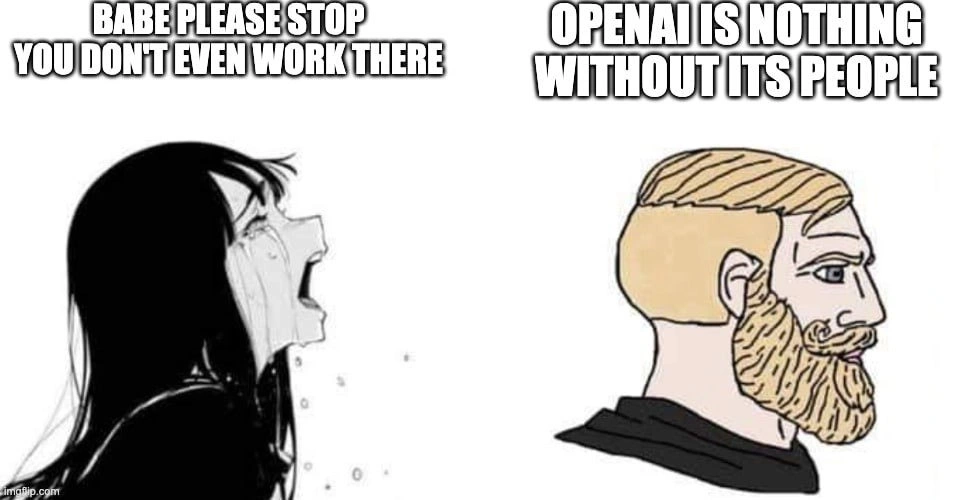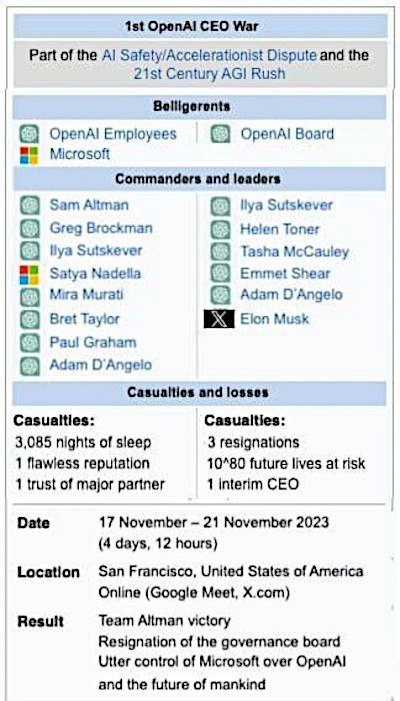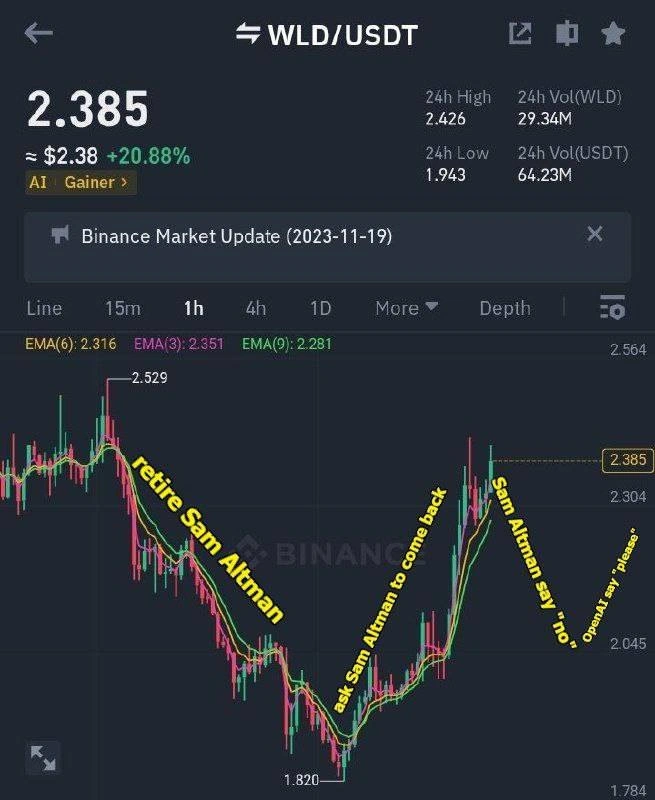
The OpenAI Boardroom Sniper Standoff of 2023
Why is this CorporateCulture meme funny?
Level 1: Big Fish, Bigger Fish
Imagine a bunch of kids playing with water guns in a backyard. One kid, let’s call him Sam, jumps out and squirts his friend – he feels like he’s in charge for a second. But then, from behind a bush, a second kid (the “board”) pops up with a super soaker and splashes Sam back. That second kid is like “Haha, I got you, I’m the boss now!” Now, they both think the second kid with the bigger water gun is going to win. But wait – up in the treehouse, a third kid (let’s call him Satya) has an even bigger high-pressure water hose. He sprays down at the first two, totally drenching the so-called boss with the super soaker. Now it looks like this kid in the treehouse is the real champion, right? He’s higher up (literally) and has the biggest hose. Here’s the funny twist: our first kid Sam quietly went and turned on the sprinkler system while everyone was busy. Suddenly, a giant sprinkler pops up and soaks the kid in the treehouse (and everyone else) all at once! Now Sam – the one who was ambushed at the start – ends up having the last laugh by using the biggest “water attack” of all.
In the end, every kid who thought they were the biggest bully with a water gun got soaked by someone else with a bigger splash. It’s a playful way to show that there’s always someone who can top you. In this story, Sam was out for a moment but came back around and soaked everyone. That’s why we find it funny – it’s like a surprise comeback in a game of one-upmanship. Everyone aimed to be the top boss of the water fight, but the power kept shifting, and the one who started the fight ended up finishing it with a splashy surprise.
Level 2: Who Controls Whom
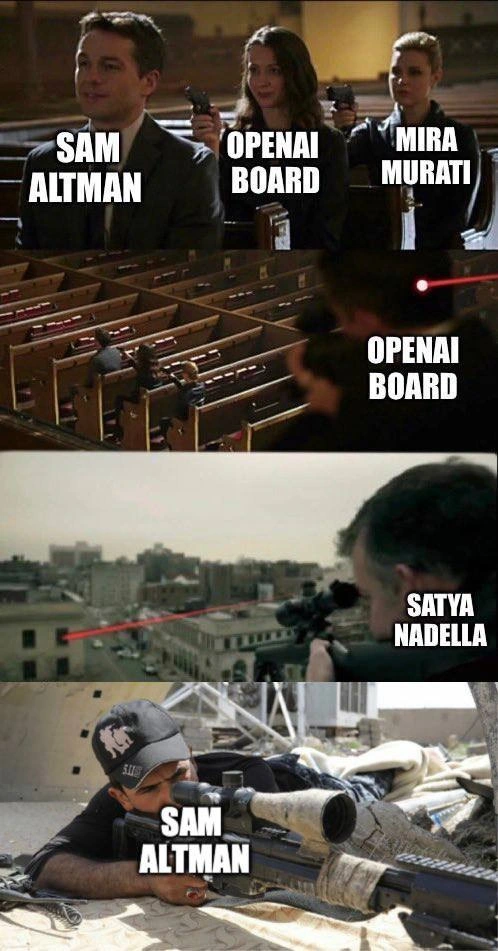
Let’s break down what’s happening in simpler terms. This four-panel meme uses a “stacked snipers” scene (a popular format where each panel reveals a bigger sniper aiming at the previous one) to tell the story of a real corporate showdown. The characters and labels here are real people or groups in the tech industry:
- Sam Altman – He was the CEO of OpenAI, a famous AI company (they created ChatGPT). In the first panel, he’s labeled on a guy with a pistol, meaning Sam’s just going about his business but he’s actually in a vulnerable spot.
- OpenAI Board – The Board of Directors of OpenAI, essentially a group of people who have the power to hire or fire the CEO and guide the company’s direction. In panel 1, some of the people with guns are labeled “OpenAI Board” and even “Mira Murati.” This shows the board and Mira (the CTO-turned-interim-CEO) pointing guns at Sam – indicating they ousted (fired) him. The board sniped Sam Altman on November 17, 2023, removing him as CEO in a shock move. So the board controls Sam’s job.
- Mira Murati – She was OpenAI’s Chief Technical Officer and became interim CEO after Sam was fired. Her presence with a gun in panel 1 suggests she’s aligned with the board at that moment (perhaps reluctantly) or at least part of the immediate aftermath. Basically, she’s involved in this sudden power shift.
- Satya Nadella – He’s the CEO of Microsoft, which is a huge investor in OpenAI (Microsoft invested billions and also provides the cloud computers OpenAI uses – think of Microsoft as OpenAI’s big partner and partial owner). In panel 3, Satya is the sniper on the rooftop with a red laser scope, meaning Microsoft’s CEO is now targeting the OpenAI Board. This happened because Microsoft was unhappy that OpenAI’s board fired Sam (since Sam is key to OpenAI’s success and Microsoft had a lot of money and reputation on the line). So Satya stepped in, saying essentially, “If Sam’s out, I’m hiring him and his team to Microsoft.” That’s a big power play – the investor pulling rank on the board. Microsoft holds a lot of cards (they supply computing power and money), so Satya had a bigger gun in the scenario.
- Sam Altman (again) – In the final panel, we see “Sam Altman” labeled on a sniper with a huge rifle lying on a rooftop, aiming at everyone above. This seems funny because Sam already appeared in panel 1 as the guy being targeted, and now he shows up again as the ultimate sniper. This represents Sam’s comeback. After being fired, Sam gained tons of support: almost the entire OpenAI staff, the public, and Microsoft all sided with him. Within a few days, the board that fired him was under such pressure that most of them resigned or reversed course. Sam basically ended up in a stronger position (either getting hired to lead a new AI unit at Microsoft or being rehired as OpenAI’s CEO with a new board – in fact, both were in motion). So Sam “having the last laugh” is like him aiming a giant rifle at the people who thought they had him out. In simple terms, the person who was fired got an even more powerful job offer and forced the people who fired him to back down – that’s the big rifle aimed at everyone.
This meme is essentially a visual CorporateCulture joke, but it mirrors a classic tech scenario: every boss has a boss. Sam might have thought he was in charge of OpenAI, but the board was actually his boss (they could remove him). The board thought they had ultimate control, but guess what – they have a boss too, in a way: the major partners/investors like Microsoft, who can heavily influence or even replace the board’s decisions when the company’s future is at stake. And then even Microsoft isn’t all-powerful because if a beloved CEO like Sam has the entire staff behind him (and options to go elsewhere), that gives him an unexpected trump card. So control in this chain was “recursive” – it looped back around.
For a junior engineer or someone new to how tech companies work, think of it like this: OpenAI is the product or project, Sam Altman was the team lead (CEO) of that project, and the Board is like upper management or the bosses who oversee the project. They decided to remove the team lead. Then Microsoft is like the big client or stakeholder funding the project – and they step in saying, “If you remove him, we’re pulling our support or taking him to our team.” Finally, Sam’s return is like the original team lead coming back because the entire team (and the client) demanded it. It’s a bit of office drama that shows how power can flow in unexpected ways.
In tech terms, people often joke about “layers of indirection.” That usually means adding another layer in software to solve a problem (like adding an abstraction). Here each layer (Sam -> Board -> Microsoft -> back to Sam) is an indirection of control: each is one step above the other. But when those layers form a circle, it’s confusing and chaotic – just like a software program that ends up calling itself in a loop. If you’ve heard of a dependency cycle (for example, Module A depends on B, B on C, and C on A again), you know it’s trouble. That’s exactly what happened in this real situation: everyone depended on someone else until it came full circle, causing a big mess (the company basically froze for days in uncertainty).
This meme also resonates as AIHumor and IndustryIrony. OpenAI is an AI company leading the hype in AI_ML, supposed to be on the cutting edge of tech innovation, yet it got tripped up by a very old-fashioned problem: boardroom politics and ego clashes. It’s ironic and a bit absurd (EngineeringAbsurdity) that building advanced AI didn’t prevent human mistakes. In fact, it might have fueled them due to high stakes. The developer community found it both concerning and comical – it’s not often you see a CEO fired and then effectively unfired in a span of five days because of a revolt! So, the meme uses the sniper stacking image to communicate that comically: no matter how high up you are, someone higher up can “get” you… until it hilariously comes around that the first person becomes the highest again.
Level 3: Stack Overthrow
For veteran engineers, this meme’s humor hits like a production bug on a Friday: painfully familiar yet darkly funny. It parodies the real openai_board_drama of late 2023, where the ousting of CEO Sam Altman by the OpenAI Board set off a chain reaction of corporate one-upsmanship. In the first panel, we see Sam (the ousted CEO) alongside the board and interim CEO Mira Murati, all armed and wary – symbolizing internal power tension. The second panel reveals another board member (or the board as an entity) acting as a hidden sniper targeting that first group, reflecting how the board thought it had the ultimate upper hand by firing Sam. Classic corporate backstab, right? But the meme’s genius is that it doesn’t stop there. The third panel zooms out to Satya Nadella on a rooftop with a laser-sighted rifle – representing Microsoft’s CEO lining up a “shot” at the OpenAI Board. This actually happened figuratively: within hours of Sam’s firing, Satya (whose company Microsoft had a ~$13 billion stake and cloud partnership with OpenAI) moved to hire Sam and 700+ OpenAI employees, taking aim at the board’s decision. That’s the “there’s always a bigger fish” moment – Big Tech oversight stepping in like an external microservice forcing a rollback on a rogue service. Finally, the fourth panel delivers the punchline: another sniper, even further out, with “SAM ALTMAN” on his back, wielding a massive rifle. This depicts Sam coming back with the biggest gun of all – ironically empowered by Microsoft and the outrage of the AI community. In reality, within days, the majority of OpenAI’s staff and the industry sided with Sam; the board (facing a revolt and IndustryIrony ridicule) practically disbanded. Sam returned, now backed by Microsoft and a new board, essentially sniping those who’d sniped him.
The humor is multilayered AIHumor mixed with CorporateCulture satire. It’s the “snipers all the way down” trope: every time one entity pulls the trigger, a larger scope marks them in return. Engineers see a parallel in system design and office politics alike. Ever debugged a microservice architecture where Service A calls B, B calls C… and somewhere down the line C depends on A? That circular call ends in a crash or deadlock – just as this executive shootout ended in chaos. In this meme, each “sniper” is analogous to a service or layer with a supposed upper hand:
- The OpenAI Board thought it had root access to kill the misbehaving process (firing the CEO for not being “transparent” enough).
- Satya Nadella/Microsoft was the higher-level orchestrator, effectively the cloud provider who could terminate the board’s session (by offering Sam a new platform and threatening OpenAI’s future funding).
- Then Sam Altman re-enters like a resurrected master process, armed with massive support (employee backing + Microsoft’s clout) to terminate or replace the board.
It’s a TechIndustryHumor rendition of a real saga: everyone had a boss, then the boss’s boss showed up. The IndustryTrends_Hype angle is strong, too. OpenAI’s meteoric rise (thanks to ChatGPT mania) made Sam Altman a poster child of AI success (AI_ML hype), but also put bullseyes on his back – an unenviable position familiar in corporate culture where big successes breed big power struggles. Seasoned devs have seen similar patterns scaled down: a project leader gets metaphorically “sniped” by upper management due to some “vision disagreements”, then an even higher executive steps in when the fallout threatens the whole division. The meme exaggerates it with literal snipers, capturing the engineering absurdity that even in cutting-edge AI companies, human governance can turn into a spaghetti Western. It’s funny because it’s true: in tech, just when you think you’re in charge, there’s always a higher-level meeting (or in this case, a person with a bigger gun) that can override you. The CorporateCulture lesson? Power in tech companies is as transient and nested as callback functions – every CEO has a board, every board answers (at least in part) to investors or partners, and those partners (like a Satya) have their own competitive agendas. And if you’re really unlucky, the ousted CEO you thought you defeated might come back loaded for bear, because in the high-stakes world of AI, loyalty and leverage can shift overnight. In short, this meme is an apt caricature of boardroom power cycles, illustrating how IndustryTrends_Hype and corporate intrigue can lead to a ridiculously entangled control structure – one that had engineers shaking their heads and laughing at the surreal “did that really just happen?!” sequence of events.
Level 4: Indirection Overflow
At the deepest level, this meme satirizes a circular dependency in organizational control, much like a dreaded cycle in a software system. It’s a metaphorical take on layers of indirection run amok. In computing theory, we often joke that “All problems in computer science can be solved by another level of indirection” – except when those layers stack into an infinite regress. Here, the OpenAI board firing Sam Altman adds one indirection layer (a governance layer “sniping” the CEO). Then Microsoft’s Satya Nadella adds yet another layer by intervening with corporate backing (the cloud provider aiming at the board). Finally, Sam reappears with an even bigger “gun” – a wry node closing the loop. This is essentially a recursive loop of power: Sam → Board → Satya → Sam, forming an ouroboros of control where each authority is overshadowed by a higher one. In graph theory terms, what should be a clear hierarchy (a Directed Acyclic Graph of corporate command) turned into a cycle. And as any seasoned engineer knows, cycles break assumptions – whether it’s a reference count cycle causing a memory leak or a management feud causing an organizational meltdown. By the final panel, the meme reaches an absurd fixed point: Sam Altman ends up effectively controlling the fate of those who tried to control him, a paradox worthy of a halting-problem joke. The Indirection Overflow on display is both hilarious and telling: without a clear base case (i.e., an ultimate authority), the chain of command in AI land became a non-terminating recursion until external reality (employee revolts, public outcry) forced a break out of the loop. It’s a reminder that in both computer systems and corporate structures, adding abstraction layers or new “controllers” can solve local problems but may introduce complex feedback cycles if you’re not careful. Just like an overly abstracted software stack, the OpenAI saga showed EngineeringAbsurdity when too many overseers ended up aiming at each other – a stack overflow in governance logic.
Description
A four-panel meme using the 'Person of Interest' sniper standoff format to depict the November 2023 OpenAI leadership crisis. In the first panel, 'SAM ALTMAN' is seated in a church, unaware that the 'OPENAI BOARD' is pointing a gun at the back of his head, while 'MIRA MURATI' aims a gun as well. The second panel shows a red laser sight on the 'OPENAI BOARD'. The third panel reveals the sniper is 'SATYA NADELLA' aiming from a rooftop. The final panel reveals an even more powerful sniper, 'SAM ALTMAN' himself, in a superior tactical position, aiming his own rifle. The meme humorously illustrates the escalating power dynamics of the corporate drama: the board fired Altman, Murati became interim CEO, Nadella (Microsoft) moved to hire Altman, but ultimately Altman held the most leverage and returned to OpenAI, effectively ousting the board that fired him
Comments
7Comment deleted
The OpenAI board thought they had root access, but they forgot Satya Nadella had a zero-day exploit, and Sam Altman *was* the backdoored firmware
Just like our microservices graph: remove one node, discover three more transitive dependencies with bigger blast radii already pointing back at prod
The OpenAI board discovered what every architect learns after 15 years: you can't kill a service that Microsoft depends on without triggering an automatic failover to a hostile takeover
When your board tries to deprecate the CEO but forgets about the Microsoft dependency injection pattern - turns out Satya had already implemented a singleton with automatic rollback on critical failures
When your org runs RAFT for executives: the board demotes the leader, Azure supplies an external quorum, and Altman gets re-elected - apparently CAP now stands for Corporate, Altman, Power
Board authority is eventually consistent; the strong consistency primitive is whoever controls the GPU quota and the Azure credits
OpenAI board saga: proving CAP theorem hits executive suites too - can't have Consistency, Altman, and Peace