The Undecidable CAPTCHA
Why is this CS Fundamentals meme funny?
Level 1: The Impossible Homework
This is like a website asking, "Before you enter, look at these sixteen wind-up toys and choose exactly which ones will ever stop moving." Some might stop quickly, some might keep going, and some are hidden inside boxes so you cannot see how they work. The joke is that the website acts like this is a normal little test, but it is secretly asking an impossible question and pretending the big blue SKIP button makes that reasonable.
Level 2: Programs Behaving Badly
A program that halts is a program that eventually finishes running. For example, print("hello") halts because it prints once and exits. A program like while true: pass does not halt because it keeps looping forever. The hard part is that real programs are rarely that simple.
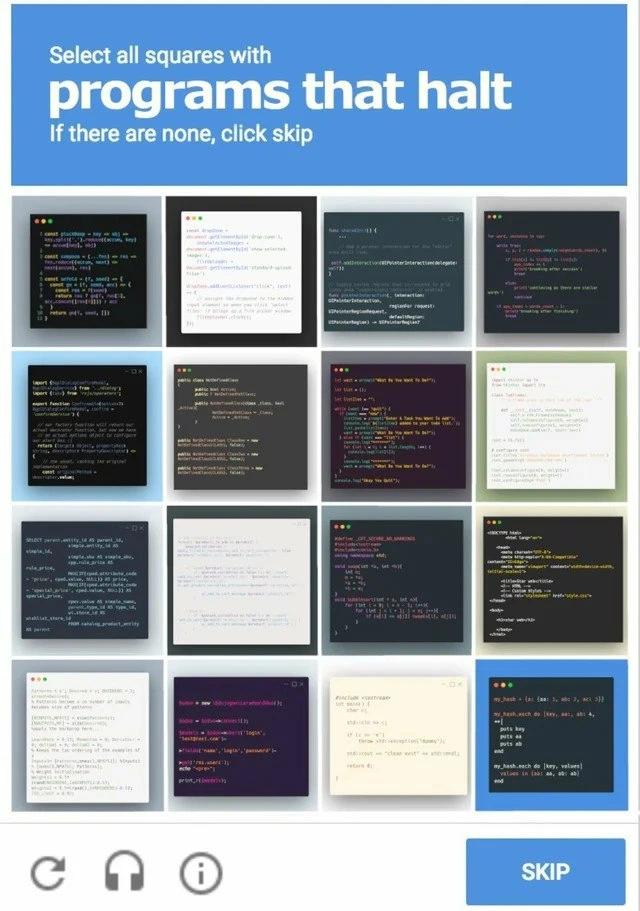
The image shows a CAPTCHA, which is normally a security check used to tell humans and bots apart. Instead of asking for buses or crosswalks, it asks the user to inspect squares containing code-editor screenshots. That pulls together Security, CS Fundamentals, and Code Execution humor: the interface is familiar, but the task has been replaced with a famous impossible one.
Early-career developers often meet this in smaller, practical forms:
- A loop seems fine until one input never changes the loop condition.
- A recursive function works for small examples, then calls itself forever.
- A test passes locally because the data is tiny, then production data makes it crawl.
- A service waits for another service that is also waiting for it.
Those are everyday versions of the same concern: control flow is about where the program goes next, and execution paths are the different routes it might take. The meme exaggerates that into a CAPTCHA that demands perfect understanding of every possible path in every visible snippet. That is funny because the whole point of a CAPTCHA is that the answer should be quick for a person, not a miniature graduate seminar with a login timeout.
Level 3: Undecidable UX
Experienced developers feel the punchline before they finish reading the prompt because the image weaponizes a familiar interface. The top panel looks like a normal "select all squares with traffic lights" challenge, but the object category has been replaced by program termination, one of the places where intuition, static analysis, testing, and bravado all eventually run out of road.
The small code screenshots matter visually. They are not presented as one readable program; they are a tiled mess of dark themes, light themes, syntax colors, and partial snippets. That mirrors how real engineering decisions often arrive: a tiny excerpt in a ticket, a pasted function in chat, a screenshot from production logs, and someone asking, "Is this safe?" The honest answer is usually, "Safe under what inputs, with which dependencies, in what runtime, after whose last commit?"
Static analyzers, linters, model checkers, and type systems can prove many useful properties for restricted languages or carefully bounded systems. They can catch unreachable branches, obvious infinite loops, missing returns, and suspicious control flow. But general-purpose software is full of escape hatches: dynamic dispatch, reflection, I/O, threads, signals, callbacks, databases, queues, timeouts, and user input that has never once respected a design document. The meme lands because every senior engineer has watched a "simple" function fail to terminate for reasons that were technically avoidable and organizationally inevitable.
The post message says, "Those AI evolve! Stackoverflow is not enough anymore for them!" That frames the joke as a next-generation bot challenge, but the deeper satire is aimed at the faith that enough automation can dissolve hard boundaries. Industry keeps selling tools that promise to understand your codebase, reason about behavior, and protect production from human fallibility. Useful? Absolutely. Omniscient? No. Some questions are not waiting for a bigger model; they are waiting for you to change the problem into one that can actually be answered.
The funniest part is the SKIP button. In an ordinary CAPTCHA, skip means "show me a different challenge." In this one, skip is also the most mathematically defensible action. If there are none, click skip; if you cannot decide, click skip; if you have read Turing, click skip and go make coffee while the product team asks why conversion dropped.
Level 4: Turing's CAPTCHA Trap
The blue reCAPTCHA-style prompt says:
Select all squares with programs that halt If there are none, click skip
That is not a quirky programming quiz. It is the halting problem wearing a web-security costume and asking you to invalidate one of the foundational results of theoretical computer science before you can prove you are not a bot.
The halting problem asks whether an arbitrary program, given arbitrary input, will eventually stop or run forever. Alan Turing proved that there is no general algorithm that can answer this correctly for every possible program. The proof is a diagonalization trap: if a perfect halts(program, input) checker existed, you could build a program that asks the checker about itself and then deliberately does the opposite. If the checker predicts it halts, the program loops forever; if the checker predicts it loops, the program halts. Either way, the checker contradicts itself. Congratulations, the CAPTCHA just assigned you a paradox with a blue SKIP button.
The 4-by-4 grid of tiny editor screenshots makes the joke sharper because code often looks locally understandable. A loop, a recursive call, a branch, a network request, or a function call may be visible, but termination depends on the full execution path: input values, mutable state, external systems, recursion depth, integer overflow, exception behavior, and sometimes pure spite from whatever dependency got updated last week. Even if one square contains an obviously finite loop, the challenge is not "find the easy examples." It says all squares with programs that halt, implying a total semantic judgment over arbitrary code snippets.
This is also why the CAPTCHA frame is so good. CAPTCHAs are supposed to separate humans from automated systems using tasks humans can solve cheaply and machines struggle with. Here, both humans and machines are boxed into the same computability wall. Better AI does not make undecidable problems decidable; it just produces more confident guesses, which is basically Stack Overflow answers with better typography.
Description
A reCAPTCHA-style challenge asks, "Select all squares with programs that halt" and adds, "If there are none, click skip." Below the blue instruction panel is a 4-by-4 grid of small code-editor screenshots showing various snippets in dark and light themes, with a blue "SKIP" button at the bottom. The joke turns a routine image-recognition CAPTCHA into the halting problem, asking the user to decide whether arbitrary programs terminate. For experienced engineers, the humor is that this is not merely tedious verification; it is a famous undecidable computer science problem disguised as web security UX.
Comments
6Comment deleted
Finally, a CAPTCHA where the correct response is either "skip" or a proof that Turing was wrong.
Self-evident joke about Halting problem Comment deleted
But AI could just read the text from pictures, classify the language and evaluate the code......... Comment deleted
https://youtu.be/eqvBaj8UYz4 Comment deleted
Yes. Comment deleted
This post is liked by Gödel. Comment deleted