The Ultimate Secret to Bug-Free Software
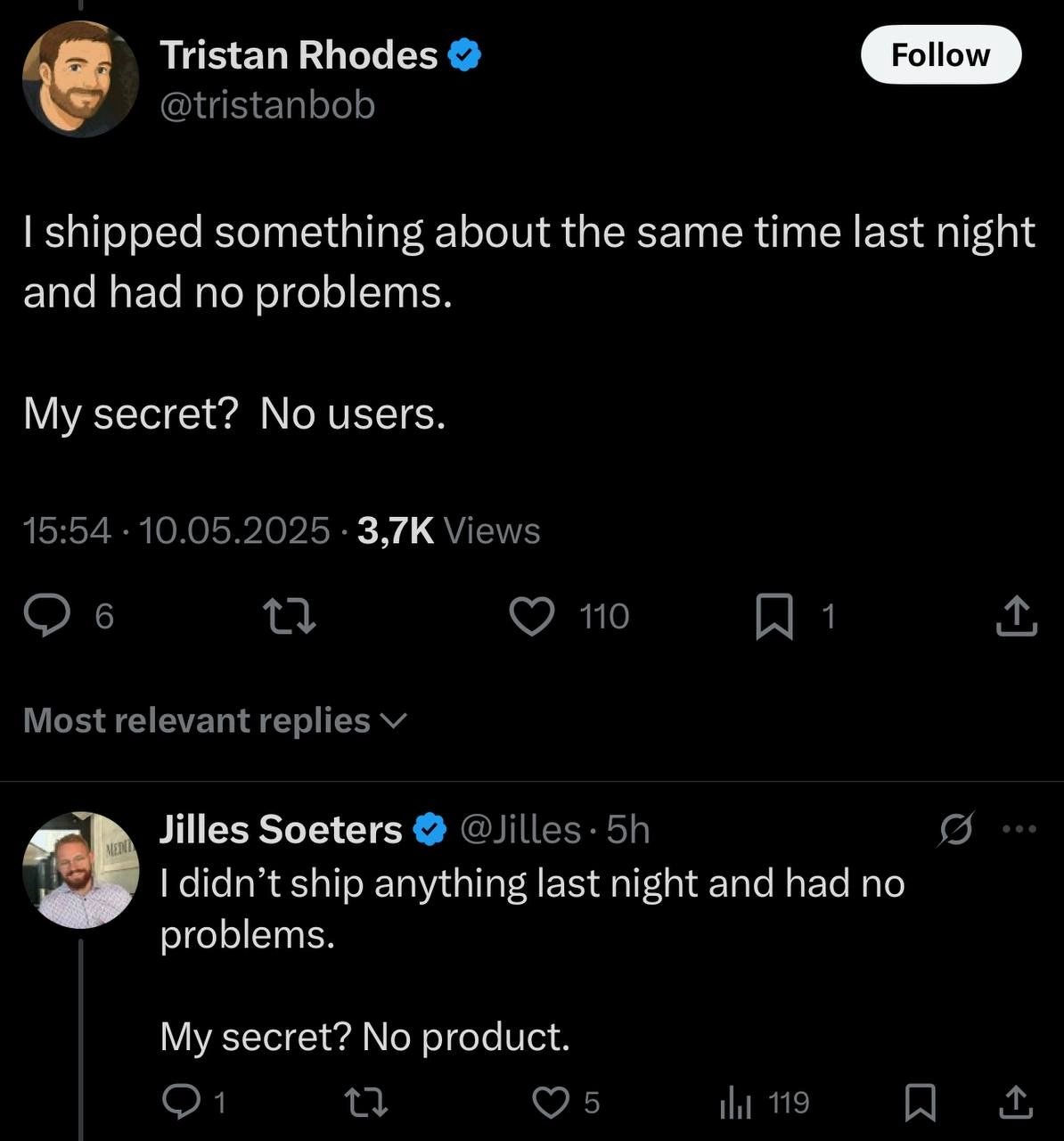
Why is this Production meme funny?
Level 1: Do Nothing, Nothing Breaks
Imagine you have a toy that sometimes makes a mess or causes trouble when you play with it. One way to never get in trouble with the toy is to simply never take it out of the box. If you don’t play with it, it can’t break, and you won’t get scolded – easy solution, right? That’s basically the joke here, but applied to software. The first person is saying, “I released a new app update at night and nothing bad happened. My trick? Nobody was using the app.” It’s like saying a teacher gave you a test but no one showed up to take it – of course no one failed the test because no one took it! The second person replies, “Well, I didn’t even make an app at all, and nothing bad happened. My trick? Have no app.” That’s like saying the best way not to lose a game is not to play in the first place. 😅 It’s funny in a silly, exaggerated way: the safest way to avoid any problem is to have nothing going on at all. In real life, that’s not very useful – if you never use your toys or never play games, you won’t have fun or accomplish anything. But when people are tired or worried about things going wrong, they sometimes joke that no action = no mistakes. So this meme is laughing about how a software team might secretly wish, “If we had no users (or no product), we’d never get those late-night emergency calls!” It’s a playful way to vent stress. Even a kid can get the gist: if nothing’s happening, nothing can go wrong – but of course, if nothing’s happening, nothing good can happen either. That’s why it’s joked about, not taken seriously. It tickles our funny bone because it’s true in one sense, but also completely opposite to the point of making a product or game or anything fun.
Level 2: No Users, No Problems
For a less experienced developer, let’s unpack the terms and scenario. Deployment means releasing new code or features to the production environment (the live system real users interact with). A late-night deploy is when engineers intentionally push updates during off-hours, often to minimize impact on users if something goes wrong. But even at midnight, if you have active users (or automated processes) on your app, a bad update can trigger errors and wake someone up with an alarm. That’s where DevOps/SRE practices come in: these are engineers focused on site reliability, keeping systems running smoothly. They set up monitoring and alerting — those are the pager alerts mentioned (back in the day, on-call engineers literally carried pagers that would beep if something broke at 3 AM; today it’s usually phone notifications or Slack messages). Getting paged at ungodly hours because the website is down is every on-call developer’s dread. Release anxiety is the nervous feeling before a deployment, worried that your new code might accidentally break the service and cause a ProductionIncident (an outage or major bug in the live system). There’s even a bit of folklore in tech: “Never deploy on a Friday”, because if you push changes right before the weekend and things go south, you’ll be scrambling to fix it on your day off.
Now the meme jokes that one guy had a smooth deploy “My secret? No users.” Why would no users guarantee no issues? Think of it this way: if a website or app has zero users, it’s under zero load. It’s like a restaurant with no customers — the kitchen can’t mess up any orders because there are none to fill. In tech terms, no traffic means the code isn’t being exercised by anyone, so even if there’s a bug, nobody encounters it. The system’s metrics dashboard (a live chart showing things like number of visitors, errors per minute, CPU usage, etc.) would be an empty flat line because nothing’s happening. That’s what the context tags ghost_town_prod and empty_metrics_dashboard hint at: a production environment as quiet as a ghost town, all dials and gauges reading zero. The first tweet essentially says: “I deployed new code and everything was fine, but only because nobody was using my app.” It’s self-deprecating humor—admitting that the only reason it went well is due to lack of customers, not because of some great skill.
Then the reply ups the ante: “I didn’t ship anything last night... My secret? No product.” This means that person didn’t even have a product to deploy. No product, no deployment; if your team hasn’t built or released anything, you literally can’t have a deployment go wrong. It’s like saying the safest car race is the one you never entered. By having “no product,” there’s nothing running live, so there’s zero chance of an outage (no_product_no_outage as the tag suggests). This one-ups the “no users” joke by going one step further: not only are there no users, there isn’t even a codebase or service to worry about. It’s poking fun at how, in software, the only truly foolproof system is one that doesn’t exist. Of course, in reality having no users or no product is not a good thing — it means your project isn’t successful or maybe you haven’t built anything! But developers joke about it when they’re stressed. It’s a form of DevOps humor and DeveloperHumor: we laugh at the absurd idea that the best way to avoid failure is to avoid doing anything at all. This echoes a common tongue-in-cheek saying: “No code, no bugs.” If you write zero code, you’ll have zero bugs (because bugs only come from code). Similarly, no users means no user complaints or incidents.
The meme also highlights the shared pain around ProductionIncidents and on-call duty. Those who have been on a DevOps or SRE team recognize the scenario: you deploy something and then you’re nervously watching graphs and logs for any spike in errors. If something’s wrong and you have users, you’ll know quickly — error alarms will go off, or users will start messaging that “Feature X is down!” That’s when the pager (or phone) starts buzzing. But if your user count is zero, you might not see any errors simply because nobody is around to trigger them. It’s like a tree falling in an empty forest: if no one’s there to hear it, does it make a sound? In a no_users_no_problems situation, maybe the code has issues, but if no one ever uses that part, it never surfaces. Late_night_deploys are already scary; doing them with an active user base can cause ReleaseAnxiety as you imagine all the things that could go wrong. These tweets joke about the “ultimate” safety net: an idle system. The humor here helps junior devs see the contrast between ideal practice (deploy carefully to lots of users) and this dark joke (deploy to none). It’s a way of coping — we know we can’t actually have no users or no product (that’d defeat the purpose of our jobs!), but joking about it eases the tension we feel when hitting that Deploy button.
Level 3: Zero Traffic Zen
In the dim glow of a midnight deployment, veteran DevOps engineers smirk at this meme because it captures a dark truth of on-call life. The original tweet mocks the usual brag—"I deployed at 2 AM and nothing broke!"—by revealing the secret sauce: there were no users to break anything. This is production nirvana achieved through a ghost town prod scenario. The software was shipped into the void, and surprise: zero incidents. From a senior perspective, it’s a wry commentary on how release anxiety often scales with user traffic. Every seasoned SRE knows that the easiest way to hit five nines of uptime is to have nobody actually using your service. No traffic, no edge-case user behavior, no 3 AM pager blasts because some customer in a far timezone did the one weird thing that topples the system. It’s essentially a cheeky inversion of Murphy’s Law: nothing can go wrong when nothing is happening.
This tweet thread escalates the joke: first “no users” then the reply “no product”, each step stripping away another layer of risk (and purpose). The deployment pipeline here leads straight to /dev/null — a tongue-in-cheek perfect run because it impacted nothing and no one. It’s the ultimate late-night deploy strategy, a play on the idea that even the best CI/CD practices (rollbacks, canaries, thorough tests) can’t guarantee a quiet night if real users are hammering your code. So why not remove the chaotic element entirely? No_users_no_problems is basically the DevOps equivalent of “the only winning move is not to play.” The meme tickles senior developers because we’ve all had those war stories: a flawless staging run, followed by a production meltdown once actual customers show up. If only we could have production metrics dashboards permanently flatlined at zero because nobody logs in – we’d all get full nights of sleep! It’s a bittersweet, battle-hardened humor: after wrestling with enough ProductionIncidents, part of you jokes that total production nihilism (having absolutely nothing to care for) might be the most stress-free architecture of all. This is SRE sarcasm at its finest – pointing out that the root cause of an incident-free night isn’t heroics or perfect code, but simply an empty system. By the time Jilles quips “My secret? No product.”, every grizzled on-call engineer is grinning (or maybe groaning) at the thought: sure, you can achieve 100% uptime... if you don’t actually run anything worth uptime.
Yet, layered in this humor is a grain of real insight about risk management. We normally chase reliability through redundancy, monitoring, and load testing. But in this meme’s absurd logic, the blast radius of a deploy is zero when the user count is zero. It’s poking fun at those ubiquitous corporate post-mortems where the conclusion is “we should have tested more” or “we should avoid Friday releases”. Here, the “solution” is far more blunt: take away the cause of failure altogether. It’s like a veteran’s tongue-in-cheek lifehack for guaranteed stability: Have you tried not having a product? 😂 Underneath the laugh, it reflects burnout and SRE fatigue — an admission that sometimes we daydream about a world with no emergency pages, no angry customers, and no ReleaseAnxiety at all. It resonates especially in DevOps circles: after fighting enough fires, even a dedicated engineer might joke that a server closet with its power off is the most reliable system ever built. Remember the gallows humor of “works on my machine”? This meme is the on-call version: “works in production, as long as no one is there.” It’s funny because it’s true in a twisted way, and we laugh because the alternative is to cry.
Description
A screenshot of a Twitter conversation in dark mode. The first tweet, by Tristan Rhodes (@tristanbob), reads: 'I shipped something about the same time last night and had no problems. My secret? No users.' Below this, a reply from Jilles Soeters (@Jilles) escalates the humor: 'I didn't ship anything last night and had no problems. My secret? No product.' The image captures a cynical but relatable exchange between developers. The core joke highlights the truth that production systems become problematic only when real users interact with them in unexpected ways. The reply takes this logic to its hilarious extreme, suggesting that the only truly perfect system is one that doesn't exist at all. It's a commentary on the inherent chaos of live software and the ironic tranquility of pre-launch or vaporware projects

Comments
12Comment deleted
A junior's goal is a bug-free launch. A senior's goal is a launch that makes enough money to justify the inevitable bugs
Turns out the cheapest way to reach five-nines is to keep QPS at absolute zero - beats any chaos-monkey strategy
After 20 years in tech, I've finally discovered the secret to 100% uptime: run your infrastructure in production but keep your users in staging. Works every time, especially during board meetings when they ask about our zero-incident streak
Ah yes, the two most reliable deployment strategies known to senior engineers: the 'perpetual beta with zero adoption' approach and the 'vaporware perfection' methodology. Both boast 100% uptime and zero incident reports - truly the pinnacle of SRE achievement. It's like achieving five nines of availability by simply never turning the service on. The CAP theorem has nothing on the NUP theorem: No Users, No Problems
The ultimate SRE metric: 100% uptime via zero-scale architecture - no users means no cascading failures
Peak reliability through denominator engineering: deploy at 2am with signups closed so the SLO reads 100% satisfied users - and the dashboard agrees
Our DORA metrics are finally perfect - turns out a zero‑QPS service ships flawlessly; the only alert left is marketing accidentally discovering product‑market fit
I release often, and at any time I see fit. My secret? Just a single user.(Guess, who?) Comment deleted
your gf(no users) Comment deleted
You do distinguish <zero/> from <one/>, don't you? Comment deleted
in bash — zero is a success. Comment deleted
As a result code, zero is widely used for indicating both success (no error) and failure (no intended result). However, when comparing values of zero and one, every programming language I am aware of makes clear distinction between them — in every context: boolean, integer, floating-point, string. Comment deleted