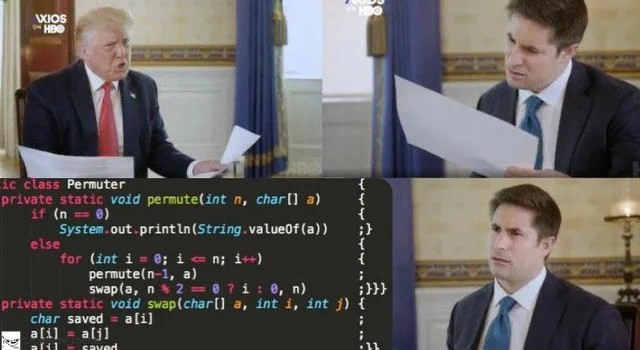
Code Reviewer Reacts to Obfuscated Permutation Algorithm
Why is this CodeReviews meme funny?
Level 1: Too Many Options
Imagine you have a big box of LEGO pieces and your friend comes up with a “brilliant” plan to find the coolest design: try every possible combination of pieces one by one. At first, that might sound okay – if you only have a few pieces, you can arrange them in a few ways and check each design. But if you have a lot of pieces, the number of different combinations goes through the roof! There could be millions or trillions of possibilities. You’d never have enough time to try them all, not in a million years. In the meme, the boss is basically doing that – proudly showing a plan (in code form) that checks every possible arrangement of something. The young engineer looking at it realizes this plan is way too slow and practically impossible if the thing they’re arranging has more than a handful of items. It’s funny because the boss is smiling like “Look what I did!”, and the engineer is staring in disbelief, thinking “This will never work if we have lots of stuff.” It’s like if a kid said, “I lost my toy, so I’ll just search every house in the city to find it!” – cute idea, but the parent knows that’s not realistic. The humor comes from that contrast: one person doesn’t see the problem with trying everything, and the other person is silently freaking out because they do.
Level 2: Permutation Primer
Let’s break down what’s actually on that sheet of paper and why our engineer looks so concerned. The code in question defines a function to generate permutations of a list of characters. A permutation is just a fancy word for a rearrangement. For example, if you have the letters A, B, C, the permutations are all the different orders those letters can be arranged in: ABC, ACB, BAC, BCA, CAB, CBA. Three items can be arranged in 6 different ways. Four items would have 24 permutations, five items have 120, and so on. The number of permutations of n items is n! (n factorial), which is n × (n-1) × (n-2) × ... × 1. This grows very fast as n increases!
Now, the code uses recursion to generate these permutations. Recursion means a function that calls itself to solve smaller pieces of the problem. In permute(int n, char[] a), the idea is: if n is 0, it means we’ve fixed all positions and we print the array as one completed permutation (that’s the base case). If n is not 0, the function goes into a loop from i = 0 to i < n. Inside that loop, it calls itself (permute(n-1, a)) to continue generating permutations for a smaller portion of the array. After the recursive call, it does a swap. That swap line swap(a, n % 2 == 0 ? 0 : i, n) is a bit tricky at first glance. What it’s doing is swapping two elements in the array a. If n is even, it swaps the 0th element (start) with the nth element (end of the current section); if n is odd, it swaps the i-th element with the nth element. This is an implementation of a known method (Heap’s algorithm) to generate permutations without repeating any sequence. The swapping basically prepares the array for the next iteration so that a different element ends up at the “end” position next, allowing new permutation orders to form. And because the function calls itself repeatedly (each time with n-1), it will eventually hit the base case and print out every possible ordering of the array elements. It’s a clever algorithmic dance: recursion and swapping to cover all arrangements.
So why is the engineer concerned? Complexity. The routine doesn’t do anything blatantly wrong in terms of logic; it will indeed list all permutations. But Big O notation is used to analyze how the runtime grows with input size, and here it grows factorially. Factorial_time_complexity (O(n!)) is extremely slow growth. Let’s illustrate how quickly the number of permutations explodes:
| n (number of items) | n! (number of permutations) |
|---|---|
| 1 | 1 |
| 2 | 2 |
| 3 | 6 |
| 4 | 24 |
| 5 | 120 |
| 6 | 720 |
| 7 | 5,040 |
| 8 | 40,320 |
| 10 | 3,628,800 |
| 12 | 479,001,600 |
| 15 | 1,307,674,368,000 (over 1.3 trillion!) |
By the time you have 10 elements, there are over three million permutations. At 15 elements, it’s in the trillions. No normal program can iterate through trillions of anything in a reasonable time. This is why the engineer’s eyes might be widening: the code works, but if someone tried it on, say, a 10-character string, it would attempt to print 3.6 million lines! Imagine running that during a demo or, worse, in a production server – it would grind to a halt or spam logs like crazy. In the context of a CodeReview, an experienced developer would point out that this approach doesn’t scale. It’s fine for small inputs (like permuting 5 letters for a puzzle), but you’d never want this as a solution for, say, generating all possible arrangements of a large dataset.
Another thing a junior developer might notice: the code is presented on paper, which is unusual. Typically, code is reviewed on a computer using tools like GitHub or code editors, not printed out. The fact it’s on paper in the meme is part of the joke – it emphasizes how the CEO is literally handing the code over like a report, and the engineer is gazing at it in confusion. It exaggerates the scenario to make it clear: the engineer didn’t expect to be doing a paper_code_review of a complex recursive function from his boss! In reality, code review means one developer shares their code changes with others, who then read through the code, often leaving comments about potential problems or asking questions. Common review comments for this snippet would likely be things like: “What’s the intended use-case for this? Do we expect large n? This looks like it could be very slow if n grows,” or “Can we add some comments to explain the swapping logic? It’s not immediately obvious.”
Let’s also clarify some terms from the tags and why they’re relevant:
- AlgorithmDesign and AlgorithmComplexityAnalysis: This meme is about choosing an algorithm (here, brute force permutation generation) and analyzing its complexity. A good algorithm design considers if the solution is efficient. A complexity analysis of this code shows it’s
O(n * n!)(roughly proportional to n factorial, since for each permutation printed there’s a bit of swapping and printing overhead). That’s why it’s a dubious design for anything except very small n. - BigONotation: This is the language we use to say “how slow or fast will this algorithm grow?” O(n!) is an example of Big O notation describing a very fast-growing runtime. In comparison, something like O(n) (linear time) or O(n^2) (quadratic time) grows much more slowly. Big O helps us communicate and reason about that, so during a review an engineer might literally say, “This is factorial time – O(n!) – are we okay with that?”
- CodeReviewPainPoints: This refers to the common issues that give reviewers headaches. In this snippet, the pain points are the high complexity and the code’s lack of clarity. It’s funny (and painful) how often in real life someone submits code that works but has one of these big issues lurking under the hood.
- DeveloperHumor/CodingHumor: The whole situation is framed as a joke that developers find funny because it exaggerates a real scenario. We often see humor in the contrast between non-technical folks and technical realities. Here, the non-technical CEO is oblivious to the performance issue that any developer would spot. It’s a “you had one job” kind of moment from the engineer’s perspective.
In short, for a junior developer or someone learning CS fundamentals, this meme is a lesson wrapped in a joke: Always consider the complexity of your code. Generating all permutations is a classic example used in textbooks to illustrate how backtracking works and how quickly the numbers blow up. It’s cool to see it print permutations for small sets, but it’s not a general solution you’d use when n grows large. And if your boss ever hands you code (especially on paper!) and says “Isn’t this great?”, it’s okay to put on your algorithmic thinking cap and evaluate it critically – just maybe don’t make the face that our engineer in the meme is making! 😅
Level 3: Factorial Facepalm
At first glance, the code in that printout looks like a neat Java permutation algorithm. It’s a Permuter class using recursion and swapping to list every arrangement of an array of characters. But any senior engineer’s alarm bells are ringing because this routine runs in factorial time complexity – that’s O(n!) – the kind of exponential blow-up that makes even O(2^n) look tame. In a code review, seeing an unbounded factorial algorithm is a classic facepalm moment. It’s like discovering a hidden landmine in what was supposed to be a straightforward feature. We immediately think: “This will work for n = 5 or 6, maybe, but what happens when n = 10 or 15? We’ll be waiting until the next ice age for the output!” The humor (and horror) here comes from the CEO proudly handing over this code as if it’s a brilliant deliverable, while the engineer’s expression screams, “Are you serious? This will grind to a halt if n grows even a bit!”
In real CodeReviews, two big pain points jump out from this snippet: algorithmic complexity and code readability. The algorithm is essentially brute-forcing all permutations, which means the number of operations grows astronomically with each additional item. Seasoned devs recognize this as a combinatorial explosion. For context, 10! (10 factorial) is 3,628,800. By 15 it’s over 1.3 trillion. Printing all those permutations would exhaust not just your patience but likely your machine (and definitely your printer!). It’s a textbook case of AlgorithmComplexityAnalysis gone wrong — a solution that’s technically correct but computationally impractical for anything but small inputs. This is why we have Big O notation in the first place: to spot these scalability red flags before they hit production. A proud manager might see “it works for my example” while the developer in us sees a performance time-bomb.
Then there’s the code style. The snippet lacks comments, and it contains that magical line: swap(a, n % 2 == 0 ? 0 : i, n); – a clever trick from Heap’s Algorithm for generating permutations. If you know the algorithm, you recognize it ensures each element gets swapped into the last position in turn (using the parity of n to decide between swapping the first element or the i-th element). It’s an ingenious little piece of logic… but without any comments or explanation, it’s cryptic. In a code review, an engineer would likely pause and say, “Can we add a comment explaining that bit? It’s not immediately obvious why that swap uses n % 2 == 0 as a condition.” The engineer in the meme is basically living that moment – staring at the code, decoding the logic, and internally groaning at how non-obvious it is at first sight. The CodeReviewPainPoints on display include:
- Unscalable Design: A method that tries every possibility (factorial complexity) – great for teaching recursion, terrible for production performance.
- Lack of Clarity: No inline comments or docs for a non-intuitive algorithm. The next developer reading this might waste time figuring out the swapping trick.
- Edge Case Blindness: No input validation or mention of limits. (What if
ndoesn’t matcha.length? What ifais huge? The code blissfully ignores those questions.)
What really nails the humor is the executive_vs_engineer dynamic. Usually, engineers present technical solutions and executives evaluate business value — here it’s comically flipped. The CEO (a non-developer leader type) is holding up this code like a trophy, akin to saying “Look, I solved it!” Meanwhile, the poor engineer is in the hot seat, mentally calculating the factorial_time_complexity and trying to keep a straight face. It’s an all-too-relatable scenario in DeveloperHumor: someone high up finds or writes a snippet that seems to solve a hard problem, but the solution is naive from a tech perspective, leaving the actual techie to diplomatically point out the issues. The power dynamics make it extra spicy – telling your CTO or CEO that their pet code has issues is a delicate task (especially when that code is essentially a recursive time bomb 😅). The chosen meme template (those AXIOS on HBO interview frames) adds a perfect layer of irony: in that real interview, a leader handed over documents that were meant to be impressive, and the interviewer gave that exact bewildered, concerned look. It’s a one-to-one parallel with a paper_code_review gone awry. We don’t literally print code on paper in modern reviews, but picturing it that way highlights the absurdity.
In sum, this meme hits on core CS_Fundamentals in a humorous way. It’s both an AlgorithmDesign joke (brute force permutations – theoretically interesting, practically frightening) and a workplace comedy skit (the boss confident in something the junior guy knows is flawed). Experienced devs chuckle because we’ve been in that engineer’s shoes: evaluating some “clever solution” and realizing it’s not scalable or maintainable. The silence and bewildered look are spot on — sometimes all you can do is pause, blink, and figure out how to politely phrase “we might need to rethink this.” It’s a CodingHumor gem that combines Big O geekery with everyday office dynamics, leaving us with that mix of laughter and a slight PTSD from past code reviews.
Description
A three-panel meme using the Donald Trump and Jonathan Swan interview format. The top panel shows Trump presenting a document, which is revealed in the bottom panel to be a snippet of Java code. The interviewer, Swan, is shown in the top-right and bottom-right panels with an expression of intense confusion and disbelief as he reviews the code. The Java code defines a 'Permuter' class with a recursive 'permute' method that generates permutations of a character array. The code is notably complex and difficult to understand at a glance, featuring a recursive call and a tricky swap operation using a ternary operator: 'swap(a, n % 2 == 0 ? i : 0, n)'. This meme humorously captures the experience of a code reviewer encountering overly 'clever,' obfuscated, or simply unreadable code. The inscrutable algorithm, a variation of Heap's algorithm, is a perfect stand-in for the kind of code that makes developers question the sanity of the original author. Swan's face perfectly embodies the reviewer's internal monologue of 'what is this and why was it written this way?'
Comments
7Comment deleted
This isn't just a permutation generator; it's a pull request that generates a permutation of which team member will volunteer to maintain it in six months. Spoiler: the list is empty
When the CEO hands you a printout of an O(n!) permutation method and calls it our “cloud scaling strategy,” you realize FaaS now stands for “Factorial as a Service.”
After 20 years in the industry, you learn that the most diplomatic way to handle a junior's creative interpretation of variable naming conventions is the same face you make when the CEO suggests blockchain will solve the legacy mainframe migration
When the interviewer asks you to implement permutations and you mentally execute Heap's algorithm with that ternary swap operator while maintaining eye contact - because nothing says 'senior engineer' quite like casually generating n! arrangements with O(1) space complexity in your head during small talk
You can tell it’s Heap’s algorithm - the permutations, closing braces, and reviewer questions all grow at O(n!)
Whiteboards it flawlessly, then they ask for duplicates: suddenly your O(n!) is 'inefficient' compared to HashSet wizardry
Heap’s algorithm with a swap that does a[i] = a[i]; - O(n!) activity, O(1) change. Perfect enterprise transformation KPI