Skip to content
DevMeme
5009 of 7435
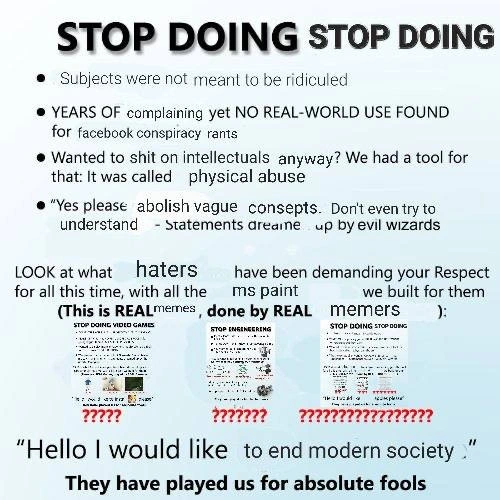
Corporate Dev Deck Says to Stop Doing the 'Stop Doing' Memes
DevCommunities Post #5478, on Sep 19, 2023 in TG

Corporate Dev Deck Says to Stop Doing the 'Stop Doing' Memes

Why is this DevCommunities meme funny?

Level 1: Yelling "No Yelling"

Imagine you’re in school and the class is getting a bit noisy. Then the teacher stands up, frowns, and yells at the top of their lungs, “Hey everyone, no more yelling in class!” Sounds kind of funny, right? The teacher is yelling to tell everyone else to stop yelling. It’s a total contradiction – like saying, “I’m allowed to do the thing I’m telling you not to do.” You might giggle because the teacher probably doesn’t even realize they’re breaking their own rule as they make it.

This meme is the grown-up, tech version of that exact scenario. Instead of a teacher and students, picture a big company and its developers. Some developers were making a certain kind of joke (the “Stop Doing” jokes). The company – like the strict teacher – decided to put its foot down. So it made a big, fancy poster (a slide) essentially saying, “Stop making those ‘Stop Doing’ jokes!” But by doing that, the company’s poster itself became one of those jokes. It’s as if the teacher’s loud scolding became the funniest joke of the day for the class.

Why is this funny? Because it’s so backwards and silly. It shows someone trying to stop a behavior by engaging in the very same behavior. It’s like a sign that says “NO SIGNS ALLOWED” – just seeing that makes you scratch your head and laugh. In the end, the meme is making us laugh at how ridiculous it is to fight jokes with more jokes. It’s pointing out a simple truth: the more you try to force people to stop laughing at something, the more laughable you become. And just like kids would laugh at the yelling teacher, developers are laughing at this pretend company slide. It’s a goofy reminder that sometimes the best way to deal with a joke is to just let it be – because trying to outlaw it might just turn you into the next punchline.

Level 2: PowerPoint Paradox

Let’s unpack what’s going on here in simpler terms. This image is basically a parody of a corporate PowerPoint presentation. It uses the format of a formal slide deck but fills it with ridiculous content to make fun of the situation. At its core, the meme itself is one big contradiction – a PowerPoint paradox. It’s a slide that says “STOP DOING ‘STOP DOING’.” In plain language, that means someone is telling people to stop making “Stop Doing” memes by making a “Stop Doing” meme. That’s the paradox: it’s doing the very thing it’s forbidding.

First, some context: developer communities love their inside jokes and meme culture. One popular format for jokes is the “Stop Doing X” meme. This format looks like a bold directive telling people to stop some practice or trend, often written in a big title with bullet points underneath. Sometimes it’s used seriously (“Stop doing unsafe casting in code!”), but more often it’s tongue-in-cheek, pointing out silly or overused habits in tech. For example, a meme could say “STOP DOING pointless stand-up meetings” and list bullet points humorously outlining why those meetings are a waste of time. It’s a way to poke fun at things developers find annoying.

Now, this particular meme is meta – meaning it’s humor about humor. It’s targeting the “Stop Doing” meme trend itself. So the slide says “STOP DOING STOP DOING.” It’s like a meme that makes fun of memes. Imagine a joke that tells other jokes to quit it – that’s what’s happening. This self-referential style is common in internet humor (sometimes called meme-ception, like a meme within a meme). The reason it works here is because apparently people have been doing a lot of “Stop Doing” memes, and someone (in a joking way) is pretending to be a corporate bigwig fed up with it.

The phrase “meta disclaimer parody” in the context tags hints at how the slide’s text is written. A disclaimer is usually a serious statement intended to clarify or warn something (like “No, we don’t actually endorse doing X”). Here, the whole slide reads like a fake corporate disclaimer or announcement, but it’s so over-the-top that it becomes a parody (an imitation for comic effect). The bullet points are written in a formal style yet talk about outrageous things, which is done to lampoon the way corporate communications sometimes sound. For instance, the slide starts with “Subjects were not meant to be ridiculed.” That sounds like something an HR department or PR team might sternly remind employees – basically “Hey, don’t make fun of stuff at work.” In a normal setting, a message like that is meant to be serious. But here, because it’s in a meme, it’s mocking that very seriousness. By putting such a stuffy statement in a meme, the creator is winking at us, saying: “Isn’t it silly when companies try to ban humor?”

Another tag mentions “MS Paint irony.” MS Paint is an old, very simple graphics program from Microsoft – the kind you’d use to doodle or quickly paste images, not exactly professional design software. In meme culture, invoking MS Paint is a way to signal something is intentionally low-tech or low-effort for comedic effect. The slide actually says “with all the MS paint we built for them” which is a joke implying, “We even gave these meme-makers a basic tool, and look what they did with it!” The irony is that the slide itself looks kind of slapped together like an MS Paint project: it’s got mismatched fonts, random sizing, and those blurry image thumbnails. That shabby look isn’t an accident – it’s part of the humor. The meme is imitating a chaotic slide deck style, almost as if someone with minimal design skills threw it together in anger. In other words, it’s bad on purpose. It exaggerates the vibe of a hastily made corporate presentation (maybe done by an exasperated manager who doesn’t really “get” memes) to make the whole thing funnier.

Let’s talk about the “infinite feedback loop” aspect. A feedback loop is when output feeds back into input – like a microphone too close to a speaker causing that endless screeching, or in code, a function calling itself with no exit. An infinite loop is one that just goes on forever. In communication, a feedback loop can happen when people keep responding to each other’s messages in a cycle. Here the loop is: people make memes complaining about something, then someone makes a meme complaining about those memes, which ironically just becomes another meme for people to respond to. It’s a never-ending circle of response and counter-response. This slide literally illustrates that: it’s complaining about complaining. The phrase “Stop doing stop doing” is a loop — it doesn’t resolve because if you follow it literally, you’d stop doing what it’s asking by doing it again! For a newer developer or someone not deep into meme culture, think of it this way: if you tell everyone “don’t repeat this joke” but in doing so you make the joke again, you’ve basically caused the very thing you wanted to stop. That’s the loop here.

The content of the slide uses a lot of extreme or absurd examples to get the point across. For example, one bullet says people spent “YEARS of complaining yet NO REAL-WORLD USE FOUND for Facebook conspiracy rants.” This is poking fun at the idea that lots of ranting (like those long Facebook posts about conspiracies) doesn’t accomplish anything. It’s like the slide is scolding, “You’ve all been whining for years and nothing has changed, so why are you still doing it?” Of course, in a real developer setting, complaints often do have roots in real issues – but the meme is showing a caricature of a boss who dismisses all that complaining as utterly pointless. It’s exaggerated to be funny.

Then there’s the especially outlandish bullet about using physical abuse as a tool against intellectuals. That one is very much not serious – it’s so over the top that it’s clearly there to evoke a “Whoa, that escalated quickly!” reaction. The reason such an extreme statement is included is to parody a certain mindset: the slide’s “voice” (this imaginary corporate speaker) is basically saying “if you just wanted to bash smart ideas, there was an old-fashioned way to do it – by literally bashing the people! Why bother with memes and conspiracy posts?” It’s a dark joke, riffing on how ridiculous it would be for a company to suggest violence as a solution. The absurdity is the point – it tells the reader not to take this seriously at all.

Similarly, the reference to “vague concepts” and “evil wizards” is comic exaggeration. It’s mocking folks who call anything they don’t immediately understand “vague” or attribute complex ideas to some shady, over-intellectual source (the “evil wizards”). In tech, sometimes people joke that certain hard-to-grasp technologies or theories (say, very abstract programming paradigms) were invented by wizards just to confuse everyone. It’s a playful jab at anti-intellectualism – basically saying “Sure, let’s just get rid of anything abstract or challenging; don’t even try to comprehend it, it must be those darn wizards doing trickery.” A junior dev might not have run into this attitude yet, but hang around long enough and you’ll meet someone who thinks anything beyond their immediate knowledge is useless magic. The meme mocks that mindset by blowing it up to cartoonish proportions.

Now, the bottom part of the slide has those big quotes: “Hello I would like to end modern society” and “They have played us for absolute fools.” These are there to show just how dramatic and silly the corporate perspective sounds when you push it to the extreme. Imagine a company actually implying that meme-makers are aiming to collapse civilization – that’s obviously a joke. It’s highlighting how out-of-touch management can feel to employees. The second quote, “They have played us for absolute fools,” suggests that management thinks the memers somehow tricked them or made fools of them. In reality, if a company is publicly freaking out about a harmless meme, they kind of are making fools of themselves – no trickery needed. The meme is basically wearing the management’s paranoid voice and cranking it up to 11 so we can all laugh at how absurd it sounds.

Finally, notice the blurry thumbnail previews with rows of red question marks in the slide. Those little images are presumably snapshots of other “Stop Doing” memes (the very ones the slide is complaining about). They’re blurred out and covered in question marks, as if to say “What is this garbage?” It mimics the style of a bad PowerPoint where someone pasted examples but didn’t bother to make them clear, or intentionally obscured them like some kind of classified evidence. It’s another layer of humor: the slide is supposedly showing us the offensive memes – “Look at what haters have been demanding your respect for all this time” – but it censors or distorts them, which is both pointless and funny. It’s like an inept attempt at saying “See? These memes are nonsense!” without actually letting you see them, forcing you to take the presenter’s word for it.

All together, what’s happening is a send-up of corporate culture clashing with meme culture. Devs often bond over irreverent humor and shared frustrations (that’s the CommunityInJokes and SharedPain in the tags). Meanwhile, corporate communications usually prefer things stay polite, controlled, and on-message (CorporateCulture meets Communication). When the two collide, you get scenarios like this: someone in charge might be tempted to decree “No more memes making fun of X,” which only inspires smarter, snarkier memers to make fun of that. This meme we’re analyzing is exactly that kind of comeback. It’s basically the community thumbing its nose at any hypothetical stuffy directive by turning it into ridiculous satire.

So if you’re newer to the tech scene, the takeaway is: this image is joking about how forbidding an inside joke only makes it spread more. It uses a fake corporate slide – a format we usually associate with serious, boring meetings – and fills it with humorous nonsense to make its point. It’s an inside joke about inside jokes. The #stopDoing tag and even the poster calling it a "#degenerateMeme" are hints that everyone involved knows this is self-indulgent and silly. It’s the tech meme community being playfully self-critical and mocking its own tendency to go in circles. And ultimately, it’s all in good fun – a way for developers to laugh at the sometimes absurd dance between the freedom to joke around and the corporate tendency to control the message.


Level 3: Infinite Feedback Loop

This meme is a perfect Ouroboros of corporate communication – a snake eating its own tail in slide deck form. We have a polished-looking corporate slide telling people “STOP DOING STOP DOING.” In other words, it’s telling folks to stop making “Stop Doing” memes by... well, making another “Stop Doing” meme. Seasoned engineers recognize this as an infinite loop of irony: the message defeats itself the moment it’s delivered. It’s like writing a recursive function that calls itself to prevent recursion – a self-negating paradox that tech veterans can’t help but smirk at.

Let’s break down why this format is darkly hilarious to experienced devs. We’ve all sat through earnest all-hands meetings or slogged through corporate emails that try to address cultural issues in the most tone-deaf way possible. Telling developers to “stop joking about problems” has the same energy as holding a meeting to complain there are too many meetings. Everyone with a few years in the industry has seen this movie before: the more management tries to forbid an inside joke, the stronger that joke becomes. It’s the classic Streisand effect applied to office humor, and the meme creators are poking fun at that self-defeating strategy.

The slide itself is deliberately chaotic and overblown in true meme fashion. At first glance, it looks like some over-eager manager’s PowerPoint went off the rails after one too many revisions. The typography is inconsistent, font sizes jump all over, and there are even MS-Paint-style artifacts – it’s visually cringey on purpose. This exaggerated incompetence is a jab at those over-produced corporate decks that try to package common sense as grand revelations. In reality, a veteran dev sees those and thinks, “Who approved this monstrosity?” Here, the monstrosity is intentional and comical: the meme mimics a “meta disclaimer” where the company tries to sound authoritative but ends up sounding absurd.

Look at the bullet points under “STOP DOING STOP DOING.” They read like a garbled list of corporate grievances:

  • “Subjects were not meant to be ridiculed” – a pompous command that nothing is allowed to be jokingly criticized. Any developer who’s been through a code review can tell you how unrealistic that is; we live on good-natured ridicule of bad code and silly requirements. Telling engineers to never make fun of subjects immediately paints the management as out-of-touch. It’s an open invitation for more ridicule, frankly.

  • “YEARS OF complaining yet NO REAL-WORLD USE FOUND for Facebook conspiracy rants” – this one swings wildly off the rails. It mocks the idea that after years of devs griping, nothing was accomplished, drawing a parallel to useless Facebook rants. The voice here sounds like a frustrated executive sneering at grassroots complaints. A senior dev reading this can almost hear the VP’s voice in a town hall: “All this whining on our internal forums hasn’t produced a single actionable outcome!” It’s a caricature of management dismissing genuine issues as time-wasting “conspiracy rants.” Of course, the humor is that this dismissive attitude is exactly why devs resort to memes instead of the official feedback process – they’ve learned formal complaints go nowhere, so why not joke about it?

  • “Wanted to shit on intellectuals anyway? We had a tool for that: It was called physical abuse” – suddenly the slide veers into shock humor. This bullet point drops a vulgar phrase (“shit on intellectuals”) and suggests physical abuse as the “old tool” for dealing with smarty-pants ideas. This absurd, violent suggestion is there to elicit a “WTF?!” laugh. It’s a parody of those times when management basically says, “If you don’t like the fancy ideas, beat them down,” which of course no sane company would openly endorse. For a jaded developer, this line lands as a hyperbolic wink: it’s making fun of anti-intellectual sentiment by taking it to a ridiculous extreme. It also subtly mocks the nostalgia some managers have for “the good old days” when orders weren’t questioned – “back then we’d just smack dissenters, none of these whiny memes!” The veteran cynic in us chuckles because, while exaggerated, it captures a real undercurrent we’ve sensed in dysfunctional orgs.

  • “Yes please abolish vague concepts. Don’t even try to understand – statements dreamt up by evil wizards.” Now we’re fully into satire territory. This line parodies a certain attitude that complex, abstract ideas (microservices? functional programming? new architecture paradigms?) are just useless fluff concocted by “evil wizards” to confuse everyone. It’s mocking those in the company who respond to any new concept with “ugh, that’s just buzzword magic, kill it with fire.” A senior engineer reading this has likely encountered coworkers who reject anything they don’t immediately grasp, blaming the idea rather than their own unwillingness to learn. By phrasing it as “abolish vague concepts” and “evil wizards,” the meme exaggerates that knee-jerk anti-intellectualism. It’s the corporate equivalent of a mob with pitchforks chasing out the R&D folks. The humor (tinged with frustration) comes from seeing that attitude laid bare. We laugh, but it’s the kind of laugh where you also sigh because you’ve seen proposals shot down by exactly this kind of willful ignorance.

Mid-slide, there’s a bolded rant: “LOOK at what haters have been demanding your Respect for all this time, with all the MS paint we built for them (This is REAL memes, done by REAL memers)”. This is a sarcasm double-whammy. First, it’s mimicking an angry exec telling the audience to “look at what the haters are doing.” It implies that those pesky meme-making employees have been asking for respect or validation for their memes, and management is like, “Seriously? You want us to respect this?!” They even drag MS Paint into it, effectively saying, “We even gave them basic tools (Paint) and this is what they come up with!” The phrasing “with all the MS Paint we built for them” is hilariously clueless – as if MS Paint (a simple drawing app that’s been around since Windows 1.0 in the 1980s) was some gift from corporate to the meme-makers. It’s a not-so-subtle jab at how companies take undue credit: “We provided the platform (or tool), so we expect quality output and gratitude.” Experienced devs recognize this kind of corporate chest-thumping and find it laughable.

Then the slide proclaims, “This is REAL memes, done by REAL memers,” next to blurry thumbnail images and a plague of red question marks. The inconsistent capitalization (“REAL memers”) and the crappy low-res images are intentional. It’s lampooning how out-of-touch people try to assert authority in a space they don’t really get. It reminds me of a clueless boss bragging, “Our design team are real meme lords, they know how to do the Internet!” while presenting something that’s obviously awful. To a meme-savvy developer, outright declaring something a “REAL meme” is absurd – real memes aren’t officially labeled, they just are. That text is basically the suit in the room saying, “Trust us, we’re the experts on what memes should be,” which is exactly the kind of tone-deaf arrogance that sparks eye-rolls across the dev floor. The red question marks scattered around might as well be the entire engineering org collectively going, “???” at the presentation. It’s visual shorthand for utter confusion and “what the heck is this?”. We’ve all been in that all-hands meeting or webinar where something on a slide was so bafflingly stupid that you could practically see a cloud of question marks above everyone’s heads. This meme nails that feeling.

Finally, at the bottom, the slide quotes: “Hello I would like to end modern society” and “They have played us for absolute fools.” This is the grand finale of melodrama. The corporate voice in this parody is basically throwing up its hands and saying, “These memers are literally out to destroy civilization, and we fell for it!” It’s an exaggerated spoof of how management can sometimes overreact to harmless fun. No, a few snarky memes won’t end modern society – and deep down every dev knows that. By including such over-the-top lines, the meme is highlighting how ridiculous and out-of-proportion the corporate response can be. A senior developer reading this is likely grinning because it’s exactly how management hysteria feels when something as benign as an in-joke gets escalated to a federal case. We’ve seen managers act as if a tongue-in-cheek Slack emoji reaction was a sign of impending cultural collapse. “They have played us for absolute fools,” says the slide – as if the meme makers ran some grand con on upper management. In reality, the only fool is the one who thought attacking the memes would do anything but spawn more memes.

In short, this meme captures a scenario every battle-hardened dev recognizes: the futile corporate crack-down that becomes fuel for the fire. The very act of trying to stop the joke is now the joke. It’s a feedback loop with no escape, much like a buggy script that accidentally spawned a process that keeps re-spawning itself. (Many of us have been there – kill one instance, two more pop up, and next thing you know your console is flooded with the same message.) Here’s a pseudo-code representation of what’s happening:

def stop_doing_meme():
    print("Stop doing the 'Stop Doing' memes!")
    return stop_doing_meme()  # Recursively calls itself - an infinite loop

This little snippet would theoretically run forever, much like how telling people to stop making a certain joke will just keep the joke alive indefinitely. Veterans find humor in this inevitability. We’ve learned that you can’t bureaucratically mandate culture; it’s like trying to debug a configuration issue by yelling at it. Instead of “solving” the problem, you end up as part of it. So the slide deck in the meme becomes a self-own, a punchline that encapsulates the absurdity of management vs. meme warfare. It’s a cautionary tale: if you fight the meme, you become the meme. And every senior dev knows, at that point, all you can do is facepalm and chuckle at the glorious inevitability of it all.


Description

The image is a light-blue, slide-deck style meme dominated by the all-caps headline “STOP DOING STOP DOING.” Beneath it, four bullet points mockingly read: “• Subjects were not meant to be ridiculed • YEARS OF complaining yet NO REAL-WORLD USE FOUND for facebook conspiracy rants • Wanted to shit on intellectuals anyway? We had a tool for that: It was called physical abuse • “Yes please abolish vague concepts. Don’t even try to understand - statements dreamt up by evil wizards.” Mid-slide, bold text proclaims, “LOOK at what haters have been demanding your Respect for all this time, with all the MS paint we built for them (This is REAL memes, done by REAL memers),” followed by blurry thumbnail previews and rows of red question marks. The bottom finishes with the quotes “Hello I would like to end modern society” and “They have played us for absolute fools.” Visually chaotic typography, inconsistent font sizes, and MS-Paint artifacts parody the over-produced corporate presentation while riffing on meme culture’s recursive self-critique - much like an engineering team’s endless feedback loop about the feedback process itself
Comments

10
Anonymous ★ Top Pick This reads like a compliance doc generated by a linter that’s tired of its own warnings: an endless `while(true){ stopDoing(); }` with no `break;` in sight
  1. Anonymous ★ Top Pick

    This reads like a compliance doc generated by a linter that’s tired of its own warnings: an endless `while(true){ stopDoing(); }` with no `break;` in sight

  2. Anonymous

    This is what happens when you let a developer who's been through one too many 'best practices' meetings create documentation - they end up writing specs that read like existential crisis manifestos, complete with references to evil wizards (probably the architects who designed the legacy system)

  3. Anonymous

    This is essentially a distributed systems problem: we've achieved eventual consistency in our collective realization that arguing about arguing on the internet has become its own self-sustaining microservice, complete with infinite retry logic and no circuit breaker. The real technical debt here is the cognitive overhead of maintaining this recursive stack of meta-commentary - we're basically running a DDoS attack on our own capacity for meaningful discourse, and the only rollback strategy is to acknowledge we've all been running in production without proper monitoring

  4. Anonymous

    In the retro we proposed “Stop doing: stop doing,” instrumented it with SLOs, and confirmed a 100% increase in bikeshedding latency with zero MTTR improvement - so we opened a PR to delete the meeting

  5. Anonymous

    Every “Stop using X” hot take abolishes nuance; in production the complexity is conserved and reappears as a 3 a.m. page with a new name

  6. Anonymous

    The ultimate anti-pattern: 'STOP DOING' tweets that scale infinitely without ever merging to main

  7. @heito_r 2y

    It jumped the shark

  8. @lord_asmo 2y

    Finally

  9. @JManray 2y

    Holy shit and I thought I was schizo

  10. @karumsenjoyer 2y

    the meme looped

Use J and K for navigation