
The Engineer's Defense Against Outcome Bias
Description
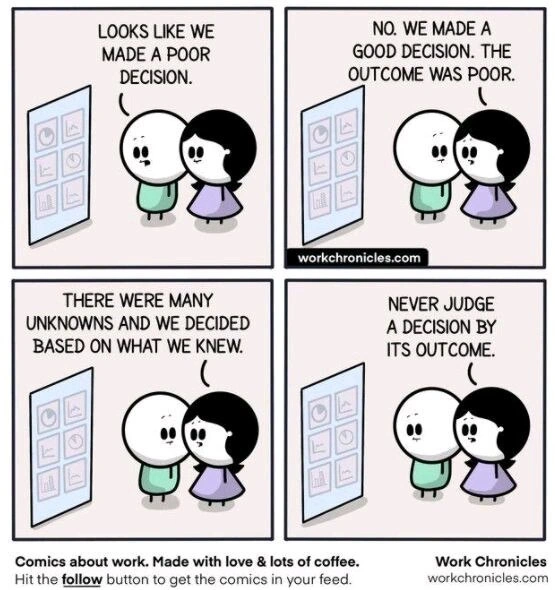
This is a four-panel comic from 'Work Chronicles' featuring two simple cartoon characters looking at a dashboard of graphs and charts. In the first panel, one character states, 'LOOKS LIKE WE MADE A POOR DECISION.' The second character consoles them, replying, 'NO. WE MADE A GOOD DECISION. THE OUTCOME WAS POOR.' In the third panel, the character continues their reasoning: 'THERE WERE MANY UNKNOWNS AND WE DECIDED BASED ON WHAT WE KNEW.' The comic concludes in the fourth panel with the philosophical takeaway, 'NEVER JUDGE A DECISION BY ITS OUTCOME.' This comic perfectly captures the concept of outcome bias, a critical topic for senior engineers and technical leaders. It champions a mature engineering culture where the quality of a decision is evaluated based on the process and available information at the time, not purely on the result, fostering psychological safety and encouraging calculated risks
Comments
17Comment deleted
Hindsight is a non-nullable field in every stakeholder's post-incident report schema
Postmortem verdict: switching to event-driven was a solid decision - the catastrophe came from assuming “exactly once” delivery wasn’t an inside joke
This is every architecture review meeting where you're explaining why microservices seemed like a good idea in 2018 - we had the best intentions, solid reasoning, and somehow still ended up with 47 services for a CRUD app that could've been a monolith
Architecture decision records exist precisely so that in two years you can prove the bad outcome was, at the time, a perfectly reasonable decision
This comic perfectly captures the engineering equivalent of 'the code was perfect until the users touched it.' It's the sophisticated dance we do in post-mortems where we separate decision quality from outcome quality - a distinction that conveniently absolves us of responsibility while sounding intellectually rigorous. The reality? We're often just applying Bayesian reasoning retroactively to decisions we made on gut feel and caffeine. The real skill isn't making perfect decisions under uncertainty; it's crafting narratives that make our past selves look thoughtful rather than lucky or reckless. Every senior engineer has delivered this exact monologue while staring at a Jira board full of technical debt, knowing full well that 'many unknowns' is code for 'we didn't do enough research but the PM was breathing down our necks.'
In the retro: the architecture was sound; the outage was a tail event - update the priors, not the org chart
Our ADR was solid and +EV; prod just rolled snake eyes - great reminder that judging decision quality by outcomes is how you end up optimizing for luck and HIPPOs
We picked Kubernetes because Docker alone was unknown territory - flawless decision, until YAML sprawl became the saga
🤡 Comment deleted
That’s mean you make a bad decision. Comment deleted
something on PM's language, me not understand, me simple coder Comment deleted
it's not on PM's language, it's on English Comment deleted
PM speaks English, PM speaks PMish -> English = PMish Comment deleted
Are you serious? xD Comment deleted
No, i'm Vyacheslav Comment deleted
that... makes some sense actually Comment deleted
how is this a joke? Comment deleted