
Achieving Cross-Platform Failure
Description
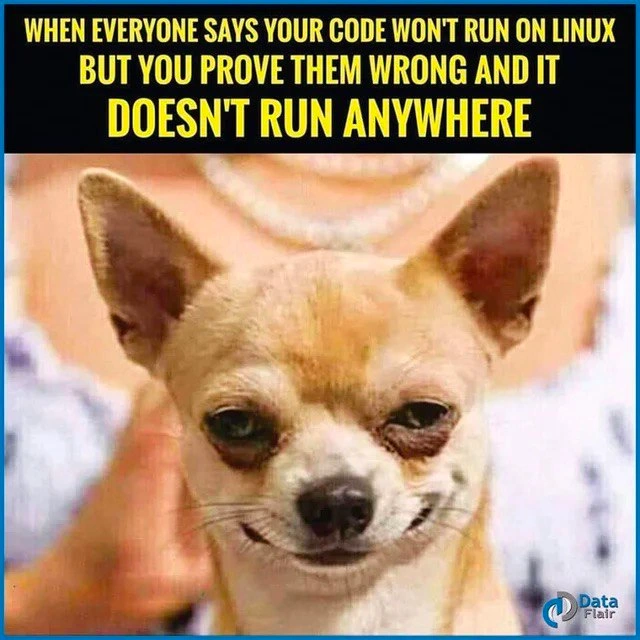
A meme featuring a close-up photograph of a small, light-brown chihuahua. The dog is looking at the camera with a smug, self-satisfied grin, as if it has just accomplished something clever. Above the image, on a black background, is yellow, bold text that reads: 'WHEN EVERYONE SAYS YOUR CODE WON'T RUN ON LINUX BUT YOU PROVE THEM WRONG AND IT DOESN'T RUN ANYWHERE'. This meme humorously captures the concept of a pyrrhic victory in software development. A developer, driven by the challenge to prove their code is portable, ends up breaking it for all environments. The smug expression of the dog perfectly represents the developer's feeling of being technically correct (it no longer fails *only* on Linux) while having caused a much bigger problem. It's a relatable scenario for experienced engineers who have witnessed how attempts at refactoring or ensuring compatibility can go horribly wrong without comprehensive testing


Comments
7Comment deleted
I've successfully abstracted the failure layer. My code is now perfectly platform-agnostic: it delivers a segmentation fault with equal efficiency on Windows, macOS, and Linux
Turns out the real portability layer is the undefined behavior we emitted along with the binary - works equally badly on every kernel ABIs you can name
Successfully achieved platform-agnostic architecture: zero runtime dependencies, zero runtime
Ah yes, the classic 'write once, break everywhere' paradigm. You've successfully achieved platform parity - by ensuring your code fails consistently across all operating systems. It's like refactoring your conditional compilation directives so thoroughly that you've abstracted away the actual functionality. At least now you can't be accused of Linux-specific bugs; you've democratized the failure. This is what happens when you fix the symptom (platform detection) instead of the root cause (architectural assumptions). Your CI/CD pipeline must be a beautiful sea of red across all build matrices - truly impressive consistency in failure
We finally achieved platform parity: the same unresolved glibc symbol on Linux, node‑gyp heartbreak on Windows, and an exit code 134 on macOS - write once, crash everywhere, with horizontal scalability
New portability tier unlocked: WORA = Write Once, Return 127 Anywhere
Peak portability: deploys to every kernel, greets with segfaults from systemd to init