The Unspoken Tax of Being a Programmer: Family Tech Support
Why is this DevCommunities meme funny?
Level 1: The Candy Brag Regret
Imagine you’re at school and you tell everyone you have a huge bag of candy. The moment the words leave your mouth, all your classmates run over and start asking, “Can I have some? Can you share with me? I want candy!” Suddenly, you realize you made a mistake by saying anything. You’re thinking, “Uh oh, I shouldn’t have said that.” Why? Because now you have to either give away your candy or feel bad saying no. You kind of wish you had kept it a secret so you wouldn’t be in this sticky situation.
This meme is showing that same feeling, but with a programmer and their family. The programmer told a relative about their special skill (being good with computers), and immediately the family member wants something from them (like help fixing a computer). The programmer feels like, “Oops, I opened my mouth and now they want free help – I really regret saying I’m a programmer.” It’s a funny way to show how sometimes sharing your talent or job can accidentally make people expect favors. Just like the candy example – sometimes it’s easier to not mention what you have or can do, unless you’re prepared to share with everyone who asks!
Level 2: Should’ve Kept It Vague
At this level, let’s spell out what’s happening in simpler terms. The meme portrays a very relatable scenario for anyone who works in tech. It shows a conversation between a programmer and a relative:
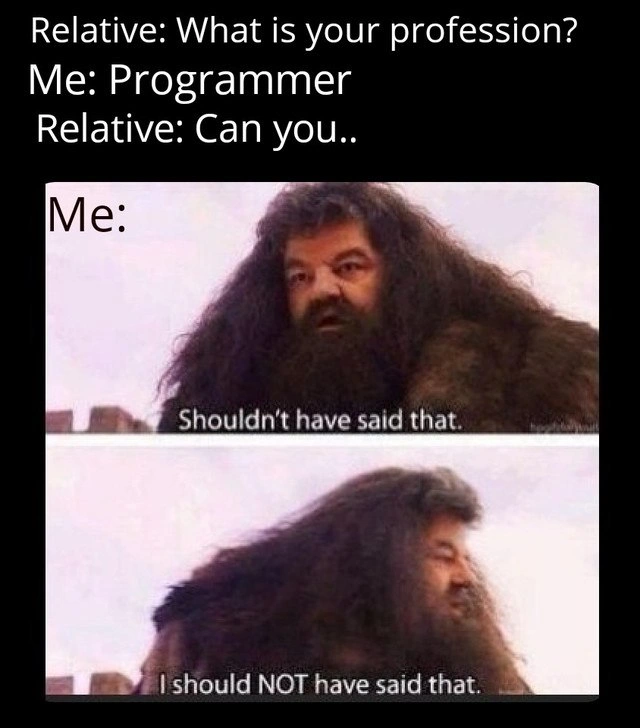
- Relative: “What is your profession?” (Basically, “What do you do for a living?”)
- Me (the Programmer): “Programmer.” (Proudly stating I write software for a living.)
- Relative: “Can you..” (The relative immediately begins to ask for help with some computer or tech problem – the meme leaves this part hanging, but we can guess it’s something like “Can you fix my computer?”)
At this point, the meme shows Hagrid (a character from the Harry Potter movies) in two panels with captions: “Shouldn’t have said that.” and “I should NOT have said that.” This is exactly how the programmer feels right after admitting what they do. Hagrid is famously large and bearded (as in the image) and in the movie scene he accidentally reveals a secret and immediately regrets it. The meme borrows that iconic moment to represent the programmer’s regret. It’s a fun way of saying, “Oops, I walked right into that one.”
Why would a programmer regret saying they’re a programmer? Because of a well-known communication gap between tech people and non-tech people. Often, when someone hears “programmer,” they think “computer expert.” They might not know the difference between a software developer (who writes programs) and an IT support technician (who fixes computers, printers, Wi-Fi, etc.). So the relative’s next question is typically something like:
“Oh, you work with computers! Great, can you fix my laptop / set up my printer / check why my phone is acting weird?”
This is such a common experience that it’s become a running joke in the developer community (hence the tags like DeveloperHumor and RelatableHumor). The programmer in the meme dreads the predictable request. It’s not that they can’t possibly help, but maybe they know from experience that these “quick fixes” are rarely quick. It might turn a relaxing family visit into an impromptu tech support session. For example, a relative might actually expect:
- You’ll remove a virus from their computer,
- or recover a lost password,
- or make their ancient PC run faster,
- or hook up a smart TV for them.
And if you’re a relatively new programmer (say you just got your first programming job), the first time this happens can be surprising. You might think, “Sure, I work with code, but I have no idea how to fix a printer!” The relatives_as_unpaid_IT_support concept means your family might assume you’ll help them for free, just because you “know computers.” It can feel flattering at first (they trust you!), but it quickly becomes overwhelming if every family gathering turns into a tech Q&A. That’s why even junior developers quickly learn the social trick of maybe downplaying their job in non-tech crowds. Some might just say, “I work in an office,” or be very vague about it, to avoid the situation entirely. It’s almost like a form of self-defense against accidental tech support duty!
The meme falls under Communication because it’s all about a conversation gone wrong (or at least, gone in an unwanted direction). It also fits Developer Experience (DX) in the sense that it’s about the personal experiences developers have outside of coding. “DX” usually refers to making a developer’s job smoother (like better tools, documentation, etc.), but here we’re playfully using it to talk about life as a developer. Part of that life is dealing with how to communicate what you do to non-developers. And clearly, saying “programmer” to someone who doesn’t know much about tech often leads to misunderstandings.
To clarify some terms:
- A programmer (or software developer) is someone who writes code to create software or applications. Think of them as authors, but instead of writing stories in English, they write instructions in programming languages for computers to follow.
- IT support (Information Technology support) is more about helping users with their computers and devices – setting them up, troubleshooting issues, installing software, fixing hardware, etc. Think of them as the helpful technicians at a computer shop or the person at work you call when your email isn’t working.
So, when the relative hears “programmer,” they jump to the conclusion that you can do all the IT support stuff. Many programmers do have some knowledge of those things (since we spend a lot of time around computers), but it might not be our specialty or passion. Plus, doing it as a favor can be tricky – if something goes wrong while I’m trying to help, I’d feel really bad!
The humor in the meme is also about how fast the situation changes. One second, the programmer is just answering a question. The next second, they realize they’ve opened a can of worms (meaning they started something that will lead to a lot more trouble than expected). Hagrid’s dramatic double-line captures that shock and regret perfectly. The first panel “Shouldn’t have said that” is like the immediate uh-oh moment, and the second “I should NOT have said that” is doubling down – yep, this was definitely a mistake.
This is very much a relatable developer experience: even if you’re new to the field, you might have experienced it with friends or family. Maybe you told your friend you’re learning coding, and they went “Oh cool, I have this app idea, can you build it for me?” or your uncle said “Hey, you’re into tech, do you mind setting up my new router?” You find yourself thinking, “Uh oh, what did I just sign up for?”
It’s worth noting that the meme isn’t mean-spirited; it’s more a light-hearted poke at this common misunderstanding. We all love our relatives, and they usually don’t realize they’re putting us on the spot. But it’s exactly this everyday social awkwardness that makes the meme funny. Every programmer who sees it immediately nods and maybe even laughs because they’ve been in that exact situation, word for word. It’s tech humor at its finest – taking a slice of life from the programmer world and exaggerating it a bit with the help of a pop culture reference (Hagrid from Harry Potter) to make a point.
In short, Level 2 analysis tells us: When I, the programmer, answered my relative’s question honestly, I unknowingly triggered a request for tech help. The meme uses a famous movie quote to show my instant regret. It’s funny because it happens all the time in real life to those in the software field. Now I (and many like me) have learned that sometimes it’s better to keep things vague about work when among non-tech folks, unless I’m ready to troubleshoot someone’s computer!
Level 3: Open Mouth, Insert Ticket
When a developer innocently admits “I’m a programmer,” it’s basically a magical incantation that summons free tech support requests out of thin air. In this meme, the hapless programmer is Hagrid-level horrified – “I should NOT have said that.” Why? Because every seasoned coder knows what comes next. The relative’s eyes light up and you can practically see the unpaid IT support ticket being opened in their mind.
Why is this funny to developers? It’s painfully relatable. The moment you say “programmer,” many non-tech relatives immediately ask, “Oh, can you fix my computer?” or any variation of “can you help with [insert tech problem]?” The humor comes from that instant regret we feel – a comedic exaggeration of a very real developer pain point. We’ve all lived this: you divulge your profession and suddenly you’re volunteered to debug Aunt Mary’s ancient laptop or recover Cousin Bob’s deleted photos. The meme nails that communication gap: what we mean by “programmer” vs. what they hear.
Let’s break down that gap. To an experienced dev, “I’m a programmer” means I write software, wrangle code, and engineer complex systems. But to a relative, it often translates to “I’m great with any and all technology; please line up your broken gadgets”. This mismatch in understanding is a classic source of developer humor. We chuckle (and cringe) because the meme dramatises that exact moment a friendly conversation turns into a support request. Cue the internal facepalm.
Notice the format: the meme’s text sets up the scenario like a dialogue. The relative asks your profession, you proudly say “Programmer,” and the relative immediately starts with “Can you...” – trailing off. We all know how that sentence ends: “… fix my printer? … build me an app? … take a quick look at my Wi-Fi?” The meme doesn’t even need to finish the question; our collective tech-trauma fills in the blank. It’s a brilliant use of relatable developer experience – just a few words and every coder knows the punchline. The two-panel Hagrid image (from Harry Potter) emphasizes the “oh no, what have I done” feeling: first panel “Shouldn’t have said that.”, second panel “I should NOT have said that.” The repetition drives home the regret, escalating it for comedic effect. It’s basically the programmer mentally replaying their slip-up in slow motion.
Why Hagrid? In the Harry Potter scene, Hagrid accidentally reveals secret information and immediately realizes his mistake – it’s a perfect parallel. Here you, the programmer, accidentally reveal your secret identity (the family computer wizard), and you just know you’ve unleashed something you can’t take back. Relatives_as_unpaid_it_support is so common that it’s almost an in-joke job title among devs. Experienced engineers swap war stories of family tech support like veterans recounting battles: “Remember the holiday when I spent 3 hours removing malware from grandma’s PC?” or “I once rewired my uncle’s Wi-Fi at a funeral reception.”
This scenario persists because of fundamental misconceptions about tech jobs. Relatives often don’t realize that programming is a very different specialty from general IT support or hardware repair. They hear “computers” and assume you’re a master of all things digital, from coding an app to fixing a printer jam or troubleshooting the TV remote. And to be fair, many developers are pretty handy with tech overall – but that doesn’t mean we relish being the on-call family helpdesk. After a week of wrangling code and debugging at work, most of us guard our downtime. The meme humorously captures that dread of “Oh no, now I have to either help or awkwardly excuse myself.” It’s a shared understanding in the developer community that saying too much about your job outside of work can backfire socially.
From a senior dev’s perspective, the meme is both cathartic and cautionary. It validates our experience (“Phew, it’s not just me!”) and also serves as a tongue-in-cheek warning: Don’t feed the tech support monster. Seasoned programmers have even developed tactics to dodge these scenarios. Some adopt opaque titles like “software engineer in data infrastructure” hoping relatives’ eyes glaze over. Others set firm boundaries or playfully say, “I only speak to computers, not about them.” But in the moment, when you’re caught off-guard by Aunt Jane’s innocent inquiry, it’s hard to dodge. Thus: Shouldn’t have said that.
The meme is tagged under Communication and DeveloperExperience for good reason. It highlights a communication challenge – explaining your high-tech job to a layperson without triggering misconceptions – and it’s very much part of the developer’s life experience. Every dev eventually learns how to handle the inevitable “Can you help me with this computer thing?” requests. Some embrace it, happy to be the hero once in a while. But many become a bit cynical (with a wry smile) about it over the years, as the favors pile up. It’s not that we don’t want to help our families; it’s that the requests often come at the worst times or turn out to be far more involved than the relative imagined.
Consider the hidden complexity: Aunt Sue’s “quick question about Word” might morph into an afternoon of reinstalling drivers. Your cousin’s “small phone issue” might involve recovering a Google account. These are tasks an actual IT support professional or helpdesk might handle, but you, the lone programmer, become the default fixer because you’re “good with computers.” The meme humorously encapsulates that inevitability. As a grizzled dev might joke, “No bug in production is as scary as a relative starting a sentence with ‘Can you have a look at…’”.
We can also recognize the DeveloperHumor angle where this is a form of collective commiseration. Memes like this appear on forums and social media because they get a knowing laugh and a “so true!” comment from coders everywhere. It’s part of the culture of tech humor – laughing at our own frustrations. The tags like programmer_conversation_regret and can_you_fix_my_computer point exactly to this mini-genre of memes sharing the facepalm moments unique to techies. We even make pseudo-code jokes about it:
# The moment you overshare your job title at a family gathering
def reveal_profession(person):
if person.is_relative:
print("I'm a programmer.")
raise ConversationRegret("Shouldn't have said that!")
In summary (without actually concluding formally): This top level analysis shows the meme is more than just Hagrid’s funny line – it’s poking at a real-world dynamic between developers and their non-tech relatives. It blends a pop culture reference (Hagrid’s quote) with a daily-life developer experience (the relatives-as-tech-support trap), creating a joke that hits home for anyone in the field. It’s the kind of humor you chuckle at and maybe share with your programmer friends with a comment like “Story of my life, haha.” It encapsulates the RelatableDeveloperExperience perfectly.
To illustrate the expectation vs reality, here’s a quick comparison that every coder will understand:
| What the Relative Thinks 🧙♂️ | What the Programmer Actually Does 💻 |
|---|---|
| Universal Tech Wizard – “fix any computer” | Specialist Problem Solver – writes and debugs code in a specific domain. |
| Loves Free Tech Chores – hobby is fixing gadgets | Needs Downtime – values off-hours not spent on more troubleshooting. |
| Instant Solutions – “It’s probably easy, right?” | Research & Patience – knows even “simple” fixes can take hours of googling and tweaking. |
| Always On Call – “you’re the family IT gal/guy!” | Not a Helpdesk – has their own work and life, not an always-available support line. |
Each of these mismatches feeds the comedy. The relative isn’t being malicious; they just lack understanding of what a programmer’s day job entails. And the programmer, caught off guard, experiences that moment of regret captured so perfectly by Hagrid’s double-take. In a single meme, we see a slice of the developer experience (DX) outside the office – the communication gap that turns a simple family question into a comedic “Should’ve kept my mouth shut” life lesson.
Description
This meme captures a universally painful experience for tech professionals using a two-panel format featuring the character Rubeus Hagrid from the Harry Potter series. At the top, a short dialogue is presented: 'Relative: What is your profession? Me: Programmer Relative: Can you..'. Below this, the first panel shows a worried-looking Hagrid with the subtitle 'Shouldn't have said that.' The second panel shows Hagrid looking away in deep regret, with the subtitle 'I should NOT have said that.' The humor lies in the immediate and predictable consequence of revealing one's profession as a programmer to a non-technical relative. The phrase 'Can you...' is the universally recognized prelude to a request for unpaid, often menial, tech support - like fixing a printer, removing a virus, or troubleshooting a phone - tasks that are typically far removed from a professional programmer's actual job. The meme perfectly encapsulates the instant regret and the social burden of being the designated family IT person
Comments
12Comment deleted
Sure, I can look at your printer. My hourly rate is $200, but for family, I offer a special 'turn it off and on again' service for the low price of my remaining sanity
Told the family I engineer five-nines distributed systems - two minutes later I’m on a P1 with Aunt Carol’s 2006 inkjet: no logs, no staging, but apparently the SLA is “before dessert.”
Twenty years of distributed systems architecture, and somehow I'm still the family's designated printer driver installer and WiFi password recovery specialist
Every senior engineer knows the three-stage grief cycle: Stage 1 - Mentioning you're a programmer at a family gathering. Stage 2 - Hearing 'Can you...' Stage 3 - Spending the next hour explaining why you can't fix their printer despite having 15 years of distributed systems experience. The real architectural challenge isn't designing for scale - it's designing an exit strategy from Thanksgiving dinner before someone asks about their iPhone storage
Admitting 'programmer' at family dinner auto-enlists you in eternal on-call for printer demons and WiFi gremlins
Telling relatives I’m a programmer auto-subscribes me to lifetime P0 on-call for a legacy monolith called Printer - no logs, no budget, infinite stakeholders
Saying “programmer” at family dinner is basically enabling an unauthenticated, unbounded webhook for free consulting - rate limits and SLAs not implemented
CaN yOu FiX oUr PrInTeR??? YoUr'E a pRoGrAmMeR!!! Comment deleted
"Oh, I have a great idea for an app.." :C Comment deleted
soooooo true Comment deleted
Can you hack Facebook? Comment deleted
"Can you hack my friend's instagram?" Comment deleted