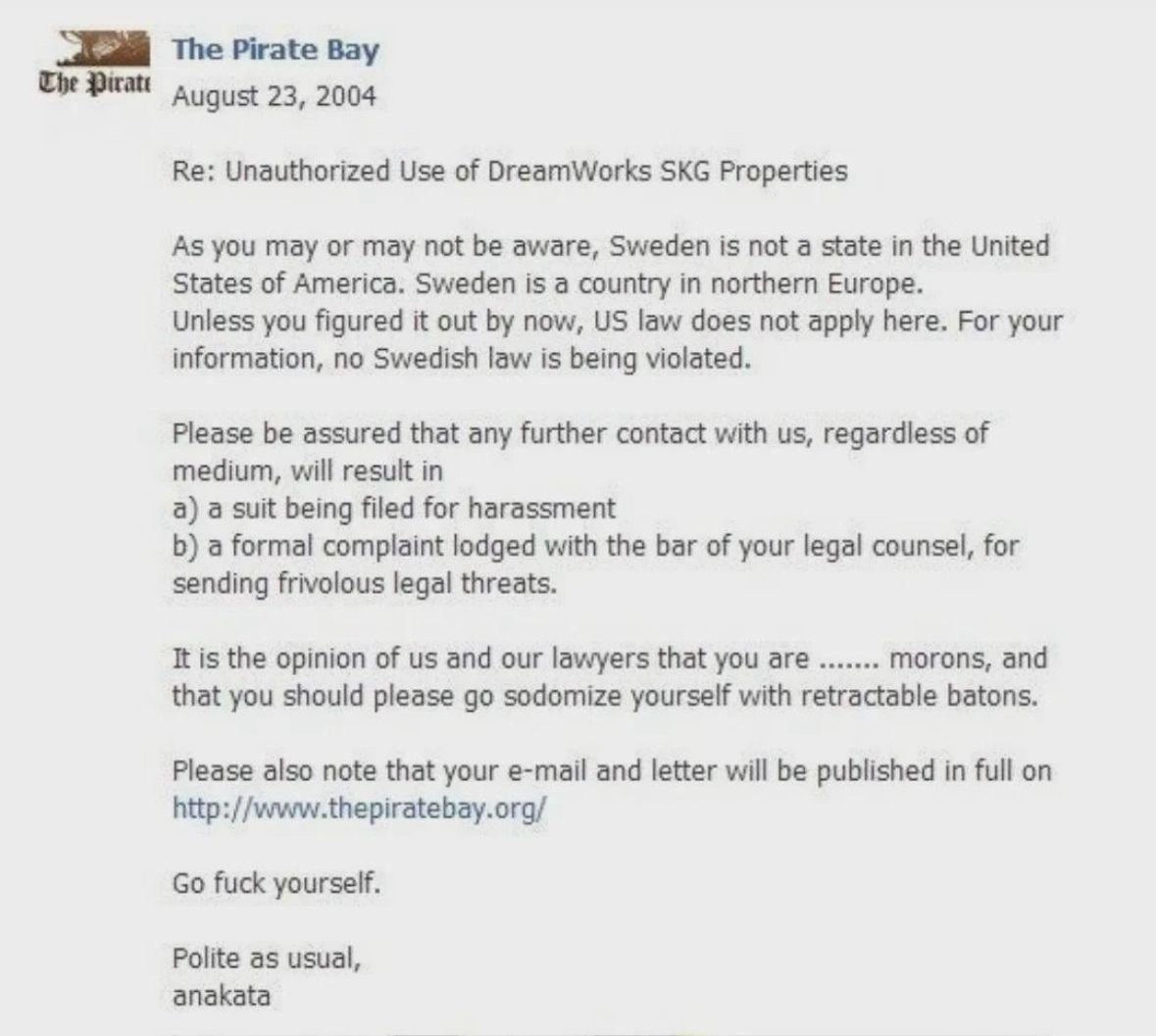
The Pirate Bay's Infamous 2004 Legal Response to DreamWorks
Why is this TechHistory meme funny?
Level 1: My House, My Rules
Imagine a big bully from another neighborhood marching into your yard and shouting, “Hey, you can’t play that game here, it’s against my school’s rules!” But you’re not in his school or his neighborhood. You stand your ground and reply, “This is my house, not yours. Your rules don’t apply here! If you keep bossing me around on my property, I’ll call your parents and tell them you’re being mean.” Then, for good measure, you add a very rude “Now get lost!” 😎. It’s funny because the little kid (on his own turf) completely flips the situation on the big bully, who suddenly has no power there. The bully expected to scare the kid, but instead he got told off big time. The attitude and sass of the kid’s reply make everyone watching go, “Whoa! He really said that!” It’s basically a playground version of what Pirate Bay did to the Hollywood lawyers — my place, my rules, now kindly go away!
Level 2: Pirates vs Hollywood
The Pirate Bay’s email is basically a giant “nope!” to a Hollywood studio’s demand. To unpack this, let’s first understand the players and terms:
The Pirate Bay: A famous website (founded by Swedish tech enthusiasts) that helped people share files through BitTorrent, a peer-to-peer (P2P) system. If you wanted a free copy of a movie or game in 2004, you likely searched on The Pirate Bay. It didn’t host movies directly, but it indexed
.torrentfiles – tiny files that let your BitTorrent program find other people sharing the movie. Because users distributed bits of the file to each other, there was no single server to shut down. The Pirate Bay acted like a search engine for pirates, enabling millions to download copyrighted stuff without paying.DreamWorks SKG: A big American film studio (think Shrek, Madagascar, etc.). In 2004, they discovered their movies were being shared on The Pirate Bay. Understandably, they weren’t happy about people downloading DreamWorks films for free. So their lawyers sent a formal cease-and-desist email accusing Pirate Bay of “Unauthorized Use of DreamWorks properties” — basically saying “you’re illegally sharing our movies, stop it or else.” This was likely under the DMCA, a U.S. law that allows copyright owners to demand online content be removed. In the U.S., websites usually comply with such notices to avoid huge lawsuits or fines.
The plot twist: The Pirate Bay was in Sweden, and at that time Swedish law didn’t have an exact equivalent to the U.S. DMCA. In 2004, hosting a torrent link in Sweden wasn’t clearly illegal, since The Pirate Bay wasn’t directly hosting the movie files. So from Pirate Bay’s perspective, no Swedish law was being broken. DreamWorks’s American lawyers were trying to use U.S. rules on a Swedish website — kind of like trying to enforce baseball rules on a soccer field.
So how did Pirate Bay respond? With snark dialed up to eleven. Their email starts by basically giving DreamWorks a geography lesson: “Sweden is not a state in the United States of America. Sweden is a country in northern Europe.” 🤦 The tone is mocking, as if the lawyers might be clueless about basic geography. Then they state clearly: “US law does not apply here. … no Swedish law is being violated.” In simple terms, “your American copyright rules don’t work in our country, so we’re not obliged to take down squat.” They’re drawing a jurisdiction line in the sand.
But Pirate Bay didn’t stop at just saying “we’re not under your law.” They went further, flipping the threat around. The email warns that if DreamWorks contacts them again, Pirate Bay will take action against DreamWorks for harassment. Specifically:
a) They’d file a lawsuit for harassment.
b) They’d lodge a formal complaint with the lawyer’s Bar Association (that’s the organization that licenses lawyers to practice law) for sending “frivolous legal threats.”
In other words, Pirate Bay essentially said, “If you keep bothering us, we will sue you.” 😲 This is highly unusual – normally small websites are terrified when big Hollywood studios threaten them. Here the small site is threatening back! It’s clearly a bluff (DreamWorks hadn’t actually broken any law), but it sends a message: Pirate Bay wasn’t scared.
Then comes the grand finale of the email, the part that made it infamous. Pirate Bay writes: “It is the opinion of us and our lawyers that you are… morons.” Yes, they flat-out called the Hollywood lawyers morons (i.e., idiots). And it gets even more extreme: “please go sodomize yourself with retractable batons.” This is an extremely crude and imaginative way to say “go f*** yourself.” The email then coolly notes that they will publish this whole exchange on their website for everyone to see (which they did, embarrassing the lawyers). Finally, it’s signed off with “Go fuck yourself. Polite as usual,
anakata.” The name “anakata” is the alias of one of Pirate Bay’s founders. The phrase “Polite as usual” is pure sarcasm – obviously, nothing about that sign-off is polite! They’re openly taunting DreamWorks.
This email became legendary in tech humor and Internet culture. Why? Because it was the little guy (a rogue tech community) talking back to a giant corporation in the most unapologetic way. For many developers and internet folks, it was satisfying to see a stuffy legal threat met with bold mockery. Usually, cease-and-desist letters result in apologies or silence, not profanity-laced retorts. The Pirate Bay’s response said, “We don’t recognize your authority, and we’re not afraid of you.” That attitude resonated with the early torrent community, which often saw themselves as rebels keeping the internet free and uncensored. The letter was widely shared in forums and blogs, becoming a meme in its own right – a symbol of defiance against overreaching copyright enforcement. It’s frequently cited in discussions about copyright, jurisdiction, and online freedom, as well as in lists of the most sarcastic or brutal comebacks in tech history. Even ~20 years later, people in developer and file-sharing communities still refer to it and laugh, because it captures an era when pirates literally told Hollywood: “Come at me, bro.”
Level 3: Beyond DMCA’s Reach
In the early 2000s, a battle raged between peer-to-peer file sharing sites and Hollywood studios. This meme captures one of those legendary moments: a scathingly sarcastic email The Pirate Bay sent to DreamWorks in August 2004. At the time, DreamWorks’s lawyers tried to invoke the DMCA (the U.S. Digital Millennium Copyright Act) to force Pirate Bay to take down pirated movie files. But Pirate Bay was headquartered in Sweden, far outside the DMCA’s jurisdiction. The letter gleefully reminds DreamWorks that “Sweden is not a state in the United States of America… US law does not apply here.” It’s a jurisdictional smackdown delivered with deadpan snark. Senior developers who lived through the torrent era recognize this as a classic moment in InternetCulture and TechHistory, when scrappy dev communities openly defied corporate legal threats.
The humor comes from how blunt and brazen the response is, especially given the formal email format. In a typical corporate exchange, you’d expect cautious legalese or at least civil language. Instead, Pirate Bay’s reply reads like a nerdy rebel’s manifesto wrapped in a polite letter template. It starts off almost formally, then escalates into outright insult. The email threatens that if DreamWorks contacts them again, they (Pirate Bay’s team) will sue for harassment and even file a complaint with the lawyer’s bar association for frivolous threats. This role-reversal — tiny Pirate Bay threatening mighty DreamWorks — is both shocking and hilarious to industry veterans. It’s basically the “UNO reverse card” of copyright takedown notices.
The most infamous lines are unabashedly NSFW by corporate standards. Pirate Bay’s co-founder (signing as “anakata”) writes, “It is the opinion of us and our lawyers that you are … morons, and that you should please go sodomize yourself with retractable batons.” 😮 In plain speak, he’s calling the Hollywood lawyers idiots and telling them to go f*** themselves in a ridiculously graphic way. The kicker: he signs off with “Polite as usual, anakata.” That absurd sarcastic humor — claiming politeness right after a vulgar insult — is what makes tech folks smirk. It’s an extreme example of Internet sarcasm and the fearless attitude of early P2P file-sharing communities.
This snarky legal response was promptly published on Pirate Bay’s site (as the email itself warns: “your e-mail and letter will be published in full”). In other words, Pirate Bay turned a private legal threat into a public spectacle. This move of publishing takedown notices was common in the torrent community – it rallied users by exposing corporate bullying and provided entertainment via Pirate Bay’s over-the-top replies. The developer community shared this pirate_bay_letter far and wide, cementing it as a piece of tech folklore. It’s a time capsule from the 2004 internet era, reflecting a Wild West period of InternetCulture where a small rogue website could openly mock a major studio with seeming impunity. Seasoned tech folks remember those days fondly (and a bit incredulously), because it shows how communication in DevCommunities can be boldly confrontational when backed by the right technical and legal loopholes. The letter’s defiant tone — effectively saying “Not in my jurisdiction, matey” — still elicits a knowing grin from anyone who dealt with copyright and torrent dramas back in the day.
Description
A screenshot of the legendary and defiant letter sent by The Pirate Bay on August 23, 2004, in response to a legal threat from DreamWorks SKG. The letter, typed in a plain, serif font on a light grey background, systematically dismantles the legal threat with sarcasm and aggression. Key text includes: 'As you may or may not be aware, Sweden is not a state in the United States of America... US law does not apply here.' It then threatens counter-legal action for harassment and frivolous threats. The letter escalates to direct insults, calling the lawyers 'morons' and concluding with 'Go fuck yourself.' It is signed 'Polite as usual, anakata,' one of the co-founders. This document is a significant artifact of internet history, embodying the early-2000s culture of anti-copyright activism and digital sovereignty. It highlights the jurisdictional challenges of enforcing national laws on a global internet, a legal battleground that remains highly relevant. For senior developers and tech veterans, this letter isn't just a crude joke; it's a symbol of a bygone era of internet freedom, representing a foundational clash between centralized content distributors and decentralized peer-to-peer technology that reshaped the media landscape
Comments
14Comment deleted
This is the 2004 equivalent of responding to a vulnerability disclosure with a '403 Forbidden' and an opinionated README.md explaining jurisdiction
Pro tip: US copyright law isn’t a globally replicated namespace - push a DMCA to the Sweden shard and you’ll get back HTTP 451 with body: “Polite as usual, anakata.”
Remember when deploying to production meant burning CDs, not containers? The Pirate Bay's response to DreamWorks is like returning HTTP 418 'I'm a teapot' to a production API request - technically correct, maximally unhelpful, and guaranteed to make legal review your new bottleneck
When your legal team's jurisdiction validation logic returns 404 and you decide to deploy the nuclear 'go fuck yourself' response in production - no rollback strategy, just pure commit-and-push energy. This is what happens when you try to enforce US copyright law on a Swedish server: a classic case of geolocation-based access control, except the firewall is made of pure audacity and the logs are published for posterity. The Pirate Bay basically implemented the most aggressive CORS policy in history: 'Access-Control-Allow-Origin: Not-Your-Jurisdiction.'
DreamWorks tried a cross‑region compliance push; TPB returned a pre‑451 “Unavailable for your jurisdiction” and deployed the thread to prod
DreamWorks attempted a DMCA write to the Swedish node; TPB chose AP in the CAP trade-off and replicated the request to prod instead
Pirate Bay's C&D handler: jurisdictional CAP theorem masterclass - partition tolerance over consistency, every time
Holy Chad Comment deleted
Go fuck yourself 20 years ago. So chad Comment deleted
And then he was arrested 🤔 Comment deleted
unfortunately it didn't age well for him Comment deleted
Sweden does actually have copyright laws though I'm sure Comment deleted
torrent tracker doesn't breaks copyright law. Comment deleted
I was wondering about dates and seems like they joined in 1995 https://european-union.europa.eu/principles-countries-history/eu-countries/sweden_en Comment deleted