Boeing vs. SpaceX: A 'How It Started vs. How It's Going' Tale of Space Race Promises
Why is this CorporateCulture meme funny?
Level 1: Bragging vs Doing
Imagine two kids in school who both say they’re going to do something really cool. One kid (let’s call him Boeing) stands up in front of the class and says, “I’m going to build a bigger, better rocket than Elon’s!” He’s very sure of himself and even challenges the other kid, Elon, to a race to see who can get to the planet Mars first. Elon just smiles and says, “Go for it.” Now, Boeing’s really hyped and shouts, “Game on!” meaning “It’s a challenge!” Everyone is excited at the start because Boeing sounds so confident.
But building a rocket (just like doing a big school project) is hard. Boeing the kid keeps running into problems with his project: maybe the engine he’s trying to build doesn’t work right, or the rocket cracks during tests. He thought it would be easy to win, but it turns out to be much tougher than he said. Meanwhile, Elon the kid is quietly working on his own rocket every day after school. Elon’s rocket starts flying little test flights; there were a few crashes at first, but he learned from them and improved quickly.
By the time it matters — say the teacher needs a rocket for the school science fair — Elon has a reliable rocket ready to launch, and Boeing’s rocket still isn’t finished or safe to use. So the teacher says, “We’ll use Elon’s rocket for the fair since it’s working, and we won’t use Boeing’s yet.” In the end, the kid who bragged loudly couldn’t deliver on time, and the kid who focused on actually doing the work succeeded. It’s a bit funny and a bit sad: funny because the big talk didn’t match what happened, and sad (or embarrassing) for Boeing because he had to eat his words.
This meme is showing exactly that kind of story with real companies and astronauts. Talking big about being first is like bragging, but actually being ready and doing it is what wins the day. So it teaches a simple lesson: just saying you’ll do something grand (even in front of a bunch of people) doesn’t mean much if you can’t back it up — you have to walk the walk, not just talk the talk.
Level 2: Space is Hard
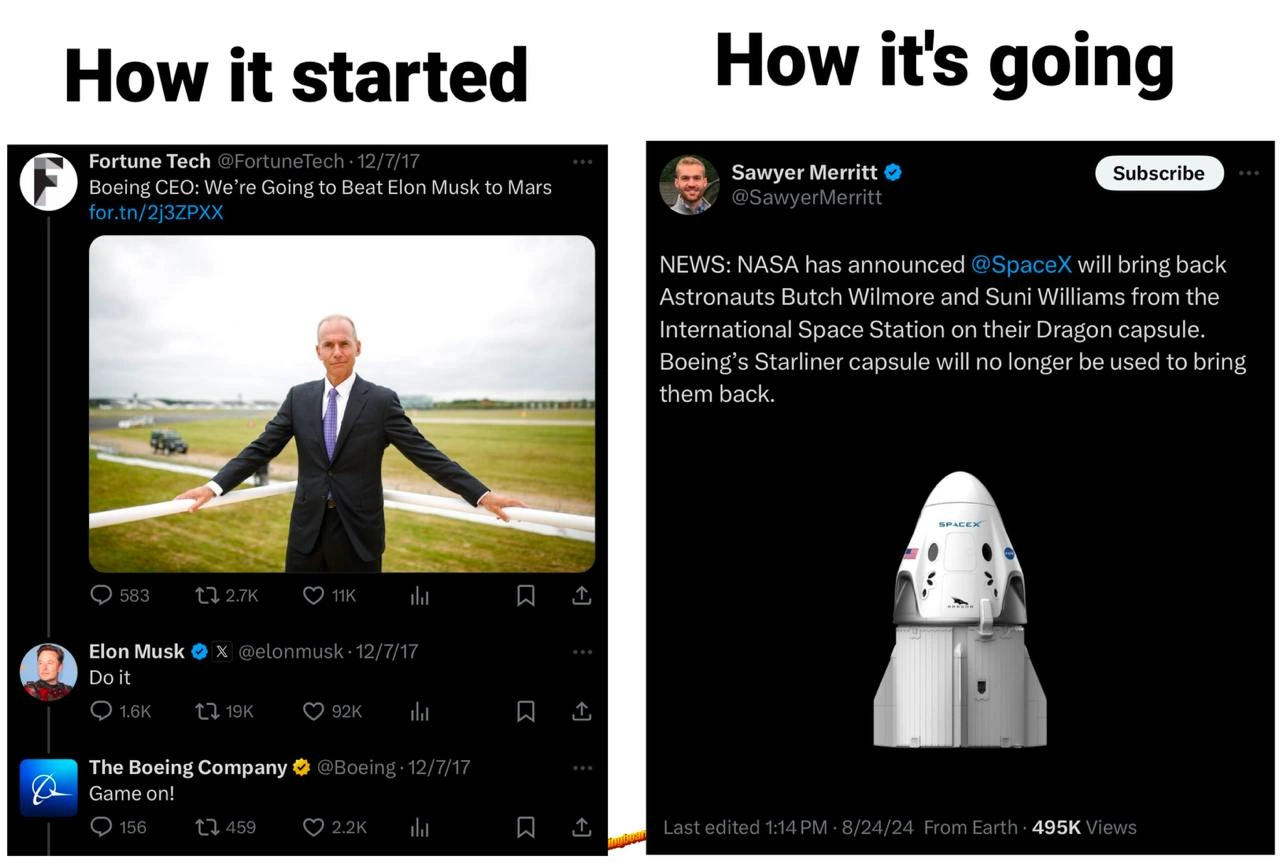
This meme shows a before-and-after comparison — a popular “how it started vs how it’s going” layout — to tell a story about big promises vs real outcomes. On the left, in 2017, the CEO of Boeing (a huge airplane and spacecraft company) publicly said something like, “We’ll get to Mars before Elon Musk does!” (Elon Musk is the head of SpaceX, a rival rocket company). Elon Musk even replied “Do it” as a dare, and Boeing’s official account answered “Game on!”. That set the stage like a race or a challenge in front of everyone. This was a major hype moment — essentially, Boeing was bragging that they would outperform SpaceX in space exploration. It’s similar to when a tech company’s boss loudly claims their product will outshine a competitor’s soon. It gets a lot of attention and creates pressure to deliver something great fast.
Now fast forward to the right side: a post in 2024 says NASA (the U.S. space agency, basically the big customer for both Boeing and SpaceX in this context) decided to use SpaceX’s Dragon capsule to bring astronauts home from the International Space Station, and not use Boeing’s Starliner capsule. This is a major update because originally Boeing’s Starliner was supposed to be one of the vehicles for these astronaut trips. So “how it’s going” is showing that, seven years later, Boeing hasn’t reached its goal — in fact, it’s behind SpaceX in a very basic way. Boeing’s spaceship project had so many delays and issues that when the time came, NASA chose the working solution (SpaceX’s capsule that was ready and proven) over Boeing’s delayed one. In simpler terms: the person who did the bragging (Boeing) didn’t get their job done on time, so the big customer went with the other person (SpaceX) who did get the job done.
For someone newer to these terms: Starliner is the name of Boeing’s spacecraft designed to carry astronauts, and Dragon (specifically Crew Dragon) is SpaceX’s spacecraft that does the same thing. Both companies were hired by NASA to taxi astronauts to and from the space station (this was part of NASA’s Commercial Crew Program). Boeing is an older, established firm (known for airplanes and space hardware), and SpaceX is a newer company that’s been very aggressive in developing rockets and capsules quickly. In 2017, Boeing’s chief made a bold statement about beating SpaceX to Mars (a very ambitious target — Mars is far away and hard to reach with people). It was like saying “we’ll be first to achieve this big dream!”. SpaceX, led by Elon Musk, of course has its own goal to go to Mars, but Musk’s playful “Do it” response on Twitter was basically him saying “go ahead, I’d love to see you try.” Boeing doubling down with “Game on!” made it feel like a direct competition.
However, aerospace projects are notorious for being complicated and taking longer than expected — there’s even a phrase in the industry: “Space is hard.” Building a new spaceship (or writing a large software system, similarly) often runs into unexpected problems. Boeing’s Starliner program experienced several setbacks: test flights failed or faced serious glitches, software errors had to be fixed, and timelines kept slipping year after year (schedule slippage is the term when planned dates keep getting pushed out). On the flip side, SpaceX, despite some early explosive tests, managed to successfully fly astronauts with their Dragon capsule in 2020 and has been doing regular trips since. By 2024, Boeing’s Starliner still hadn’t flown any astronauts due to those delays and technical issues — meaning it wasn’t ready for NASA to use when needed. NASA, being the stakeholder (the party that needs the service), can’t wait forever; they have astronauts that need rides. So the announcement in the right panel basically says: SpaceX’s capsule will be used to bring the astronauts back, and Boeing’s capsule won’t be used for that mission. In context, that’s a bit of an embarrassment for Boeing (imagine being publicly passed over for your competitor’s solution).
This is very much a project hype vs delivery story. The initial hype was Boeing saying they’d outdo SpaceX and conquer a major goal quickly. The delivery (or lack thereof) is that Boeing’s product isn’t even ready for a routine task, while SpaceX’s product is already operational and gets the nod. People in tech or project management see this and nod because they’ve seen similar patterns: a company or team promises something huge to keep up with competition or impress clients (stakeholder pressure can push leaders to over-promise), but the project encounters real-world difficulties and falls behind. Meanwhile, a competitor or another team that focused on actually building and testing steadily ends up delivering first. The humor or irony here comes from how stark the contrast is: the confident “Game on!” challenge from years ago versus the humbling news now. It’s like if two students said they’d each build the best science project: one student boasted loudly but is still tinkering with their project past the due date, and the other quietly finished theirs and got first prize. The meme uses the Twitter screenshots as evidence of this turnaround. It’s a bit of a corporate humor snapshot, showing how big talk can lead to big blushes later. And the phrase “How it started… How it’s going” is commonly used online to highlight exactly this kind of dramatic change or outcome, often in a tongue-in-cheek way. In summary, Boeing vs SpaceX here is a lesson that making something work (and meeting your deadline) is what counts in the end — big promises alone don’t fly the rocket.
Level 3: Failure to Launch
For seasoned developers and engineers, this meme sparks a knowing grin (or maybe a groan). It highlights the classic industry pattern of corporate moon-shot bravado followed by a hard reality check. On the left, we have the quintessential overconfident executive proclamation – Boeing’s CEO essentially thumping his chest and saying “Game on!” to Elon Musk in a high-stakes space race. This is corporate culture at work: big promises made under stakeholder pressure (be it investors, board members, or, in this case, NASA contracts) to show that “We’ve got this, we’ll beat the competition.” It’s the aerospace equivalent of a CTO boasting in an all-hands meeting, “We’ll outship our rival’s product by next summer, no sweat.” Everyone who’s been through a few product cycles knows to cringe a little at those moments, because bold claims without grounding in the team’s reality are usually a prelude to unrealistic deadlines and painful crunch times.
Fast forward to the right panel: “How it’s going.” Ouch. Boeing’s much-delayed Starliner capsule still isn’t ready for a routine astronaut taxi ride, so NASA is tapping SpaceX’s Dragon capsule to do the job instead. In plain terms, the competitor actually delivered, while the boaster slipped behind schedule so far that the customer (NASA) had to change plans. This turn of events is both funny and painfully familiar to veterans of big projects. It’s humorous in that schadenfreude way – seeing an overly confident pronouncement fall flat – but it’s also too real. Many of us have lived through projects where managers promised the moon (sometimes literally, in Boeing’s case) and later found ourselves explaining to leadership why we’re nowhere near liftoff.
The meme cleverly uses the “How it started vs How it’s going” format to juxtapose rosy beginnings with sobering outcomes. In software project terms, "How it started" is the kick-off meeting with cheerful Gantt charts and quotes like “We’ll be the first to market, guaranteed.” "How it’s going" is the status update a year later where the deadline has slipped multiple quarters, dependencies didn’t line up, and the competitor already launched their feature while you’re still debugging critical issues. The Boeing vs SpaceX saga is a case study in project management challenges. Boeing had a lot of legacy process and perhaps overconfidence from decades of aerospace dominance, whereas SpaceX, the scrappy newcomer, iterated quickly and accepted early failures (they blew up a few prototypes to get it right – a very different culture!). Internally, Boeing’s engineers were likely grappling with bureaucratic hurdles, exhaustive compliance checks, and integration headaches. Imagine being an engineer on that Starliner team in 2019, watching a demo flight fail due to a clock synchronization bug – you know the schedule just got blown up along with your morale. Meanwhile, SpaceX was pushing out updates and flying multiple test missions. It’s the old industry trend of a nimble team with modern practices outpacing a slower-moving giant weighed down by process (we’ve seen this in tech with startups vs incumbents, and here it’s playing out in space).
From a corporate rivalry perspective, Boeing and SpaceX were in a public relations duel as much as an engineering one. Twitter (now X) became the arena for their macho posturing – Elon’s casual “Do it” retort and Boeing’s “Game on!” tweet show a very public stake being driven into the ground. That’s like two dev leads of rival projects trash-talking on Slack about who will hit performance milestones first. It might energize the troops, sure, but it also raises the stakes for embarrassment. And indeed, by 2024, Boeing got the proverbial pie in the face. NASA’s announcement effectively said: we don’t trust Boeing’s capsule schedule anymore, we’re using the one that works. This is analogous to a big client dropping a stalled enterprise project in favor of a startup’s solution that’s already in production. For senior engineers, it’s a lesson in humility: shipping code (or in this case, spaceships) matters more than flashy promises. It also underlines the danger of unrealistic deadlines: Boeing’s timeline to “beat Elon to Mars” wasn’t just optimistic — it was fantastical, given that neither company has landed anyone on Mars yet and Boeing’s own near-Earth project was struggling. The stakeholder pressure to show progress can lead companies to promise absurd timelines (“sure, we can get to Mars soon!”) that come back to bite them.
Ultimately, this meme is a tech-industry morality tale dressed in space-race clothes. It mocks the hype-driven project management failures we’ve all seen. The left side is the hype (big talk at the project kickoff), and the right side is the delivery (or lack thereof). The comedic contrast resonates with anyone who’s had to debug grand plans under a looming deadline. It’s funny because Boeing set itself up for this punchline — they literally said “Game on!” in front of millions, turning a hard engineering marathon into a brash contest of egos. And in true ironic fashion, the one who quietly focused on delivering a working product (SpaceX) ended up winning that unspoken game. For those of us in development, we see a parallel: it’s like that rival team that was quietly unit-testing and iterating while your team was stuck in meetings about “beating them to market.” The meme’s aerospace face-off is just a high-profile version of the age-old tech lesson: deliverables speak louder than declarations.
Level 4: Physics vs Hype
At the most fundamental level, this meme underscores a harsh truth of engineering: you can’t cheat reality with bravado. In aerospace (and any ambitious tech project), no executive tweet or bold PR statement can bend the laws of physics or the realities of complex system development. Boeing’s CEO proclaiming “We’re going to beat Elon Musk to Mars” was pure hype meeting the unforgiving constraints of rocket science. Consider the monumental challenge of reaching Mars: the delta-v (change in velocity) required is enormous, life-support and re-entry systems must be fail-safe, and every extra kilogram of payload demands exponentially more fuel (thanks to the rocket equation, a fundamental formula dictating rocket fuel requirements). Boeing’s boast in 2017 essentially wagered that their traditional aerospace approach could outpace SpaceX’s breakneck innovation. But Nature cannot be fooled – no matter how many press releases or PowerPoint slides one creates, the chemistry of propellants, the rigor of safety-critical software, and the years of testing required all march to the beat of physics, not PR.
In fact, this scenario echoes a famous lesson from the Challenger shuttle disaster: management’s wishful thinking can’t overcome physical reality. (Physicist Richard Feynman once put it succinctly: “For a successful technology, reality must take precedence over public relations, for Nature cannot be fooled.”) Boeing’s commitment to beat SpaceX was a classic case of rhetoric colliding with engineering complexity. Building a human-rated capsule isn’t just another quarterly project; it involves thousands of interconnected components (from spacecraft avionics to parachute systems) and strict oversight from NASA. Each subsystem is a potential single point of failure that must be discovered and corrected via painstaking integration tests. Such complex systems have emergent problems — e.g., Boeing’s Starliner encountered a timing software bug in 2019 that prevented a proper orbital insertion, a tiny glitch with massive schedule impact. This phenomenon will resonate with any senior engineer: it’s reminiscent of finding a critical concurrency bug in a distributed system right before launch, forcing a painful redesign. There’s a project management analogue to the laws of physics here: Hofstadter’s Law, which wryly states that everything takes longer than you expect, even when you account for it taking longer. In other words, major projects inherently hide “unknown unknowns” that no amount of initial optimism can eliminate.
So, Boeing’s grand promise to beat Musk to Mars ran up against the inescapable constraints of time, complexity, and gravity. You can declare a moon-shot goal, but the actual trajectory is governed by Murphy’s Law and orbital mechanics, not by press bravado. The meme’s punchline — Boeing’s Starliner getting sidelined in favor of SpaceX’s Dragon — is effectively physics saying, “Checkmate.” In tech terms, it’s like a legacy enterprise vendor claiming they’ll ship a revolutionary new system by year’s end without a working prototype: the fundamental effort required isn’t swayed by the announcement. Reality won here, as it usually does, illustrating that in engineering, reality > rhetoric every time.
Description
A 'How it started vs. How it's going' meme format contrasting aerospace giants Boeing and SpaceX. The 'How it started' panel on the left displays a December 2017 tweet from Fortune Tech quoting the Boeing CEO: 'We're Going to Beat Elon Musk to Mars'. Below are replies from Elon Musk saying 'Do it' and The Boeing Company stating 'Game on!'. The 'How it's going' panel on the right shows a recent tweet from August 2024 announcing that NASA will use a SpaceX Dragon capsule to bring back astronauts from the ISS because 'Boeing's Starliner capsule will no longer be used to bring them back', accompanied by an image of the SpaceX capsule. The technical context is a stark illustration of the difference between corporate pronouncements and engineering reality. It highlights the failure of a legacy enterprise (Boeing) to deliver on an ambitious project (Starliner, a precursor to Mars ambitions), while its more agile competitor (SpaceX) not only succeeded with its own program but was ultimately called upon to rescue the former's mission. For senior engineers, this is a classic case study in corporate hubris, the perils of technical debt, and the disruption of established industries by nimble, engineering-focused companies. It's a powerful commentary on how execution and delivering a working product will always trump marketing and bold claims
Comments
71Comment deleted
Boeing's Starliner project is the perfect enterprise legacy system: it has critical bugs, it's not delivering, and now they need a startup to write a migration plan for its users
“We’ll beat SpaceX to Mars” was the aerospace version of a VP promising Kubernetes in Q3 - six years and seven slip charts later, we’re paging Dragon for the rollback
Boeing's Starliner is like that legacy codebase that passed all unit tests in dev but somehow manages to throw a NullPointerException in prod - except this time the pointer is literally pointing to space and the exception leaves astronauts stranded
Boeing's approach to beating SpaceX to Mars perfectly demonstrates the difference between waterfall and agile: they spent seven years planning the announcement while SpaceX iterated their way to actually flying the mission. Turns out 'Game on!' is not a valid project delivery methodology, and Elon's 'Do it' was less trash talk and more of a code review comment that Boeing failed to address. Classic case of confusing a press release with a product roadmap - at least their Starliner had the decency to fail in LEO rather than interplanetary space
Boeing's Starliner: waterfall roadmap to Mars since 2017, now a flaming hotfix PR from SpaceX's infinite sprint velocity
Procurement said “game on,” but seven years later the incident bridge picked the capsule with an SLO and an MTBF histogram, not the one with the keynote
ADR-042: replace Starliner with Dragon because SLAs beat press releases - never confuse roadmap tweets with production readiness
Tbh I'd be scared to fly either in Boeing or SpaceX stuff xd Comment deleted
SpaceX has all the necessary acreditations and has more successful launches than Boeing. I'm betting on SpaceX now. Comment deleted
You can have all the accreditations in the world but you still need to manufacture stuff that works reliably and SpaceX isn't exactly great at that. I don't know much about rocket stuff but from what I've heard SpaceX isn't really all that great and are in the process of reinventing everything from the last 50 years. And they suck even at that if you compare how such projects from 50 years ago went. Comment deleted
dude... NOBODY before them made re-usable rockets. Even space shuttle used expendable ones. The need to reinvent because of different goals. Comment deleted
Neither did SpaceX. What's reusable about them? Comment deleted
The falcon series can be repaired and reused, vs sold for scrap Comment deleted
Yeah that is the whole point of them landing themselves lol Comment deleted
Yup, and it looks cool, especially when they did the falcon heavy launch and multiple landed simultaneously Comment deleted
Was this ever actually done? Comment deleted
So you didn’t knew that there’s boosters which were already reused DOZENS time? Gotcha, Internet be Internet Comment deleted
Lmfao Comment deleted
https://en.wikipedia.org/wiki/SpaceX_reusable_launch_system_development_program Comment deleted
I wouldn't bet on anything muskrat runs lolol Comment deleted
You suffer from Musk Derangement Syndrome. Please seek help. Comment deleted
Ah yes, anybody who disagrees with the rat must be ill. Ok Comment deleted
You are sick from hatred. Calling the dude "rat" and claiming everything of his is bad. No need to agree to everything but damn, give the man credit where it's due. Comment deleted
Credit for what lmao Comment deleted
For making retards around the world seethe with rage for one 🤣 Comment deleted
Oh yeah, he's master troll in Chief. That makes him super duper qualified to do anything! Comment deleted
This right here. Musk is so incredibly irresponsible and foolish. Boeing gave up the Engineering centric leadership and it shows. Fuck both for passenger centric items Comment deleted
I dislike Elon but you can't deny what the company is doing is beneficial Comment deleted
https://youtu.be/1AXnMlxK22A?si=ot_nPf7WSgsX6Xnb Comment deleted
Their testing with the barge landing probably helped a lot for maintaining control at low speeds Comment deleted
Their crew capsule is designed to separate from the rocket in the event of a failure and propel itself away, though it hasn't been tested in an emergency yet Comment deleted
Yes, many times Comment deleted
The first falcon heavy launch was all reused boosters Comment deleted
Their starlink launches are reused rockets Comment deleted
According to Wikipedia the most a booster was reused was 22 flights Comment deleted
By 2020, only five of the 26 Falcon 9 launched that year used new boosters. By 2021, only two of the 31 Falcon 9 launches used new boosters. Comment deleted
That's not great tbh Comment deleted
I've read that at this point it was more economical to just use the space shuttle Comment deleted
It costs $450 million to launch the space shuttle Comment deleted
what's not great? 2 out of 31 launches used new boosters, all others were re-used. Comment deleted
Compared to others which can only be reused once? Comment deleted
Yes Comment deleted
Actually yes Comment deleted
In 2023 they had 96 successful launches with the falcon 9. All successful Comment deleted
TLDR: Elon sucks, SpaceX good, starlink sucks Comment deleted
How tf starlinks became "sucks"? 😂 Comment deleted
It sucks for the people who thought it was super high end laser beam for everyday consumer Comment deleted
I see, thanks I remember the idea of Low-orbits circling around since 2000s but no other company had guts to went all-in on that one Google was so desperate that last iteration of that idea was with balloons 😂 Comment deleted
Afaik its not profitable Comment deleted
It sucks for anything which keeps a connection open, like games or downloads. Every 75 seconds you change satellites. It's also not viable for households with multiple active devices as the latency will increase quite a bit. Comment deleted
Did you own one? Thats not how it works... there will be barely any interuptions. The app uses camera and TeslaBS vision to see of the sky is clear anought (aka no tress or such) Comment deleted
used it for about a year Comment deleted
I thought games use udp Comment deleted
Depends Comment deleted
It's more like TCP over UDP in competitive games Comment deleted
yeah like that Comment deleted
It basically can start a cascade effect on the orbit which will destroy all our devices over there and prevent us from any space launches for a looooong time. Also, starlink gives like nothing new. We already have satellite internet, and it uses much less satellites (a handful for a more classical high orbit one vs 6000 by now for this garbage). Yes ping sucks, but it sucks with starlink as well, the goal to make a "space internet" with ping comparable to landline is a futile goal, and Elon taking that goal itself tell a lot about his "engineering" qualities. Not to say about that irony of "space visionary" severing the humanity from the space itself Comment deleted
how much is the ping you get with starlink? Comment deleted
I don't have starlink, so I cannot tell for sure but the internet says anything between 20 and 100ms. Not so bad, but those sites seem suspicious and I don't think it really worth the possible Kessler Effect Comment deleted
dude if I ever get that ping it would be my luckiest day Comment deleted
The only other reusable booster is Rocket Lab's Electron. They have had 2 successful retrievals so far Comment deleted
Though Electron is for a small launch vehicle while falcon 9 is a medium launch vehicle Comment deleted
Ohh cool graphic Comment deleted
dragon deez nuts Comment deleted
How it started: Boeing will do it. 😎 How it's going: Space-X will do it. 🚀 How it will actually be done: by Russia, or China, or whoever else... 😱 Comment deleted
Sir, please, no 😭 Comment deleted
Let's do a gentelman's bet on that. I'm betting on SpaceX. Comment deleted
Just in time. 😅 https://spacenews.com/falcon-9-booster-lost-in-rare-unsuccessful-landing/ Comment deleted
Still betting on SpaceX. 316 landings for 321 attempts with this failure being first in couple years. Which other company does successful orbital flights with re-used boosters? Comment deleted
Btw it was a 23rd flight of that booster Comment deleted
Lovely one, thanks for sharing! Comment deleted