When Users Invent New Ticket Categories
Why is this Stakeholders Clients meme funny?
Level 1: Both, Please!
Imagine you’re at an ice cream shop, and the server asks, “Do you want your ice cream in a cup or in a cone?” That’s an either-or question – you should pick one. But you, feeling a bit silly or indecisive, blurt out, “I want a cup-cone!” 🤷♂️ Now the server is looking at you funny because cup-cone isn’t really a thing; you just combined the two choices into one. It’s a goofy, mixed-up answer. This meme is funny in the same way. The computer program was asking someone to choose either a problem with the software (a bug) or a new idea for the software (a feature). But the person answered “BUG REQUEST,” which is like saying “both, please!” when only one choice was expected. It doesn’t actually make sense – nobody really wants to add a bug on purpose – and that unexpected answer makes people laugh. It’s the kind of simple mix-up that’s amusing because it’s so wrong-and-strong. Just like your cup-cone answer might make your friends giggle, seeing “BUG REQUEST” makes programmers laugh and shake their heads, because it’s a silly mistake that they totally understand.
Level 2: Bug vs Feature 101
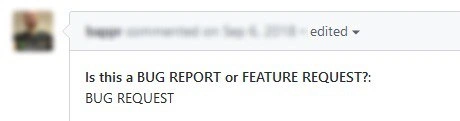
Let’s break down what’s going on in that GitHub issue screenshot in simpler terms. On GitHub (a popular platform for hosting code and tracking issues), maintainers often provide an issue template to guide reporters. It usually asks something like: “Is this a bug report or a feature request?” In other words, are you reporting that something is broken (bug), or are you asking for a new capability to be added (feature)? They want you to pick one, because it helps triage the issue. Typically, you would delete the option that doesn’t apply and fill in the rest of the form.
In the meme image, the person writing the issue saw that question and answered it very literally with “BUG REQUEST”. This phrase is inherently contradictory — normally, nobody requests a bug! We try to get rid of bugs, not ask for more. What they likely meant was either “I am reporting a bug” or “I have a feature request,” but somehow they ended up combining the two terms. It’s a bit like checking both boxes on a form that said “choose one.” This mix-up is funny to developers because it’s a relatable humor scenario: we’ve encountered people confusing bugs and features all the time. Maybe the reporter was unsure of the difference, or maybe they genuinely thought the absence of a feature was a defect. Either way, writing that in all caps makes it look hilariously earnest and clueless at the same time.
To clarify the terminology here, let’s define the key terms from the world of bug tracking systems and project communication:
| Term | Meaning |
|---|---|
| Bug Report | A notification that something is broken or not working as intended in the software. For example, “The app crashes when I click the Save button.” A bug means the code isn’t doing what it’s supposed to do. Developers treat bugs as tasks to fix errors. |
| Feature Request | A suggestion to add new functionality or improvement that doesn’t exist yet. For example, “Can we have a Dark Mode in the app?” A feature request means new code needs to be written to introduce a capability. This is usually planned and scheduled later, not an emergency. |
| “Bug Request” (joke) | Not an official term, just what we see in the meme. It’s a confused mix of the above two – basically someone asking for a new feature but phrasing it like a bug. It implies they feel the missing feature is a mistake/bug in itself. This isn’t a standard category in any tracker, it’s just a funny error. |
In a healthy development process, bugs and features are kept distinct. Why? Because they’re handled differently. A bug might get high priority (“fix the broken Save button ASAP, users can’t save their work!”). A feature usually goes to a roadmap or backlog (“plan the Dark Mode feature for next version, since it’s not critical”). Mixing them up can cause confusion. If a newcomer labels a new idea as a bug, developers might scratch their heads: “Is something actually broken, or do they just want something new?” It can lead to miscommunication. That’s why the GitHub template explicitly asks the reporter to choose one: they want to know how to categorize the issue.
Now, the heart of the joke is in the communication oops here. The template text Is this a BUG REPORT or FEATURE REQUEST? was probably meant to be replaced or answered with either “Bug” or “Feature.” Instead, the person literally wrote “BUG REQUEST,” which reads as if they’re asking for a bug. It’s like they took the two available labels and mashed them together, creating a little nonsensical phrase. To an experienced dev or project maintainer, this is both funny and a tiny bit facepalm-worthy. On one hand, it’s obviously a mistake (or maybe a cheeky way to say “I think the lack of this feature is a bug”). On the other hand, we’ve all seen similarly confusing tickets in real life. For instance, a user might open an issue saying “The software doesn’t have X feature, this is a bug.” That’s a real-world example of bug_vs_feature_confusion – the user thinks the product is supposed to do something that it actually never did. In their mind, not having the feature feels like an error. Meanwhile the dev team sees it as a new feature request.
For junior developers or anyone new to issue tracking, the takeaway is: bugs and features are not the same. Communicating which one you mean is important. If you call everything a bug, the developers might prioritize incorrectly or get frustrated. If you call a genuine bug a “feature,” it might be ignored when it actually needs fixing. In this meme’s scenario, the person filing the issue either didn’t understand the template or was in such a hurry (Friday evening panic, perhaps) that they just blurted out “BUG REQUEST.” The humor is in that little moment of human error and the role reversal it implies. It’s a reminder to slow down and choose our issue labels carefully — and also a little nod of empathy, because who hasn’t been a bit confused filling out someone’s overly formal template? The reason developers find this so funny is because it’s a perfect little example of how communication in software can go awry in a blink, often with absurd results.
Level 3: Feature in Bug’s Clothing
In the GitHub issue tracker trenches, we sometimes witness a special kind of irony. Here we have an issue template politely asking, “Is this a BUG REPORT or FEATURE REQUEST?” – a simple binary choice. And our intrepid reporter responds with an all-caps “BUG REQUEST”. Seasoned developers can’t help but smirk at this conflation of mutually exclusive terms. It’s like the poor soul was so desperate to get a new feature treated with urgency that they literally disguised it as a bug. After all, in corporate triage, a bug sounds critical while a feature can usually wait. Why not hedge your bets and call it both?
This comedic mishmash hints at a deeper truth in software teams: the line between a bug and a feature isn’t always as clear as project managers want it to be. We’ve all heard the sardonic refrain, “It’s not a bug, it’s a feature.” Here we have the inverse – a missing feature framed as a “bug” so it might get fixed now instead of later. It’s a classic case of bug_vs_feature_confusion in action. In agile planning and bug tracking systems, a bug report usually means something broken that should be working, whereas a feature request means “please add this new capability.” They’re meant to be opposites. But in practice, especially under pressure, people blur these categories. A tester or manager might insist a lack of a feature is a defect because they expected it. Suddenly a wish becomes a “flaw in the product” on the tracker. This meme’s “BUG REQUEST” is basically that absurdity distilled into one line. It’s a wink to every developer who’s had a debate where someone exclaims, “Well, not having this button is a bug!”
Why is this so relatable (and painful) for senior devs? Because we’ve seen features silently morph into defects whenever deadlines loom or communication breaks down. Imagine it’s Friday 5 PM (because of course it is — these things always hit on a Friday). A higher-up storms in: “We need this SUPER URGENT change live tonight!” The team’s mid-sprint and officially in bug-fix mode only. No new features allowed before the release. So what does the manager do? They redefine reality: “Actually, this isn’t a new feature, it’s a bug that it’s missing! Yeah, a critical P0 bug. Fix it immediately.” Suddenly the feature request is wearing a bug label, granting it a free pass through the process. Priority inversion at its finest – where something new leapfrogs all known issues because someone in power yelled “bug.”
Manager: “I don’t care if it never existed before, not having this option is a bug. Log it and fix it ASAP.”
Developer: (gritting teeth)* “Alright… filing a ‘bug’ request now.”
If you’ve been in the industry a while, this exchange hits close to home. There’s an unwritten war story behind every instance of “bug vs feature” mix-up. Tools like GitHub try to enforce clarity with templates (choose bug or feature, not both). But when real-world pressure kicks in, those careful categories can fly out the window. The meme’s issue_template inversion – responding “BUG REQUEST” – feels like a weary developer’s form of protest and dark humor. It’s the tracker equivalent of a facepalm. The user either misunderstood the form or—more likely—knew exactly what they were doing: gaming the label to get attention. Maintainers reading that line probably chuckled and rolled their eyes, because they’ve seen people try every trick to mark their ticket “URGENT.” Calling something a bug inherently screams fix me now! whereas a feature might languish. The communication here failed in a comical way: the template aimed for either/or clarity, and got back a nonsensical both/neither answer. It’s a reminder that even with guidelines, human reporters can and will inject chaos.
From an architectural viewpoint, conflating bug and feature is a process smell. It often means the team’s prioritization system is broken or being circumvented. Maybe the project has a policy of no new features in a stable release, so someone sneaks one in by dubbing it a “bug fix”. I’ve survived projects where “only bug fixes after code freeze” was the rule, yet magically we kept “discovering” conveniently timed “bugs” that were basically features we forgot earlier. Every senior dev eventually becomes a bit jaded by this dance. It’s all fun and games until a “BUG REQUEST” shows up at 6 PM Friday, and you know you’re about to spend your evening in the office. We laugh at the meme because it’s true. The absurd text “BUG REQUEST” might as well be a cry of pain from an engineer who’s seen one feature too many get rammed through as a “quick fix”. It encapsulates the gallows humor of software development: when planning fails, vocabulary contorts. Bugs become features, features become bugs, and if you object, well, you’re told to stop splitting hairs and start coding. As the battle-scarred might say, the only real bug here was thinking we’d get to go home on time.
Description
A screenshot of a comment in a project management tool like Jira or GitHub. The interface is clean and white, with a blurred user avatar on the left. The text in the comment box, presented in a standard sans-serif font, first asks a templated question in all caps: 'Is this a BUG REPORT or FEATURE REQUEST?:'. The user's response, also in all caps, is typed directly below: 'BUG REQUEST'. The humor comes from the user's absurd blending of the two distinct categories, creating a new, nonsensical classification. For developers and product managers, this is a relatable moment that captures the challenge of triaging user feedback. Users often perceive a missing feature as a bug or simply don't care about the distinction, leading to confusing or miscategorized tickets that require extra effort to clarify. It's a subtle nod to the communication gap that can exist between technical teams and their user base
Comments
7Comment deleted
Ah, the 'Bug Request': when a user believes the product's failure to read their mind is a critical defect
Finally an issue classification that aligns with production reality: every ‘feature’ eventually closes as a BUG REQUEST anyway
When the PM marks it as "bug request" because technically it IS a bug that we don't have their feature yet
When your stakeholder creates a 'bug request,' you know you're in for a requirements gathering session that will redefine both terms. It's the Schrödinger's ticket of software development - simultaneously a defect that needs fixing and a feature that never existed, existing in superposition until a senior engineer collapses the wave function by asking 'what's the expected behavior?'
The eternal triage koan: every 'bug' is a feature request until the stakeholder says otherwise - pure Zen scope creep
‘BUG REQUEST’ is the most honest label I’ve seen - please specify the desired regression and target subsystem so we can prioritize it ahead of Q4 OKRs
Finally, a BUG REQUEST - the only backlog item with a deterministic 0‑point estimate: deploy as-is and let production provision it automatically