Skip to content
DevMeme
2571 of 7435
The Programmer's Performance Anxiety on Display
DeveloperProductivity Post #2846, on Mar 21, 2021 in TG

The Programmer's Performance Anxiety on Display

Why is this DeveloperProductivity meme funny?

Level 1: Stage Fright (Why It’s Funny in Everyday Terms)

Imagine you’re really good at doing something – say, solving a puzzle or riding a bike in your backyard. When you’re alone (or no one is paying close attention), you feel calm and confident. You climb up the “stairs” of the task easily, just like the man in the meme climbing the airplane stairs without any trouble. Now picture having to do that same thing with everyone’s eyes on you – like solving the puzzle on stage in front of your class, or riding your bike while your whole family watches. Suddenly you might get nervous. Your hands shake a little, maybe you forget a step, and you make a silly mistake. It’s like when a kid who knows their poem by heart suddenly forgets the lines at the school play because they see all the people watching from the audience.

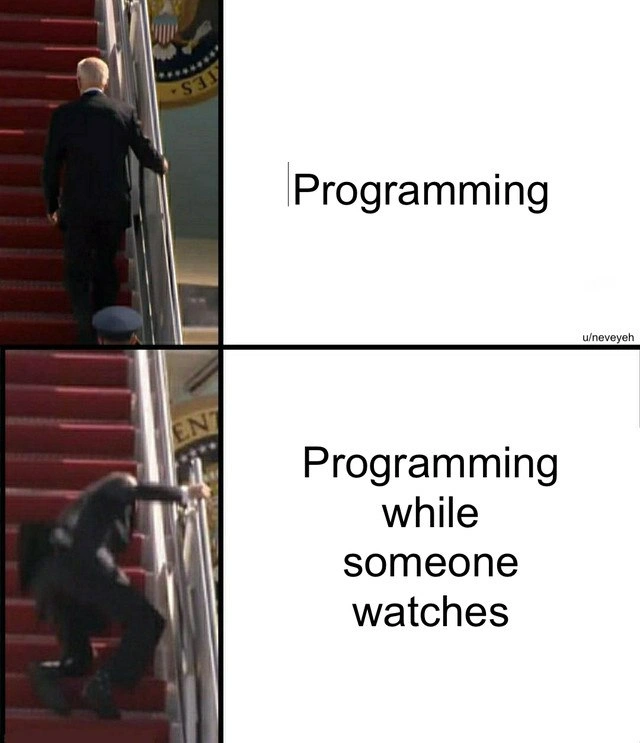
This meme is funny because it’s showing that exact feeling, but with coding. When nobody’s watching, a programmer feels as steady as a pro climber on stairs. The word “Programming” by itself in the meme’s top half stands for that comfortable feeling of doing it alone. But the moment someone looks over your shoulder, that confidence can wobble, just like the poor guy who trips on the stairs in front of cameras. The phrase “Programming while someone watches” in the bottom half is basically saying doing it with an audience = potential tumble. We find it funny and relatable because it’s a very human thing: even if you’re good at something, being watched can make you suddenly awkward. It’s a little embarrassing, sure, but since it literally happens to everyone in one way or another, we can all laugh about it. The meme takes a everyday developer experience – getting stage fright while coding – and shows it in a simple, exaggerated way (smooth climb vs. epic stumble) that anyone who’s felt nervous performing in front of others can understand. In short, it’s humor about being human under pressure.

Level 2: Performance Anxiety in Plain Terms

When the meme says “Programming” versus “Programming while someone watches”, it’s talking about a common scenario: writing code by yourself versus writing code with an audience. If you’re a newer developer (or even experienced), you might have noticed that when you’re alone at your keyboard, things often just flow. You can think clearly, type quickly, and even if you run into a problem, you methodically debug it. That’s like the man climbing the stairs smoothly in the top-left of the meme — everything is going upward and onward just fine.

Now compare that to coding with someone else watching over your shoulder (literally or via screen share). This could happen during a pair programming session – an Agile practice where two developers work together on one computer. It also happens in technical interviews (ever had to do a live coding test with an interviewer silently watching your every keystroke?), or even just when a coworker comes by and says “show me how you do that.” The meme’s bottom images (the stumble on the stairs) perfectly represent how we feel in those moments: suddenly clumsy at something we’re usually good at.

This is a form of performance anxiety – a nervous feeling you get when you know you’re being observed and evaluated, even informally. Developer anxiety in this context means a coder feeling stressed about coding in front of others. It’s closely related to the fear of making mistakes publicly. One small error that wouldn’t bother you alone (like a missed semicolon or a typo in a command) now feels painfully embarrassing because someone else saw it happen. That anxiety can lead to DeveloperFrustration: you’re upset at yourself for messing up, and the more frustrated you get, the more you slip on the next “step.”

Let’s break down some terms and why they matter here:

  • Pair Programming: This is a collaborative coding technique. Two developers, one keyboard. One person types (called the “driver”), and the other person watches and guides (called the “navigator”). In theory, it’s great for catching errors early and sharing knowledge. In practice, especially at first, it can be nerve-wracking. You might worry “Oh no, my partner is seeing all my mistakes in real time!” The meme captures that initial pair programming panic. Over time as you get used to it, many people actually start to enjoy pair programming — but that comfort usually comes after learning to trust that your partner isn’t judging your every typo.

  • Live Coding / Screen Sharing: Beyond just pair programming, there are times you have to code with an audience in more formal situations. For example, a live coding interview where an interviewer says “Alright, please implement function X. I’ll watch your screen as you do it.” Yikes! Or you’re in a meeting and someone says, “Can you quickly demo how the script works?” and suddenly you’re typing with ten people watching on Zoom. These situations create a lot of performance pressure. Even if no one is trying to pressure you, you feel it. The meme’s joke is that programming itself hasn’t suddenly become harder, but it feels 100x harder when you’re being watched.

  • Audience Effect: This term comes from psychology. It describes how people’s performance can change when others are watching. Sometimes having an audience can improve performance of very well-practiced simple tasks (like a musician playing a piece they’ve mastered might play even more energetically for a crowd). But for tasks that require concentration or are a bit challenging, an audience often makes performance worse. Coding tends to be the second kind of task – complex and requiring concentration – so another person watching can cause what’s called social inhibition (holding back or stumbling because you’re self-conscious). In developer-speak, we joke about a “observer effect” or even a Heisenbug-like effect where the act of observing a coder changes the outcome of the coding process, much like a physics experiment.

  • Impostor Syndrome: This is a common feeling in tech where a developer (often a perfectly capable one) feels like they are not as good as others think, and fears being “exposed” as a fraud. Having someone watch you code can trigger impostor syndrome thoughts like “They’re going to realize I’m actually not that smart, because look, I can’t even type this correctly in one go.” It’s important to know everyone experiences this to some degree. The meme resonates because we all secretly hope we appear competent, and a simple stumble when coding in front of someone hits that insecurity directly. But rest assured, making a mistake while someone watches does not actually mean you’re bad at coding — it means you’re human.

  • Relatable Developer Experience: This phrase just means an experience that many developers share and relate to. The reason this joke lands in the developer community is precisely because it is so common. It’s practically a running joke among programmers: “I wrote a complex algorithm yesterday, but today I can’t even center a div in CSS while my colleague observes.” Everyone has their own anecdote of sudden brain-freeze when coding under observation. Because it’s such a shared pain point, it’s part of coding culture to laugh about it together. This helps reduce the stigma; when you know others also fumble, it doesn’t feel like it’s “just you.”

  • Communication and Pairing: The category of Communication here highlights that programming isn’t always a solo activity. Being able to program while communicating your thought process is actually a skill on its own. When you pair program effectively, you’re talking through what you’re doing: “I’m going to open this file, then call that API... hmm that didn’t work, maybe the data format is wrong…” etc. Doing this with someone else listening can feel awkward at first. But good communication can turn a nerve-wracking session into a productive one. For instance, a supportive pair programming partner might gently point out a typo you missed, or say “take your time, no rush” if they sense you’re nervous. That kind of communication can ease the anxiety. On the flip side, if the person watching is impatient or critical (“Why are you doing it that way?” in a harsh tone), it can amplify the anxiety and make the “stumble” even worse. The meme doesn’t show the other person, but we can imagine maybe someone at the top of the stairs waiting – that’s the pressure presence.

To sum up this level: programming while being watched introduces psychological pressure that can make a developer fumble simple tasks. It’s a normal human response. The meme is relatable because we’ve all been there, and it’s poking fun at that universal “uh-oh” moment. If you’re a newer developer and have experienced this, don’t worry – even the experienced folks stumble on the “red carpet” occasionally when the spotlight is on. The trick is to remember it’s okay to make a mistake, take a breath, maybe even narrate what’s happening (“whoops, typo – let me fix that real quick”) to break the tension. With practice and a comfortable environment, that over-the-shoulder coding will start to feel more like normal programming again, and you’ll stumble a lot less.


Level 3: Pair Pressure (Coding Under Observation)

This meme nails a widespread unspoken truth in programming culture: the moment someone watches you code, everything that was second nature becomes a struggle. On the left, we see a confident individual (in fact, a certain world leader) striding up the aircraft stairs. That represents “Programming” in the top-right text — coding solo, at ease. In the next frame, the same person is mid-stumble on those steps, paralleling “Programming while someone watches” in the bottom-right text. The humor hits home because every developer has felt their coding confidence trip the instant an observer appears.

Technically speaking, this is akin to a software developer's observer effect. It’s not the code that changes under observation, but the coder’s brain state. Alone, you might be in a blissful flow state – your fingers dancing over the keyboard, effortlessly recalling syntax and APIs. But introduce an audience (even a friendly colleague for a bit of pair programming) and suddenly your mental CPU starts thrashing. Now you have an extra background process consuming cycles: self-consciousness. It’s like your brain context-switched: one thread writes code, another anxiously monitors what the onlooker might be thinking. The result? Minor bugs and typos that never happen when you’re alone start popping up everywhere.

Why does this occur? One theory is performance anxiety ramping up cognitive load. In solitary programming, all your working memory is devoted to the problem at hand. Under watch, some of that precious memory is now locked by thoughts like “Am I taking too long?”, “Do I look like I know what I'm doing?”, or “Oops, did I just misspell that variable with them looking?”. It’s a bit like enabling verbose debug logging on a live system – suddenly everything runs slower and weird race conditions appear. In human terms, choking under pressure is a well-documented phenomenon (common in sports, music, and yes, coding). Even top engineers can blank on something simple like the syntax for a for-loop when all eyes are on them.

This meme also alludes to the realities of pair programming as championed by Extreme Programming (XP) practices. Pair programming means two developers share one workstation: one “drives” (types) and the other “navigates” (reviews, thinks ahead). In theory, it can produce higher code quality and knowledge transfer. In practice, especially early on, it often feels exactly like the meme – the “driver” fumbles with basic operations they normally execute flawlessly. The irony is that pair programming is meant to improve DeveloperExperience_DX and code quality, yet initially it might decrease DeveloperProductivity due to nerves. The social dynamics require good communication and psychological safety; without those, the “navigator’s” mere presence can make the “driver” feel judged on every keystroke.

Anyone who’s done a live demo or coding interview can relate: it’s Murphy’s Law for developers. The code that ran five times in a row will inexplicably fail only when someone else is in the room. We jokingly call this the “demo effect”. A classic wisecrack: “It works on my machine... until I plug into the projector.” Similarly, if you want to find a hidden bug in your program, just invite an observer — somehow that bug manifests immediately when someone is watching, as if the code knows. (Developers half-jokingly attribute this to malicious gremlins or quantum entanglement between the code and the audience’s gaze! 😅)

To make it even more concrete, consider some things that routinely go wrong when programming with an audience versus alone:

  • Muscle memory misfires: You confidently touch-type git status a hundred times a day, but in front of your manager it comes out as git stauts and you get command not found.
  • Sudden amnesia for syntax: You’ve written for (let i = 0; i < n; i++) loops since forever, but while screen sharing, you pause, thinking “wait, do I need to declare i? how do I even loop?”.
  • Tool discomfort: That trusty IDE or editor where everything is instinctual? The moment someone pairs, you fumble to remember your own shortcuts. “What was that keyboard shortcut to run tests… oh no, they probably think I don’t even know my tools.”
  • Overthinking trivial decisions: Alone, you’d quickly name a variable count. With a senior dev watching, your brain agonizes, “Is count too simple? Should it be itemCount? Or maybe this needs a more descriptive name? They must be wondering why I’m slow…”, and now you’ve lost the train of thought entirely.
# 🤖 Normal day at the terminal:
$ mkdir new_project && cd new_project
$ git init .
Initialized empty Git repository in ~/new_project/.git/

# 😨 Live demo day (someone peering at your screen):
$ mkdir new_project && cd new_project
$ git nit .
git: 'nit' is not a git command. See 'git --help'.
# (I swear I know Git, my finger just slipped under pressure!)

In the code snippet above, the second scenario with git nit instead of git init is the kind of facepalm typo that happens only when you’re hyper-aware of being observed. The DeveloperAnxiety is real and manifests physically — sweaty palms, shaky hands on the keyboard, maybe your mind going blank on commands you otherwise execute by rote. It’s programming’s version of stage fright.

From a Developer Experience (DX) perspective, this highlights that a programmer’s productivity isn’t just about having the right languages or fastest laptop; it’s also about the environment and comfort level. In an environment where one feels psychologically safe (e.g., a pair programming partner who is chill and supportive), that pressure can dissipate. In a high-stakes or judgmental environment, even the best tools won’t prevent the stumble. Good teams recognize this and try to foster a culture where mistakes are okay — essentially helping developers feel less like they’re climbing a steep staircase under a spotlight. Pair programming works best when both people communicate openly, share ideas without blame, and maybe even laugh off the typos. A quick “haha, I do that all the time” from the observer when you mistype something can completely defuse the tension, letting you regain footing.

In summary, the meme exaggerates a relatable developer experience: alone you’re a coding ninja scaling the stairs of logic swiftly, but with an extra pair of eyes, you turn into that person tripping on a very public stage. It’s funny because it’s true. Every developer, from junior to senior, has felt that pair programming panic or live demo dread at some point. The shared understanding of “I swear I’m not normally this clumsy” is exactly why this meme brings both a chuckle and a sympathetic wince. After all, we’ve all been the person figuratively (or literally) stumbling while all eyes are on us.


Description

A two-panel meme that captures the universal developer experience of coding under pressure. The meme uses two photos of U.S. President Joe Biden on the stairs of an airplane. In the top panel, he is shown walking up the stairs competently, with the adjacent text reading 'Programming'. In the bottom panel, he is shown stumbling and falling on the same stairs, and the text reads 'Programming while someone watches'. This meme humorously illustrates the common phenomenon where a programmer's ability to code fluently and think clearly seems to vanish the moment they are being observed, whether during pair programming, a live demo, or a screen-sharing session. The simple act of coding becomes a clumsy, error-prone struggle under the perceived pressure of scrutiny
Comments

8
Anonymous ★ Top Pick My brain's JIT compiler just completely deoptimizes my entire skillset the moment someone looks at my screen
  1. Anonymous ★ Top Pick

    My brain's JIT compiler just completely deoptimizes my entire skillset the moment someone looks at my screen

  2. Anonymous

    Solo: piping kubectl logs through jq while weighing CAP trade-offs; someone starts watching and my brain’s GC instantly collects the keyword for ‘for’

  3. Anonymous

    It's like Heisenberg's Uncertainty Principle for senior engineers - you can either know exactly what your code does OR have someone watching you type it, but never both simultaneously. The quantum state of competence collapses the moment your screen-sharing indicator turns green

  4. Anonymous

    The Heisenberg Uncertainty Principle of programming: you can either write elegant code OR be observed doing it, but never both simultaneously. The mere act of observation collapses the wave function of your competence into a state of frantic Stack Overflow searches and suddenly forgetting every keyboard shortcut you've used for a decade

  5. Anonymous

    Enable watch() on the developer and the typing subsystem downgrades from lock-free to two-phase commit with unbounded retries - see the backspace storm in the logs

  6. Anonymous

    Programming is fine; add a spectator and your IDE becomes Schrödinger’s keyboard - every keystroke is simultaneously a typo, a merge conflict, and the one time the Heisenbug reproduces

  7. Anonymous

    Quantum observer effect in dev: your refactored monolith collapses into technical debt the instant a colleague peers over your shoulder

  8. @PopovichVladimir1 5y

    biden is nigger

Use J and K for navigation