Manager overrides warnings then blames engineer when metrics tank a month later
Why is this Management PMs meme funny?
Level 1: Not My Fault
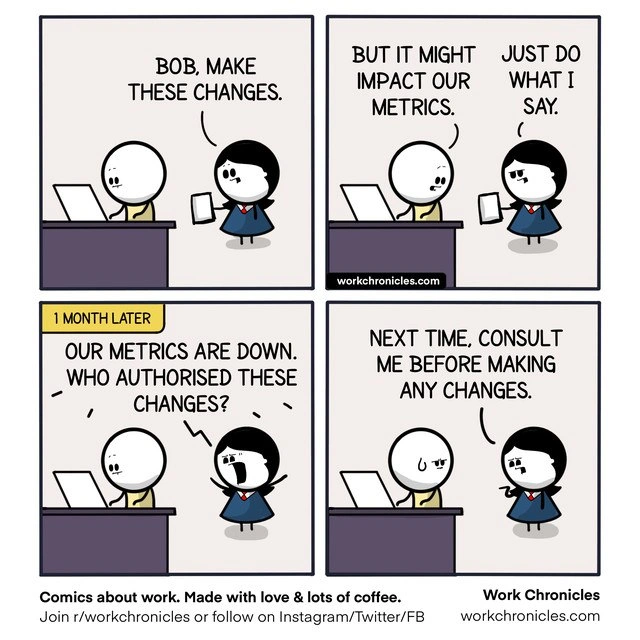
Imagine your teacher tells you to do your science project in a certain way, even though you warn, “If I do it like that, it might not work.” The teacher insists, “Just do it my way.” So you do. A month later at the science fair, your project doesn’t work and gets a bad score. Now the teacher is angry and asks, “Who told you to do it this way?!” – as if it wasn’t their idea. Then they scold you, “Next time, ask me first before you change anything!” You’d probably be standing there confused and upset, right? It’s totally unfair – you did exactly what you were told, and now you’re getting blamed for the bad result. That’s the joke in this comic. The boss acts like a kid who doesn’t want to take the blame and says “Not my fault!” even though it really was his idea. The engineer (Bob) is like the kid who followed directions and is now angry because he’s getting blamed. It’s funny in a “UGH!” kind of way, because we all know how bad it feels when someone blames us for a mistake that they caused. This cartoon just shows that happening at work, with a boss and an employee instead of a teacher and a student. It’s a silly way to say: sometimes people in charge don’t listen and then don’t want to take responsibility when things go wrong.
Level 2: Metrics Meltdown
Let’s break down what’s happening in simpler terms. Bob is a developer who cares about the product’s metrics – these are numbers that track how well something is doing. For example, a metric could be how many users sign up, how long they stay, how much money the app makes, or any measure of success. When Bob says “it might impact our metrics,” he’s warning that the change the manager wants could make those numbers worse. Maybe fewer people will click a button, or the site might slow down and annoy users, or some misaligned expectation will cause users to leave. Bob is basically saying: “If we do what you’re asking, our scorecard might go down.” This is a big red flag for any business, because falling metrics can mean lost revenue or unhappy customers.
The manager, however, is not listening to Bob’s caution. He says, “Just do what I say.” This is a clear CommunicationBreakdown. Instead of discussing Bob’s concern or investigating the potential impact, the manager is pulling rank – essentially saying, “I’m the boss, and I’ve decided, so just follow orders.” This often happens when there is StakeholderPressure from above; maybe his boss or a client demanded a quick change, and he’s tunnel-vision focused on delivering it. Managers (and Product Managers, a.k.a Management_PMs) sometimes prioritize immediate results or pleasing higher-ups over the technical team’s advice. So Bob, being the employee, goes ahead and makes the change as instructed.
Now the comic jumps to “1 MONTH LATER.” Why a month? Because some changes don’t show bad effects immediately. Over time, the negative impact Bob feared has actually happened: the metrics are down. Perhaps user engagement dropped or sales fell – whatever it is, those numbers Bob was worried about have now tanked (hence our title: a metrics meltdown). This is where the blame game begins. The manager storms in, angry about the poor results, and yells, “Our metrics are down. Who authorized these changes?” “Authorized” means who gave permission or said it was OK to do. It’s a bit absurd, because Bob knows exactly who authorized the changes – it was the manager himself! Bob literally got a direct order. But now the manager is acting like he has no idea how this happened. This is a form of blame shifting – instead of saying “I made this call and it didn’t work out,” he’s looking for someone else to fault. Bob stays silent in the comic (probably thinking “You, you idiot…” in his head), because contradicting your boss openly can be risky in a real workplace.
Finally, the manager has the nerve to say, “Next time, consult me before making any changes.” Consult me means ask for my approval first. This is rich because Bob actually did raise concerns initially, and the manager brushed him off. In a normal process, “consulting the manager” is exactly what Bob tried to do – he flagged the risk! The manager either forgot his own directive or is pretending that Bob acted alone. This shows a complete Communication failure and probably a toxic CorporateCulture where managers don’t take responsibility. Bob’s glare in that last panel – you can just feel his DeveloperFrustration. It’s that feeling when you did everything you were supposed to, warned about the problem, got ignored, and then get blamed for the fallout. In healthier teams, if an engineer raises a potential problem, the manager would discuss it, maybe do a small test or consider alternatives. And if upper management pressures a change, they’d all be aware of the risks together. If things still went wrong, a good manager would say, “We took a calculated risk and it didn’t pan out. Let’s learn from this,” rather than pointing fingers. Unfortunately, Bob’s manager represents the opposite – a boss who overrides warnings and then claims ignorance when the predicted problem occurs. It’s a Management vs Engineering tale as old as tech: the people giving the orders aren’t always the ones who understand the consequences, yet they’re rarely the ones who take the blame when the consequences hit.
For a junior developer or someone new to office life, this comic is a warning-story. It introduces concepts like the “blame game,” where people try to avoid being blamed for a mistake by making someone else look responsible. It also highlights why communication is so important: Bob tried to communicate a risk, but the manager didn’t really listen. If you ever find yourself as Bob, it’s a tough spot – you might feel you should push back harder on a bad idea, but if the boss insists, you might have to do it. Then if it fails, you need to calmly remind or prove that you had raised the concern. That’s why seasoned developers often document decisions (even just an email saying “Per our conversation, implementing X as requested”) to protect themselves in case of a blamegame scenario. And as frustrating as it is, keeping professional (like Bob does by not yelling “You told me to do it!”) can be important. This comic is a humorous take on a serious lesson: good managers listen to their engineers, and good teams share responsibility – but when that breaks down, misalignedExpectations and finger-pointing ensue.
Level 3: Cascading Blame Failure
This comic nails a classic corporate culture anti-pattern: a manager under stakeholder pressure overrides an engineer’s warning and later plays the BlameGame when things go south. Bob, the developer, cautiously says the changes “might impact our metrics,” which is polite engineer-speak for “this could hurt the product or user engagement.” The manager, fixated on immediate orders, barks “Just do what I say.” This is a textbook CommunicationBreakdown – the person in charge dismisses critical feedback, creating a recipe for disaster. Fast-forward 1 month later, and surprise (to no one except the boss): the key business metrics tank. User growth, conversion rates, performance KPIs – whatever the metrics_drop entails – they’re all down. Instead of recalling why this happened, the manager conveniently develops selective amnesia. He demands, “Who authorized these changes?” as if he wasn’t the one waving the go-ahead flag. This is ManagementHumor in its darkest form, because it rings so true: the higher-up who insisted on the risky change is now acting shocked and demanding a scapegoat. It’s the ManagementVsEngineering saga we know too well – when things break, blame rolls downhill.
From a senior engineer’s perspective, the humor cuts deep because we’ve lived this scenario. The manager’s “Next time, consult me…” line in the final panel is dripping with irony – Bob did try to consult him, and was told to shut up and obey. This encapsulates misaligned expectations and stakeholderExpectations gone awry. The boss wanted speedy changes (probably to please his boss or meet some short-term target), ignoring the long-term impact on quality or user satisfaction. The MisalignedExpectations here could fill a binder: Bob expected his expertise to be respected, the manager expected blind obedience without consequences. When the metrics did nosedive, the manager’s first instinct wasn’t problem-solving or owning the mistake – it was classic CYA mode (Cover Your Assets) and DeveloperFrustration is the inevitable result. We witness a communication failure on multiple levels: Bob raised a risk and was shut down; a month later, the manager screams about the very risk coming true, yet still doesn’t listen. This is the opposite of a blameless post-mortem. Instead of calmly analyzing why the metric dropped (e.g., “our conversion rate fell 20% after we changed the onboarding flow”), the manager goes into authorised_changes_blame overdrive, essentially saying “Not my fault!” while pointing at Bob. It’s a toxic loop of denial that any battle-scarred engineer recognizes. The unspoken lesson for devs: always keep receipts. Bob likely has an email or Slack thread where he warned the boss. In real life, experienced engineers learn to document “I have some concerns about X…” so when the blame storm comes, they can at least quietly prove you were the one overriding expert advice. But even then, as the meme shows, confronting the boss with “I told you so” isn’t exactly career-friendly. So Bob just sits there, silently seething, giving the manager that death-stare 👀 that says “Seriously?”
On a systems level, this is like a cascade failure of accountability. One component (manager) fails to heed a warning, causing a larger system failure (bad metrics), and then that component isolates itself and dumps the error log on someone else’s desk. In coding terms, the manager’s algorithm for handling outcomes is brutally simple:
if (metricsOutcome === "improved") {
manager.claimCredit(); // "See what a great decision I made!"
} else {
manager.assignBlame(bob); // "Who on earth allowed this? Clearly Bob's fault."
}
It’s a Communication and management failure that propagates through the project just like a bug in production. Ironically, any seasoned dev team promotes blameless culture and open communication precisely to avoid this scenario. But here we see the opposite: a culture of fear and finger-pointing. The comic’s minimalist style (from Work Chronicles) might be cute and simple, but it lays bare a painful reality: managers who ignore risks and then blame the implementers create an environment where engineers feel powerless and undervalued. It’s a form of technical debt in the human realm – call it organizational debt. If leaders consistently punish those who raise concerns, soon nobody will warn about looming problems (why bother, if you’ll just get shot as the messenger?). The result? Bigger failures down the line. The humor here is laced with frustration: every experienced dev can relate to Bob’s stone-faced glare in that last panel, holding back the urge to print out the email where the boss said “Just do it.” It’s laugh-or-cry CorporateHumor because we’ve been Bob – stuck between doing what the boss demands and what the data or best practices dictate. And when it all blows up? The higher-ups act like the engineer went rogue. As the cynical saying goes, “Success has many fathers, but failure is an orphan” – or in this case, failure is Bob’s illegitimate child according to the boss.
Description
Four-panel Work Chronicles comic in minimalist cartoon style. Panel 1: a developer named Bob (white round head, seated at a laptop behind a purple desk) looks up as a black-haired manager holding a tablet orders, “BOB, MAKE THESE CHANGES.” Panel 2: Bob raises a hand, replying, “BUT IT MIGHT IMPACT OUR METRICS.” The manager, stern, retorts, “JUST DO WHAT I SAY.” Panel 3, captioned with a yellow label “1 MONTH LATER,” shows the irate manager shouting, “OUR METRICS ARE DOWN. WHO AUTHORISED THESE CHANGES?” while Bob sits silently. Panel 4: the manager, arms crossed, says, “NEXT TIME, CONSULT ME BEFORE MAKING ANY CHANGES,” and Bob glares back. Footer text reads: “Comics about work. Made with love & lots of coffee. Work Chronicles. workchronicles.com Join r/workchronicles or follow on Instagram/Twitter/FB.” The strip humorously captures classic blame-shifting and communication breakdown between management and engineering teams, highlighting how disregarding technical risk warnings can hurt product metrics and morale

Comments
20Comment deleted
Manager-driven development: they smash the “override CI & merge anyway” button, then open a Sev-0 a month later to investigate which engineer dared to follow orders
The only metric that truly matters in enterprise software: how quickly management can pivot from 'ignore the warnings' to 'why didn't anyone warn me?' - typically measured in sprint cycles and inversely proportional to proximity to quarterly reviews
This comic perfectly captures the 'Schrödinger's Engineer' paradox: you're simultaneously responsible for all decisions and authorized to make none of them. The manager's final demand to 'consult me before making changes' is the cherry on top - a masterclass in rewriting history where the engineer who warned about metrics impact is now blamed for not preventing the very changes they were ordered to implement. It's the corporate equivalent of a rollback without version control - everyone knows what really happened, but the commit history has been force-pushed
Classic PM pattern: 'Ship it fast' until observability proves it's a distributed denial-of-responsibility attack
Classic HiPPO-driven development: bypass change control, crater the SLOs, then run a ‘root cause analysis’ to find a person
HIPPO-driven deploy, no flags, no A/B, and the CAB happens afterwards - rebranded as a postmortem called 'Who authorized this commit?'
Next time ask for a written order. Comment deleted
Exactly Comment deleted
More paper, cleaner ass Comment deleted
Cleaner ass, cleaner paper Comment deleted
don't work for retards, simple as Comment deleted
S Comment deleted
We have a lot of customers who request changes non stop, making them confirm the changes by online form (and letting the person who pays the bills approve them) has resulted in a much cleaner relationship with them Comment deleted
That's reason why these changes always was approved via email or/and task board Comment deleted
Just cleaned from spam Comment deleted
thanks meow whose name I don't remember and I don't see in the sidebar 😛 Comment deleted
probably @Linegel Comment deleted
Mask anonymous indistinguishable personality shit in the entrances Comment deleted
That's why I'm recording on dictophone Comment deleted
https://t.me/sendmegifs/298 Comment deleted