Technical Debt with Line Voltage
Why is this Hardware meme funny?
Level 1: Hidden Mess
This is like painting a room and saying it is brand new, but behind the wall the same broken wires are still there. The joke is that the new thing is not really new if it secretly depends on the old broken thing.
Level 2: New Paint, Old Pipes
Legacy code is older code that a team still depends on, often with weak tests, unclear ownership, or behavior nobody fully remembers. A bug is a mistake that causes software to behave incorrectly. Technical debt is the future cost created when a team chooses a quick solution now instead of a cleaner one that would take more time.
The picture works because the wall looks like something was patched badly. You can imagine someone seeing only the outlet cover and assuming the work is fine. Then the cover comes off and the hidden mess explains why problems keep happening.
In programming, a "new" feature can have the same problem. A developer may write fresh code but reuse an old function because it already exists. If that old function has a hidden bug, the bug appears in the new feature too. From the outside it looks like new work; underneath it is still connected to old wiring.
Level 3: Load-Bearing Workaround
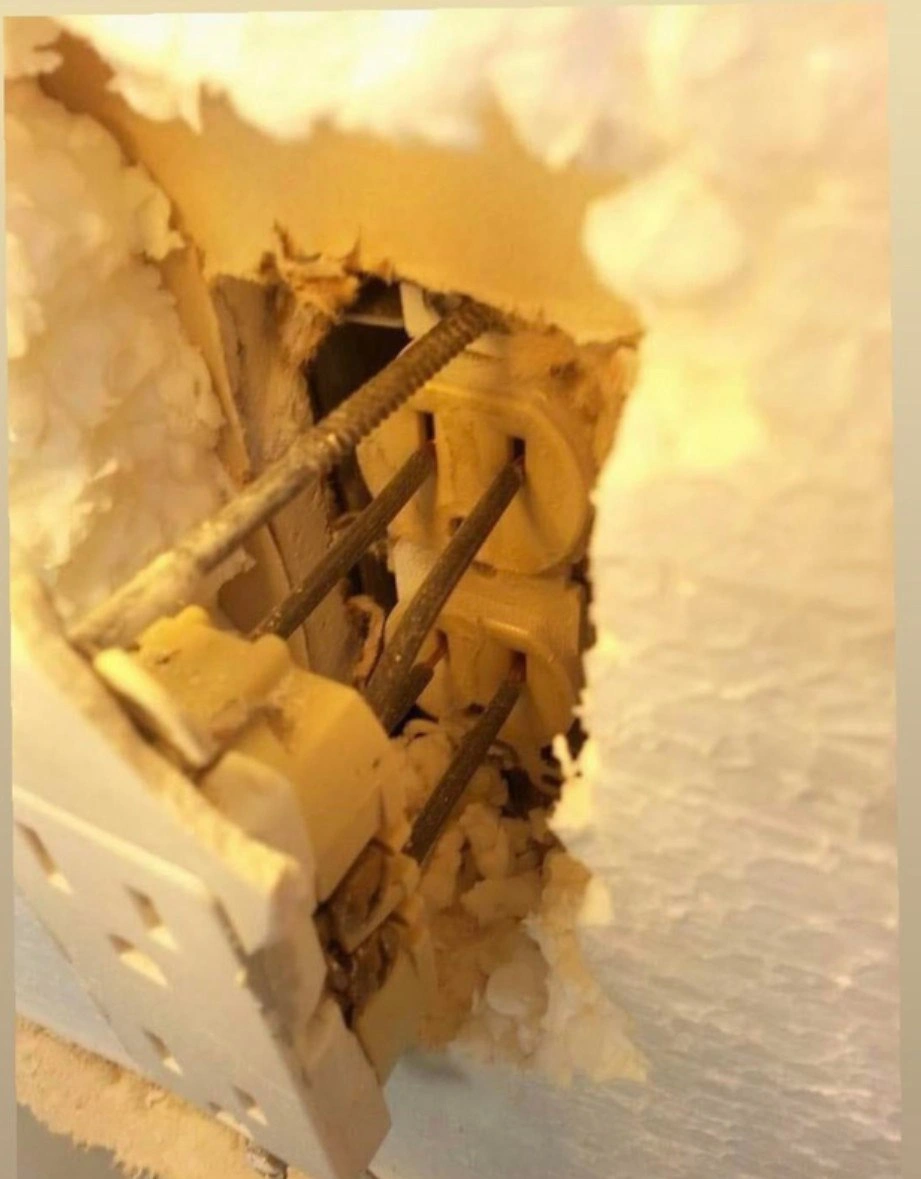
The image shows a damaged wall opening packed with pale foam, rough outlet hardware, and dark conductors or cables running through a mess that does not look cleanly mounted. There is no visible caption in the image, but the post message frames it as the moment when a legacy bug appears in a coworker's "new" code. That mapping is painfully exact: the new surface looks fresh until you open the wall and find the old decision still carrying current.
This is technical debt as physical archaeology. The visible outlet face suggests something familiar and ordinary from the outside. Behind it, the structure looks improvised, obstructed, and hostile to maintenance. Software teams see the same pattern when a modern feature, new service, or "clean rewrite" quietly reuses an old helper, data model, copied function, shared database table, or undocumented assumption from the legacy system it was supposed to replace.
The senior pain is not that somebody made a workaround. Workarounds are often rational under pressure. The pain is that the workaround became infrastructure without being named, tested, documented, or paid down. Years later, a bug resurfaces in "new" code because the new code inherited the old coupling. The organization gets to rediscover history by outage, which is the most expensive documentation format.
The foam is the perfect visual metaphor. It fills the gap. It hides the void. It makes the area look "handled" until someone needs access. In software, that foam is adapter layers, copy-pasted validation, feature flags nobody can remove, database columns named misc2, and comments saying temporary fix with a commit date from a previous geological era.
Description
The image is a close-up photo of a damaged wall cavity filled with pale expanding foam or insulation. Inside the opening are electrical outlet components, exposed conductors, and rough hardware that appear wedged through the foam rather than cleanly mounted in a proper box. There is no visible caption or text. In a developer meme corpus, the picture reads as a physical-world version of production hacks, hidden infrastructure debt, and the terrifying maintenance surprises found behind a clean surface.
Comments
10Comment deleted
This is what "temporary workaround" looks like after the sprint ends and the electrons become stakeholders.
adapter pattern Comment deleted
No ground issue Expectation: loose wire Reality: Comment deleted
I like my ground wire coming to the ground couple meters deep Comment deleted
@RiedleroD Comment deleted
@linegel ? Comment deleted
if she writes secure and private messaging, free and open-source, peer to peer or decentralized app that produces zero to nothing metadata and uses elliptic-curve encryption, has VoIP and Video calls, removes any metadata from sent files, which servers doesn't use 3GB per user and up to 8GB of ram for 100 users, that would be hot Comment deleted
I just thought that's like communism. Impossible in practice Comment deleted
Well yes but actually no Comment deleted
dendite is all of this except metadata Comment deleted