Skip to content
DevMeme
1779 of 7435
The Meme-Based Programming Curriculum
Learning Post #1986, on Aug 31, 2020 in TG

The Meme-Based Programming Curriculum

Why is this Learning meme funny?

Level 1: Secret Club Lessons

This meme is like saying the smartest way to learn cooking is not from cookbooks, classes, practice, or videos, but from jokes chefs tell each other after burning dinner. That is funny because jokes are not supposed to be the main school. But they can still teach you what usually goes wrong, what everyone secretly struggles with, and why people laugh when something breaks in the exact way they expected.

Level 2: Tutorials Meet Trauma

At a practical level, each row names a real way people learn programming. Books usually give careful explanations of concepts like variables, functions, data structures, and algorithms. They are slower, but they build foundations. Online tutorials are more hands-on: they show a sequence of steps for building a web app, using a framework, or solving a specific problem. They are useful, but they can hide the messy parts by choosing the perfect example.

Trial and error is the phase where code starts teaching back. You change one line, run the program, get an error, search the error, change another line, and slowly build a mental model. It is inefficient, but it is also where many developers learn debugging, because debugging is mostly the art of being wrong in smaller and smaller ways.

YouTube videos add motion and narration. Watching someone set up a project, fix an error, or use a tool can make abstract steps feel concrete. The danger is passive learning: it can feel like understanding because the instructor knows what to type next.

The final line, "learning to program from memes," points at MemeCulture inside programming communities. Developer memes joke about bugs, deadlines, confusing tools, bad documentation, and the strange customs of engineering teams. They do not replace actual study, but they help beginners recognize common experiences. If a meme says every project eventually has "temporary" code that lives forever, that is a joke, but it is also a warning label.

The glowing brain images exaggerate the idea that each method is more advanced than the last. The humor comes from putting memes above serious learning resources. Anyone can laugh at the ranking, but programmers also recognize the uncomfortable truth: some lessons only become clear after you see the same joke, the same bug, and the same doomed shortcut several times.

Level 3: Curriculum By Osmosis

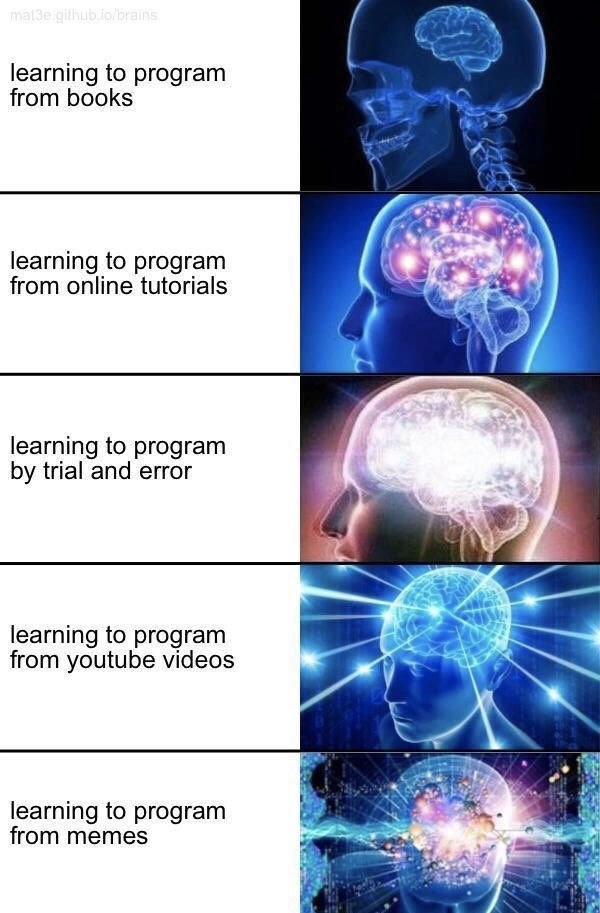
The image uses the classic expanding-brain format: each row claims to be a more enlightened way to learn, and the brain on the right becomes more radiant as the advice gets less formally respectable. The visible progression is:

learning to program from books
learning to program from online tutorials
learning to program by trial and error
learning to program from youtube videos
learning to program from memes

The joke lands because developer education has always lived in tension between structured knowledge and tribal knowledge. Books teach fundamentals, online tutorials teach a path through one specific stack, trial and error teaches consequence, videos teach workflows, and memes teach the emotional footnotes that never make it into documentation: works on my machine, "just one small refactor", git push --force, "it was DNS", and the quiet dread of touching legacy code on a Friday.

That final panel is absurd on purpose, but it is not entirely wrong. Developer memes compress shared experience into tiny, sticky warnings. A junior can read a textbook chapter on deployment environments and still not understand why everyone flinches at "quick production fix." One meme about staging behaving differently from production can transmit the same social lesson instantly: the problem is not only syntax, it is systems, incentives, missing context, and the fact that reality has a mean little integration test suite.

The expanding-brain escalation also satirizes how programmers learn pattern recognition. A meme usually will not teach someone how to implement a balanced tree or reason about memory ordering, but it can teach them that certain situations are common enough to have folklore. That matters in DeveloperCulture because software work is full of recurring anti-patterns:

  • Tutorial code that ignores error handling because the video would be too long.
  • Copy-pasted snippets that work until the library version changes.
  • Trial-and-error debugging that accidentally becomes the architecture.
  • Community jokes that encode hard-earned operational lessons in one sentence.

The sharpest part is that the "best" learning method in the image is also the least complete one. Memes are high-retention and low-precision. They are great at making a pain point memorable, terrible at teaching the full mechanism behind it. The cosmic brain is funny because it treats social fluency as enlightenment, and in real teams, social fluency really does matter. Knowing why a joke about merge conflicts is funny often means you have already met version control as a living hazard, not just a chapter in an onboarding guide.

Description

This is a five-panel expanding-brain meme with labels on the left and glowing brain images on the right. The panels read, in order: "learning to program from books", "learning to program from online tutorials", "learning to program by trial and error", "learning to program from youtube videos", and "learning to program from memes." The brain imagery escalates from a small x-ray brain to increasingly radiant and cosmic visuals, implying that memes are the most enlightened learning source. The developer humor comes from exaggerating a real phenomenon: programmers often internalize patterns, anti-patterns, and community lore through jokes as much as through formal study.

Comments

1
Anonymous ★ Top Pick The meme-driven curriculum has terrible prerequisites but unbeatable retention: every bad abstraction ships with a punchline.
  1. Anonymous ★ Top Pick

    The meme-driven curriculum has terrible prerequisites but unbeatable retention: every bad abstraction ships with a punchline.

Use J and K for navigation