
Why is this developer meme funny?
Level 1: House of Cards
Imagine you have a tower of cards (or blocks) that’s already shaky. It’s swaying, maybe some cards are bent, and you’re not even sure which card is holding the whole thing up. Now, your friend comes along and says, “Let’s put one more card on top!” You both kind of know that adding another card will probably make the whole tower crumble, but you do it anyway because, well, you really want that tower just a bit taller. This situation is both funny and a little nerve-wracking: funny because it’s absurd (why are we still adding cards when the tower is so unstable?), and nerve-wracking because you’re courting disaster.
This meme is laughing at that exact kind of moment, but in the world of software. The “tower” is a big computer program that’s already fragile (like the wobbly card tower). Instead of fixing the base or rebuilding the tower properly, people keep insisting on stacking more on top – adding more features to the program. It’s a common scenario that anyone can understand: if you don’t fix the foundation and just keep piling on, something’s going to give. The humor comes from the clear foolishness of it. It’s the kind of laugh you do when you see a character in a cartoon keep loading stuff onto a teetering pile – part of you is amused at how ridiculous it is, and part of you is just waiting for the inevitable crash.
For developers (the people who build the software), this is a bit of “we’ve all been there, haha” kind of joke. They often find themselves in situations where they know they should stop and repair things, but real-life pressures (like bosses or deadlines saying “just get it done!”) push them to do the risky thing and hope it doesn’t collapse. It’s a form of nervous laughter at their own predicament. Even if you’re not a programmer, you can relate: it’s like doing one more lazy thing you know you shouldn’t, thinking “I’ll deal with the consequences later.”
So the meme uses a fake book cover to say, “Look, there’s practically a manual for this silly behavior we keep doing!” Everyone secretly knows it’s a bad practice, just like everyone knows a flimsy card house can’t hold much more. By presenting it in a tongue-in-cheek, over-the-top way (with that fancy book style and a weird fish on it), it highlights the silliness. It’s funny because it’s true: people really do keep stacking features on broken foundations, and we can only shake our heads and chuckle at how common it is. In simple terms, the joke is: “We keep doing this obviously dangerous thing (adding one more card to a shaky house) and act surprised when things start falling apart. Oh, really?!” It’s a light-hearted poke at a shared human tendency – procrastinating the fix and pushing our luck – which makes the meme relatable even outside of coding.
Level 2: Technical Debt Jenga
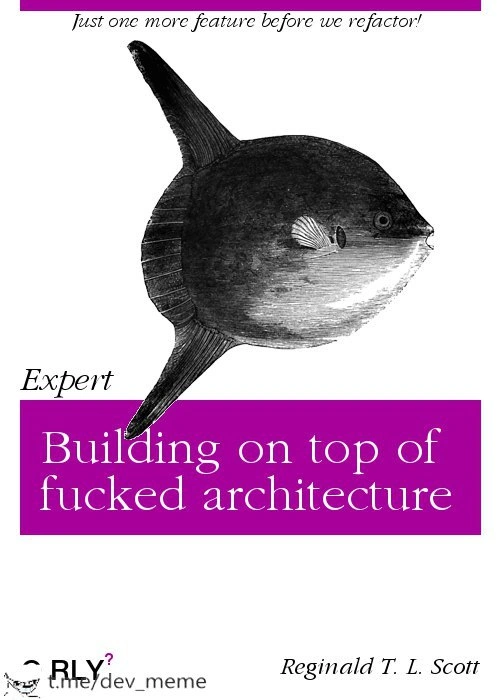
For newer developers, let’s break down what’s going on in this meme and why it’s funny (and a bit sad). The meme presents a mock cover of a programming book. O’Reilly is a famous publisher known for technical books with animals on the cover – for example, Learning Python has a cute mouse on it, Programming Perl has a camel, etc. They’re usually very serious, high-quality books. Here, though, the title of this fake book is “Building on top of fked architecture”** – bluntly stating a terrible idea. The top says “Just one more feature before we refactor!” which is a quote that sets the stage for the joke. Essentially, it’s highlighting a common scenario in software teams: delaying important improvements (like fixing the system’s design) because something new needs to be built right now.
Now, some key terms and concepts to know:
Architecture: In software, architecture means the big-picture structure of the system – how the components or modules of a program are organized and how they interact. A good architecture is well-designed, making the system easy to understand, extend, and maintain. A bad (or "f**ked") architecture is poorly designed or has deteriorated over time, making everything brittle. Imagine a building: a good architecture is like a house with a solid foundation and logical layout; a bad one is like a house built haphazardly with extra rooms sticking out at odd angles and maybe a sinking foundation. It might still stand, but it’s one ugly storm away from trouble. In the context of the meme, the architecture is described in a very crude way to emphasize just how bad it is.
Legacy Code / Legacy System: This refers to an old system or old codebase that is still in use. “Legacy” often implies that the code was written a long time ago (perhaps by developers who have since left), using older technologies or quick-and-dirty methods. Such code tends to be hard to modify either because it’s become very complex or because people are afraid to change it (since they might not fully understand how it works anymore). It’s like inheriting an old, creaky building – you’d love to renovate or rebuild, but if you even touch one beam the whole thing might wobble. Legacy systems are notorious for containing cruft (extraneous or ill-structured code) from years of add-ons and fixes. In the meme, the phrase "fucked architecture" is basically saying the legacy system’s structure is deeply messed up.
Refactoring: This means improving the internal structure of code without changing its external behavior. Think of it as tidying up or reorganizing the code. For example, if you have a function that’s 500 lines long and does ten different things, you might refactor it into smaller functions or classes, each with a clear role. Refactoring is important because it addresses ArchitectureDecay – over time, as changes are made under pressure, code can become less organized. Regular refactoring keeps the design clean and maintainable. When the meme says “before we refactor,” it implies the team knows the code needs cleaning up, but they are postponing it.
“Just one more feature”: This is the crux of the issue. A feature is a new piece of functionality or an improvement in the software – something the end-users or customers will see value in. Teams often face pressure to ship new features quickly (to beat competitors, please stakeholders, etc.). Saying “just one more feature before we refactor” is often a promise that after this next big push, we’ll take time to clean the code. The joke is that in many environments, that time never actually comes, because as soon as that feature ships, the next feature request is waiting. It becomes a never-ending cycle.
Technical Debt: This is a metaphor used in software development. It compares doing quick-and-dirty development to taking on debt. For instance, if you rush to add a feature in a sloppy way instead of doing it the “right” way (perhaps due to time constraints), you incur technical debt. Like financial debt, technical debt isn’t always bad in the short term – it gets you something now (a feature delivered fast) – but it comes with interest that you’ll have to pay later. The interest in this case is the extra effort and problems you’ll face in the future because of the quick-and-dirty job you did. Code gets harder to change, bugs appear, development slows down. If you never “pay off” the debt by refactoring (i.e., cleaning and improving the code), the interest accumulates. In our meme scenario, each “one more feature” without refactoring is like swiping the credit card again – piling on more debt. The title Building on top of f**ked architecture implies stacking new stuff on an already shaky base – that’s a metaphor for accumulating technical debt upon an old system that really needed overhaul.
Feature Creep: This term describes the process of continuously adding new features to software, often beyond the original scope. While feature creep can make a product very rich in functionality, it can also lead to bloat and complexity, especially if those features aren’t planned within a solid architecture. In a healthy project, you’d periodically re-architect or at least refactor parts of the system to accommodate all the new capabilities. In an unhealthy one, you just keep tacking features on wherever they fit. It’s like constantly adding new additions to a house without ever reinforcing the foundation or structure – eventually the house might become unstable.
Bad Practices: Generally, there are software design principles and best practices (like keeping functions small, avoiding global variables, writing tests, etc.) that help maintain code quality. Bad practices would be cutting corners on those principles – for example, copying and pasting code in ten places instead of creating a single reusable function, or tightly coupling components that should be independent. In a “fucked architecture,” you’ll find lots of these bad practices, often because expedience (“just get it done now”) won out over doing it right.
Architecture Tradeoffs: This refers to the choices architects and developers make, often between conflicting priorities – e.g., speed of development vs. maintainability, or short-term gains vs. long-term stability. In context, choosing “one more feature now” is a tradeoff decision (consciously or not) that favors short-term progress over long-term code health. The meme is highlighting that this tradeoff has been made so often that the long-term health of the code is severely compromised.
Now, the visual presentation: The meme mimics an O’Reilly book cover with comedic twists. The top banner in cursive writing, “Just one more feature before we refactor!”, is styled like a cheeky motto. Real O’Reilly books sometimes have a subtitle or a phrase, but here it's clearly poking fun at a common excuse. The bright magenta color used for the bands and title text isn’t a standard O’Reilly color (they usually use a more conservative red or blue). The choice of such a loud color itself feels humorous and eye-catching, as if yelling, “Look at this ridiculous idea!”
The sunfish illustration in the center is done in that classic engraved style O’Reilly uses for animals. On a genuine cover, the animal often has some oblique connection to the book topic (sometimes just a thematic link or a pun). If we search for meaning: a sunfish is a huge, oddly-shaped fish that many consider not very graceful – it’s often just drifting and occasionally getting chopped by boat propellers because it swims near the surface. Some fun facts: sunfish can grow giant but have tiny brains relative to body size; they can carry a lot of parasites and rely on other fish or birds to clean them – in other words, they’re a bit hapless despite their size. This makes it a funny mascot for a software project that’s similarly huge and ungainly, surviving more by luck than brilliance. Even if you don’t know those details, the fish’s weird look (essentially a big head with fins) gives an impression of an evolutionary kludge, much like a legacy codebase that’s a product of many quirky additions. It’s the kind of animal you wouldn’t expect on a real tech book, which adds to the humor.
In the bottom left, the logo normally reading “O’Reilly” is distorted to “O RLY?” with a little owl-like sketch. “O RLY?” is netspeak for “Oh, really?” often used in a sarcastic or incredulous tone. It became a famous meme (typically with a picture of a snowy owl). By altering the publisher’s logo to say that, the meme injects an extra layer of snark — as if even the publisher is rolling its eyes at the idea of what’s being presented. It’s like the book cover itself is smirking: “Oh REALLY – one more feature, huh? Sure, that’ll solve everything.” This detail would definitely get a smile from folks who remember early internet meme culture, but even without that background, you get the gist that it’s a mockery.
Finally, the author name “Reginald T. L. Scott” is presumably fictional (there’s no well-known tech author by that name). It sounds fancy and authoritative, which contrasts with the absurd title. It adds to the parody: a proper-sounding author name on an improper topic. It’s akin to saying “By Dr. I. M. JackedUp, Ph.D. in Spaghetti Code” – obviously tongue-in-cheek. If you spot the initialism, R.T.L. might subtly nod to “Release To Live” or “Run-Time Library” (though that might be a stretch). It could just be selected for an erudite vibe. The point is, everything about this cover screams that it’s treating a dysfunctional reality as if it were a legitimate, scholarly subject worthy of a handbook.
So, putting it all together: the meme is about technical debt and the habit of deferring clean-up. To a junior developer, the humor comes from exaggeration and truth. It exaggerates by imagining there’s an “Expert” book that teaches you how to do something universally acknowledged as a bad idea – piling new code onto a broken system. And it’s truthful because, in the real world, teams often end up doing exactly that. Perhaps you haven’t experienced it yet, but eventually you might join a project where the codebase has grown unwieldy. People will groan about it in private, yet when a feature request comes in, they’ll still push forward, adding one more layer of mess because the show must go on. This meme is basically the developer community collectively facepalming and laughing at our own tendency to let short-term wins undermine long-term stability. Consider it a cautionary chuckle: Don’t let your codebase become this sunfish of doom! If you ever hear “let’s just implement this now and we’ll fix the foundation later,” know that you’re witnessing this very scenario, and remember this meme – it might help you laugh instead of cry.
Level 3: Big Ball of Mud
Seasoned developers will immediately recognize the painfully familiar scenario this meme skewers. The phrase “Just one more feature before we refactor!” is practically an inside joke in the industry – it’s the battle cry of TechnicalDebt denial. Everyone in the room secretly knows that the promised refactor will be pushed off indefinitely, yet management or product owners keep insisting on squeezing in that next feature. The result? A LegacySystem that resembles a Jenga tower built on quicksand. Every new feature is another block on a structure that’s already teetering. We laugh (maybe with a groan) because we’ve all been there: living atop a giant heap of LegacyCode that really should be cleaned up, but hey, there's a deadline Friday, so let's just jam in another module and hope the whole thing doesn't collapse.
In practice, this leads to what is jokingly (and officially, in architecture lore) called a Big Ball of Mud – an amorphous, “f**ked” architecture with no clear design, just accreted patches and features. The meme nails this with the faux O’Reilly title. O’Reilly Media’s real books are known for teaching best practices, clean architecture, elegant coding patterns, etc. So seeing a fake O’Reilly cover that basically advocates for doing the opposite – building feature upon feature on a broken design – is hilariously ironic to an experienced dev. The subtext is: This is so common, it might as well be an official methodology! 😅 (Cue the “Expert” tag in italics, which drips with sarcasm – as if one can truly be an expert in masochistically prolonging bad practices.)
Why a sunfish on the cover? O’Reilly books traditionally feature animals, often somewhat obscure ones, to represent topics. A sunfish (Mola mola) is a notoriously weird, clumsy creature – it’s huge and flat, with a stunted tail, often seen just drifting aimlessly. It’s sometimes joked about as an evolutionary oddball, all massive bulk but not a lot of agility or sense. That makes it a pretty spot-on avatar for a bloated legacy application that just lumbers along. The sunfish visual gag tells senior devs, “Yep, this system is a sluggish behemoth that nature (or sane architects) kind of forgot.” And in the context of an “O RLY?” (Oh, really?) parody, it adds to the absurdity – like, “O RLY, you’re seriously continuing to build on that bloated fish of a system? Bold move!”
The top banner “Just one more feature before we refactor!” in cursive feels like the motto of doomed projects everywhere. It’s in a whimsical script, as if it’s this light, throwaway promise – something we tell ourselves with a wink, knowing full well it’s a lie. Senior engineers chuckle at that because it captures a real corporate theater we’ve all witnessed. It’s the product manager cheerfully saying the company will allocate time to fix the architecture after this next release, honest! – but that day never comes. There’s always another feature, another client request, another demo to prepare for. Refactoring is perpetually next quarter’s project (next quarter maybe never).
This dark comedy resonates strongly with anyone who’s maintained a brittle system. FeatureCreep – the tendency to keep adding new capabilities beyond the original plan – is one culprit. Each new feature is often hacked in as cheaply as possible because "we'll clean it up later." But "later" keeps sliding, and the codebase becomes a museum of quick fixes and kludges. Schedules slip, quality drops, and the ArchitectureTradeoffs made (speed now over stability later) come back to bite hard. What’s funny is that management might still be celebrating new features on the outside while engineers are silently praying each deployment doesn't bring production down. It’s humor born from shared trauma.
To paint a picture, here are some classic signs that you’re “building on top of a f$%@ed architecture”, which any veteran dev will find all too familiar:
- Leaving
// TODO: refactor thiscomments scattered in critical code, which accumulate dust as months go by. - Constant hotfixes in production whenever a new feature accidentally breaks something old and fragile.
- Performance bottlenecks and weird bugs multiplying, because the code has so many layers of patches interacting (often leading to the infamous “it’s always DNS or caching or concurrency... or maybe ghosts” kind of debugging sessions).
- Developers terrified of touching certain modules – that one legacy core file (e.g.,
GodClass.javaor a 5000-line singleton) that everyone calls “the spider’s nest” because one wrong move and you break half the app. - Forever postponed rewrites – grand plans to overhaul or rebuild the system that have been in the backlog for ages (often named something hopeful like “Project Phoenix” or “Refactor Q3 Initiative”), repeatedly delayed as feature tickets swarm in.
Reading the meme’s fictional book cover is like a collective inside joke for senior devs: we’ve essentially all written that book by living through it. It’s labeled as “Expert” because surviving and continuing to deliver in such an environment does demand skill – albeit a perverse kind. You become an expert in firefighting and creative hacking. One could say it’s a guide to BadPractices taken to their logical extreme, which paradoxically every seasoned developer seems to have experience with. The distorted O’Reilly logo saying “O RLY?” in the corner amplifies the snark. That phrase “Oh, really?” in meme-speak usually mocks a dubious statement. Here it’s as if the publisher itself is side-eyeing the idea of piling another feature onto a wobbly system: “Oh really, you think this next feature won't bring the house down? Sure, go ahead...”
Historically, the industry has countless examples of this scenario. Think of decade-old monolithic applications that started as a quick prototype and, after years of “just ship it” mentality, turned into critical infrastructure no one dares to rewrite. Banks, airlines, even tech companies have cores written in antiquated languages or slapdash frameworks that persist because “if it ain’t broke, don’t fix it” – until one day it is very broke. Senior devs swap war stories about the gigantic class that runs the entire application, or that time a simple new requirement caused a chain reaction of failures due to hidden dependencies. It’s practically a rite of passage to work on a project like this.
So the humor here is equal parts catharsis and commiseration. It’s saying: “We know this is insane, we know we should refactor, but we also know why it keeps happening.” It pokes fun at the reality that planning a proper Refactoring or system redesign is often talked about like a distant dream. Meanwhile, features are demanded today. The result is a codebase that’s more patch than product. For a seasoned developer, this meme might elicit a chuckle and a sigh – laughing because it’s true, and because sometimes humor is the only way to deal with the absurdity of it.
And of course, the fictional author name Reginald T. L. Scott just adds to the parody – a posh sounding author for an utterly un-posh topic. It's a playful nod to how O’Reilly covers usually credit real experts. Here the expert might as well be that cynical senior engineer in every team who’s seen some 💩 and could write the (satirical) book on coping with horrific legacy code. If you’ve been that person, this meme feels painfully spot-on.
Level 4: The Second Law of Code Rot
At the deepest theoretical level, this meme highlights a sort of software entropy in action. Without regular maintenance and refactoring, any large codebase tends toward disorder – a phenomenon so consistent that it echoes fundamental laws of physics. In fact, one of Lehman's Laws of Software Evolution (formulated by computing scientist Meir M. Lehman) states that software complexity increases unless active effort is made to reduce it. This is essentially the Second Law of Thermodynamics applied to code: over time, and without energy put into reorganizing or cleaning it, a software system's internal structure will become more chaotic. The sarcastic "Expert" book title Building on top of f**ked architecture is like an absurd manual for embracing maximum entropy in your design. It implies an advanced (and reckless) skill: continuing feature development on a system that's already in a high-entropy, disordered state.
From a theoretical standpoint, a legacy application that’s never refactored turns into a “Big Ball of Mud” – an academic term for the ad-hoc, sprawling architectures lacking clear modular boundaries (originating from a well-known 1999 paper on architecture anti-patterns). In such a system, coupling between components increases unchecked, while cohesion (the logical unity of each component) breaks down. The code's dependency graph starts to resemble a densely interconnected web. In extreme cases, adding a new feature can be like adding a new node to a fully connected network – it might introduce interactions with nearly every other part. The complexity growth isn't linear; it can approach combinatorial explosion. (Think of an $n$-component system where worst-case interactions could grow on the order of $O(n^2)$ as each piece becomes tangled with the rest.) This means each "just one more feature" amplifies the system's complexity significantly, often in unpredictable ways.
Such brittle architectures also resist formal understanding. In a clean, well-designed system, one can often reason about modules independently or even apply formal verification methods to prove certain properties. In a crumbling architecture, however, the lack of clear interfaces or invariants means the system’s state space grows enormous and tangled. Verifying or even fully comprehending the impact of a change becomes a Herculean task – akin to proving properties about a chaotic system. Small changes (a tiny new feature or even a one-line tweak) can have ripple effects due to hidden couplings, reminiscent of chaos theory where tiny perturbations lead to large outcomes. Essentially, the architecture has entered a chaotic regime where control is lost; there's no easy mathematical model for "what could go wrong next," but you can assume plenty will.
The concept of Technical Debt was introduced by Ward Cunningham as a metaphor, and here we see its most interest-accruing form. Each deferred refactor is like not paying off your credit card – interest compounds. The codebase accumulates “debt interest” in the form of growing complexity and more bugs, which makes future changes even harder (and riskier). Over time, the interest payments (extra development effort, bug fixes, performance hits) balloon to the point that the mere act of adding a feature or even applying a security patch could require untangling a maze of dependencies. In theoretical terms, optimizing or refactoring such an entangled system can become an intractable problem. Deciding on an optimal partitioning or redesign might be as hard as solving an NP-complete problem, because you'd have to consider countless interdependent parts and there’s no clear path to break the cycle of interdependencies. It’s a computational and organizational quagmire.
The meme’s dark humor lies in the inevitability of this software decay. By titling the fake book as an “Expert” guide, it alludes to the grim knowledge that veteran engineers possess: given enough time without refactoring, any system will devolve toward a messy, maximally disordered state. It's practically a law of nature in computing. And the only way to fight that entropy is to invest energy (time, effort, careful design) to impose order – exactly what isn't happening when teams say “just one more feature before we refactor.” In summary, the meme is riffing on a fundamental engineering truth: if you continuously build on a broken foundation, you’re aligning with entropy and ArchitectureDecay rather than against it. Eventually, chaos wins – a reality as unyielding as physics, dressed up here in O’Reilly book parody form.
Description
This image could not be processed due to an error
Comments
7Comment deleted
I'd make a joke about this image, but I can't see it. Maybe it's a 404 error?
Architectural strategy: tape a GraphQL gateway onto the 2008 monolith, call it the strangler fig pattern, and promise the board we’ll refactor once the sunfish learns CI/CD
The sunfish evolved to be 60% scar tissue and can barely swim straight, yet somehow survives in production. Your codebase and the sunfish are now discussing their shared architectural philosophy at conferences
Every senior architect has lived this nightmare: that 'quick feature' stakeholders want is the tiny dorsal fin, while you're acutely aware of the grotesque, evolutionary mistake of a codebase lurking beneath - a system so fundamentally broken it makes the ocean sunfish look like intelligent design. The real expertise isn't building on top of it; it's recognizing when the foundation is so compromised that the next feature won't just add weight - it'll be the one that finally makes the whole thing sink
We deferred the refactor until the “temporary adapter” had a service mesh, three caches, and its own on-call rotation - turns out “temporary” is our most persistent abstraction
Sunfish architecture: 99% features, 1% structural integrity - until the next zero-day sprint
Just one more feature before we refactor is the Strangler Pattern implemented backwards - eventually the monolith strangles you