From One Notification to a Thousand Code Review Comments
Why is this CodeReviews meme funny?
Level 1: Little Notification, Big Surprise
Imagine you’re at school and your teacher says, “I have a note for you about your assignment.” You see the teacher holding just one little note, so you think, “Okay, maybe I just need to fix one small thing.” But when you read it, that note magically unfolds into a huge list of 971 corrections! Every little line of your homework has a red mark with “change this, fix that.” Your eyes go wide 🙀 – you thought you did pretty well, but now there are so many things to fix that it’s overwhelming. And at the end, your teacher just smiles and says, “Fix, please,” as if it’s no big deal to tackle all of that. How would you feel? Probably shocked and a bit frustrated, maybe even a little amused at how ridiculous it is. That’s exactly the feeling this meme is joking about.
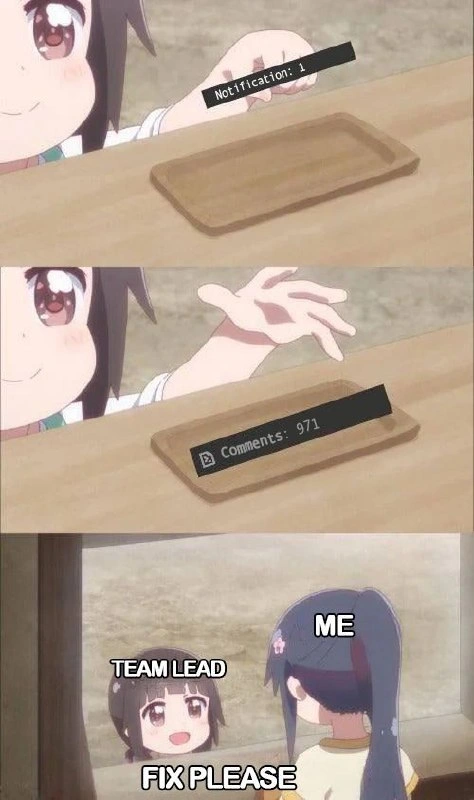
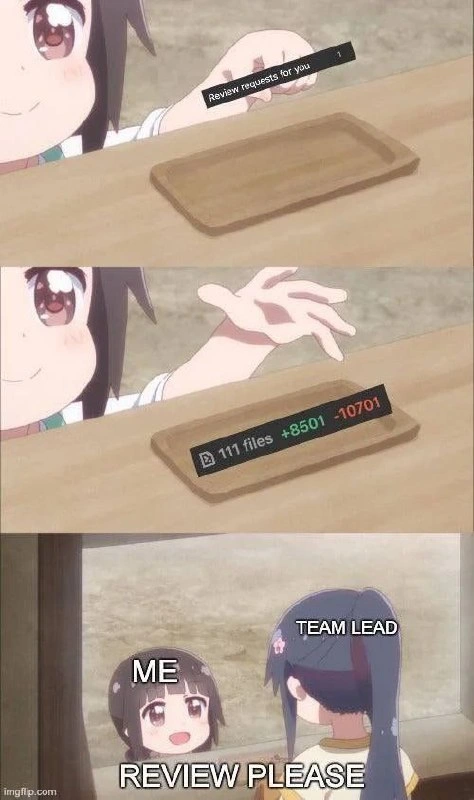
In the meme, a developer sees a tiny alert (like a little blinking light saying “1 new message”). He expects a quick comment from his team lead (kind of like his boss or a mentor). But when he clicks it, he finds 971 comments full of things he needs to change in his code. It’s like getting a simple gift box, opening it, and boom! 971 task cards explode out of it. It’s funny because it’s such a big surprise hidden behind a tiny hint. Just like you’d laugh (after recovering) if one homework note turned into a whole book of fixes, developers laugh (and cringe) at this situation. The meme uses cute cartoon kids to show this: the little kid hands over what looks like a small bar labeled “Notification: 1,” but then it turns into a huge bar labeled “Comments: 971.” The older kid (labeled “ME,” the developer) is left standing there like, “Wait, seriously?!” while the smaller kid (“TEAM LEAD”) just says “FIX PLEASE.”
So, in super simple terms: the joke is about expecting a tiny bit of feedback and instead getting a flood of problems to solve. It’s the surprise and shock that makes it funny. Anyone can relate to the idea of thinking you have a small task, but it turns out to be a giant one. It’s like if your parent asked you to clean one shelf, and when you went to do it, you discovered the whole room was messy and you had to clean everything. You’d be like, “Oh nooo, this is so much more than I thought!” But maybe you’d laugh a little because of how badly you misjudged it. That’s the laugh this meme gives to software developers – a laugh that comes with a sympathetic wince, because ouch, that’s a lot of fixes to do!
Level 2: Feedback Avalanche
If you’re a newer developer or just learning about this, let’s break down the scenario. This meme is about a pull request and a code review gone haywire. In software teams, when you finish working on some code changes, you don’t just put it into the main app immediately. You first open a pull request (PR) – basically a request asking, “Hey, can we pull (merge) my changes into the codebase?” Other developers (often your teammates or a team lead, who is like the lead developer or supervisor for the project) will then do a code review. That means they look at all the changes you made: every line you added, removed, or modified. They check if the code works, if it follows the team’s guidelines, and if it’s clear and well-written. During a code review, they can leave comments on specific lines or overall suggestions. For example, a comment could be: “Hey, I think you should rename this variable for clarity” or “This function might break if X happens, maybe add a check?” – stuff to help improve the code or fix mistakes before the code becomes part of the main project.
Now, usually a pull request might get a handful of comments. Maybe zero (if you nailed it) or a few if things need tweaking. 971 comments, though? That’s extremely high – it’s an absurdly exaggerated case meant to be funny (and a little scary). Here’s what likely happened: the team lead went through the PR with a fine-toothed comb and found a lot of issues. Maybe the PR was huge or had a lot of things not done the “right” way. Many code hosting platforms (like GitHub) allow a reviewer to write all their comments first, then submit them in one go. So from the author’s perspective (the poor developer who made the PR), the interface might just show a single notification – like a little icon or an email that says “Your team lead reviewed your PR” or “1 review comment.” It looks innocent, as if there’s just one note to check. But when the developer clicks it and opens the review… BAM! They see a list of 971 separate comments. It’s a comment avalanche indeed – a flood of “please change this, fix that” covering their entire code.
Imagine the PullRequest process unfolding: you thought your code was ready to go, but now you have a monumental task of reading through every single comment your lead left. A team lead is usually very experienced and responsible for maintaining code quality, so their reviews can be thorough. But this one is over-the-top thorough. The meme exaggerates to make the point: it feels like every line of code might have a sticky note saying “Do it differently.” The final part of the meme shows the team lead character handing a note that says “FIX PLEASE” to the person labeled “ME” (the developer). This basically summarizes what all those comments are saying: “There’s a lot wrong – please fix it.” It’s humorous in a dark way, because the team lead in the picture looks so casual and cute handing over this request, while for the developer, it’s anything but cute. It’s a huge pile of work dumped on them unexpectedly.
For a junior dev, this scenario is both a cautionary tale and an oddly relatable joke. On one hand, it’s teaching: don’t underestimate that single notification. One seemingly small review can hide a ton of feedback. Maybe you’ve experienced something similar on a smaller scale – like getting back a school assignment with red marks all over it. In coding, a big review like this means you’ll have to go back and change a lot in your code. It can happen if you didn’t know some of the rules or best practices, or if the task was very complex and you took a different approach than what the lead expected. It’s also a hint about team communication: ideally, if there are this many issues, you probably should have had a chat earlier. Sometimes, instead of writing hundreds of comments, a good team lead will call you over for a quick talk or do a pair-programming session to help fix the bigger problems. But in the meme scenario, that didn’t happen – the dev only discovers all the problems after they completed the work, all delivered at once in text form. That’s why it’s a communication breakdown moment.
Let’s define a few key terms and ideas so everything’s clear:
- Pull Request (PR): A feature of version control platforms (like Git or GitHub) where you ask to merge your changes into the main code. It’s like saying, “I’ve finished some work. Can you please add it to the project?” It comes with a discussion thread and is where code review happens.
- Code Review: The practice of having peers or leads review your code changes. They will read your code and give feedback – this can be praise, questions, or requests for change. The goal is to catch bugs, improve code quality, and share knowledge. It’s a normal part of software development teamwork.
- Comments (in a PR): These are the actual feedback notes reviewers leave. They often attach to specific lines of code. For example, if you forgot to handle a null-check, a reviewer might click that line and comment “What if this value is null? We should handle that to avoid a crash.” Each comment opens a mini-discussion thread. The author (you) can reply or just fix the code based on it.
- Team Lead: This is usually a senior developer in charge of the project or team. They often do final reviews and have a big say in what gets approved. A team lead tends to have a strong opinion on how code should be written (for good reasons, like maintaining consistency and quality). When they review, you pay attention. In this meme, the team lead is the one who unleashed those 971 comments. So… yeah, they had a lot to say.
- “FIX PLEASE”: This isn’t a standard term, but in the meme it’s the (very blunt) message from the reviewer. It’s basically shorthand for “I’ve pointed out many things; please address them and make corrections.” In real code reviews, the equivalent might be selecting “Request Changes” with a summary comment like “Please fix the above issues.” It’s a polite command: you can’t merge your code until you resolve what I flagged.
Now, how might a junior developer feel opening something like this? Probably overwhelmed! It’s like turning in your first big project and getting it back covered in notes. It’s a bit embarrassing and stressful, but also part of learning. Usually, you’d never see literally 971 comments; that number is exaggerated for comic effect. But getting maybe 20, 30, or 50 comments on a large PR can and does happen. The meme just cranks that feeling up to eleven. And trust me, even 30 critical comments can feel like a ton when you’re new – you start second-guessing your skills. This meme resonates because many of us have had a moment where a reviewer (often a senior dev or lead) found way more issues than we expected. We thought our code was okay, and then we get a long list of improvements and mistakes to fix. It’s a normal part of growing as a developer, but in the moment it can induce a bit of panic. The good news (that the meme doesn’t show) is that you can tackle them one by one, maybe ask the reviewer for guidance on the big stuff, and you’ll learn a lot in the process. Still, it’s a scenario every dev hopes to avoid – better to catch things early or do smaller chunks of code so this kind of feedback avalanche doesn’t hit all at once.
In summary, Level 2 explains that the meme is joking about the pull request process where code is reviewed: a single small notification ended up hiding an enormous list of review comments (971 of them!) from the team lead, all telling the developer to fix things. It’s funny in a “oh no, that would be awful” way, especially if you’ve been on the receiving end of a heavy code review. The key takeaway for a newcomer: always be prepared that a simple ping from your code repo might not be so simple – sometimes there’s a mountain of feedback behind that little number. And if you ever do get such an extreme review, don’t be too discouraged; even though the meme makes us laugh, in real life you can get through it step by step (and maybe have a chat with your lead on how to avoid surprises like that!).
Level 3: Pandora's Pull Request
One pull request notification pops up – Notification: 1 – innocent as can be. You click it, expecting maybe a quick question or a single nitpick. Surprise! It unveils a colossal code review comment overload: Comments: 971. This anime-style meme perfectly captures a senior developer's nightmare: a tiny alert was a trojan horse hiding an avalanche of feedback. It’s like opening a small box and unleashing a hundred-page code review document. The humor is equal parts shock and pain: any experienced dev recognizes this as the ultimate CodeReviewPainPoint (borderline CodeReviewHorrorStory). One moment you're content, thinking "Probably just a minor change request", and the next moment you’re staring at what amounts to a full novel of critique from your team lead.
Why is this so funny and traumatic to a seasoned engineer? It’s the classic bait-and-switch of the PullRequest process. Modern code platforms (GitHub, Bitbucket, etc.) often bundle review comments: the team lead likely submitted a batch review. So the interface politely says "1 new review" – hiding the fact that inside that review are 971 individual comments. The meme exaggerates it to absurdity, but it strikes a nerve because we’ve all clicked that one seemingly benign notification only to scroll… and scroll… through wall after wall of text. It’s a relatable gut-punch: Oh no, what did I do wrong this time? – a prime example of DeveloperFrustration in code reviews. The communication here is technically thorough but practically overwhelming – a genuine communication breakdown where the signal-to-noise ratio collapses under sheer volume. The team lead is effectively rewriting or heavily critiquing the code via comments, culminating in that curt demand: “FIX PLEASE.”
This scenario hints at deeper software team dynamics. A code review with 971 comments is the stuff of legend (or infamy). It suggests one or more of:
- Massive Changes: Perhaps the PR was too large, touching many files or critical systems at once. Big pull requests are notorious: they invite proportionally big reviews. A senior knows that a monolithic PR is an anti-pattern – it’s hard to digest, and any thorough review might snowball into hundreds of notes.
- Strict Standards: The team/org might enforce very strict coding standards or style guides. If the developer overlooked those (naming conventions, formatting, architecture rules), the team lead will flag every single instance. 971 comments could easily include repetitious “follow the style guide” reminders. It’s basically a linter's job done manually (with lots of human exasperation).
- Fundamental Flaws: The approach or design might be off the mark. A senior reviewer might use the review to point out every design issue, essentially asking for a major refactor. Instead of one general “this approach won’t scale” comment, they leave granular comments at each problematic line. The result is an explosion of threads – a detailed to-do list for a rewrite.
- Pedantic Nitpicking: Let’s be honest, some reviewers comment on everything. Missing semicolons, extra spaces, minor optimizations – nothing escapes their gaze. The team lead in this meme might be that person who treats a code review like an English teacher grading an essay with a red pen. Even solid code can get dozens of “suggestions”; now multiply that by a large diff. The outcome? Comment overload.
Any of these factors (or all at once) make a PullRequest review go nuclear. The meme exaggeration (971 comments!) pokes fun at a real tension: code reviews are meant to maintain quality, but when does it become counterproductive? DeveloperExperience (DX) suffers when feedback comes as a deluge rather than a dialogue. A senior dev will chuckle because it’s a hyperbole with a grain of truth – we’ve seen overzealous code reviews that felt this brutal. It highlights a process smell: if you ever feel the need to write a hundred-plus comments, perhaps a face-to-face talk or a design discussion was needed before the code even got to review. In healthy teams, a review is collaborative and focused on key issues. Here, it’s a feedback flood from a single person in authority, which is funny on paper but pretty demoralizing in practice. The team lead in the meme (depicted as a small smiling anime character sliding over the “Comments: 971” bar) is ironically adorable, yet we all know that sinking feeling of seeing dozens of red comment icons littering our diff. It’s the cute visualization of a not-so-cute reality: your boss just handed you a gargantuan fix list. And the kicker? The final panel where the team lead’s only verbal follow-up is a cheerful "FIX PLEASE" – as if those 971 comments were just gentle nudges. That tiny phrase is dripping with understated irony, much like a manager dropping a 50-page report on your desk with a Post-it note saying “minor edits.”
From an old-timer’s perspective, this is hilariously cruel. It reflects a trope in developer culture: the never-ending code review. Seasoned devs swap war stories of PRs that dragged on for weeks due to endless feedback loops. This meme is basically one of those war stories distilled into three panels. The use of an anime meme template adds an extra layer of irony: the sweet, wholesome aesthetic of the characters contrasts with the absolutely brutal reality of the situation. It’s a sugar-coated cyanide pill of developer humor. 😈 More than one senior dev has likely commented, "This hit way too close to home," under such a post. After all, who hasn’t had a relatable dev experience where a seemingly small update turned into a multi-day bugfix and refactor marathon because of thorough review comments? It’s funny because it’s true – and a little traumatic. The meme shines light on the absurdity of overkill code reviews and how they can turn the simple act of clicking a notification into a moment of dread. In summary, the senior perspective here is a mix of been there, suffered that laughter and a head-shake at how easily the best intentions (maintaining code quality) can devolve into a nightmare of DeveloperFrustration. Better brew a strong coffee when you see that one notification – you might be in for a PullRequest apocalypse.
Description
A three-panel anime meme, a variation of the 'Wataten! An Angel Flew Down to Me' format, illustrating the painful code review process. In the first panel, a cute anime girl offers a tray with an item showing 'Notification: 1', representing the initial submission of a pull request. In the second panel, the item is replaced with one showing 'Comments: 971', indicating an overwhelming number of feedback comments on the code. The third panel reverses the roles from the original meme: a character labeled 'TEAM LEAD' is now the one eagerly asking a dismayed character labeled 'ME' to 'FIX PLEASE'. This meme humorously depicts the developer's dread upon receiving a massive volume of critique on their work, turning a simple task into a monumental effort of revisions, and the pressure from leadership to address every single point
Comments
7Comment deleted
The delta between 'LGTM' and a 971-comment PR review is the difference between a drive-by approval and a full architectural audit by someone with a grudge and a lot of free time
Three-line hotfix PR; 971 comments later we’ve redesigned the bounded context, resolved the event-sourcing vs. CQRS debate, and I still have to rename `foo`
When you realize those 971 comments are actually just the linter complaining about tabs vs spaces because someone forgot to run prettier before pushing
When you deploy a 'minor fix' on Friday afternoon and wake up to 971 Slack mentions, 400 PagerDuty alerts, and your team lead's passive-aggressive 'FIX PLEASE' - that's when you realize your rollback strategy should have been as robust as your confidence was
GitHub: 1 notification. Reality: your “small refactor” in the monorepo has 971 comments - apparently our code review is Paxos with extra bikeshedding
971 PR comments? That's not feedback - it's a CAP theorem violation on your sanity: choose two from consistent, available, or productive
That one GitHub ping that expands into 971 review comments after Prettier hits the monorepo; the team lead’s summarizer reduces it to a single line: “fix please.”