The Load-Bearing Unreachable Code
Why is this IDEs Editors meme funny?
Level 1: The Weird Spare Part
This is like finding an old screw on the floor, deciding it must be useless, throwing it away, and then watching the whole chair collapse when someone sits down. The funny feeling is the confused panic of learning that the ugly little piece you removed was secretly holding everything together.
Level 2: Warnings Meet Reality
Unreachable code means the editor believes a piece of code can never run. For example, anything after an unconditional return in the same block is normally unreachable:
int GetNumber()
{
return 42;
Console.WriteLine("This should never run");
}
Visual Studio and similar IDEs are trying to help by pointing out code that probably adds confusion. Removing it often improves code quality, because fewer unused branches mean fewer places for bugs to hide.
The meme is funny because beginners are taught that warnings are bad and cleanup is good, but real applications are full of exceptions to that clean story. A program can depend on code in ways that are not obvious from reading one file. Frameworks may call methods automatically. Configuration files may name classes as text. Build settings may include code only in certain environments. Tests may miss the path that production hits every day at 2:17 PM, because of course they do.
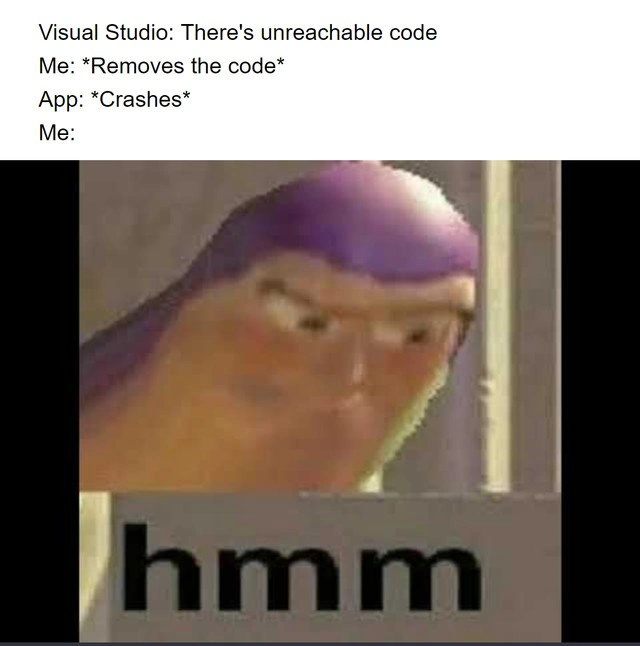
Buzz's suspicious hmm represents the moment after a simple fix creates a runtime error. It is the developer realizing that the warning was not the whole truth. The app crashing does not mean warnings should be ignored; it means changes need context, tests, and sometimes a careful search for hidden dependencies before deleting "useless" code.
Level 3: The Dead Code Load-Bearing Wall
Visual Studio says:
Visual Studio: There's unreachable code Me: Removes the code App: Crashes Me:
Then Buzz Lightyear stares down at hmm, which is exactly the correct facial expression when a compiler or IDE warning has just lied to you in the most technically defensible way possible.
The joke lands because unreachable code sounds like free cleanup. In a healthy codebase, a branch that cannot execute should be deleted, tests should stay green, and everyone gets to feel morally superior for five minutes. In a real legacy system, that suspicious block may be reachable through reflection, dynamic dispatch, generated code, dependency injection magic, configuration-driven routing, partial classes, conditional compilation, or some framework lifecycle hook nobody has thought about since the last office chair had lumbar support.
The dark part is that Visual Studio can be correct locally while the application is wrong globally. Static analysis usually reasons about a constrained model of the program: visible control flow, known symbols, compile-time constants, and reachable paths from ordinary entry points. Production software often includes behavior that arrives from outside that tidy model:
- A method is called only by a serializer using a string name.
- A constructor appears unused but is required by a framework.
- A field assignment looks pointless but triggers a lazy initialization side effect.
- A dead-looking
catchblock quietly normalizes an exception some ancient library still throws. - A conditional branch is disabled in one build target but active in another.
That is why the app crashing after the removal feels so painfully plausible. The code was not dead; it was undocumented infrastructure wearing a fake mustache. The warning exposed a code quality smell, but the crash exposed the real issue: the system has hidden contracts that are not expressed in types, tests, or architecture. Once those contracts live only in folklore, every cleanup becomes archaeology with a deploy button.
This is also a debugging and maintenance joke. The developer did the rational thing: trust the IDE, remove noise, run the app. The system responded by revealing that its survival depended on something nobody could explain. That gap between "the tool says this is safe" and "the runtime strongly disagrees" is where senior engineers develop the habit of searching commit history like it owes them money.
Description
The meme text reads, "Visual Studio: There's unreachable code" followed by "Me: *Removes the code*", "App: *Crashes*", and "Me:". Beneath the text is a blurry close-up of Buzz Lightyear staring at a sign that says "hmm," expressing confused suspicion. The technical humor comes from an IDE or compiler warning identifying apparently dead code, only for that code to hide side effects, build-order quirks, undefined assumptions, or brittle legacy behavior that kept the application alive.
Comments
1Comment deleted
In mature systems, unreachable code is sometimes just dependency injection with terrible branding.