Skip to content
DevMeme
3494 of 7435
The Slippery Slope of a Developer's Skill Set
Learning Post #3830, on Oct 18, 2021 in TG

The Slippery Slope of a Developer's Skill Set

Why is this Learning meme funny?

Level 1: Too Many Toys

Imagine you start with one toy that you really love – say, a red block. You’re playing with it and having so much fun. Then you see another, slightly different block – maybe a blue one – and you think, “Oh, this one looks fun too!” So now you have two blocks, one in each hand. It’s a bit trickier to play with both at the same time, but you manage and you’re excited.

But then, all of a sudden, a whole bunch of different colored blocks come tumbling off a shelf, falling all around you: green blocks, yellow blocks, big blocks, small blocks – an avalanche of toys! They pile up so high that you can barely see over them, and you feel a bit buried and overwhelmed.

This comic is like that story, but with programming languages instead of toy blocks. The little red panda is like a kid who tried to grab every fun toy (programming language) they saw. At first it was great – one toy, then two – but grabbing everything at once turned into chaos. It’s funny because we understand the panda’s feelings: learning one new thing can be so enjoyable that you want more, but if you try to take on too many new things at the same time, you might end up covered in too much stuff, just like being buried in toys.

The meme makes us smile because we’ve all seen someone (or been someone!) who got overexcited and said “I want all the cool things!” – whether it’s toys, candies, or in this case, programming languages – and ended up in a bit of a mess. It’s a playful way to say “learning new things is awesome, but be careful not to overload yourself – or you’ll get buried!”.

Level 2: Juggling Languages

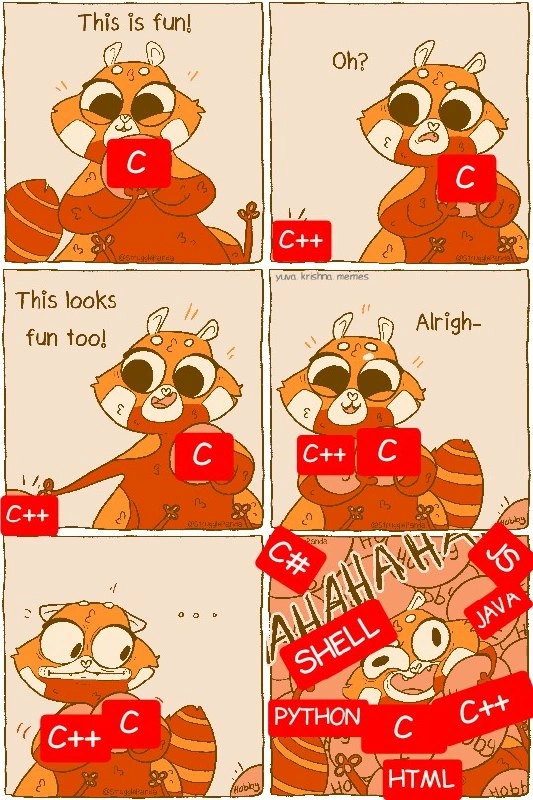
This meme shows a cute red panda cartoon character literally collecting and juggling cubes, each labeled with the name of a programming language. In the first panel, the panda holds a red block marked C and says “This is fun!” The language C is one of the oldest and most fundamental programming languages. It’s known for being very powerful (you can do things like direct memory manipulation), but it’s also low-level, which means you have to manage a lot of things yourself. Many computer science students and beginners start with C because it teaches the basics of how programs work under the hood. So our panda is having fun learning C, hugging that block proudly – success with the first programming language feels empowering!

In the next panel, the panda spots another block on the ground labeled C++ and curiously says “Oh?” as it picks it up. C++ is essentially an extension of C (the name even looks like “C plus plus”, implying it’s C improved). C++ adds a bunch of features on top of C, like the ability to use classes and objects (object-oriented programming). It’s like going from driving a simple car (C) to piloting a racecar with more gears and buttons (C++). At this point, the panda exclaims “This looks fun too!” and adds the C++ cube to its collection. This reflects a common situation for learners: once you get the hang of one language, you often get excited to learn another, especially one that’s related. The panda is now holding two cubes – literally juggling two programming languages. Many junior developers do this – for example, after learning Python, they might try JavaScript, or after learning Java, they give Kotlin or C# a go. Each new language learned can be exciting because it opens up new possibilities and ways of thinking or new types of projects you can work on.

By the fourth panel, the panda is trying to say “Alrigh–” (probably “Alright!”) while balancing both the C and C++ blocks. The speech is cut off, which suggests the panda might be getting a bit unstable or surprised. Juggling multiple languages isn’t easy – even just two can be tricky. Each programming language has its own syntax (the rules and structure, like keywords and punctuation) and its own set of best practices. When you switch from one to another, you have to mentally switch contexts. For example, C uses semicolons to end lines and curly braces {} to group code, whereas Python (another language coming up) doesn’t use semicolons and uses indentation (spaces/tabs) to group code. Keeping those straight is like balancing two different blocks: doable, but you need to concentrate.

Then comes the big surprise in panel 6: in panel 5 the panda looks uneasy (maybe hearing a rumble), and suddenly panel 6 has an avalanche of blocks raining down on the panda. The onomatopoeia “AHAHAH” in huge letters hints that this is a chaotic, maybe comical disaster. The blocks that pile onto the panda are labeled C, C++, C#, SHELL, PYTHON, JAVA, JS, and HTML. That’s a lot of languages! Here’s what each of those are in simpler terms, and why a developer might end up with all of them:

  • C# (pronounced “C-sharp”): Another programming language in the “C family”, but it’s actually more similar to Java in how it works. It’s mainly used in Microsoft’s .NET framework, for things like Windows applications, and also popular in game development with Unity. A person who learned C++ might pick up C# if, say, they start working on a Windows app or a Unity game, because C# is the go-to language there. It’s like a cousin of C++ that runs with a managed runtime (meaning you don’t manually free memory; it has a garbage collector that does memory management for you).

  • Shell (shell scripting): This isn’t a single language but refers to scripting languages used in the command-line shell. For example, Bash on Linux or the Windows PowerShell. Shell scripts are what you write to automate tasks on your computer – things like saying “copy all these files, then compile this program, then deploy it” can be done with a shell script. The syntax for shell scripts is quite different from C or Java or Python – it often involves writing commands just like you would type in the terminal, using $ for variables and lots of quirky short keywords (ls for listing files, grep for searching text, etc.). Developers often need at least a little shell scripting when setting up environments or automating builds. So as you become a more advanced beginner, you might realize, “Hmm, to easily run my C program or my Java program, maybe I’ll write a bash script to execute a bunch of commands” – and boom, you’re learning shell scripting too.

  • Python: A very popular high-level programming language known for its easy-to-read syntax and versatility. Many people learn Python as one of their first or second languages because it’s friendly (you can do a lot with a little code). If our panda had started with C/C++ (which are quite low-level and sometimes tricky), picking up Python might feel like a breath of fresh air – no need to worry about types as much or manual memory, and you can accomplish tasks with fewer lines of code. Python is used in web development, data science, scripting, automation, you name it. The panda might have thought, “Python looks fun too!” – maybe after hearing how popular it is or needing it for a quick task like processing a data file or scraping a web page.

  • Java: Another big name language, famous for the slogan “write once, run anywhere.” It’s heavily used in large enterprise environments, Android app development, and lots of backend systems. Java’s syntax has similarities to C++ and C# (curly braces, similar keywords). A developer might encounter Java if they work on corporate software or large-scale applications. Our panda could have come across a project or a job posting that needs Java, and decided to add that block to the stack. Java introduces its own ecosystem (the JVM, a huge standard library, and frameworks like Spring). It’s a bit verbose, but very powerful for large applications. It’s not uncommon for someone who knows C++ to also learn Java, as they share some concepts (object-oriented programming) but Java handles memory for you (no manual pointers), which can be a relief.

  • JS (JavaScript): Despite the name, JavaScript is not directly related to Java – it was named that way for marketing reasons. JavaScript is the language of the web browser; it runs inside web pages to make them interactive. Almost any time you do something dynamic on a website (like clicking a button and something changes without the page reloading), JavaScript is involved. So, if our panda ventured into web development or wanted to make a personal website or a web app, learning JS became necessary. JavaScript has a very different feel – it’s dynamically typed like Python (you don’t declare variable types), and it’s event-driven and often asynchronous (things happening in the background, like waiting for a server response). It’s another whole set of concepts to grasp. Many developers who primarily worked in server-side languages (like C++, Java, or Python) eventually pick up JavaScript because at some point they need to work on the frontend (user interface) too.

  • HTML: Stands for HyperText Markup Language. HTML isn’t a programming language that does logic; instead, it’s a language for describing the structure of web pages. You write HTML to say “this is a heading, this is a paragraph, this is an image”. Web browsers read HTML to display content. If you’re making a website, you must use HTML to put content on the page, and then use CSS to style it and JS to program interactions. So poor panda probably just wanted to code something cool in Python or C++, but the moment they decided “let me also build a simple website for it,” they suddenly had to pick up HTML (and likely CSS, though ironically a CSS block isn’t shown). It’s another “language” to add to the list, even if it’s a different kind of language.

So, by the final panel, the panda is buried under a pile of languages. This represents being overwhelmed by trying to learn too many at once. Each of those cubes is like a new subject to master. The panda’s expression (wide eyes, a bit shocked) is a humorous way to show "Uh oh, what have I gotten myself into?". Developers find this funny because it’s a very real feeling: you start a simple journey learning to code, and before you know it, you have tons of windows open on your computer – one running a C program, one a Python script, a browser with HTML/JS, maybe a Java program compiling – and you’re trying to remember all the different commands and syntaxes.

Language overload is a common challenge. New developers often feel like they have to catch up by learning many programming languages, especially when they see job listings or experienced devs who list multiple languages on their resume. It’s exciting to become more versatile, but it can also be overwhelming. Each language has a learning curve – the time and effort it takes to become comfortable and effective in that language. If you try to climb too many learning curves at the same time, it’s easy to get confused or burnt out. For example, a beginner might mix up syntax between languages accidentally (like using Python’s # comments when writing C++ code, which actually would be a mistake because C++ uses // or /* ... */ for comments). Or they might be writing a piece of code and momentarily forget which language’s conventions they’re supposed to follow.

The comic exaggerates this scenario for humor: a literal avalanche of cubes suggests the situation quickly goes from fun to chaotically out of control. The caption “One language leads to an avalanche of programming cubes and chaos” spells out the idea – once you start with one, you might trigger a chain reaction of learning many more (“avalanche” is a strong word for an unstoppable chain reaction). It’s not that learning multiple languages is bad – in fact, eventually developers do learn several over their careers – but doing it all at once or very quickly can feel like you’re getting buried, much like the panda.

This meme falls under Languages and Learning because it’s highlighting the learning process of programming languages and how quickly it can escalate. The tags like LanguageAdoption and multi_language_juggling directly point to this theme: adopting one language after another and trying to juggle all the knowledge. LanguageWars is a tag likely included because there’s a long-standing humorous debate in the developer community about which language is best (“C vs C++ vs Java vs Python vs JavaScript” and so on – sometimes called language wars). The comic isn’t showing an actual fight, but it cheekily bypasses the “war” by having the character embrace all the languages – and then suffer for it! So it resonates with jokes about how instead of arguing which single language is superior, some of us just try to learn them all (and then realize each has its own headaches).

For a junior developer or someone new to coding, the takeaway is: it’s normal to be excited and to try out different languages – that’s part of learning and it is fun! Each new language can teach you new ways to think about programming (for instance, learning Python might introduce you to quick scripting and working with lists and dictionaries easily, while learning C teaches you about performance and memory, and learning JavaScript teaches you about asynchronous calls in a browser). But it’s also okay (and common) to feel overwhelmed if you take on too many at once. The meme uses humor to say “we’ve all been that overenthusiastic panda at some point, ending up in a bit of a chaos.” The key concepts here – learning curve, language overload, juggling multiple languages – are things you’ll become familiar with as you progress in programming. It’s generally wiser (and more manageable) to get comfortable in one or two languages at first, then gradually learn others as needed, rather than trying to master eight in a week. Otherwise, you might end up like the panda with cubes everywhere!

In short, the second level explanation of the meme is: a developer (the red panda) joyfully starts learning programming with one language (C), then quickly picks up a second (C++), thinking each new language looks fun. But then unexpectedly, many more languages (C#, Shell scripting, Python, Java, JavaScript, HTML – basically a who’s who of programming) come tumbling into their life, creating a chaotic situation. This reflects a typical learning adventure in coding – one thing leads to another, and soon you have a stack of languages to deal with. It’s funny and a bit cautionary at the same time, showing the excitement of discovery and the comical overwhelm when you bite off more than you can chew.

Level 3: Avalanche of Syntax

At the highest level, this meme hilariously captures the polyglot developer experience: that slippery slope where learning one programming language opens the floodgates to many more. The red panda’s journey mirrors a common industry pattern: a developer starts with C (a low-level, powerful language that’s been a foundation since the 1970s) and thinks “This is fun!” – and it is! C teaches you core concepts like manual memory management (pointers, malloc/free), and gives you a taste of low-level control. But then curiosity (or job requirements) strike: “Oh? There’s C++ just lying here – this looks fun too!” C++ is basically C’s bigger sibling, adding object-oriented programming, templates, and a lot more complexity. As our eager panda picks up a C++ cube, they’re embracing things like classes, inheritance, and the notorious template metaprogramming. Any seasoned dev knows that stepping up from C to C++ often feels natural (they share syntax and the name letter!), yet it introduces new headaches: managing constructors/destructors, dealing with the dreaded undefined behaviors, and wrestling with super-long compile times when those templates get out of hand.

By the time the panda is balancing both C and C++ blocks, we’re witnessing the beginning of multi-language juggling. This resonates deeply with senior engineers – that moment when you’re actively maintaining code in multiple languages at once, and your brain has to keep the different syntaxes and quirks straight. Many of us have juggled a compiled language like C++ in one hand and a scripting language in the other, using each where they shine. It’s exhilarating and a bit precarious. The humor here comes from the implicit overconfidence: “Alright, I got two, I can handle this,” which every experienced dev recognizes as famous last words.

Then comes the avalanche: an entire mountain of language-labeled cubes buries the poor panda in panel 6 with a giant “AHAHAH!” looming overhead. This is where the meme really winks at the seasoned crowd. We see cubes labeled C#, Shell, Python, Java, JS (JavaScript), and HTML crashing down. Why these? They represent the inevitable snowball effect in a programmer’s career. Start with C, then C++… soon you’re dabbling in C# because maybe you took a job in a Windows/.NET environment or wanted to build a Unity game. Now you’ve got three languages all derived from that letter C but each wildly different in practice (manual memory in C, semi-manual in C++, garbage-collected in C#). Along the way you likely pick up shell scripting (sh/Bash/Powershell) because every developer eventually has to automate something in the command line – and shell languages have their own arcane syntax (dollar-sign variables, backticks, pipe operators, oh my!). It doesn’t stop: Python appears – perhaps because you needed a quick script or fell in love with its simplicity for tools and automation. Python’s a joy, but its dynamic typing and indentation-based blocks are a whole new mental model compared to curly-brace languages. Next, Java might drop in your lap – maybe the team’s backend is written in it, or you needed to maintain that enterprise application. Java brings verbose syntax and the JVM ecosystem into play. And of course, if you venture into web development, JavaScript (JS) and HTML pounce on you too – even if you’re primarily a backend dev, you often can’t escape writing a bit of client-side code or tweaking a webpage. HTML isn’t a programming language (it’s a markup language for structuring content), but from the perspective of being overwhelmed it might as well be another block to learn. Web folks also know if HTML is there, CSS likely is too (surprisingly absent from the cubes, maybe it’ll fall in next!).

For senior engineers, this avalanche is painfully relatable and funny because it highlights how one small step in tech leads to ten more. We joke about “just learning one more language” and then suddenly find ourselves installing half a dozen compilers and interpreters. The text “AHAHAH” in the background feels like the universe laughing at the panda – or perhaps the collective cackling of all these programming languages as they bury the unwitting enthusiast. It’s satirizing the chaotic reality of modern software development: systems today are polyglot by necessity. A simple web app can easily involve half the languages mentioned: you write server code in Java or Python, use Shell scripts for deployment, handle data processing with a bit of C++ for performance, and craft the frontend with HTML/JS. Each language has its own syntax, toolchain, and gotchas – and juggling them means you’re constantly context-switching. Senior devs chuckle (or groan) remembering times they wrote a semicolon at the end of a Python line out of C-habit, or tried to use // comments in Bash, promptly causing a script error. That “oops, wrong language!” moment happens to the best of us when our mental parser gets overwhelmed.

The meme’s humor also touches on learning curve excitement vs. reality. Initially, learning a new language is fun – there’s the rush of “Hello, World!” printing successfully, the power of new features (like discovering Python’s import antigravity Easter egg and feeling clever). But as you keep adding languages, the cognitive load skyrockets. The panda’s delighted face slowly turning to a wide-eyed stare by panel 5 is basically a senior engineer’s thousand-yard stare remembering when they had to simultaneously debug interactions between a Java backend, a Python script, and a JavaScript frontend – each with different debugging tools and error message styles. We have all seen someone’s project or resume that lists every language under the sun; the meme wryly suggests that collecting languages can become chaos rather than a badge of honor if you’re not careful.

Underneath the laughter, there’s an element of truth about language adoption in our field: technology evolves quickly, and what starts as “I’ll just learn this one new cool language” can turn into an avalanche as new needs and shiny tools emerge. It’s a jab at the “Jack of all trades, master of none” trap. Each of these languages is a powerful tool on its own – C for system programming, C++ for high-performance applications, C# for GUI apps or enterprise .NET projects, Python for scripting and AI, Java for cross-platform big systems, JavaScript/HTML for pretty much every web interface – but trying to master them all simultaneously? That’s a tall order, often resulting in a feeling of being buried under syntax, much like our panda friend. Senior devs laugh because they’ve been there: juggling multiple programming paradigms and wishing for a single unified language, yet also knowing that the right tool for each job is different. It’s a chaotic kind of fun — the kind that leads to late-night debugging sessions where you momentarily forget which language’s comment syntax you need to use in this file (// or # or <!-- ... -->?). The meme captures that absurdity in one dramatic avalanche scene.

In summary, the avalanche of programming cubes represents the nearly inevitable expansion of a developer’s world from one language to many, and the chaotic joy (and terror) of it. The experienced perspective here is laughing at how accurately the comic portrays a common rite of passage in software development: today’s simple experiment with a new language can become tomorrow’s overwhelming pile of tech to maintain. The humor lands because it’s so true: one minute you’re enthusiastically saying “This looks fun too!” about a new framework or language, and the next you’re buried in { curly braces, semicolons, and stack traces } from eight different runtimes. A senior engineer will nod knowingly (and probably share this meme with the caption “my life in tech, summed up”). It’s a lighthearted reminder that in programming, one thing leads to another – and before you know it, you’re a collector of languages trying not to get crushed by all your tools of the trade. 😄

Description

A six-panel comic strip featuring an adorable, orange, raccoon-like creature that illustrates the overwhelming journey of learning to code. In the first panel, the creature happily holds a red block labeled 'C', saying, 'This is fun!'. It then notices a 'C++' block and decides to pick it up too. Initially confident, the creature's expression turns to panic in the fifth panel as it juggles both. The final panel shows the creature completely buried and screaming under a massive pile of red blocks representing numerous technologies, including 'C#', 'JS', 'JAVA', 'SHELL', 'PYTHON', and 'HTML'. This comic humorously and relatably depicts how a developer's journey often starts with one language but quickly spirals into the daunting reality of needing to master a vast and ever-growing ecosystem of technologies, a feeling well-known to both junior and senior engineers


Comments

19
Anonymous ★ Top Pick A developer's skill set starts as a stack and ends as a heap... a heap of technologies you're trying to keep from causing a memory leak in your brain
  1. Anonymous ★ Top Pick

    A developer's skill set starts as a stack and ends as a heap... a heap of technologies you're trying to keep from causing a memory leak in your brain

  2. Anonymous

    Started with one C file “for performance,” now the repo’s README is a Rosetta Stone and the CI matrix needs horizontal autoscaling

  3. Anonymous

    The real plot twist is when you realize after 15 years that the raccoon's initial 'This is fun!' with C was actually Stockholm syndrome, and now you're the one maintaining a legacy codebase that mixes all six languages through various FFI bindings and shell scripts

  4. Anonymous

    Ah yes, the classic journey: 'I'll just learn C for systems programming' → 'C++ adds useful features' → 'Wait, I need Python for tooling, JavaScript for the frontend, Java for enterprise integration, shell scripts for deployment, and HTML because someone has to fix the docs.' Before you know it, you're maintaining a polyglot codebase where each language was chosen for 'the right tool for the job' and you're the only one who remembers why. The red panda's descent from joy to existential crisis perfectly captures that moment when you realize your 'simple C project' now has a package.json, requirements.txt, CMakeLists.txt, and a Dockerfile - and you're somehow responsible for all of them

  5. Anonymous

    Polyglot productivity scales sublinearly - after C → C++ → C#, my brain’s L3 cache evicts the type system and I start writing Python list comprehensions in bash while trying to free() Java strings

  6. Anonymous

    “Let’s keep it simple and write it in C” quickly becomes C++ wrappers to keep the ABI sane, Python codegen, shell build glue, a Java/JNI bridge to the vendor SDK, JS+HTML for the admin UI, and a C# installer - aka the polyglot monolith nobody budgeted for

  7. Anonymous

    C feels fun until the PM says 'prototype in Python,' ops demands shell wrappers, and suddenly you're refactoring a Java monolith at scale

  8. @ShiningFlames 4y

    Now pour in js frameworks :v

  9. @CcxCZ 4y

    Mostly reskins of Algol/Simula. Be more adventurous next time, learn something that changes the way you think and approach problems next time. ;-)

    1. Deleted Account 4y

      eeh, don't think c++ is just a simula reskin anymore

      1. @CcxCZ 4y

        Not anymore, no. Heck, even the templates are turing-complete. But is it a good language to learn any one of those paradigms it tries to support?

        1. Deleted Account 4y

          even more, it's awesome for that

  10. @daniilkozlov3119 4y

    Who said that C is fun?…

    1. Deleted Account 4y

      it is

    2. @sashakity 4y

      i did

    3. Deleted Account 4y

      Of course it is. The funniest parts of it are void* and lack of classes

      1. Deleted Account 4y

        oh hello there

        1. Deleted Account 4y

          General kenobi

  11. Deleted Account 4y

    It’s literally me

Use J and K for navigation