The Containerization Paradox: Docker's Struggle for Profit
Why is this Containerization meme funny?
Level 1: Cleaning Up After Giants
Imagine a kid who invents a super fun new game at school. He teaches everyone how to play for free. Then two bigger kids, who own huge fancy playgrounds, start charging all the other children money to play this game in their yards. Those two big kids get rich selling tickets to play the game, and they sit on big comfy chairs like kings. Meanwhile, the kid who actually invented the game isn’t getting any money – he’s just left sweeping up the playground after everyone’s done playing. It’s silly and a bit unfair, right? That’s what this picture is joking about: the little inventor does all the work, and the big kids collect the money. It’s funny in a kind of “poor little guy” way, because you wouldn’t expect the inventor to be the one cleaning up the mess while others profit from his idea.
Level 2: Cloud Giants and Containers
This meme might confuse a new developer at first, so let’s break down the characters and terms. Docker is an open-source tool that introduced containerization – a way to package an application along with everything it needs (libraries, system settings) into a container. A container is like a lightweight little ship for your code: you can launch that same container on any computer or server and expect it to run the same way. It’s much slimmer than a full virtual machine, which made Docker super popular for deploying apps. Now, AWS (Amazon Web Services) and Google Cloud are huge cloud platforms – basically giant online providers of computing resources, storage, and services. Instead of running your own servers, you rent time on theirs. And guess what? They both let you run Docker containers on their infrastructure.
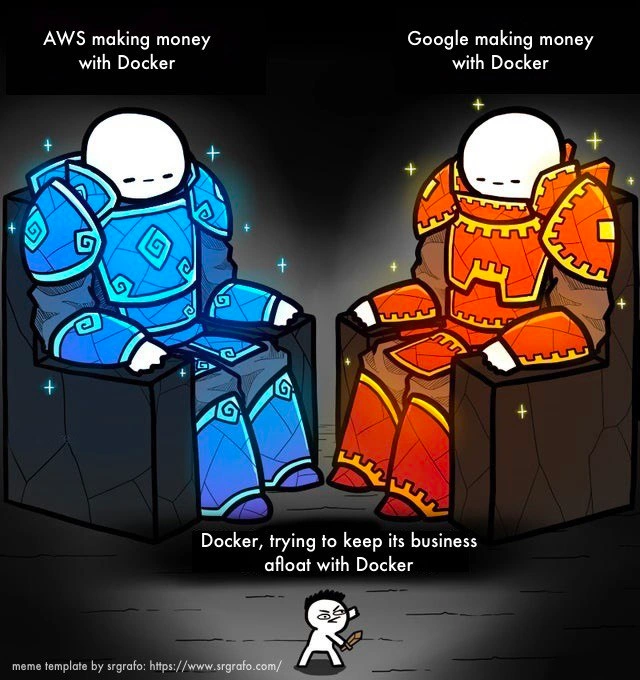
In the image, the two big armored knights on thrones represent AWS (in blue armor) and Google (in red armor). They look powerful and are literally “making money with Docker” – meaning AWS and Google are earning revenue by offering services that run Docker containers. For example, if you use Amazon’s Elastic Container Service or Google’s Kubernetes Engine, you pack your app into a Docker container and upload it. Then Amazon or Google charges you for the compute power to run that container, and for any extras like storage or management. It’s convenient for you as a developer: you don’t have to maintain physical servers, and deploying a container on AWS or Google Cloud might be as easy as a few CLI commands or clicks. But all those usage fees go to Amazon or Google. They’re like the big shop owners selling a product built on Docker’s technology.
And where is Docker (the company) in all this? Docker Inc. is much smaller than those cloud giants. They created this container tech and gave a lot of it away for free (Docker Engine and the core tools). Their plan was to make money by offering things like Docker Enterprise editions, Docker Hub (a cloud registry to store container images), and support/services for companies. Some companies did pay Docker for these, but not nearly at the scale that millions of developers were using Docker’s free tools on AWS or Google. In the cartoon, Docker is drawn as a small stick figure sweeping the floor, under the caption “trying to keep its business afloat.” That captures Docker’s struggle: they’re working hard just to survive financially. The big cloud providers essentially built lucrative services on top of Docker’s invention, while Docker’s own revenue model was not as successful.
To a junior dev, this is also a lesson in how the tech industry works. You might use docker build and docker run commands on your laptop to containerize your app, then push that container to a cloud service:
# Build a Docker image of your app
docker build -t myapp:1.0 .
# (Imagine pushing the image to Google Cloud's registry)
docker tag myapp:1.0 gcr.io/my-gcp-project/myapp:1.0
docker push gcr.io/my-gcp-project/myapp:1.0
# Now you'd deploy that container image on Google's cloud (GKE or similar).
# Google will charge for the resources your container uses.
In the above example, we use Docker’s tooling (docker build, docker push), but ultimately we’re uploading to gcr.io (Google’s container registry) and running it on Google’s servers. Google charges for storing that image and running it on their cloud. Docker Inc. doesn’t get a cut of those charges; they only potentially earn money if you pay for Docker Hub or enterprise features. This is the crux of the joke: AWS and Google make money every time you deploy a Docker container on their platforms, but Docker’s own wallet doesn’t automatically get fat from that. In fact, around the time this meme was made, Docker as a business was struggling so much that it had to sell part of its company and rethink its strategy.
So, the meme’s humor comes from this real-world situation. It uses a funny cartoon (familiar in TechHumor circles) to represent AWS and Google as mighty knights enjoying the wealth of container tech, while Docker is the little guy doing janitorial work to stay afloat. If you’re new to DevOps or cloud, it’s a cheeky reminder: the most popular technology isn’t always the best moneymaker for its creators. Sometimes the “cloud giants” take the lion’s share of the profit, even if a smaller player invented the tool. Docker is still hugely important in software development, but this meme jokes that being important doesn’t automatically pay the bills for Docker’s own company.
Level 3: Cloud Feudalism
In the grand saga of containerization, this meme paints a medieval metaphor for modern tech economics. We see two armored knights on thrones – one blue (Amazon AWS), one orange (Google Cloud) – both gleaming with prosperity. At their feet, a tiny stick-figure labeled Docker frantically sweeps the floor. The humor hits experienced developers immediately: Docker (the company that popularized containers) is depicted as the overworked servant, while the cloud lords (AWS and Google) sit back and make a fortune from Docker’s invention. This frames a classic startup vs. enterprise story in DevOps: the innovator toils, and the big vendors reap the rewards. It’s essentially “big_clouds_vs_docker” in cartoon form, highlighting an industry-wide monetization_struggle.
Why is this so ironically true? Docker introduced a revolutionary way to package and deploy applications in lightweight containers. Developers and ops teams loved it – it solved the “works on my machine” problem and fueled the microservices boom. Docker, Inc. open-sourced the core runtime and syntax (e.g. the Dockerfile format and Docker Engine), hoping to build a business on top. But in doing so, they inadvertently empowered the tech giants. AWS and Google Cloud integrated Docker’s container tech into their cloud services, turning it into a revenue engine for themselves. For instance, AWS launched Elastic Container Service (ECS) and later Elastic Kubernetes Service (EKS), letting companies run Docker containers at scale on AWS’s infrastructure. Every time you spin up containers on AWS, you pay for EC2 instances, data transfer, and perhaps AWS’s own container registry (ECR). Similarly, Google’s GKE (Google Kubernetes Engine) and container registry leverage Docker images under the hood and charge users for the VM instances, storage, and management. In other words, Docker’s open technology became the gold rush of cloud computing, and AWS/GCP were the ones selling the shovels (or rather, renting the servers). The vendor_monetization_inequality is stark: AWS and Google earn cloud profits hand over fist thanks to containers, while Docker’s own cash register barely rings.
This is a familiar pattern in tech history. The meme’s knightly imagery evokes a kind of cloud feudalism: the powerful lords (big cloud providers) extract rent from innovations, and the smaller inventor is left with crumbs. Seasoned engineers recall other cases of this startup_vs_enterprise dynamic. Think about open-source databases and search engines: the creators (MySQL, Elasticsearch, etc.) built great tools, but AWS launched branded cloud services (Amazon RDS for MySQL, Amazon Elasticsearch Service) and captured much of the revenue. Docker’s tale is perhaps even more ironic because “Docker” became a household name in IT – an entire ecosystem standard – yet the company behind it struggled to monetize that fame. By late 2019 (around the time of this post), Docker Inc. was in such financial straits that it sold off its enterprise business to Mirantis and refocused on developer tools. The meme text nails it: “Docker, trying to keep its business afloat with Docker.” The container_business_model just wasn’t tilting in Docker’s favor. It’s almost feudal: Docker provided the container technology “land” for free, and the cloud kings levied the usage “taxes” on that land.
For veterans, there’s a bittersweet laugh here. Many of us remember deploying our first Docker containers and being amazed at how quickly AWS and Google offered to host them for us – for a price. Docker did the heavy lifting (from Linux cgroups and namespaces to the Docker Engine) and nurtured the community. But AWS and Google had the massive data centers and sales channels to monetize that work at scale. The meme exaggerates it humorously: AWS in shiny blue armor, Google in flashy orange, both looking comfortable and rich, while Docker is literally sweeping the floor. Docker’s basically cleaning up in the castle it built, while the cloud kings sit on the throne. It’s tech irony at its finest, and a dose of DevOpsHumor that makes you smirk and sigh at the same time.
Description
This image uses a popular comic meme template by artist SrGrafo to illustrate a business dynamic in the tech industry. It features two massive, god-like figures in ornate, glowing armor sitting on thrones. The one in blue armor is labeled 'AWS making money with Docker', and the one in orange armor is 'Google making money with Docker'. At their feet is a tiny, determined-looking character with a small sword, labeled 'Docker, trying to keep its business afloat with Docker'. This comic visually represents the irony that while Docker created the containerization technology that revolutionized modern software deployment, major cloud providers like Amazon Web Services (AWS) and Google Cloud Platform (GCP) are the ones who have profited most handsomely from it by building high-margin managed services like ECS, EKS, and GKE on top of Docker's open-source foundation. The meme highlights the significant challenge Docker Inc. has faced in monetizing its own creation, a common struggle for companies that build and maintain critical open-source infrastructure

Comments
7Comment deleted
Docker built the perfect ship and open-sourced the blueprints. Now they're selling tickets for a rowboat while AWS and Google are running luxury cruise lines using the original design
Kubernetes turned “docker run” into a billion-dollar AWS invoice; meanwhile Docker Inc. is stuck running “docker system prune” on its cash flow
Docker revolutionized deployment so thoroughly that AWS and Google built empires on containers while Docker Inc. is still trying to figure out how to charge for Docker Desktop without losing the entire developer community to Podman
The ultimate irony of containerization: Docker revolutionized how we deploy applications and made 'works on my machine' obsolete, only to watch AWS and Google build multi-billion dollar managed container services on top of their open-source tech while Docker Inc. struggles to convert 'docker pull' into 'docker profit.' It's the classic open-source dilemma - create something so fundamental that hyperscalers build empires on it, then realize you've commoditized yourself out of the value chain. At least they still control Docker Hub... until someone forks containerd and builds a better registry
Docker built containers; GKE/EKS bill per container-second while Docker bills for Hub pulls and Desktop nags - classic cloud economics: own the platform, not the runtime
Docker open-sourced the containers; AWS and Google Kubernetes'd the cash flow
OCI made images portable; the only thing that didn’t port was the revenue - ECR/GCR meter the pulls while Docker sells Desktop life jackets