Skip to content
DevMeme
3396 of 7435
The Unseen Labor of a Decade in DevOps
DevOps SRE Post #3729, on Sep 21, 2021 in TG

The Unseen Labor of a Decade in DevOps

Why is this DevOps SRE meme funny?

Level 1: Keeping It Running

Think of a school janitor who works all night to make sure the school is clean, safe, and everything is fixed by morning. If a student asked them, "What did you do all night?", it would be hard to list every little thing: they fixed a broken faucet, replaced some light bulbs, cleaned up a big spill in the cafeteria, and made sure all the doors were locked. By the time the students come in, the school just works – it’s clean, lights turn on, water runs, no problems. The student might not realize how much work went into making it that way. The janitor might just shake their head with a tired smile and say, "I took care of a lot of things — it's hard to explain." In the same way, a DevOps engineer is like the behind-the-scenes helper for a software product. When you use your favorite app or website and it runs smoothly, a DevOps person has been working to make that happen – setting things up, fixing issues, and preventing new problems – all invisible to users. So if you ask them what they do and they answer, "You wouldn’t get it," it’s a humorous way of saying, "I do a lot of important stuff to keep everything running, but it's complicated to explain in a quick way."

Level 2: The Many Hats of DevOps

DevOps is a term combining "Development" and "Operations." In practice, a DevOps engineer’s job is to connect the people who write the code (developers) with the people who manage the systems that code runs on (IT operations). Instead of those being separate worlds, DevOps folks often wear both hats. They build tools and processes so that software can go from a developer’s laptop to a live website or service reliably, frequently, and with less chaos. It's as much about communication and teamwork as it is about tech.

Let's break down some of the key things a DevOps person does:

  • Continuous Integration/Continuous Deployment (CI/CD): This is like an automated assembly line for software. Every time developers make changes to code, the CI/CD pipeline automatically compiles the code, runs tests, and then deploys the updates to a staging or production environment. A DevOps engineer sets up and maintains this pipeline using tools like Jenkins, Travis CI, or GitHub Actions. The goal is to ship new features and fixes quickly and safely. When it's working well, updates happen with a click of a button (or on every git push) and nobody has to manually copy files or take the system offline.
  • Infrastructure Automation: Traditionally, if you needed a new server, someone would manually set up a computer or VM. Now we use Infrastructure as Code. That means writing scripts or configuration files (often in YAML or JSON) to create and configure servers and networks automatically. Tools like Terraform or AWS CloudFormation let DevOps engineers define, for example, “We need 3 servers, each with X amount of RAM and Y CPU, all behind a load balancer,” in code. Then they run that and the cloud provides those servers. This approach makes it easy to recreate environments and reduces human error. So a DevOps engineer might spend their day writing these configs to launch machines or containers in the cloud, rather than clicking around a web console.
  • Monitoring and On-Call: Once the software is up and running, someone has to keep an eye on it. DevOps engineers set up monitoring systems (like Nagios, Prometheus, or CloudWatch) and logging so they can see if anything goes wrong. They define alerts for things like "is the website responding slowly" or "is the server running out of memory." If an alert triggers in the middle of the night, an on-call DevOps person gets a notification (pager duty). Being on-call means if it's 3 AM and the site crashes, you're the one who might have to wake up and fix it. It's a bit like being a firefighter or a night watch guard: you prevent issues when you can, and you’re the first responder when something breaks.
  • Bridging Development and Operations: A big part of DevOps is making sure developers and operations folks work together smoothly. This can mean creating wiki pages or runbooks (how-to guides) for deploying new apps, coaching developers on writing apps that are easier to deploy and run, and setting up chat channels or routines where everyone shares information. DevOps people often introduce practices like blameless post-mortems (after an outage, the team discusses how to improve without blaming individuals) or automation of manual tasks to avoid human error. Culturally, DevOps is about breaking down the wall that used to exist where devs said "Hey Ops, here's my code, it's your problem now." Instead, everyone is jointly responsible for getting that code to users and keeping it working.

Now, why does the meme show a tired-looking person saying "you wouldn't get it"? Because after doing all of the above for years, explaining it in one go is really hard! Imagine trying to summarize to your non-tech friend: "I help our software get from development to production smoothly by automating processes, managing cloud infrastructure, monitoring systems, and responding to incidents." Even that mouthful might prompt follow-up questions like, "So you write code or you set up computers?" The DevOps engineer in the meme has basically given up on giving a neat answer. The top text is essentially asking, "After all this time, what do you actually do?," and the bottom response means "It's too complex to explain in a few words."

This is a classic communication challenge. DevOps roles are broad, and the work is mostly behind the scenes. Often, if a DevOps engineer does their job perfectly, you won't notice anything — deployments happen without drama, the app stays online, and everything "just works." It’s a bit like being the stage crew in a play: if they do everything right, the audience only sees a flawless show and has no idea that someone was busy behind the curtains changing sets and fixing the lights. So when someone asks a DevOps person, "What have you been doing all this time?", the truthful answer might be a long list of technical chores and preventative fixes that are hard to describe to someone outside of tech. Saying "You wouldn't get it" in the meme is a tongue-in-cheek way of admitting, "I could tell you, but your eyes would glaze over with all the technical details." It’s a relatable joke in tech circles because many developers and IT folks have experienced that moment where you just summarize your job as "working with computers" rather than delving into details about pipelines, servers, and code deployment strategies. In short, DevOps engineers do a bit of everything to keep software products running smoothly, and that very scope makes it tricky to give a simple, satisfying answer to the question, "So, what do you do?"

Level 3: Jack of All Ops

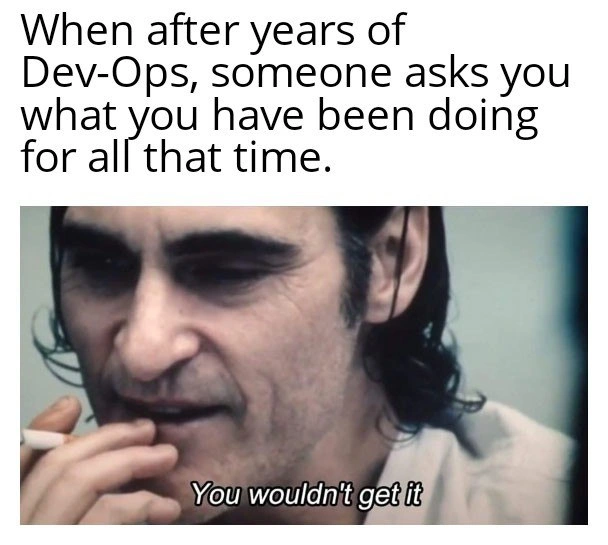
The meme calls out the DevOps paradox where after years on the job, you can't sum up what you do in a simple sentence. In the top caption, someone asks a seasoned DevOps engineer, "what have you been doing for all that time?" — basically the question no one in DevOps wants to hear at family dinners. The bottom image — a battered Joaquin Phoenix Joker with the subtitle "You wouldn't get it" — captures that moment of defeated sarcasm. It's funny because it's painfully true: the more complex and vital your work is, the harder it is to explain to outsiders.

Why is it so hard to explain? Because a DevOps role touches every part of the software lifecycle. This engineer has likely spent the past few years:

  • Building CI/CD pipelines – automating how code gets integrated, tested, and deployed (so devs aren't scp'ing files to servers at 2 AM anymore).
  • Infrastructure as Code – writing endless YAML and Terraform scripts to spin up servers and cloud resources on demand, treating servers like cattle, not pets.
  • Monitoring and Incident Response – setting up dashboards, alerts, and jumping on pager duty whenever the production site hiccups, effectively being the firefighter and the night watch of the system.
  • Cultural Cat Herder – trying to break silos between devs and ops, teaching developers about containerization, and convincing managers that no, DevOps is not just a person you hire, it's a philosophy.

After years of this behind-the-scenes work, the systems are (hopefully) running smoothly. And ironically, when everything works fine, non-technical folks assume it must be easy or wonder what you actually did. In reality, a DevOps engineer is the one quietly scripting away at dawn so that deployment doesn’t bring down the site, or chasing a weird bug in the build pipeline that only appears on the production cluster on Tuesdays. It’s a classic case of “if it ain't broke, I must have fixed it already”. You prevent disasters, so outsiders just see an absence of disasters and thus imagine no effort was needed – a warped invisibility cloak over your contributions.

The humor here also pokes at how "DevOps engineer" can be a vague catch-all title. In theory, DevOps is a culture of collaboration between development and operations, but in practice many companies interpreted it as "Here, you handle everything from server configs to Jenkins jobs to on-call alerts; we'll call you the DevOps guy." After years in such a role, you've done a bit of everything – you're the jack of all (Dev)Ops trades. How do you even begin to explain a day’s work that might include debugging a flaky deployment script, containerizing a legacy app, reviewing cloud security settings, and ending the day leading a blameless post-mortem for that outage no one noticed (because you fixed it before they did)? It’s overwhelming to summarize.

There's a shared, trauma-laced humor in this for senior engineers. Everyone in DevOps has faced the blank stares or confused follow-up questions when they try to describe their job. You might start answering seriously — "Well, I work on automating the software delivery pipeline and ensuring site reliability..." — but then comes the inevitable “So... do you program, or do you manage servers?” At that point you just give up and channel the Joker: "You wouldn't get it." That subtitle is basically DevOps slang for "I could spend an hour explaining continuous deployment, cloud infrastructure, and on-call firefighting, and you'd still be lost."

This meme strikes an DevOps/SRE industry truth: DevOps work is mission-critical yet invisible when done right. It's a role born from bridging silos and reducing friction in software delivery, but because it's so broad and behind-the-curtains, it defies a quick elevator pitch. In DevOps circles, there's a wry saying that the best outcome is when nobody notices your work — because everything just works. The meme’s punchline “You wouldn't get it” is the weary, slightly cynical laugh of self-awareness. Unless you’ve wrestled with a broken build at 3 AM or coaxed a stubborn Kubernetes cluster back to life, you truly wouldn't get what goes into keeping modern software infrastructure humming along. And that’s okay — just don't be surprised when a DevOps veteran smirks at the question “So, what do you do again?” and gives you that exact Joker look.

Description

This meme uses the popular 'You Wouldn't Get It' format featuring Joaquin Phoenix as Arthur Fleck from the movie 'Joker.' The top section contains black text on a white background that reads, 'When after years of Dev-Ops, someone asks you what you have been doing for all that time.' Below this text is the image of a weary-looking Arthur Fleck, smoking a cigarette, with the subtitle, 'You wouldn't get it.' The meme powerfully conveys the frustration of DevOps and SRE professionals whose work, when done correctly, is often invisible. It's about building and maintaining the vast, complex infrastructure - CI/CD pipelines, automation, monitoring, and reliability systems - that allows development to proceed smoothly. The joke lands with experienced engineers who know that success in this role means preventing disasters that never happen, a contribution that is incredibly difficult to quantify or explain to those outside the discipline
Comments

7
Anonymous ★ Top Pick I spent a decade building a seamless, fully automated, push-button deployment system, so now everyone thinks my job is just pushing a button
  1. Anonymous ★ Top Pick

    I spent a decade building a seamless, fully automated, push-button deployment system, so now everyone thinks my job is just pushing a button

  2. Anonymous

    I write Terraform that deploys Kubernetes to run Helm charts wrapping code the devs built FROM scratch - well, FROM latest - then I get paged when marketing launches the feature

  3. Anonymous

    After years of DevOps, you've mastered the art of being simultaneously responsible for everything and nothing - you're Schrödinger's engineer, both the hero who automated away 80% of manual work and the villain who broke production with a misplaced YAML indent

  4. Anonymous

    After years of achieving five-nines uptime, implementing zero-downtime deployments, automating away thousands of hours of toil, and building self-healing infrastructure that prevents incidents before they happen, the hardest part of DevOps remains unchanged: explaining to executives why 'nothing ever breaks anymore' is actually the result of immense, continuous effort rather than proof that your team has too much free time

  5. Anonymous

    It's not 'keeping servers up' - it's recursively optimizing etcd clusters while dodging 3AM PagerDuty chaos in a CAP theorem minefield

  6. Anonymous

    After years in DevOps? Mostly converting human panic into idempotent YAML so Kubernetes can panic for me at scale

  7. Anonymous

    DevOps performance review: shipped five 9s, retired 40 bash scripts with pipelines, reduced MTTR to minutes - and, as usual, there’s nothing to demo but an uneventful Grafana flatline

Use J and K for navigation