Skip to content
DevMeme
3397 of 7435
A Programmer's Perspective on a Half-Full Glass
Performance Post #3730, on Sep 21, 2021 in TG

A Programmer's Perspective on a Half-Full Glass

Why is this Performance meme funny?

Level 1: Too Big a Glass

Imagine you have a big cookie jar, but there are only a few cookies left at the bottom. One friend sees it and says, “Yay, we still have half a jar of cookies!” – they’re happy because there are cookies remaining. Another friend looks and says, “Oh no, the jar is already half empty...” – they’re sad because a lot of cookies are gone. But then you chime in and say, “This jar is way too big for the amount of cookies we have.” You’re not focusing on the cookies at all, you’re looking at the jar and thinking it doesn’t fit the situation. It’s like you want to get a smaller jar or add more cookies to fill it up! This is funny because most people would be busy feeling good or bad about the cookies, but you’re busy solving a problem that nobody else even thought about (the “problem” of the jar being the wrong size). In other words, you’re being super practical – and that surprise twist in thinking is what makes everyone laugh!

Level 2: Right-Sizing 101

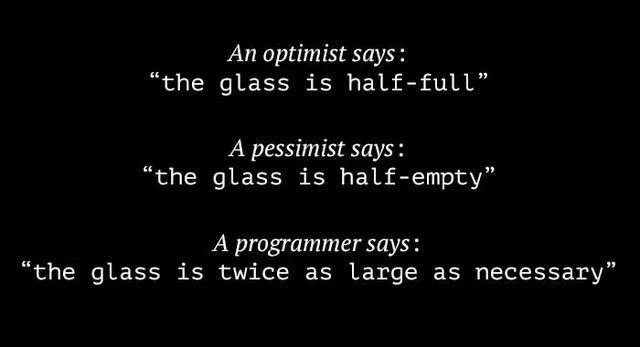
At its heart, this meme plays on a simple analogy with a technical twist. You’ve likely heard the expression about seeing a glass as “half-full” vs “half-empty” – it’s a common way to gauge optimism or pessimism. In the image, the text shows three statements in a format almost like code output (white monospaced text on black, which feels like a console or terminal). The first two lines set up the familiar optimistic and pessimistic viewpoints about a glass of water. But then the third line delivers the punchline: “the glass is twice as large as necessary.” That’s the programmer’s response. Instead of an emotional reaction, it’s a dry, literal assessment of the glass’s size relative to its contents. This is funny to anyone in tech because it sounds exactly like how an engineer or programmer thinks – focusing on the specs of the glass rather than the state of the water. It instantly transforms a philosophical question into an engineering problem.

Let’s break down the technical ideas hinted here. The programmer is effectively talking about resource_overprovisioning. In tech, over-provisioning means allocating more resources than needed. For example, imagine a web server that can handle 1000 users at once, but you only ever have 500 users online – that server is running at 50% capacity. The “glass” (server capacity) is twice as big as what’s necessary for the “water” (the current load). Developers often use terms like capacity planning and right-sizing to talk about this. Capacity planning is when you figure out how much resource (memory, CPU, disk, servers, etc.) you’ll need for a system to run smoothly without wasting too much. If you do it wrong, you either end up with too little (your system can’t handle all the users – like a glass that’s too small and overflows) or too much (your system has a lot of unused power – like a glass half empty all the time). Right-sizing is the Goldilocks principle of getting that size just right. A programmer saying the glass is twice as large as necessary is basically saying the system isn’t right-sized – it’s overkill for the job at hand.

This ties into Performance and efficiency. If a program uses a giant chunk of memory but only fills half of it with useful data, a new developer might scratch their head and wonder, “Why don’t we use a smaller data structure and save memory?” In programming, you might encounter this the first time you learn about arrays or lists. For instance, if you create an array of 100 elements but only store 50 items, that array is half empty – the glass is half empty. A seasoned coder might suggest using a smaller array or a dynamic structure that grows as needed. Similarly, when deploying applications, juniors often start with safe defaults that might be too generous. Maybe you spin up a server with 4 CPU cores for a tiny app that barely uses one core. When you check the monitoring dashboard, you see CPU usage sitting at 10-20% (mostly idle). A senior team member might point out, “We’re over-provisioned; this machine is twice (or many times) bigger than necessary for our little app.” This is a learning moment: you discover that scaling down (using a smaller server instance or container) could make your setup more cost-effective and simpler, without hurting performance. That lesson is exactly what the programmer in the meme is humorously applying to the poor glass of water! Instead of worrying about how full or empty it is, they jump to “we could have designed this better.”

A few key terms from the meme’s tags highlight what’s going on:

  • OptimizationTradeoffs – In any system, there’s a trade-off between having extra capacity (safety, ability to handle spikes) and not wasting resources. The optimist is okay with unused capacity (sees the positive), the pessimist worries about not enough content, and the programmer weighs the trade-off and tends to prefer eliminating waste. They opt for optimization by removing what isn’t needed.
  • CapacityPlanning – This is planning for exactly how “big” your glass (or server, or data structure) should be. Get it wrong and you either overflow (too small) or sit half-empty (too large). The meme highlights the case of it being too large.
  • Performance – If something is twice as big as it needs to be, you might be paying a performance or memory penalty for that extra size (or at least paying cloud dollars for unused space!). Performance-minded devs try to keep systems efficient: not too slow, not too memory-hungry, and not running a bunch of empty, wasted space.

The humor also relies on the RelatableHumor factor among programmers. We’ve all been in situations where non-technical folks focus on the outcome (“we have half of it left!” or “we’ve used up half already!”), while the engineers zero in on the design (“could this be done with less?”). It’s reflecting the programmer_mindset: always in problem-solving mode. In everyday life, most people don’t worry about the size of a drinking glass – but a programmer in joke world does! The meme’s format itself (plain text, almost code-like) feels like something you’d see on an engineer’s t-shirt or a slide in a tech presentation for laughs. It’s succinct and gets to the point, much like a one-line piece of code that flags an inefficiency. In fact, you could imagine a joking comment in code like:

// TODO: Glass has 50% unused capacity - optimize container size.

When you’re new to development, it might take a moment to get why this is funny. But once you’ve dealt with provisioning servers or optimizing a program, you start to see the analogy. It’s basically saying, if the glass only has half the water, instead of debating perspectives, let’s solve the “problem” by using a smaller glass. This aligns with a common developer attitude: fix it, don’t just comment on it. And that’s why the meme is so popular in tech circles – it comically captures how programmers often respond to situations with pure logic and efficiency in mind, even when it’s totally inappropriate to do so from a normal person’s standpoint. (Because honestly, who looks at a glass of water and complains about the glass? A programmer, that’s who! 😄)

Level 3: Over-Engineered Glassware

This meme is a textbook example of how developers reframe everyday situations in terms of system design and efficiency. While an optimist and pessimist see the classic half-full vs half-empty emotional scenario, the programmer immediately spots an over-provisioned capacity problem. In other words, the glass (our "system") has twice the volume needed for the water it holds. Instead of debating positivity or negativity, the developer jokes about right-sizing the container. This twist is funny to engineers because it hijacks a well-known cliché and turns it into a nerdy commentary on resource utilization. Even the meme’s plain monospaced font feels like reading a code snippet or config file, setting a techy tone.

From a senior developer’s perspective, “the glass is twice as large as necessary” speaks to real-world capacity planning and performance tuning concerns. We’ve all seen systems running at 50% utilization or code with buffers that are half empty. A seasoned DevOps engineer might chuckle, recalling times they found servers idling with way more CPU/RAM than needed. For example, imagine a production server averaging 5% CPU usage – a pragmatic programmer will quip that the “server is twice as powerful as necessary” (and probably suggest downsizing it to save costs). This reflects a core programmer_mindset: constantly examining whether resources are over-allocated or underused. The meme humorously echoes the practice of eliminating unnecessary overhead in infrastructure and code. Why keep a giant memory buffer or an XXL cloud instance when a smaller one would do the job? It’s a nod to the ethos of optimization and not letting things go to waste.

There’s a subtle irony here: in software architecture, we often preach not to over-engineer solutions. Designing a glass that’s twice too big is essentially over-engineering – you built in far more capacity than the current requirement. This touches on principles like YAGNI (“You Aren’t Gonna Need It”). The programmer in the meme is pointing out exactly that kind of over-engineering with a snarky one-liner. Yet, experienced devs know there’s a balance: sometimes extra capacity is intentional, allowing for future growth or burst traffic. (For instance, dynamic arrays like std::vector or ArrayList often double their size when they run out of space, leaving them half-empty until more elements are added – a deliberate trade-off between memory usage and performance to avoid constant reallocations.) So in practice, seeing a “half-empty glass” isn’t always bad – it could mean you’re prepared for spikes. But the joke here is that a true programmer can’t resist calling out the inefficiency in the moment. It’s funny because it’s precisely the kind of literal, solution-focused response that non-engineers don’t expect in an everyday philosophical question.

The meme resonates with developers also because it spotlights that engineering habit of problem-solving over sentiment. While others debate optimism vs pessimism, the programmer has already filed a bug report about the inappropriately sized container. It’s relatable humor: many of us have been in meetings where someone says, “We’re only using half of our capacity,” and the engineer in the room suggests cutting the resources in half before anyone else has finished their coffee. In capacity planning meetings, talking about utilization percentages is basically asking “is our glass the right size for our water?” The shared joke is that engineers turn even simple observations into efficiency checklists.

To really illustrate the contrast, consider how each viewpoint might sound in tech terms:

Perspective (Role) What They Say Developer’s Translation (Tech Terms)
Optimist (User) “The glass is half-full!” 😊
—Yay, we have something!
System is only 50% utilized, but that’s fine – there’s plenty of headroom left. No action needed, we’re comfortable.
Pessimist (User) “The glass is half-empty…” 😟
—Oh no, it’s running out!
The resource is already 50% consumed – capacity might become an issue. We should watch out or add more soon.
Programmer (Engineer) “The glass is twice as large as necessary.” 🤓
—This design is flawed.
We’ve over-allocated resources by 2×. There’s 50% wasted space. Optimize it: use a smaller container or fill it more so we’re not so inefficient.

In short, the optimist and pessimist see the state of the water, but the programmer evaluates the design of the glass. The humor hits home for senior devs because it’s a gentle parody of our own compulsive need to tweak and optimize everything. We can’t even let a figurative glass alone – we have to improve its design! And honestly, who hasn’t looked at a poorly tuned system (or a literal half-empty coffee mug on their desk) and thought, “This could be sized better…”? 😅 It’s funny because it’s true: the programmer isn’t being positive or negative about the situation – they’re being analytical. And that overly analytical, fix-the-problem approach is both our hallmark and our running gag in the tech world.

Description

This is a text-based meme on a solid black background. The text is written in a white, monospaced font, giving it a classic terminal or code editor feel. The meme presents three different viewpoints on the classic 'glass half-full' scenario. The first line reads, 'An optimist says: "the glass is half-full"'. The second reads, 'A pessimist says: "the glass is half-empty"'. The final, punchline section reads, 'A programmer says: "the glass is twice as large as necessary"'. The humor stems from the programmer's unique perspective, which prioritizes efficiency and resource management over optimism or pessimism. For experienced developers, this resonates deeply with the constant need to optimize memory, storage, and processing power, where any form of over-allocation is viewed as waste or poor design

Comments

15
Anonymous ★ Top Pick The product manager sees 'twice as large as necessary' and translates it to 'perfect, we have enough buffer for the next three pivots and a last-minute feature creep'
  1. Anonymous ★ Top Pick

    The product manager sees 'twice as large as necessary' and translates it to 'perfect, we have enough buffer for the next three pivots and a last-minute feature creep'

  2. Anonymous

    The cloud architect shrugs: “Relax, the glass is on Kubernetes - once it hits 51% full the HPA will spin up eight more glasses and triple the AWS bill.”

  3. Anonymous

    The senior architect says: "the glass has a 50% buffer for future growth, but nobody documented why we needed it and now we're afraid to resize it"

  4. Anonymous

    This perfectly captures the engineer's instinct to optimize everything - though in production, we'd probably provision a glass 4x larger than needed 'for future growth,' add monitoring to track fill levels, implement auto-scaling for liquid volume, and then spend three sprints debating whether to refactor to a cup

  5. Anonymous

    Senior architect: it’s neither half-full nor half-empty - the glass was sized for Black Friday with 2× headroom; without HPA, the only thing autoscaling is the cloud bill

  6. Anonymous

    Architect translation: half water, half SLA margin - bin packing fails because every service insists on a 2x glass

  7. Anonymous

    Twice as large? YAGNI violated, but hey, future reqs might double - classic overprovisioning trap

  8. @azizhakberdiev 4y

    👍The best of all made before

  9. @Vlasoov 4y

    .shrink_to_fit();

    1. @ZgGPuo8dZef58K6hxxGVj3Z2 4y

      .sort()

      1. @feskow 4y

        .clear()

        1. @ZgGPuo8dZef58K6hxxGVj3Z2 4y

          .dispose()

          1. @RiedleroD 4y

            .take_back_out_of_trash().recycle()

            1. @ZgGPuo8dZef58K6hxxGVj3Z2 4y

              😂😂😂😂

            2. @sashakity 4y

              glass = realloc(glass, strlen(water) + 1)

Use J and K for navigation