Skip to content
DevMeme
6634 of 7435
All Modern Digital Infrastructure Depends on Electrons
Infrastructure Post #7271, on Oct 14, 2025 in TG

All Modern Digital Infrastructure Depends on Electrons

Why is this Infrastructure meme funny?

Level 1: Don’t Forget the Batteries

Imagine you have the coolest remote-controlled toy car with all the latest gadgets. It has flashy lights, makes neat sounds, and can zoom around really fast. Now imagine if you take out its batteries. Suddenly, no matter how awesome that toy car is, it won’t move an inch – it just sits there completely lifeless. All its fancy features mean nothing without power! This meme is basically saying the same thing about computers and apps: no matter how advanced and fancy our digital creations become, they still need electricity to work, just like that toy needs its batteries. It’s a funny way to remind us that even the biggest, most complex high-tech system in the world can shut down because of something as simple as a power outage. In the end, no power = no play – so don’t forget the batteries!

Level 2: Foundations of the Stack

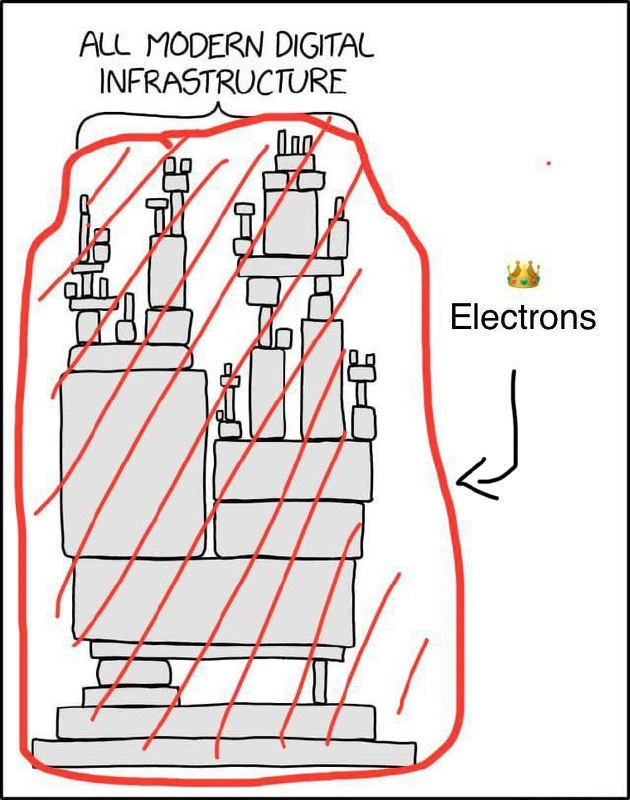
The meme illustration shows a tall, wobbly tower of grey blocks labeled “All modern digital infrastructure,” with a big red outline drawn around it. This tower represents the many layers of technology that make up our software systems. On the right side, an arrow points to the word “Electrons” marked with a 👑 crown. That arrow basically says: “all these fancy computer layers still depend on electrons!” In plain terms, electrons are the tiny charged particles that carry electricity. The crown is crowning electricity as the king. It’s highlighting that underneath all the buzzwords and software, computers are literally just electric circuits. This is a lighthearted reminder in the Hardware/Infrastructure world that no matter how advanced our system gets, it runs on electricity at the end of the day.

Let’s break down the stack of layers from top to bottom to connect that grey tower to real life:

  • Microservice / Application – A microservice is a small, independent application or service that focuses on one task (for example, a service just for user logins, or just for sending out notifications). In modern apps, you might have many microservices working together instead of one big program. They communicate over the network using APIs. Developers love microservices for scaling and organization, but each one still needs an actual computer to run on.
  • Cloud Platform / Container – Most microservices run in the cloud, which really means on servers in big data centers (often run by companies like Amazon, Google, or Microsoft). They might run inside a container (using tools like Docker) or on a virtual machine that an orchestration system (like Kubernetes) manages. There are even serverless services where you just deploy your code and don’t worry about the server at all – but behind the scenes, trust me, there’s still a physical server doing the work for you. The term "serverless" just means the cloud provider handles the actual machine and you never see it.
  • Operating System & Hardware – Each microservice ultimately runs on an operating system (e.g. Linux or Windows) which talks to the hardware. Hardware is the physical machine: the CPU (processor) that executes instructions, the memory chips (RAM) that store data, the disks/SSDs that hold files, and network cards that send data over wires. This hardware provides the actual resources (compute power, storage, etc.) that the software needs. It’s like the kitchen where all the cooking happens – the software is the recipe, but the hardware is the stove, oven, and ingredients.
  • Electrons / Electricity – At the very bottom, making all of the above work, is electricity. Electrons moving through circuits create the binary signals (1s and 0s) that represent all our data and instructions. For instance, a RAM chip stores a “1” by trapping electrons in a tiny cell, and a “0” by letting them go. A CPU’s transistors switch on (allowing electrons to flow) or off (blocking the flow) to perform calculations. If you cut the power, those electrons stop moving, and every part of the stack above them stops working instantly. It’s like a chain reaction: no power means no hardware function, which means no operating system, which means no containers or apps – everything goes dark.

The key idea here is that all those high-level layers depend on the layers below. This meme is pointing out the most fundamental dependency of all: power at the physical layer. In everyday development, we use many abstractions — friendly tools and cloud services that hide the complexity of what’s beneath. For example, when you deploy an app to the cloud, you don’t see the actual machine or the electricity; you just click a button and it runs. That’s abstraction at work. But sometimes those hidden layers remind you they exist (this is often called a “leaky abstraction,” and in this context it’s a hardware abstraction leak). For instance, if a server’s power supply fails or a network cable gets unplugged, your microservice will go down, no matter how perfect your code is. A new developer might not think about power or hardware issues at first — you usually focus on bugs in your software or configuration. But in the real world, a major outage can be caused by things as basic as the machine running out of power, overheating due to a failed fan, or a stick of RAM going bad. The reason we call the stack a “house of cards” is because if one card at the bottom is pulled out, the whole tower collapses. Likewise, if the electrical supply or a hardware component fails, all those software layers (the tall stack of cards) come crashing down.

In short, this meme delivers a friendly warning: it’s easy to get excited about cutting-edge frameworks and cloud services, but never forget the lowest layer. The entire digital castle we build is resting on physical foundations. The joke is that even in an age of high abstraction, the physical layer truth remains — every bit of our digital world is anchored in real, physical electrons zipping around. No matter how complicated our engineering gets, it still relies on basic physics to actually run. For a newcomer, it’s a funny and useful reminder that even “virtual” things run on real hardware. We can build the most sophisticated software skyscraper, but it still needs electricity — that tiny king with a crown — to power it all.

Level 3: The Hardware Always Wins

The humor in this piece of tech industry satire comes from flipping our perspective upside-down. We spend all day designing fancy microservices, scaling out cloud infrastructure, and bragging about serverless architecture – yet a tiny glitch at the hardware level can bring the whole party to a stop. It’s an insider nod to the reality that no matter how much software abstraction and orchestration we pile on, hardware is the final boss. The cartoon’s stack of grey blocks (the “ALL MODERN DIGITAL INFRASTRUCTURE” tower) looks imposing, but it’s drawn like a precarious Jenga structure or a digital infrastructure house-of-cards. One tug on the base (pull the power plug, fry a circuit, or let one transistor misbehave) and that entire edifice of services, databases, and networks could topple. The arrow and crowned “Electrons” text drive home the punchline: however high-tech we get, we still worship the mighty electron. In other words, electrons rule everything around us in tech. This absurd truth is prime hardware humor fuel – it tickles engineers because it’s both obvious and too often forgotten.

Seasoned engineers have plenty of war stories echoing this message. Picture a hectic 3 AM outage: dashboards are red, ops teams are scrambling, Slack is on fire. The incident investigation might start with blame on a bad deployment or a memory leak in some microservice. But then a senior engineer calmly points out, “The database disk isn’t responding.” Further digging reveals a hardware abstraction leak in the worst way: the storage server’s RAID controller died or a DIMM (memory stick) popped out of its slot. All the brilliance of our multi-region, auto-scaling, Kubernetes-orchestrated masterpiece didn’t matter because a 5-cent solder joint cracked on a motherboard. It’s an almost comic reminder that even the most advanced infrastructure still relies on physical components behaving as they should. There’s a classic saying in IT, “There is no cloud, it’s just someone else’s computer.” This meme riffs on that sentiment. Your slick serverless microservice still runs on a server somewhere, and that server runs on electricity. No electrons, no service – it’s that simple. Such bottom-of-stack dependencies like power and silicon rarely get the spotlight until they fail spectacularly.

It’s also funny (in a slightly painful way) how much faith we place in layers upon layers of tech. We talk about five-nines uptime (99.999% availability) and design resilient distributed systems, but a simple power outage or network card failure can instantly negate those extra “nines.” Senior developers have learned never to ignore the basics: check the power cable, check the network link, check the hardware temps. It’s almost a rite of passage in engineering to troubleshoot an “impossible” bug that turns out to be a basic hardware reality – from an overheated CPU throttling performance to a cosmic ray flipping a memory bit (yes, it happens!). This cartoon exaggerates that scenario for comic effect by crowning the electron as king. It satirizes our tendency to act as if cloud computing is pure software magic, when in reality it’s all grounded (literally grounded) in physics. The thick red outline in the drawing might as well be a big red warning: “Don’t forget what lies at the bottom!” Every senior dev knows that sinking feeling when a perfectly architected system fails due to something like a faulty network cable or an “uninterruptible” power supply that wasn’t so uninterruptible. It’s tragic and funny at the same time – tragic because it causes real downtime, funny because it’s such a familiar tech-humor cliché. As one pragmatic engineer quipped:

“All that abstraction doesn’t change the fact that your code is just switching transistors on and off.”

Level 4: Where Bits Meet Atoms

At the deepest level, every digital bit in our lofty cloud architecture is ultimately a physical phenomenon. The meme cheekily reminds us that the elegant dance of microservices and orchestration still reduces to electrons in silicon flipping on and off. In theoretical terms, our most abstracted software layers obey the laws of physics at the base. A microservice might spin up a container with a few API calls, but under the hood those calls trigger machine instructions that manipulate transistor states. Each 1 or 0 is represented by the presence or absence of an electrical charge (essentially clusters of electrons) in a transistor gate. The crown emoji labeling “Electrons” is a nod to the sovereignty of physics: no matter how many layers of virtualization or how advanced our programming paradigm, the computation must be grounded in electromagnetic reality.

From a hardware architecture perspective, this is a humbling leak in abstraction. Even as we build distributed systems and serverless platforms, we can’t escape Maxwell’s equations governing electricity, or the quantum limits of tiny transistors. Modern CPUs contain billions of transistors—tiny switches that control electron flows to perform logic operations. Through layers of logic gates, registers, caching hierarchies, and buses, a high-level microservice request (like retrieving data from a database) becomes an astonishing cascade of physical events. Electrons surge through ALUs (Arithmetic Logic Units) as binary operations, and data moves via electric signals along copper traces or optical pulses in fiber (photons are just light electrons in a sense). The speed of light and the charge of an electron set hard limits on how fast data can move and how small transistors can get. The cartoon’s red-slashed tower labeled “ALL MODERN DIGITAL INFRASTRUCTURE” playfully illustrates that our entire digital world is built on these subatomic foundations. It’s a software empire erected on the Silicon Throne where electrons quietly rule.

In academic terms, this highlights a fundamental of computing: information requires a physical medium. Claude Shannon’s information theory showed us how to encode bits reliably over noisy physical channels, essentially teaching engineers to make electrons dance in unison to represent data. Today’s microservices exchanging JSON over HTTP rely on error-corrected signals and semiconductor memory that store bits as trapped charges. Even the cloud is just an array of data centers brimming with circuits and current. No matter how virtualized or cloud-native our system becomes, we hit immutable laws like Landauer’s principle, which says erasing a single bit of information releases a tiny burst of heat. That heat is literally the kinetic energy of electrons being scattered – your high-level service call warming the CPU by a fraction of a degree. In short, the meme points out a truth often glossed over: in the grand tower of abstractions from microservice to metal, the bottom-stack dependency is physics itself. Electrons rule everything in computing, and ignoring that is at our peril (or at least to our comedic embarrassment when a stray cosmic ray flips a bit and crashes a server). The mighty electron, crowned in the illustration, is a reminder that even the most sophisticated infrastructure bows to the basic physical layer truth.

Description

A hand-drawn illustration showing a towering, precarious stack of blocks and components labeled 'ALL MODERN DIGITAL INFRASTRUCTURE' at the top with a bracket. Red diagonal hatching lines cover the entire structure. To the right, a crown emoji sits above the word 'Electrons' with an arrow pointing into the base of the tower. The meme makes the point that all complex digital infrastructure -- servers, networks, cloud services -- ultimately depends on the simple physical phenomenon of electron flow. It is part of a recurring series of 'ALL MODERN DIGITAL INFRASTRUCTURE' memes highlighting fundamental dependencies
Comments

7
Anonymous ★ Top Pick We built a trillion-dollar industry on top of angry little particles that just want to reach ground potential, and we have the audacity to call a CSS centering issue 'hard'
  1. Anonymous ★ Top Pick

    We built a trillion-dollar industry on top of angry little particles that just want to reach ground potential, and we have the audacity to call a CSS centering issue 'hard'

  2. Anonymous

    If your incident post-mortem traces root cause past Layer 8, just blame the Electrons SRE team - they’re the only ones with a truly global monopoly on uptime

  3. Anonymous

    After 20 years of building 'cloud-native, distributed, fault-tolerant' systems, you realize you're just one cosmic ray flip away from explaining to the board why a single electron decided your multi-region Kubernetes cluster should take a vacation

  4. Anonymous

    After years of architecting multi-region Kubernetes clusters with service meshes, implementing event-driven microservices across three cloud providers, and debugging distributed tracing spans at 3 AM, you realize the CTO who said 'it's all just moving electrons around' during your architecture review wasn't being reductive - they were being honest about the only part of your infrastructure that actually works reliably

  5. Anonymous

    All that IaC, K8s, and SRE ceremony is just shepherding electrons - until a single‑event upset reminds you who actually owns your SLOs

  6. Anonymous

    Kubernetes orchestrating a billion containers, yet it's all electrons too lazy to flow without IaC

  7. Anonymous

    Debate REST vs gRPC all day; in prod the SLA is negotiated with electrons and the power supply - everything else is just YAML with opinions

Use J and K for navigation