The Design vs. The Chasm of Technical Debt
Why is this TechDebt meme funny?
Level 1: Don’t Look Down
Imagine you’re playing in your yard and you see a shiny new toy at the other end. You’re so excited that you start running straight toward it, eyes on the prize. But here’s the catch: between you and the toy, there’s a big hidden hole in the ground. It’s covered by just a thin layer of wood and some grass, so it looks like solid ground. You don’t notice the danger because you’re only looking forward at the toy. Now, this is exactly like a classic cartoon moment – think of a character running off a cliff because they’re chasing something fun and not realizing there’s no ground under their feet until they’re mid-air. It’s funny to us watching, but uh-oh for the character!
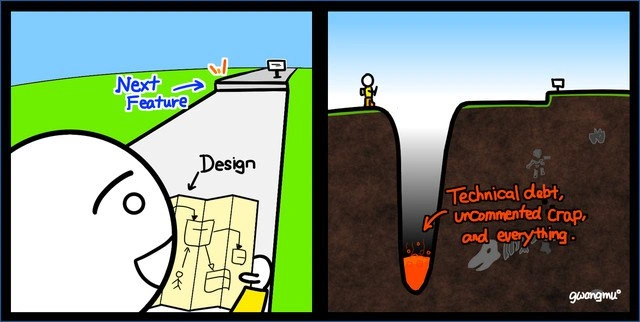
In this meme, the developer (the round-headed cartoon person) is like that character, joyfully charging towards the next cool feature (the toy) without looking down at what’s beneath the road. The road looks nice and firm on top, but just underneath it is a giant pit filled with scary stuff (lava and skeletons, yikes!). That pit represents all the messy, unfinished work and problems in the code that have been ignored for a long time – kind of like shoving all your toys and clothes under your bed to hide the mess. On the surface your room looks clean, but underneath, it’s a disaster waiting to happen.
The emotional punchline here is a mix of silly and uh-oh. It’s silly because the character is grinning and completely oblivious to the obvious danger right below him – we, the viewers, can see the lava pit, so we know something the character doesn’t. And it’s “uh-oh” because we sense that if he keeps going like that, he’s going to fall into that hole big time. In real life, it’s like someone happily adding more and more decorations to a shaky treehouse without fixing its rickety base — one day it might all come tumbling down.
So, the simple idea: Don’t ignore the big hidden mess while you’re excitedly chasing something new. It’s funny in the comic because the difference between the happy journey and the scary pit is so extreme, and it reminds us of a common human habit: focusing on the fun, new thing and ignoring the boring, important chores. Just like a kid might ignore a messy room to go get ice cream, a developer might ignore messy code to quickly build a new feature. And just like the messy room can cause you to trip or lose your stuff, messy code can cause big problems later. The meme gives us a laugh and a gentle poke: remember to look down every once in a while and deal with that mess, or you might end up in a cartoonish fall!
Level 2: Beneath the Surface
This meme uses a simple cartoon to depict a serious software concept: the idea of technical debt. In the first panel, a happy little developer character is holding a design blueprint and walking on a new road towards a sign that says "Next Feature". Everything looks clean and optimistic – blue sky, green grass, and a clear path ahead. This represents a team focusing on adding a new feature to their software product. The blueprint with UML-style boxes stands for a plan or design document for that feature. UML diagrams and design docs are supposed to outline how new code should be written in a clean, organized way. In a perfect world, following that plan means the codebase stays neat.
However, the second panel reveals what’s underneath that road. It’s like the comic gives us X-ray vision into the ground. We see a giant vertical pit right below the road’s surface. At the bottom of the pit, there’s glowing orange lava and a few grey skeletons scattered around. On the wall of the pit, scrawled in red text, are the words: "Technical debt, uncommented crap, and everything." There’s even a small stick figure at the edge looking down into the chasm, suggesting someone just discovered this hidden problem. This starkly contrasts with the happy scene above.
So what does all that mean in software terms? Let’s break those down:
Technical debt: This is a metaphor in software engineering. It means that if you take shortcuts in your code or skip best practices (like not writing tests or not refactoring messy code), you "borrow" time now but you’ll have to "pay" it back with interest later. Imagine doing a rushed job on your homework; you finish faster, but it’s so sloppy you spend double the time later fixing the mistakes. Technical debt accumulates when a codebase has lots of issues that haven’t been addressed. The meme’s pit is literally filled with these unresolved problems – that’s why it’s called a technical_debt_pit. The lava at the bottom symbolizes danger; it’s telling us that having too much hidden debt in the code is a recipe for a fiery disaster.
Uncommented crap: Blunt wording aside, this points to the lack of documentation and clarity in the code. Uncommented code means code written with no comments explaining how it works or why it’s written that way. It’s considered a bad practice because when someone new (or even the original author, months later) tries to read that code, it’s much harder to understand. The meme is highlighting that the pit contains “crap” (i.e., low-quality code) that no one even took the time to document. This could include weird fixes, old hacks, or confusing logic that everyone is afraid to touch. In a healthy codebase, important or tricky parts of the code have comments, and there’s good documentation. In our comic, though, everything under the road is pretty much the opposite of good CodeQuality practices.
...and everything.: This suggests that the pit isn’t just one or two minor issues – it’s everything. All sorts of problems: maybe CodeSmells (common patterns that indicate something might be wrong, like extremely long functions or duplicate code everywhere), perhaps LegacyCode (old code written years ago, possibly by developers who have left, using outdated practices), and other unresolved issues. Essentially, it’s an et cetera of bad stuff, reinforcing that the pit is full of an unknown depth of trouble.
The humor in the meme comes from the contrast: the developer is cheerfully focused on building the next cool feature, following a design, as if everything is fine. But unbeknownst to him, the entire path he’s walking on is dangerously unsupported. It’s like he’s walking on a thin crust covering a volcano. The phrase "ignoring the chasm of buried technical debt" in the title means that the team is choosing not to look at or address this huge pit of problems buried in their project. They are ignoring it and just charging ahead. For a junior developer or someone new to a team, this might actually be a familiar situation: you join and everyone is talking about the new features to build, but as soon as you look into the code, you find confusing parts that no one has fixed, or old modules with no comments. It can be bewildering – you see a nicely written plan (perhaps in the project wiki or a design doc), but then the code is a total mess. This meme captures that exact "surface vs reality" disparity in a visual way.
Let’s clarify some terms from the tags and context to make sure everything is understood:
CodeQuality: This refers to how good the code is in terms of readability, maintainability, and correctness. High code quality means the code is clean, well-documented, well-tested, and organized. Low code quality (what the meme calls "crap") means the code might work, but it’s hard to read, full of hacks, or unstable. It’s the difference between a well-built house and a shaky shack that hasn’t been repaired in years.
LegacyCode: This is code that is old and inherited from the past. Often, legacy code was written for earlier requirements or with older technology. It might not follow current best practices, and unfortunately, it often lacks proper documentation or tests. Working with legacy code can feel like archaeology – you dig through layers of old decisions. In the comic, the skeletons can be seen as a representation of legacy code (or the developers who wrote it). There’s even a phrase developers use: “Here be dragons,” denoting that a part of the code is dangerous or tricky – that vibe is definitely present in the pit.
FeatureCreep: This means the tendency for software projects to accumulate more and more features over time, sometimes beyond the original scope. While adding features can make a product more attractive, it often increases complexity. If you don’t tidy up the code as you go (or adapt the design), feature creep can result in a Frankenstein codebase: lots of bolted-on parts that don’t fit neatly. In the cartoon, the arrow to "Next Feature" shows the direction the project is moving – always onto the next thing, possibly without consolidating or cleaning up the previous parts. That can lead directly to technical debt if done carelessly.
OverEngineering: This is kind of the opposite problem but can relate. Over-engineering means designing a solution that is far more complex than necessary (maybe building an elaborate system for something simple). How does it tie in here? Sometimes teams swing between hacking too quickly and over-engineering to avoid future problems. The blueprint in the character’s hand might hint that they created a fancy design. But if that design doesn’t account for the reality of the existing system (or if it’s all talk and the implementation is sloppy), it doesn’t help. The meme mostly stresses the messy side, but it subtly reminds us that even a "good design" on paper can be pointless if the actual code underneath is rotten.
HiddenComplexity: This tag is directly illustrated by the meme. It’s the complexity that is not immediately obvious. On the surface, the road is smooth – the project might even look simple or the product might seem to work fine. But hidden complexity means there’s a lot of complicated, unresolved stuff under the hood that people don’t see until they dig in. A junior dev might experience this when they open a single seemingly simple task, only to discover it touches ten different modules with interlocking parts. That deep pit of complexity was hidden until you looked.
Now, why do experienced developers find this meme so accurate? Because it happens a lot: A project starts with good intentions and perhaps a clean design. Over multiple releases, deadlines and pressure lead to sacrifices. For instance, say you have a function that’s almost what you need for a new feature, but not exactly. Instead of rewriting or properly extending it (which might take longer), someone might quickly jam in an extra condition or a special-case flag to make it do the new thing. It works for now, so everyone moves on. But now that function is a bit more convoluted. Multiply that by dozens of quick fixes and you have a codebase that “works” but is incredibly fragile. This is how technical debt accumulates. Each quick fix is like digging the pit a little deeper.
Let’s look at a tiny pseudo-code example of what technical debt in code might look like, especially something with no comments (uncommented code) and hacks:
def process_order(order):
# Quick hack: Assume order is valid (no proper validation to save time)
if not order.items:
return None # no handling of empty orders beyond this
result = legacy_calculate_total(order) # using an old function no one understands fully
apply_discount(result, order.promo_code) # another call that might have side effects
return result # No logging, no docstring explaining what this does
# TODO: handle edge cases like negative quantities (left for later)
In this snippet:
- There’s an important assumption made (
Assume order is valid) without checks – a shortcut that might cause issues later (what if the order isn’t valid? It could crash or do wrong calculations). - It calls
legacy_calculate_total(order), which we imagine is an older piece of code perhaps written by someone else. Maybe it’s complex and we avoid touching it, just hoping it gives correct output. - There’s a
# TODOcomment at the end, meaning the developer knew there’s more to handle (negative quantities), but left it “for later.” Sometimes later never comes until that exact situation causes a bug.
This kind of code works for the common case (so you release the feature), but it’s brittle. It’s exactly the sort of thing you find in the pit of technical debt: no comments explaining tricky parts, missing error handling, reliance on mysterious legacy functions, and deferred tasks (the TODO). If many parts of the code look like this, adding the next feature becomes like navigating a minefield.
The comic’s second panel text explicitly calls out "uncommented crap". For a junior developer, encountering uncommented, messy code is frustrating. You open a file expecting to see clear logic, and instead you might find something like:
// No class or function comment explaining usage
public void doEverything() {
Connection c = getConn();
try {
// no explanation of why we need this if
if (config.isFlagSet()) {
legacyProcess(c);
} else {
newerProcess(c);
cleanupOldStuff(); // what is old stuff? unclear
}
} catch (Exception e) {
// swallowing exceptions - not great for debugging
}
}
Reading that, you have to reverse-engineer what’s happening because the original authors left no hints. It’s labeled “crap” in the meme because it’s stuff nobody is proud of, but it’s still sitting in the critical path of the application.
The stick figure peering down into the pit in panel 2 is like a developer who just discovered the extent of the technical debt. That moment is both terrifying and enlightening. Maybe a new hire innocently asks, "Why don’t we just extend Module X for this feature instead of adding a new one?" Then the senior devs exchange looks and show them Module X… which turns out to be a big ball of mud (i.e., a completely unstructured program) deep down in that pit. The newbie’s like, “Oh wow,” just like the stick figure at the edge thinking "uh-oh, look at all that!"
Refactoring is the big concept absent from the meme but very relevant: it’s the process of cleaning up code (improving its structure and clarity) without changing what it does. It’s essentially how you fill in that pit or build a stronger bridge over it. However, refactoring takes time and doesn’t deliver a flashy new feature to the user, so it often gets postponed. Many junior devs learn about refactoring as a good practice in theory, but then in their first job they might see that in practice, teams sometimes skip it because of deadlines. Over time, skipping refactoring is exactly how you get a scary chasm of old problems.
The tags like next_feature_blind_rush capture the idea that there’s a rush to get the next thing done, blind to the issues underneath. And design_blueprint_comic highlights the joke that having a design or blueprint doesn’t automatically save you from a bad foundation. It’s similar to building planning in real life: you can draw a beautiful plan for a second floor of a house, but if the first floor is full of cracks, that plan isn’t going to keep the house standing. The meme artist Giangmur (noted by the signature) often draws comics about software truths, and this one is a clear caution: pay attention to your code’s foundation, not just the fancy features on top.
In summary, for a junior developer, this meme is saying: be aware of the hidden complexity in your projects. New features are exciting, and good design documents are useful, but always remember to look under the hood (or under the road, in this case). If you find a lot of technical debt (like messy, uncommented code, or confusing old modules), that’s normal in many projects — but it’s also a sign that you should proceed carefully. Maybe take some time to understand that legacy code or even improve it if you can. Otherwise, you might be that happy character, sprinting towards a goal, only to be shocked later when something breaks unexpectedly because of the buried issues nobody addressed.
Level 3: The Paved-Over Pit
At first glance, this comic is a tech lead’s nightmare wrapped in a joke. We see a developer merrily marching towards the Next Feature along a freshly paved road of design docs – completely unaware of the infernal pit lurking just beneath. That pit is labeled "Technical debt, uncommented crap, and everything", and it’s a mix of legacy code horrors and CodeQuality nightmares that seasoned engineers know all too well. The humor hits hard because it’s painfully relatable: teams often pave over a codebase’s problems with new features, pretending the foundation is solid when it’s actually a thin crust over molten lava.
This scenario is common in real projects under pressure. The green field of a new feature is always so inviting, and there’s a shiny blueprint (UML boxes and all) promising a clean design. But beneath that neat surface lies a decade’s worth of quick hacks, code smells, and “temporary” fixes. TechnicalDebt is the star here – a metaphor first coined by Ward Cunningham – comparing clunky, rushed code to financial debt. Every time we cut corners (say, copy-pasting code or skipping tests “just this once”), we borrow time. The “interest” on this loan is paid later in the form of harder maintenance, debugging nightmares, and panicked late-night refactoring sessions. In the meme’s second panel, those grey skeletons at the bottom of the pit are past developers’ sanity – the remains of engineers who tried to fix that snarled mess and didn’t survive (at least metaphorically). The glowing orange lava? That’s the ever-present risk of production failures bubbling underneath our surface vs depth façade. It’s a HiddenComplexity that burns us at the worst times (usually Friday at 5 PM, right?).
The contrast between the design blueprint and the underground horror is a sharp jab at the difference between plan and reality in software projects. On paper (or in a planning meeting), the architecture looks clean: modules talk to each other in perfect UML harmony. In reality, opening the code is like finding a secret trapdoor into chaos. We’ve got functions hundreds of lines long with no documentation, mysterious global variables (magicNumber42 anyone?), and // TODO: fix this later comments dating back to the Bronze Age of the codebase. All that uncommented code and cruft is what the meme bluntly calls "crap." It’s the stuff no one wants to touch because if it ain’t broke (yet), don’t fix it. This creates a vicious cycle: FeatureCreep pushes us to add more layers atop unstable code, and each layer just covers up the cracks without repairing them.
Why is this funny? Because every experienced dev has lived this. We chuckle darkly since we’ve been the happy character, eyes on the Next Feature prize, ignoring the fact that the ground we’re stepping on is hollow. The signpost "Next Feature" and the oblivious grin capture the blind rush we often get into. Management is cheering, users want new shiny functionality, and we, the developers, charge forward hoping the thin road holds. It’s ironic and a bit tragic: the LegacyCode underneath is supporting everything like a Jenga tower missing half its pieces, yet here we are dancing on top of it.
From a senior perspective, the meme highlights the classic trade-off between delivering features fast and keeping the codebase healthy. Everyone knows ignoring technical debt is bad – it’s a CodeQuality time bomb – but in the short term, new features are tangible and excite stakeholders. The road gets paved over the pit time and again, each layer of concrete thinner than the last, until one day something collapses. That collapse could be a critical bug in production that nobody can trace because the code is such a tangled mess. Or it’s an integration effort that should take 1 day but takes 2 weeks because you have to untangle the spaghetti code first.
Notice the stick figure with the blueprint is utterly cheerful. This is a tongue-in-cheek nod to how teams sometimes over-engineer their design documents and slide decks to impress at sprint planning, yet the actual implementation is held together by duct tape and prayers. There’s irony in labeling the paper "Design" – as if having UML diagrams means the code is solid. Meanwhile, reality is screaming for a refactor down below. It’s a bit like painting a clean architecture diagram on the road while ignoring the giant sinkhole under it.
Let’s break down the two layers depicted:
| On the Surface (What we say we have) | Beneath the Surface (What we actually have) |
|---|---|
| Neat design docs with boxes & arrows (UML) | |
| "Next Feature" shiny roadmap milestone | Half-implemented old features nobody cleaned up |
| Confidence and smiles during sprint planning | Nervous laughter during code review of a 5-year-old module |
| “It’s fine, we have a plan.” | // TODO: Fix this comments every 10 lines |
| Assurances debt will be handled later | A growing pile of hacks making later much harder |
This table reads like a horror story every senior dev can tell. We often promise on the surface that everything is modular and under control, but one peek beneath and it’s a dungeon of quick fixes. For example, you might have a beautiful diagram of how data flows from Module A to B. In reality, Module A calls B, C, and X, Y, Z in a chain of if-statements with special cases for “legacyMode”. There’s possibly a global flag that if set incorrectly causes the app to catch fire (that’s the lava 🟠). The CodeSmells are all there: long methods, cryptic names, dead code (skeletons!), and zero unit tests so far.
The text in red, "Technical debt, uncommented crap, and everything," scrawled on the pit wall is basically the graffiti of frustrated developers who know how bad it is. It’s like someone left a warning sign for any soul brave enough to dig under the road: “Here be dragons (and really bad code)!” 🐉 But our happy protagonist either hasn’t seen it or is willfully ignoring it to keep morale high. This is often how overworked teams cope – a bit of cognitive dissonance. We tell ourselves “We’ll fix it later, after this release,” and then another feature comes, and another. As a result, that technical_debt_pit keeps deepening.
From the veteran engineer’s angle, the comic also pokes at company culture. The sign "Next Feature ->" shows the direction set by product management – always forward, rarely downward to address foundational issues. If you’ve ever been in sprint planning and brought up refactoring or debt repayment, you might get responses like:
Product Manager: "Great point, but let’s schedule that after we deliver this next feature. Customers won’t see refactoring, so it can wait."
Engineer (internal monologue): Sure, it can wait... until the day it all catches fire. 🔥
That disconnect is exactly why this meme exists. It’s highlighting the absurdity of always prioritizing visible features over invisible quality, a pattern that leads to hidden complexity biting you later. Every skeleton in that pit might represent a rushed job that seemed harmless. Maybe an uncommented function that nobody fully understands now, or a piece of over-engineered general-purpose code that no one dare modify because it’s become the Blob holding the system together.
In essence, the humor comes from recognizing a fundamental truth in software development: if you don’t pay attention to the abyss of technical debt under your project, you’re eventually going to fall in. The meme exaggerates it with lava and skeletons, but it’s not far off. LegacyCode can feel like a crypt full of scary surprises. The next feature built on a shaky foundation can lead to on-call nightmares (the 3 AM emergencies where you discover just how deep the rabbit hole goes). So when senior devs see this, they smirk and maybe groan a little, because they remember all the times they’ve had to climb down into that pit armed with nothing but a debugger and hope.
Ultimately, "Charging toward the next feature while ignoring the chasm of buried technical debt" is a satirical mirror of industry practice. It’s bitterly funny: we laugh so we don’t cry. This comic panels scream the cautionary tale every Cynical Veteran tries to tell new engineers – don’t ignore the skeletons in your codebase. Otherwise, you’re just blissfully sprinting across a bridge to nowhere, and one day it’s going to collapse under the weight of one feature too many.
Description
A two-panel comic illustrating the gap between software design and implementation reality. In the first panel, a smiling cartoon character holds a 'Design' map, looking at a clean, paved road leading towards a sign labeled 'Next Feature' under a bright, sunny sky. This represents the ideal, clean-slate plan. The second panel reveals the hidden truth: the character is standing on the edge of a massive, deep chasm. The cross-section of the earth shows buried fossils and skeletons, with a pool of lava at the very bottom. An arrow points into the abyss, labeled 'Technical debt, uncommented crap, and everything.' This powerfully visualizes the common developer experience where a beautiful new feature design collides with the ugly, dangerous, and undocumented reality of the existing legacy codebase that must be built upon
Comments
7Comment deleted
Every legacy codebase is an archaeological dig. You start with a map to the 'next feature,' but spend most of your time unearthing fossilized dependencies and trying not to fall into the lava pit of global variables
Management sees a clean UML arrow to v2; I see a core sample of commit-history lava, TODO fossils, and the skeletons of three previous rewrites
The sprint demo is just a carefully choreographed tour of the penthouse while the basement floods with setTimeout callbacks from 2016 and that one MongoDB collection nobody remembers why we're still paying for
Every product roadmap looks like a gentle stroll to the next feature until you git blame the codebase and discover the 'temporary workaround' from 2015 that's now load-bearing infrastructure. That design document? It's really just a treasure map where X marks the spot you'll spend three sprints refactoring before you can even think about adding that checkbox
Feature roadmap: 'Proceed straight to ship' - skipping the 'paydown debt' offramp since sprint zero
Design promised a paved road to the next feature; open the repo and it’s a vertical shaft - apparently our architecture diagram forgot the z-axis where all the technical debt and undocumented behavior live
Roadmap says “Next Feature →”; the repo replies, “first refinance the 2017 hotfix balloon loan,” because technical debt compounds faster than your cloud bill